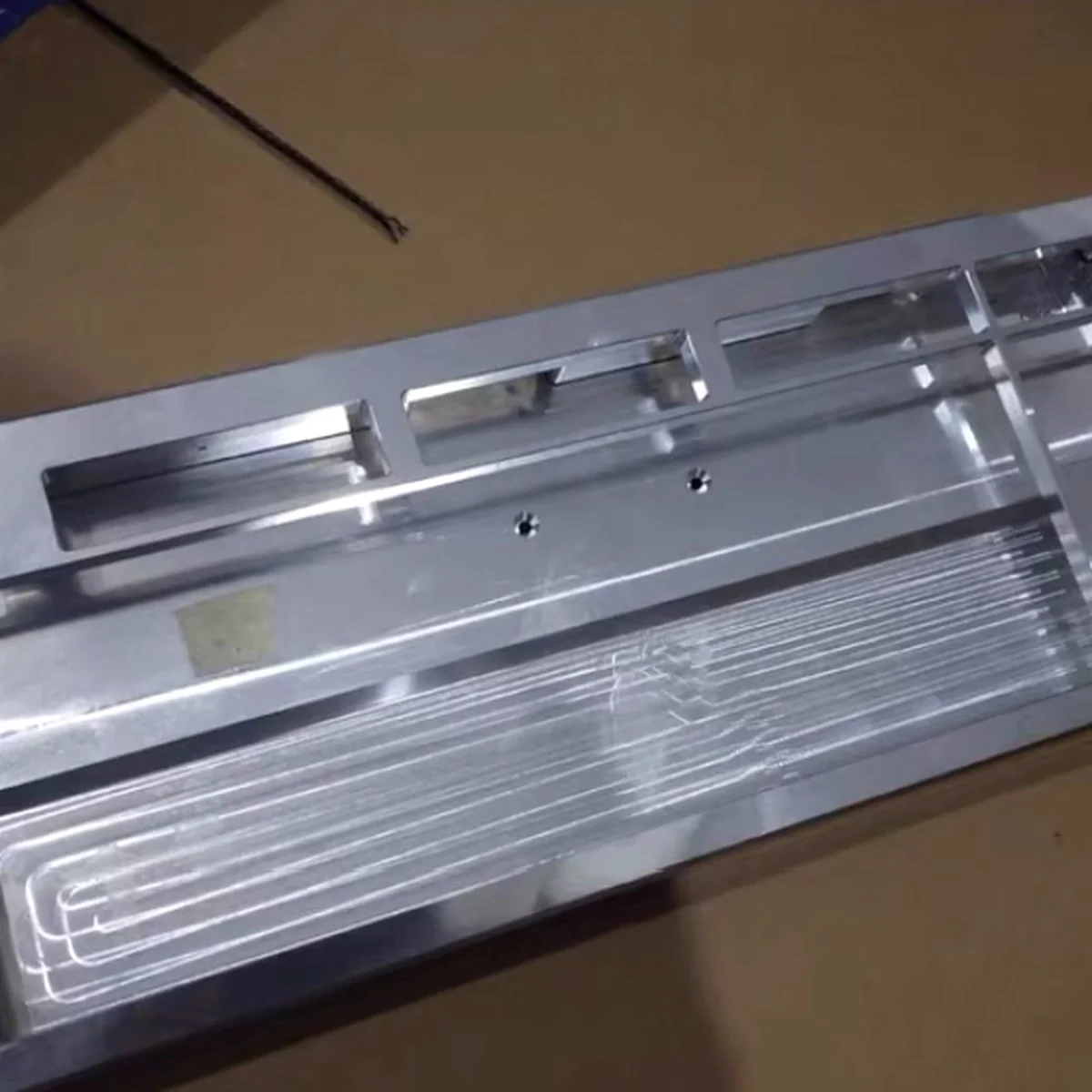
What a Cold Plate Has to Do
Liquid cold plates pull heat out of power electronics, lasers, battery packs and inverters. The job has three hard requirements at once: a coolant channel routed for even heat pickup, a flat mating face that makes intimate thermal contact with the devices it cools, and a sealed, leak-free liquid path. Aluminium is the natural material — light, highly conductive, and easy to machine — but every one of those requirements is a machining discipline.
The make-or-break detail: flatness of the contact face. A cold plate that isn't flat leaves air gaps, and air is an insulator — the cooling simply fails. We hold the face flat so heat actually crosses the interface.
How It Was Made
1 — Mill the channel
The coolant channel was milled into the plate, routed to spread flow across the heat-source footprint. Channel width, depth and path all affect flow resistance and how evenly heat is collected, so the geometry follows the cooling layout, not just the outline.
2 — Hold the contact face flat
The mating face was machined flat and to a fine finish, because thermal contact resistance is set by flatness and surface quality. Tight, repeatable tolerance and flatness control is what separates a working cold plate from a warm one.
3 — Seal & leak-test
The channel is closed (by a sealed cover or plug) and the liquid path leak-tested before shipping — a cold plate that leaks onto live electronics is worse than no cold plate at all. Inlet/outlet ports are threaded to the customer's fitting standard. The plate is machined from machining-grade aluminium matched to the application.
The Workflow
Route the channel
Coolant path milled to spread flow across the heat-source footprint.
Finish the contact face
Mating face machined flat and fine for low thermal contact resistance.
Seal & port
Channel closed and sealed; inlet/outlet threaded to the fitting standard.
Leak-test & inspect
Liquid path pressure/leak-tested; flatness verified before shipping.
Outcome
A cold plate that does the unglamorous but critical job perfectly: coolant where it's needed, a flat face that actually transfers heat, and a sealed path that doesn't leak. Thermal and precision parts like this sit squarely in our industrial equipment work — from a single prototype plate to a production batch.
Need a cold plate or thermal part? Send your drawing, a sample, or your cooling layout and footprint. We machine it flat, seal it, and leak-test it. Email [email protected] or message us on WhatsApp.
// More Case Studies