Short answer: A physical sample is enough to reproduce a part. The sample is measured — ideally on a CMM (coordinate measuring machine) — then rebuilt as a CAD model and drawing, confirmed with you, and reproduced by CNC machining or injection molding. No original drawing or CAD file is needed. Worn, partial, or broken samples can be copied too.
Copying from a sample vs. ordering from a drawing
Most machining suppliers — and every big instant-quote platform — start from a CAD file you provide. Copying from a sample is the reverse: the geometry is recovered from the part, and the drawing is created for you along the way. This process is called reverse engineering, and it's the only route when the part is obsolete and no documentation exists.
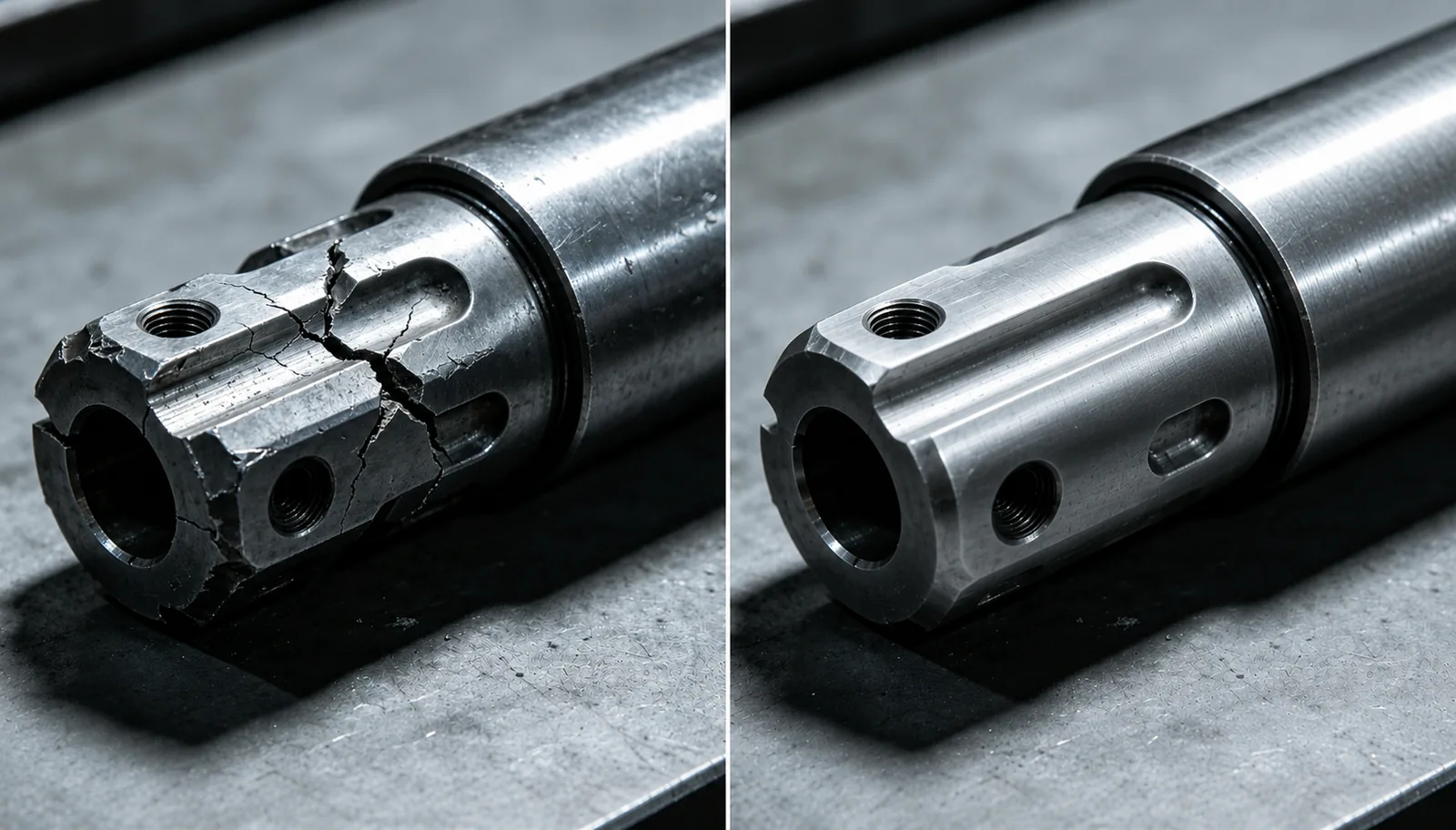 Copied from a sample: a broken coupling (left) reproduced as an exact replacement (right). See the case →
What makes a good sample
The ideal sample is a complete, unmodified original. But in the real world samples are rarely perfect, and that's fine:
- Worn samples — the worn surfaces are remade to their intended (as-new) dimensions, so the copy often fits better than the sample you sent.
- Broken or cracked samples — undamaged features are measured directly; missing geometry is reconstructed from function and from the mating evidence on the fracture faces.
- Multiple samples — if you have more than one (even several worn ones), send them all. Combining them helps reconstruct areas that are damaged on any single piece.
- Assemblies — if the part mates with another, sending the mating part too lets us nail the fit exactly.
How the sample is measured
Accuracy starts with measurement. A good shop uses a combination of:
- CMM (coordinate measuring machine) for precise diameters, positions, and form
- Micrometers, bore gauges, and calipers for individual critical features
- Thread gauges and comparison against published standards (ISO, ASME, BS) to identify the exact thread
- Hardness testing / material identification when the material must be matched (important for load-bearing parts)
The measurements become a 3D CAD model and a fully dimensioned drawing — the documentation the part never had.
Confirm, then reproduce
Before anything is cut or molded, you receive the rebuilt drawing to confirm the critical dimensions. Then the part is reproduced in the right process and material:
- Metal parts — CNC turned and/or milled in steel, stainless, aluminum, brass, or titanium
- Plastic parts — CNC machined for one-offs and low volumes, or injection molded for production runs
Each part is inspected against the rebuilt drawing before it ships, so it drops into your assembly.
Worn-sample tip: tell us how the part is supposed to fit (the shaft size it runs on, the bore it seats in). That lets us correct for wear and reproduce the part to its original intent — not to its worn-down state.
How many can you order?
One is fine. Reverse engineering is routinely used for single replacements and small batches of spares. Because the measurement and CAD rebuild are a one-time effort, ordering a few extra pieces at the same time brings the per-piece price down — a smart move for any part that's no longer available to buy.
Have a sample to copy? Send the part — or photos and caliper measurements if you can't ship it — to [email protected] or on WhatsApp. We measure it, rebuild the drawing, confirm it with you, and reproduce it. Learn more about our reverse engineering service.
Frequently Asked Questions
Yes. A physical sample is enough. It's measured — ideally on a CMM — and rebuilt as a CAD model and drawing, then reproduced by CNC machining or injection molding. No original drawing or CAD file is required.
A complete, unmodified original is best, but worn, partial, or broken samples work too. Undamaged features are measured directly and the rest is reconstructed from function. If you have more than one sample, send them all — combining them helps reconstruct worn areas.
With CMM measurement and confirmation of critical dimensions before machining, a copied part can match the original to precise tolerances. Where the original was worn, the copy is made to as-new dimensions and often fits better than the sample.
Yes. One-off replacements and small batches of spares are normal. Low minimums apply to machined parts; for molded plastic, low-volume CNC or short-run molding is available.