Short answer: Send the discontinued part — even worn or broken — to a manufacturer that offers reverse engineering. They measure it, rebuild it as a CAD model and drawing, confirm the critical dimensions with you, and machine or mold an exact replacement. You do not need the original drawing or CAD file. If you can't ship the part, clear photos plus a few caliper measurements are often enough.
Why machine parts get discontinued — and why that leaves you stuck
Equipment routinely outlives its spare-parts supply. The original manufacturer closes, gets acquired, or simply stops supporting an old model. A single small component — a shaft, a bushing, a coupling, a gear, a plastic housing — fails, and suddenly a machine worth thousands is dead because one part worth a few dollars can't be bought.
The frustrating part is that the big online machining platforms can't help here. Every one of them (Xometry, Protolabs, and similar) requires you to upload a finished CAD or STEP file before they'll even quote. But you don't have a CAD file — you have the opposite: a physical part and no drawing at all.
The solution: reverse engineering from the part itself
Reverse engineering means recreating a manufacturable part from a physical sample. A shop that offers it starts from your part — not from a file. Even a part that has cracked clean through still carries almost all of its design intent in the surviving surfaces.
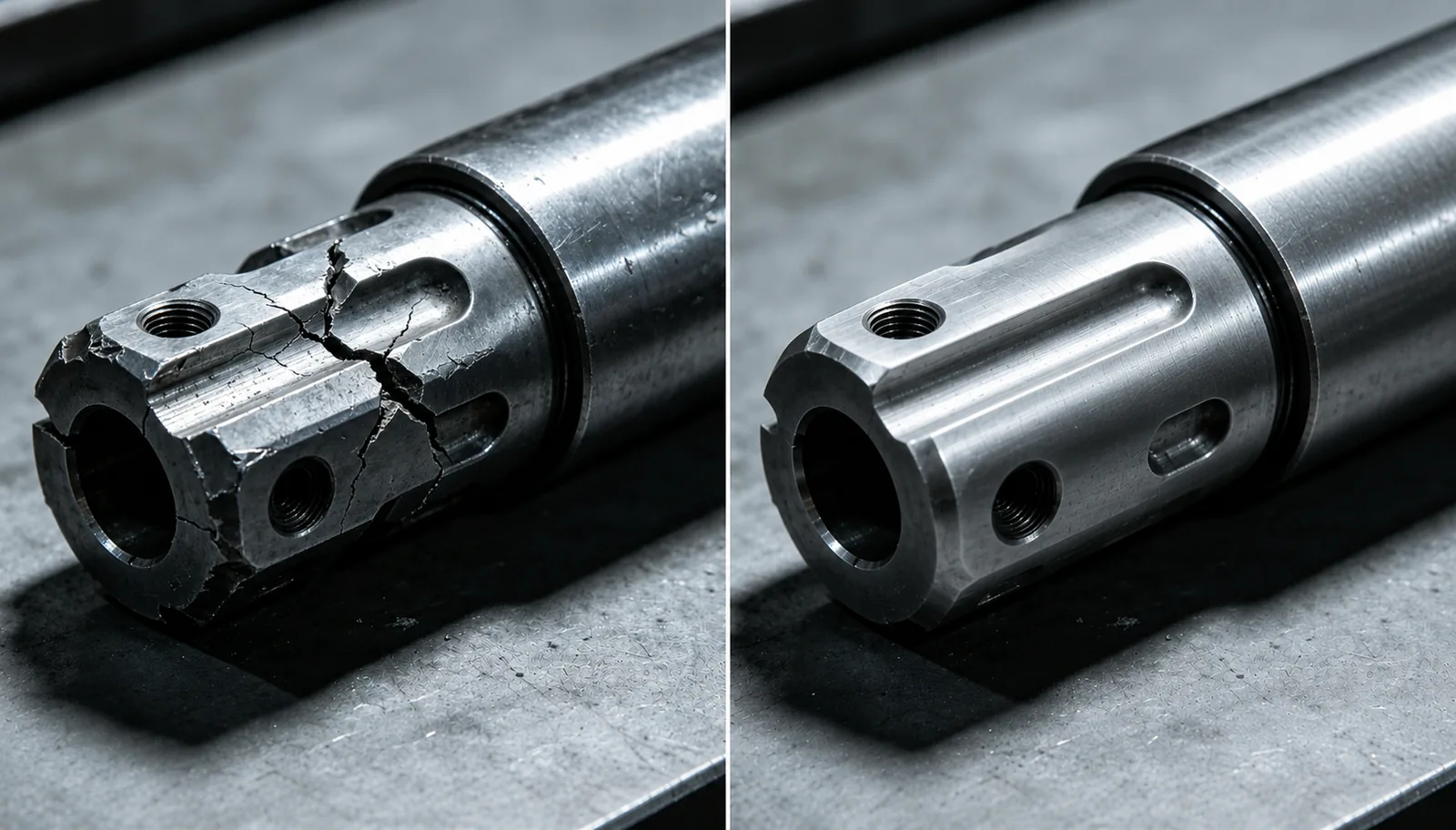 A real example: a cracked drive-shaft coupling (left) rebuilt from the broken part with no drawing (right). See the case →
Step by step: how to get the replacement made
1. Gather what you have
The ideal input is the old part itself — even if it's worn, seized, or in pieces. If the machine is still running and the part can't be removed, gather the next-best evidence (covered below).
2. Send it to a reverse-engineering shop
Ship the part, or send a clear set of photos and measurements. A good supplier replies with a few targeted questions, not a demand for a CAD file.
3. The shop measures and rebuilds the drawing
The part is measured — ideally on a CMM (coordinate measuring machine) for accuracy — and rebuilt into a 3D CAD model and a dimensioned 2D drawing. In effect, they recreate the drawing the original maker never gave you. Thread sizes are matched against published standards (ISO, ASME, BS); fits are reasoned from function.
4. You approve, then they machine
You review the rebuilt drawing and confirm the critical dimensions before any metal is cut. Then the replacement is machined (or molded, for plastic), inspected against the drawing, and shipped.
If you can't ship the original part
Sometimes the part can't leave the machine. You can still get it reproduced — send:
- Photos from multiple angles, in good light, with a ruler or caliper in frame for scale
- Caliper measurements of the key features: outer diameter, inner/bore diameter, overall length, step lengths, thread size and pitch
- A note on what the part fits — the mating bore, bearing size, or shaft it sits on
- Any old catalog page, part number, or partial drawing you can find
Many parts have been reproduced successfully from photos and hand measurements alone.
Tip: If you have any spare budget, order a small batch of spares rather than a single piece. The engineering and machine setup are the same either way, so a few extra units cost very little — and you'll never be stranded by that part again.
Metal or plastic — both can be reproduced
Metal parts (shafts, couplings, bushings, gears, brackets, fittings) are CNC machined. Plastic parts (housings, knobs, clips, gears) are CNC machined for one-offs and low volumes, or injection molded for production runs. A shop that runs both processes can reproduce either from the same starting point: your old part.
What it costs and how long it takes
Reverse engineering a single replacement is usually a modest fixed engineering effort (measurement + CAD rebuild) plus the machining cost. Lead time is typically a couple of weeks for a one-off, depending on material and complexity. Ordering spares at the same time spreads the setup cost across more pieces.
Have a discontinued part to replace? Send the old part or photos with a few dimensions to [email protected], or message us on WhatsApp. We reverse-engineer it, confirm it with you, and machine an exact replacement — no original drawing needed. See how our reverse engineering works.
Frequently Asked Questions
Send the old part (or clear photos with a few measurements) to a manufacturer that offers reverse engineering. They measure the part, rebuild it as a CAD model and drawing, and machine or mold an exact replacement. You do not need the original drawing — the part itself contains the information.
Yes. A worn or broken part still carries most of its design. Undamaged features are measured directly and missing dimensions are reconstructed from function and from the mating evidence. Critical dimensions are confirmed with you before machining.
Send detailed photos from several angles plus caliper measurements of the key features (OD, ID, lengths, thread pitch) and a note on what the part fits. Many parts can be reproduced from photos and hand measurements alone.
It depends on size, material, complexity, and quantity. A single replacement is usually a low fixed engineering effort plus machining cost; ordering a few spares at once lowers the per-piece cost because the setup is already done.