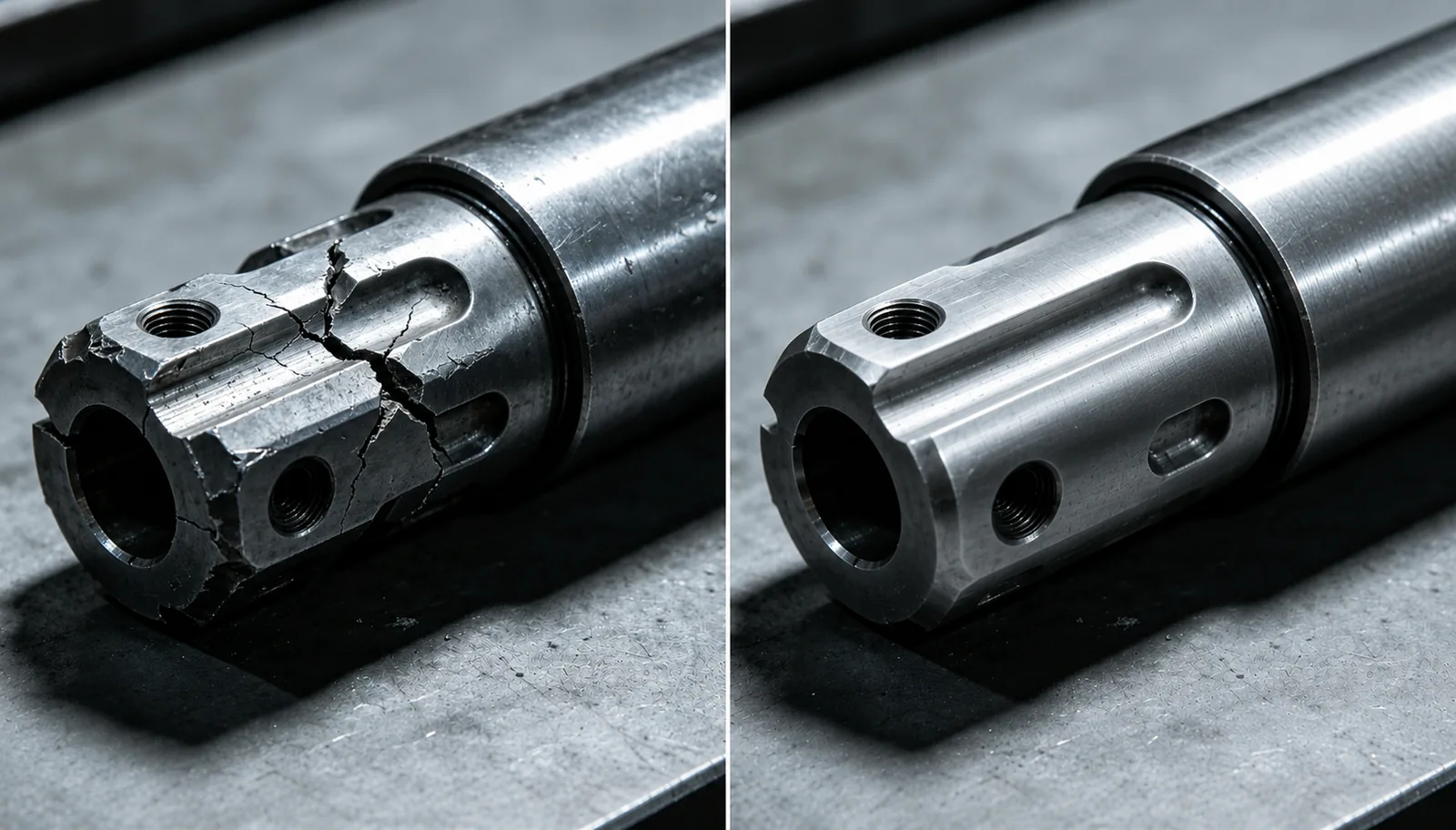
The Problem
The client's machine was down. The drive shaft had fractured through the coupling head — the splined/keyed end that transmits torque — and the part was no longer available to buy. There was no engineering drawing and no CAD file; the original maker either no longer existed or no longer supported the part.
This is the exact situation where the big online machining platforms can't help: every one of them requires a STEP or CAD file to even start a quote. The customer had the opposite of a CAD file — they had a pile of broken metal.
What we received: The fractured part itself (and photos). No drawing, no model, no dimensions — just the broken coupling head with its keyway, side cross-hole, tapped hole, retaining groove, and bore still measurable on the surviving sections.
How We Reverse-Engineered It
1 — Recover the geometry from the broken part
Even a cracked part carries almost all of its design intent. Our engineers measured every surviving feature directly and cross-checked against the mating evidence on the fracture faces:
- Bore & outer diameters along the stepped shaft, measured with micrometers and bore gauges
- Keyway / flat width, depth and position — critical for torque transfer
- Cross through-hole diameter and its axial/clocking position
- Tapped hole thread size and location on the end face
- Retaining / seal groove width and diameter near the shoulder
- Overall length and shoulder positions
2 — Rebuild it in CAD
From the measurements we reconstructed a clean 3D CAD model and a fully dimensioned 2D drawing — effectively recreating the drawing the customer never had. Where the fracture made a dimension ambiguous, we reasoned it from the function (fit with the mating bore, standard thread sizes, standard key sizes) and confirmed the critical ones with the customer before machining.
3 — Match the material
A drive-shaft coupling is a load-bearing, torque-transmitting part, so material and condition matter. We matched the replacement to the original's steel specification so the new part behaves like the one it replaces. (Material grade and any heat-treat / hardening matched to the original on this job — confirmed with the client.)
4 — Machine, inspect, and fit-check
The replacement was CNC-turned for the shaft and stepped diameters, then milled for the keyway, cross-hole and tapped hole. Every recovered dimension was re-measured against the rebuilt drawing before the part shipped, so it drops straight into the existing assembly.
The Workflow
Broken part & photos received
Client sent the fractured coupling and photos — no drawing, part discontinued.
Measure & reconstruct in CAD
Every surviving feature measured; geometry rebuilt into a clean 3D model and 2D drawing.
Confirm critical dimensions
Keyway, bore fit, hole pattern and thread confirmed with the client before cutting.
Turn, mill & inspect
Replacement machined in matched steel, all features inspected against the rebuilt drawing.
Drop-in replacement delivered
The new coupling fits the existing assembly — the machine is back in service.
Outcome
From a part that no supplier would touch — no drawing, discontinued, snapped in half — to a precise, drop-in steel replacement. This is the core of what reverse engineering at EKINSUN is for: if you can put the old part (or even just a clear photo and a few dimensions) in our hands, we can rebuild it, whether it's one piece to get a machine running again or a small batch of spares so it never strands you again.
Have a broken or discontinued part? Send us the part or clear photos with a few key dimensions. We reverse-engineer the geometry, confirm it with you, and machine an exact replacement — no original drawing needed. Email [email protected] or message us on WhatsApp.