When Corrosion Resistance Has to Be Serious
316 is 304's tougher sibling. The key difference is 2–3% molybdenum, which transforms resistance to chloride attack and pitting — the failure modes that destroy ordinary stainless in salt water and aggressive chemicals. That single addition makes 316/316L the standard for marine hardware, chemical processing, pharmaceutical and many surgical and food-contact parts. It costs more than 304 and machines a little slower, so it's the right choice specifically when the environment demands it.
316 Mechanical & Physical Properties
| Property | Typical value (316, annealed) |
|---|---|
| Ultimate tensile strength | ≥515 MPa |
| Yield strength (0.2%) | ~205 MPa (316L min ~170) |
| Elongation at break | ~40% |
| Hardness | ~79 HRB (~150–170 HB) |
| Density | 8.0 g/cm³ |
| Elastic modulus | 193 GPa |
| Composition | ~16–18% Cr, 10–14% Ni, 2–3% Mo |
| Magnetism | Essentially non-magnetic (annealed) |
| Machinability | ~36% — work-hardens |
316L's low carbon (≤0.03%) resists weld-zone (intergranular) corrosion, so it's preferred for welded assemblies. We machine to certified mill spec and supply certs on request.
316 Chemical Composition
316 is an austenitic stainless whose defining ingredient is molybdenum — it's what lifts chloride/pitting resistance above 304. Nominal composition (balance iron):
| Element | Content | Element | Content |
|---|---|---|---|
| Chromium (Cr) | 16.0–18.0% | Manganese (Mn) | ≤2.0% |
| Nickel (Ni) | 10.0–14.0% | Silicon (Si) | ≤0.75% |
| Molybdenum (Mo) | 2.0–3.0% | Phosphorus (P) | ≤0.045% |
| Carbon (C) | ≤0.08% (316L ≤0.03%) | Sulphur (S) | ≤0.030% |
How We Machine 316
316 behaves like 304 but cuts a little harder and holds heat, so discipline matters even more:
- Sharp, rigid tooling with positive feeds to stay under the work-hardened layer
- Strong coolant to carry heat away and protect tool life
- Tolerances: ±0.025 mm (±0.001 in) on critical features — verified on inspection
- We avoid cross-contamination with carbon steel so the corrosion resistance isn't compromised
Tooling, Speeds & Feeds — Starting Points
Same golden rule as 304 — never let the tool dwell or rub — but 316 is more demanding: lower machinability (~36%), more heat retained, faster tool wear. Cut firmly, flood it, and keep tool engagement constant. Typical starting points (tuned per part):
| Parameter | Typical for 316 / 316L |
|---|---|
| Tooling | Coated carbide — TiAlN / TiCN for heat & wear |
| Cutting speed | ~50–70 m/min (165–230 SFM) carbide end mills — a touch below 304 |
| Feed / chip load | 0.15–0.35 mm/rev — positive & consistent, never trailing off |
| Depth of cut | Stay below the previously work-hardened layer each pass |
| Coolant | High-pressure flood — non-negotiable on 316 |
| Golden rule | Tool always cutting — no dwell, no rubbing |
Finishing 316
- Passivation — essential after machining to restore the protective oxide layer
- Electropolishing — bright, ultra-clean, easy-to-sterilise surface for medical/pharma
- Bead blast / brushed — uniform decorative or matte finishes
316 vs 304 — Quick Comparison
| 316 | 304 | |
|---|---|---|
| Molybdenum | 2–3% | None |
| Chloride / pitting resistance | Excellent | Good |
| Marine / chemical / medical | Preferred | Limited |
| Machinability | ~36% | ~45% |
| Cost | Higher | Lower |
No chloride exposure? 304 is the cheaper default. See all options on our materials overview.
Typical 316 Parts
- Marine fittings, fasteners and deck hardware
- Chemical and pharmaceutical process parts
- Surgical and medical-device components
- Food and beverage contact parts
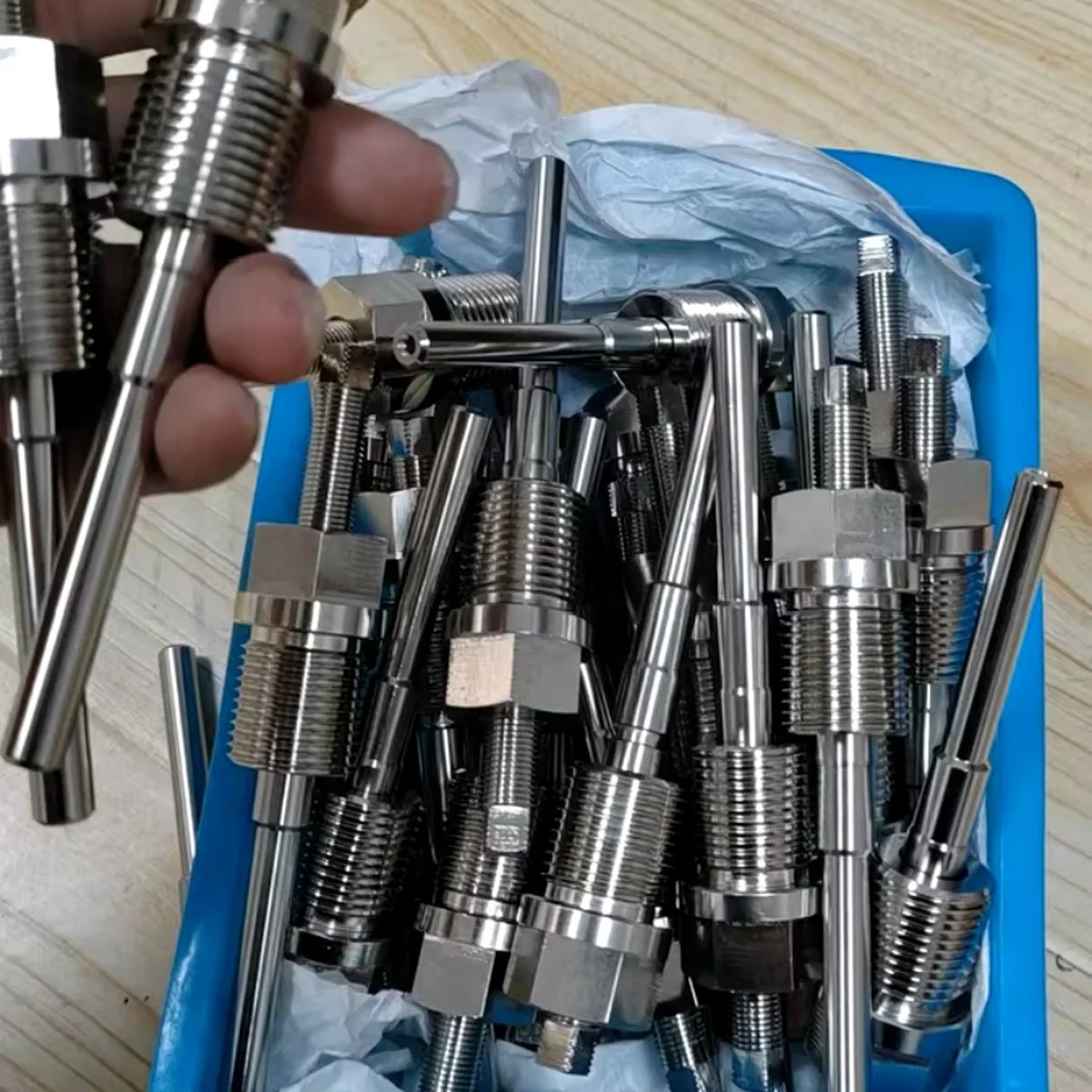
- Sensor and instrumentation fittings — e.g. our stainless fittings batch
Frequently Asked Questions
316's 2–3% molybdenum gives far better resistance to chlorides and pitting — essential for marine, salt, chemical and many medical parts. Without chloride exposure, 304 is more cost-effective.
316L has lower carbon (≤0.03%) to resist intergranular corrosion at welds — better for welded assemblies. Standard 316 has slightly higher strength for non-welded parts. We stock both.
Slightly — ~36% machinability vs ~45% for 304, and it work-hardens similarly. Sharp rigid tooling, positive feeds and good coolant give clean parts; it just runs slower.
Yes — it's a standard for surgical, pharma and food-contact parts. We passivate and can electropolish to a bright, hygienic surface.
Get a 316 Quote
Any drawing format accepted — sketch, photo or CAD. Reply in 24h.