Is Reverse Engineering What You Actually Need?
Most service provider pages skip this question. We don’t — because sending samples when a simpler route would work wastes everyone’s time. Check your situation against these cases:
Part is worn/broken, no drawing exists, cannot be bought. The original supplier is gone or the part is discontinued. You have the physical part (or fragments). This is the core use case for reverse engineering.
Part exists but you want a material or design upgrade. The original cast iron gear keeps failing. You want it in ductile iron or 4140 steel. RE recovers the geometry; your engineer specifies the upgrade. The new part outlasts the machine that runs it.
Part is standardised (bearings, seals, fasteners, standard fittings). If the part matches a catalogue standard — a bearing with a known designation, an NPT fitting, a standard key — look for an off-shelf equivalent first. RE is for geometry that doesn’t map to a catalogue.
You want to 3D-print a replacement. RE can produce the STL or STEP for 3D printing, but consider whether a printed part is adequate for the load and environment. For structural or high-cycle parts, CNC machining from the RE'd model is usually the right output.
You have a drawing and just need parts made. If the geometry is fully documented, you need CNC machining from print, not reverse engineering. See CNC Turning & Milling.
You want to reproduce a competitor’s branded product for resale. Copying logos, model numbers, or trade dress is trademark infringement regardless of whether the design patent has expired. We do not take these jobs.
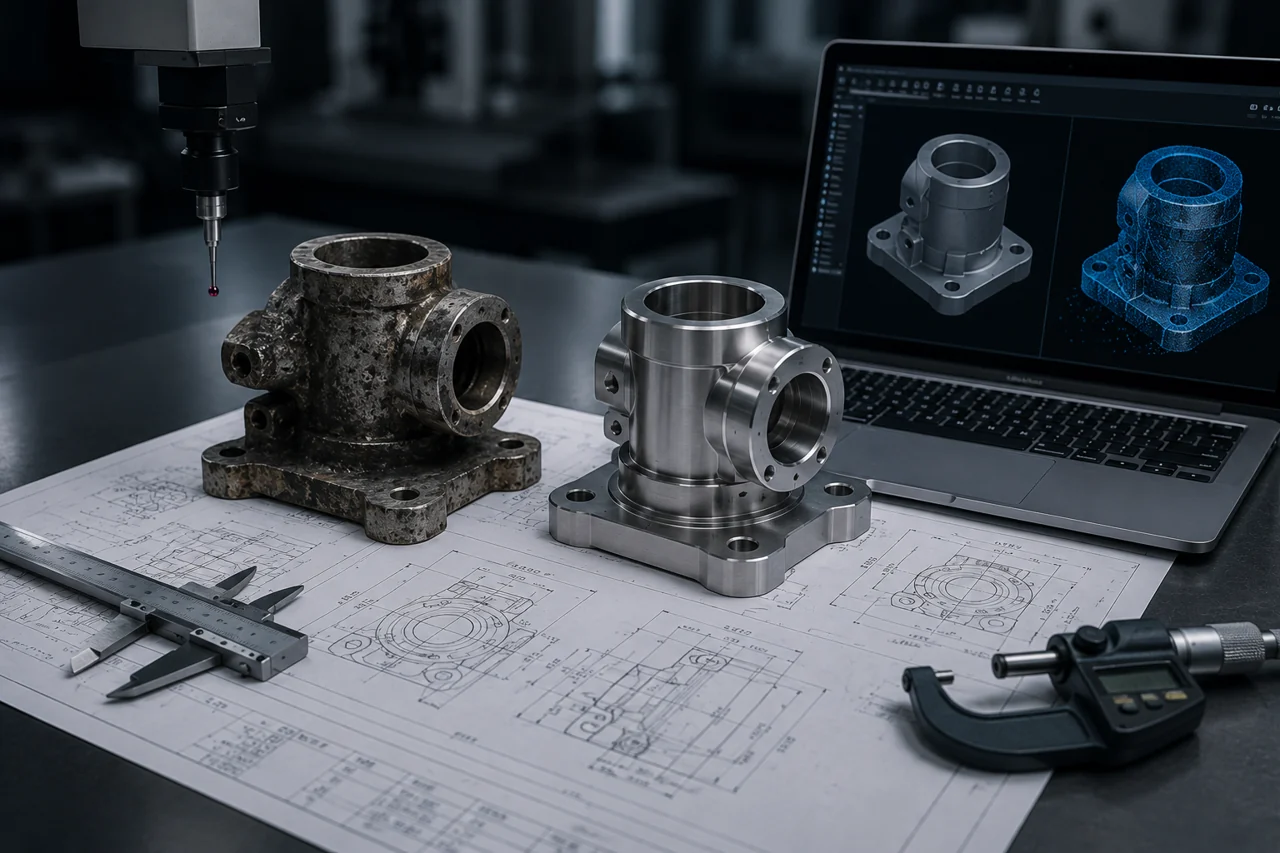
What Reverse Engineering Actually Involves
The process is more structured than most buyers expect. There are no guesses and no “we’ll figure it out when we start machining.”
You ship the part
Worn, broken, corroded — in almost any condition. A padded bag and a note describing the machine it belongs to is all you need. We handle measurement; you don’t need to prepare the part.
We measure by CMM or 3D scanner
Non-destructive. The original is returned to you. CMM is used for machined features with geometric tolerances; 3D scanning captures freeform surfaces and complex profiles. Complex parts may use both.
We build the CAD model
Measurement data is converted to a parametric STEP model. We reconstruct geometry to design intent — not to the worn state. A shaft that has worn from 30.0 mm to 29.7 mm is modelled at 30.0 mm with the appropriate tolerance for its bearing fit.
You review and approve the drawing
We issue a 2D drawing with critical dimensions called out. You confirm fits, thread specifications and surface finish before machining starts. This step catches misinterpretations before they become scrap.
First article machined and inspected
The first piece is measured against the approved drawing. Dimensional report available on request. Only after the first article passes does a batch run.
Parts and CAD delivered
You receive the machined part(s), the STEP file, and the inspection report. The CAD is yours — re-order with us or take it anywhere.
The Three Levels of Input You Can Provide
| What you have | What the shop needs to do | Quote confidence |
|---|---|---|
| Physical sample + machine context | CMM/scan the part, build parametric CAD — straightforward reconstruction | High — most accurate quote |
| Photos only (part lost or destroyed) | Estimate from 2D images; more questions likely; geometry assumptions must be confirmed | Medium — expect follow-up |
| Broken part + partial old drawing or manual | Cross-reference drawing dimensions with physical fragments; fastest reconstruction route | High — fewer ambiguities |
| Worn part with unknown material | Measure geometry; identify material by spark test, XRF or chemical analysis | High — material analysis adds 2–3 days |
Sending the physical part is always more reliable than photos alone. If the original is beyond recovery, see our reverse engineering without drawing service for how we handle photo-only cases.
5 Questions to Ask Any Reverse Engineering Service
Q1 — What measurement equipment do you use?
CMM is appropriate for machined parts with geometric tolerances. 3D scanning suits freeform surfaces. Manual callipers alone are adequate only for simple turned parts. The answer tells you how seriously they treat dimensional accuracy.
Q2 — Do I receive a drawing for approval before anything is machined?
This is non-negotiable. Without a drawing approval step, the shop is betting that their interpretation of your worn part is correct. It often isn’t — worn geometry is ambiguous and only you know what the mating assembly requires.
Q3 — Who owns the CAD model when the job is complete?
Ask explicitly. Some shops treat the CAD as proprietary and use it to make you dependent on them for re-orders. The geometry was recovered from your part, paid for by you — it should come to you as a STEP file you can use freely.
Q4 — Can you provide First Article Inspection and share the dimensional report?
FAI verifies the first machined piece against the approved drawing. Without it, you are trusting the machinist’s word that the part is in spec. A dimensional report is standard practice for any tolerance-critical reproduction job.
Q5 — What happens if the first article doesn’t fit, and who bears the cost?
Ask before the job starts. A reputable shop will correct measurement or machining errors at their cost. Errors caused by ambiguous geometry in the original that they flagged and you approved are a shared risk — agree in advance how those situations are handled.
What You Receive at the End
The machined part(s) — manufactured to the approved drawing with First Article Inspection. Packaged and shipped with appropriate protection for the geometry (keyways, threads, precision bores).
STEP file (CAD model) — the parametric model built from your part. Yours to use with any supplier, any CAM system. Re-order in 5 years without repeating the RE process.
2D drawing — the drawing you approved, returned with machining annotations. Useful for incoming inspection and future sourcing.
Material certificate (on request) — mill cert tracing the material to heat number. Required for regulated industries; available for any job on request.
Dimensional inspection report (on request) — CMM or manual measurement of key features on the first article. Confirms the part is to spec before it ships.
Your original part returned — measurement is non-destructive. The worn original comes back to you.
Realistic Cost and Lead Time
Reverse engineering costs more than machining from a supplied drawing, because engineering work is included in the price. Here is what the time and money actually look like:
| Scope | Typical lead time | What drives cost |
|---|---|---|
| Simple turned part (shaft, bushing, ring) | 7–10 working days | Material selection, tolerance of critical fits |
| Moderate complexity (housing, bracket, gear) | 10–18 working days | Number of features, drawing review rounds |
| High complexity (5-axis, tight tolerance, freeform) | 18–30 working days | Scanning time, CAD reconstruction effort, machining complexity |
The RE cost is typically absorbed in the first-article price. There is no separate “scanning fee” invoice — you pay for the finished part, which includes the engineering. When you re-order from the STEP file later, you pay only for machining.
The math that justifies RE almost always: a machine that earns $500 per day has already covered the cost of a $3,000 one-off part after 6 days of uptime. The RE cost is rarely the right number to optimise. Downtime is.
Frequently Asked Questions
No. Measurement by CMM or 3D scanner is non-destructive — the original part is returned to you after scanning. If the part is broken into pieces, we work from the fragments to reconstruct the geometry. Destruction is not part of the process.
For machined parts measured by CMM, we routinely hold tolerances of ±0.01 mm on critical features. For surfaces reconstructed from 3D scan data, the model accuracy is typically within 0.05 mm. We identify and flag critical-fit features for your approval before machining — so you confirm the intended tolerance, not just our measurement of the worn state.
Any material that can be CNC machined: steel alloys (4140, 4340, D2), stainless (304, 316, 17-4 PH), aluminium (6061, 7075), brass, copper, titanium, and engineering plastics (Delrin, nylon, PEEK). We can also reproduce parts in a better material than the original on request.
Reproducing parts for your own machinery for maintenance is generally legal — design patents on industrial mechanical parts expire after 20 years. What is not permitted: copying branded aesthetics, logos or markings, or reproducing parts under active IP protection for resale as branded equivalents. We never copy brand identifiers.
Yes — worn and broken parts are the most common case. We reconstruct geometry to design intent, not to the worn state. For broken parts, we align fragments and reference mating parts where available. In most cases a worn or broken part is sufficient; we will tell you if the damage is too severe to resolve.
Send a Part for RE
Worn or broken accepted. NDA signed first. Reply in 24h.