Luer connections are the universal interface standard for medical fluid delivery — used on syringes, IV tubing, stopcocks, catheters, and hundreds of other devices. But there are two types — Luer lock and Luer slip — and choosing the wrong one for your application has real clinical consequences.
What Is a Luer Connection?
A Luer connection is a standardized taper used in medical fluid tubing since the early 20th century. The male tip has a 6% taper that inserts into a matching female bore. The taper geometry is defined by ISO 80369 (and the earlier ISO 594), ensuring global compatibility between devices from different manufacturers.
Luer Lock: The Secure Connection
A Luer lock adds a threaded collar around the male Luer tip. As the tip is inserted into the female port, the collar is rotated and threads onto a matching ridge on the female fitting, locking the connection mechanically. The connection cannot be pulled apart without actively rotating the collar.
When Luer lock is required:
- Arterial lines — accidental disconnection causes blood loss and air embolism risk
- Contrast media injection — power injector pressures would blow a friction-fit connection apart
- Epidural and spinal access — ISO 80369-6 requires non-Luer connections to prevent wrong-route errors, but where Luer is used, lock is mandatory
- Any application where the connection is under tension or movement stress
- Connections made by staff in unfamiliar clinical environments (emergency, transport)
Luer Slip: The Fast Connection
A Luer slip (also called Luer taper or friction-fit Luer) has no threading. The male tip is inserted into the female bore and held in place by friction from the taper geometry. It can be connected and disconnected with one hand, quickly and without rotation.
When Luer slip is appropriate:
- Peripheral IV lines with low flow pressures
- Applications requiring frequent connection and disconnection
- Syringe connections for medication preparation (not direct patient injection)
- Low-risk fluid administration where rapid disconnection would not cause harm
Pressure Comparison
| Property | Luer Lock | Luer Slip |
|---|---|---|
| Disconnection prevention | Mechanical lock | Friction only |
| High-pressure rated | Yes | No |
| Connection speed | Slower (requires rotation) | Faster (push to connect) |
| One-hand connection | Possible but awkward | Easy |
| ISO standard | ISO 80369 / ISO 594 | ISO 80369 / ISO 594 |
| Application | High-risk, high-pressure | Low-risk, frequent disconnect |
Where a stock connector is the right buy — and where one gets moulded
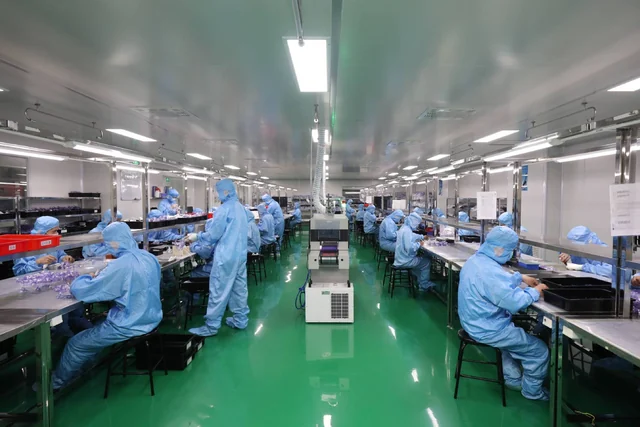
EKINSUN LTD is a custom parts manufacturer in Guangdong, China whose medical work is moulded in an ISO 13485 certified partner facility. Standard Luer connectors are a commodity and should be bought as one; the table below is the honest line between the two, because a moulded part only makes sense once something about it cannot be bought.
| What you need | Off the shelf? | How it gets made |
|---|---|---|
| A standard male or female Luer in a catalogue size, small quantity | Yes — commodity | Buy it from a distributor. Cheaper and immediate; a mould only pays off at volume — honest recommendation |
| Mixed port types on one body — Luer lock one port, Luer slip another | Rarely stocked | Specified port by port on the drawing; the two forms cost the same to mould |
| A resin chosen for the sterilisation route — gamma, EtO or autoclave | Catalogue parts state one material | Resin selected against the cycle — PC, ABS and PP behave differently, and a gamma-stable grade is a different pellet |
| Your own geometry — port count, angle, hub length, an integrated feature | No | Tooled to your drawing; this is where an OEM part stops being a purchased component |
| Colour coding, branding or moulded-in markings | Generic parts only | Masterbatch colour and cavity engraving set at tooling stage — not addable later |
| A metal Luer fitting for a test rig, filling line or instrument | Almost never | Machined from 316L or brass rather than moulded — see custom sealed metal parts |
One boundary worth stating plainly: EKINSUN moulds and machines to your specification, and the parts are produced in ISO 9001 and ISO 13485 certified partner facilities — but device registration, biocompatibility testing and regulatory submission remain the device owner's responsibility. Ask us what we make, not whether your device is approved.
Specifying for Custom Manufacturing
When ordering custom stopcocks, connectors, or fittings, you must specify the Luer type on each port independently. A single stopcock can have a Luer lock on one port and Luer slip on another — the specification should call out each port individually.
For OEM medical device companies, we recommend Luer lock as the default for any new product design. The small speed disadvantage is outweighed by the safety margin, and regulatory bodies increasingly require justification for choosing Luer slip in high-risk applications.
Manufacturing note: EKINSUN manufactures both Luer lock and Luer slip configurations in all of our medical products. The choice is specified at the design stage and costs the same to produce. See our 3-Way Stopcock and Luer Lock Connector pages for specific product options.