If you are qualifying a supplier for a disposable device — a stopcock, a manifold, a Luer connector, an extension set — the certificate logo on a homepage tells you almost nothing. What your quality team needs to see is the chain of control: what happens to the resin before it enters the barrel, who touches the part after it leaves the mold, what gets measured, and what evidence you receive. That is what this page documents.
The Line, Photographed
These are real photographs of the ISO 13485 certified facility where EKINSUN medical components are manufactured, published with the facility's permission. They are not stock images and not a different factory.
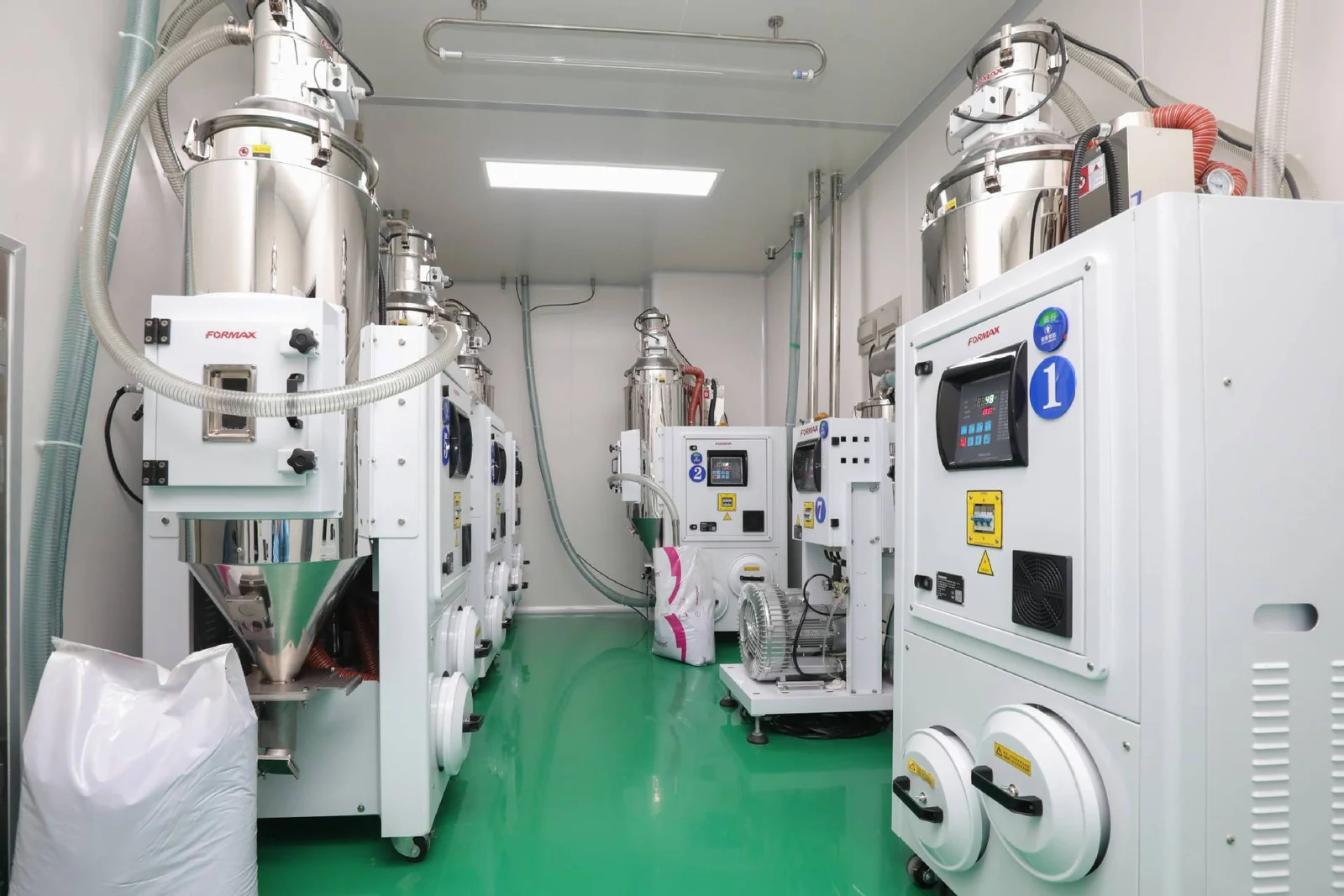
Dedicated resin drying, per station
Each molding station draws from its own numbered dehumidifying hopper dryer with its own drying profile — not a shared central hopper. Medical-grade PC is hygroscopic; molding it wet produces splay and micro-voids at the Luer taper, which is precisely where a connector fails a leak test.
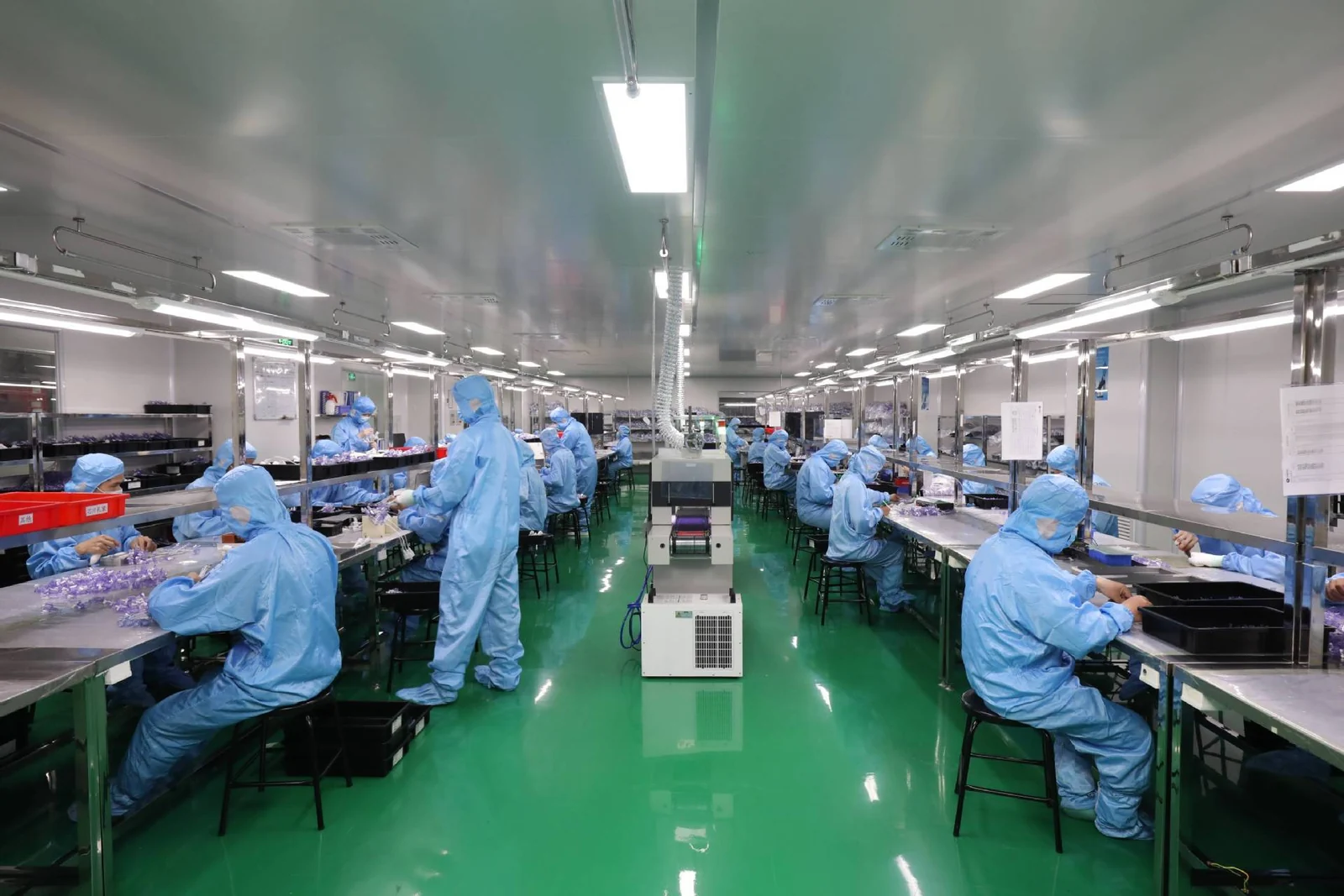
Gowned cleanroom assembly
Assembly happens inside the controlled room, not on an open shop floor. Full-coverage gowning and hoods, HEPA ceiling supply, seamless epoxy flooring, and segregated reject bins at every bench so a non-conforming part cannot re-enter the good flow.
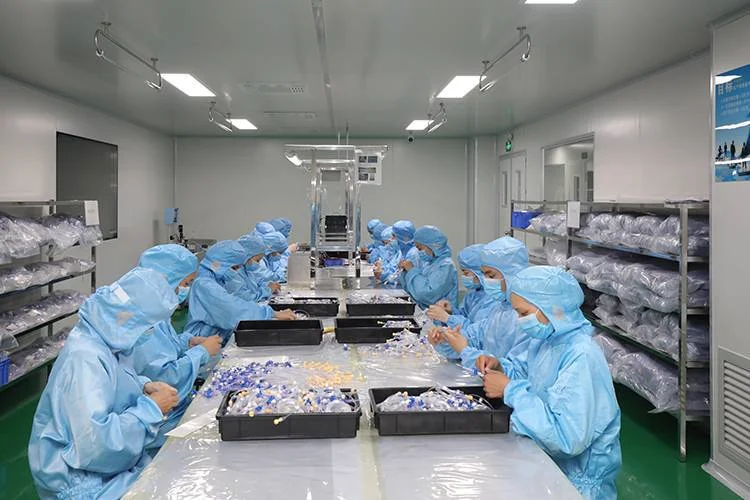
Hand assembly under the same controls
Small-component work — mating connector halves, fitting seals, setting handle orientation — stays inside the controlled room. Bagged sub-components are staged on stainless racking, so work-in-progress never leaves the environment between operations.
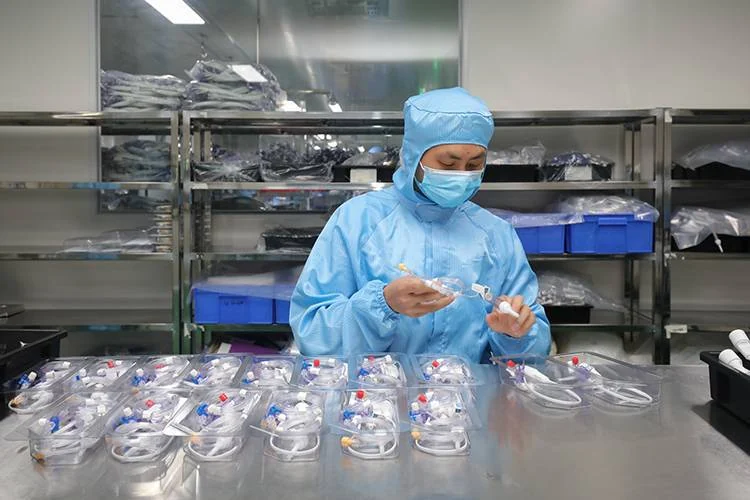
Inspected and blistered in the room
Finished sets — manifolds, stopcocks, extension lines with colour-coded Luer fittings — are inspected and loaded into blister trays without leaving the controlled area. Colour coding is checked against the build sheet at this station, because a mis-coded port is a use error, not a cosmetic defect.
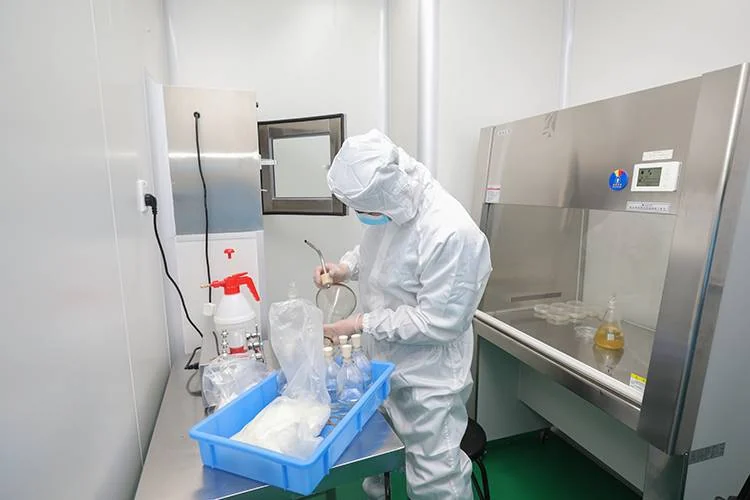
On-site microbiology lab
Bioburden and sterility work is done in a dedicated micro lab — biosafety cabinet, material pass-through hatch, plated culture media, sterile sampling bags. Sampling happens on the production lot, so the result maps to the batch you receive rather than to a one-off qualification run.
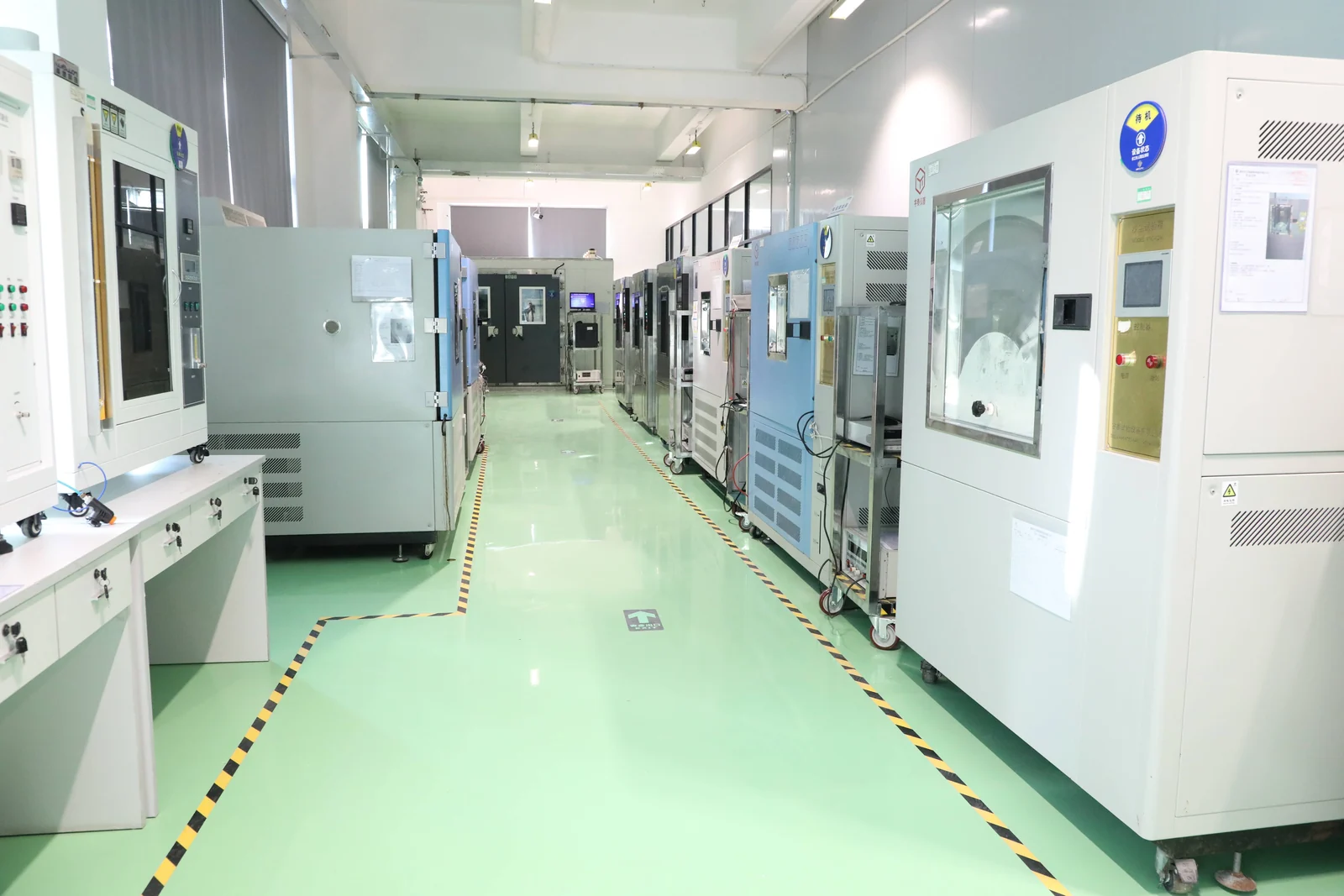
Environmental chambers for validation
A bank of temperature and humidity chambers is available for conditioning and accelerated ageing — the equipment behind shelf-life substantiation and behind the question “does this seal still hold after transport and storage?” Protocols are agreed per project.
The Chain of Control, Step by Step
-
Incoming resin, identified and quarantined
Medical-grade resin arrives in sealed bags with a lot number and a certificate of analysis from the resin producer. The lot number is what ties everything downstream together — without it there is no traceability, only paperwork.
-
Drying to a defined moisture target
Resin is dried in a dedicated dehumidifying hopper at the temperature and dwell time specified for that grade. PC, PP, PE, ABS, PA and PEEK each have their own profile; they are not interchangeable, and a shared hopper cannot serve two profiles at once.
-
Molding on validated parameters
Shot size, hold pressure, cooling and cycle time are locked to the approved parameter sheet for that mold. Changing a parameter to chase cycle time is a change that requires re-qualification, not a shift-level decision.
-
In-process dimensional checks
Critical dimensions — the Luer taper above all — are measured on a sampling plan during the run, against the drawing you approved. On connectors, taper geometry is the difference between a secure fit and a slow leak that appears only under pressure.
-
Cleanroom assembly and colour verification
Sub-components are mated inside the controlled room. Port colour coding, handle orientation and rotation feel are verified against the build sheet at the bench.
-
Functional testing on the finished set
Assembled sets are checked for leak integrity and, where the product is pressure-rated, against the rated working pressure. A stopcock that passes dimensionally but weeps at pressure has still failed.
-
Blister packing inside the room
Finished product is trayed and sealed without leaving the controlled environment, so the last thing that touches the part before its barrier is still inside the control boundary.
-
Lot release with documents
The lot ships with its record set — see the table below for what that contains as standard and what is added on request.
What Documentation You Actually Receive
Supplier qualification stalls when nobody will say in advance which documents exist. This is the standing answer. If your file needs something in the “on request” column, ask before you order and we confirm in writing whether it can be issued for your specific product.
| Document | Availability | What it evidences |
|---|---|---|
| Resin certificate / COA | Standard | Grade, lot number and properties of the medical-grade resin used for your batch, issued by the resin producer. |
| Dimensional inspection report | Standard | Measured critical dimensions against the drawing you approved, with the sampling plan used. |
| Lot & batch traceability record | Standard | Links finished lot back to resin lot, mold, machine and production date. |
| Packing list & shipping marks | Standard | Carton contents, quantities, lot identification on the outer packaging. |
| First article inspection (FAI) | On request | Full dimensional report on the first production article before mass run — commonly required for a new part number. |
| Biocompatibility (ISO 10993 / USP Class VI) | On request | Test data for the resin grade. Scope depends on device contact type and duration; confirm what your submission needs. |
| Sterilization certificate (EO / gamma) | On request | Issued by the licensed sterilization provider, not by the molder. Applies only where the product ships sterile. |
| ISO 13485 / ISO 9001 certificate | On request | Certificate with scope and validity dates for the manufacturing site, for your supplier qualification file. |
| Bioburden / sterility test report | On request | Lot-level microbiological result from the on-site laboratory, where the product specification calls for it. |
| Conditioning / accelerated ageing protocol | Project-specific | Chamber-based conditioning to support shelf-life or transport claims; protocol agreed before the run. |
Scope — What We Do and Where Your Responsibility Starts
Medical sourcing goes faster when the split of responsibility is written down before the first sample. Ours is:
The division of work, in writing
- Manufacturing runs under ISO 13485 and ISO 9001. Parts are produced in ISO 13485 certified facilities under documented process control, with lot traceability, in-process and final inspection records and retained batch documentation. The certificate with its scope and validity dates goes in your qualification file on request.
- Cleanroom assembly is Class 100,000 (ISO Class 8). Gowned and hooded operators, HEPA-filtered ceiling supply, gowning airlocks, seamless epoxy flooring — the environment photographed above. The class that applies to your specific product is confirmed on your quotation.
- Class 100,000 is also written Class 100K — and, under ISO 14644-1, ISO Class 8. Three names for the same room class; the photographs above show that room.
- Sterilization is arranged to your requirement, EO in most cases. It is performed by a licensed sterilization provider, so that certificate is issued by them. Sterilization validation records and the sterilization certificate are issued with the batch.
- We are a component and sub-assembly manufacturer, not the legal manufacturer of your finished device. Regulatory registration, device labelling and market authorisation in your territory remain yours. We supply the parts, the process controls and the evidence that supports your file.
- Biocompatibility data belongs to the resin grade, not to the finished part. An ISO 10993 or USP Class VI dossier for a resin is not the same as biological evaluation of your device. We supply the former; the latter is a submission-level activity on your side.
Materials We Mold for Medical Work
| Material | Typical medical use | Why it gets chosen |
|---|---|---|
| Polycarbonate (PC), medical grade | Stopcocks, manifolds, Luer connectors, injector sets | Clarity for flow visibility, high stiffness, holds a precise Luer taper, tolerates gamma and EO. The default for pressure-rated fluid path parts. |
| Polypropylene (PP) | Syringe barrels, caps, non-pressure fittings | Chemically inert, low cost, excellent for high-volume disposables; poorer clarity and lower stiffness than PC. |
| Polyethylene (PE / HDPE / LDPE) | Soft caps, plugs, flexible components | Low friction and compliance where a soft seal or a snap that must not crack is needed. |
| ABS | Housings, handles, non-fluid-path structures | Tough and easy to mold with good surface finish; used where fluid contact and clarity are not required. |
| Nylon (PA) | Structural fittings, high-wear parts | Strength and wear resistance; moisture uptake must be controlled in both molding and use. |
| PEEK | Reusable instruments, autoclavable components | Survives repeated steam sterilization and aggressive chemistry, where a disposable-grade polymer would not. |
| Liquid silicone rubber (LSR) | Seals, masks, soft catheters, dental guards | Elastomeric sealing across a wide temperature range, skin-contact suitable in the appropriate grade. |
Grade selection — not just polymer family — determines whether biocompatibility data exists. Tell us the contact type and duration and we will propose grades that already carry the documentation your submission needs.
Frequently Asked Questions
Are EKINSUN medical parts manufactured to ISO 13485?
Yes. EKINSUN medical components are manufactured in compliance with ISO 13485 and ISO 9001 quality management systems, in ISO 13485 certified facilities. That covers documented process control, material traceability by lot, in-process and final inspection records, controlled cleanroom assembly and retained batch documentation. The certificate, with its scope and validity dates, is supplied on request for your supplier qualification file.
What cleanroom class are medical parts assembled in?
Class 100,000, which corresponds to ISO Class 8 under ISO 14644-1. Molded components are assembled, inspected and blister-packed inside that controlled environment, with gowned and hooded operators, HEPA-filtered ceiling supply, dedicated gowning airlocks and seamless epoxy flooring. Class 100,000 is the normal and appropriate classification for disposable fluid-path components such as stopcocks, manifolds and Luer connectors.
Why does resin drying matter for medical parts?
Medical-grade polycarbonate and similar hygroscopic resins absorb atmospheric moisture. Molding wet resin causes hydrolytic chain scission, which shows up as splay, silver streaking, reduced impact strength and micro-voids at the Luer taper — exactly where a connector leaks. Each molding station therefore runs a dedicated dehumidifying hopper dryer with its own numbered station and drying parameters, rather than a shared central hopper.
Do you perform sterility or bioburden testing?
Yes. The manufacturing facility operates an on-site microbiology laboratory with a biosafety cabinet, sample pass-through and plated culture media for bioburden and sterility work, sampled from the production lot so the result maps to the batch you receive. Terminal sterilization is arranged to your requirement — ethylene oxide (EO) is the usual route for these disposable polymer components — and is performed by a licensed sterilization provider, so the sterilization certificate is issued by that provider.
What documentation do we receive with a shipment?
A standard medical shipment file includes the material certificate or COA for the resin lot, dimensional inspection report against the approved drawing, lot and batch traceability records, and the packing list. Biocompatibility documentation (ISO 10993 or USP Class VI for the resin grade), sterilization certificates and first-article inspection reports are added when your specification calls for them. Tell us what your supplier qualification file needs and we confirm what can be issued before you order.
Can you produce to our drawing without a CAD file?
Yes. A hand sketch, a marked-up photo or a physical sample is enough to start. Our engineering team produces the manufacturing drawing and returns it to you for written approval before any tooling is cut, so the geometry you approve is the geometry that gets molded.
Where to Go Next
Products made under the controls on this page:
- Custom 3-way stopcocks — medical-grade PC, custom handle and port configurations
- IV manifolds — 2, 3 and 4-port stopcock bars for ICU and surgical use
- Luer lock connectors — ISO 594 and ISO 80369 geometries
- High-pressure contrast injection stopcocks — pressure-rated fluid path
- High-pressure extension tubing — the sets shown in the inspection photo above
- Medical injection molding overview — capability, MOQ and ordering process
- NDA & confidentiality — how your design and tooling are protected