Needle plate grooved, scored, or the hole worn out of round — and the part number comes back discontinued? We machine a replacement needle plate from your worn original: hole restored to the nominal size, mounting holes copied from your sample, top face ground and polished. No drawing needed, one piece up. Get a quote →
Why the Needle Plate Is the Part That Quietly Kills Your Thread
A needle plate does almost nothing mechanically. It carries no load, transmits no motion, and has no bearings. What it does is present the thread to the hook through a hole roughly two millimetres across — and that hole is where the entire thread path concentrates its wear.
The failure is gradual, which is why it is usually diagnosed last. Thread dragging over the same few millimetres for thousands of hours polishes a shallow groove into the top face, then a fan of radial scoring around the hole, and eventually the hole itself stops being round. Nothing breaks. The machine simply starts breaking thread more often, on designs that used to run clean, and the operator spends a week changing needles, retensioning, and blaming the thread.
Every troubleshooting guide in the trade gets this far. They all say the same thing: check the plate for burrs and roughness, and replace it if it is worn. That advice is correct and it is where the published answer stops — because it assumes you can buy one.
When the Plate Is Discontinued, the Substitute Is Often Not the Same Plate
This is the part worth slowing down for. When a needle plate goes out of production, the dealer will usually offer a superseding number, and the description that comes with it tends to read “nearly identical”. On most parts that is fine. On a needle plate it frequently is not, because the difference is almost always in the small raised area around the hole — the pad or strip that the thread touches.
We have seen substitutions offered where the successor plate omits a cut-out in that raised strip. Geometrically that is a small change. Functionally it changes how the thread is released into the hook, which is the one thing the plate exists to do. A plate that is right in outline, right in mounting holes and wrong in the two square centimetres around the needle is a plate that will keep breaking thread.
Read the substitute description before you accept it. If it says the geometry differs — a strip without a cut-out, a different pad height, a different hole treatment — that is the vendor telling you plainly that it is not the same part. Copying the plate you already own removes the question.
What the Parts Catalogue Can Supply — and Where We Take Over
| What you need | Parts catalogue | EKINSUN |
|---|---|---|
| Needle plate still in current production | Ships from the shelf | Buy it from them — faster and cheaper, and we will say so |
| Plate discontinued, no stock, no generic option | “Contact us for other options” | Remade from your plate |
| Substitute number offered, geometry differs at the raised strip | Sells the near-miss anyway | We copy the plate that runs on your machine |
| Needle hole back at nominal size | Not a service that exists | Machined to the published nominal, not to your worn oval |
| One plate for every head, all at once | Limited by whatever stock is left | One batch, tiered pricing |
| Harder plate than the original | Not offered | Specified from the wear pattern on your sample |
| Sensors, driver cards, control boards | Frequently discontinued too | Outside what a machine shop can do — we will tell you so |
You Cannot Measure a Worn Needle Hole
This is the single most important thing to understand before anyone copies a needle plate, and it is the reason a straight scan-and-duplicate job is the wrong approach here.
Reverse engineering normally works because a worn part still contains its own specification: wear is uneven, so you measure the surfaces that did not wear and reconstruct the rest. On a gear the tooth tips survive while the flanks erode. On a shaft the unloaded side stays close to nominal. On a needle plate, though, the needle hole is the one feature where the wear is the whole story — it has been enlarged and pulled out of round in the exact place you would put the caliper.
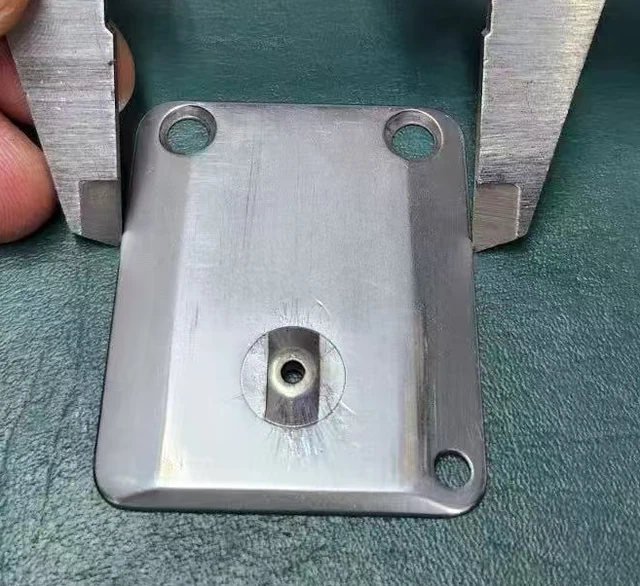
So we split the part in two when we measure it:
| Feature | Where the dimension comes from | Why |
|---|---|---|
| Plate outline and thickness | Measured from your sample | Does not wear — nothing runs against it |
| Mounting hole positions | Measured from your sample | Clamped, not loaded; still at original position |
| Raised pad or strip geometry | Measured from the least worn area of your sample | Wear concentrates at the hole, not at the pad edges |
| Needle hole diameter | Never from a worn plate | Taken from the published nominal size for your plate, or from an unworn plate off another head |
| Hole entry radius and finish | Specified fresh | The original radius is gone; this is what was breaking your thread |
If you have more than one head, this gets easier. Pull the plate off a head that has run less, and send us that one as the master alongside the failed one. Two plates at different stages of wear tell us more than either alone: the difference between them is the wear map.
The Original Is Two Pieces. Yours Will Be One.
Look at the underside of a needle plate and you will often find a seam — a round or polygonal pad set into the plate, sometimes with weld marks around it. Customers regularly point this out and ask whether we can reproduce the assembly. We can, and we usually should not.
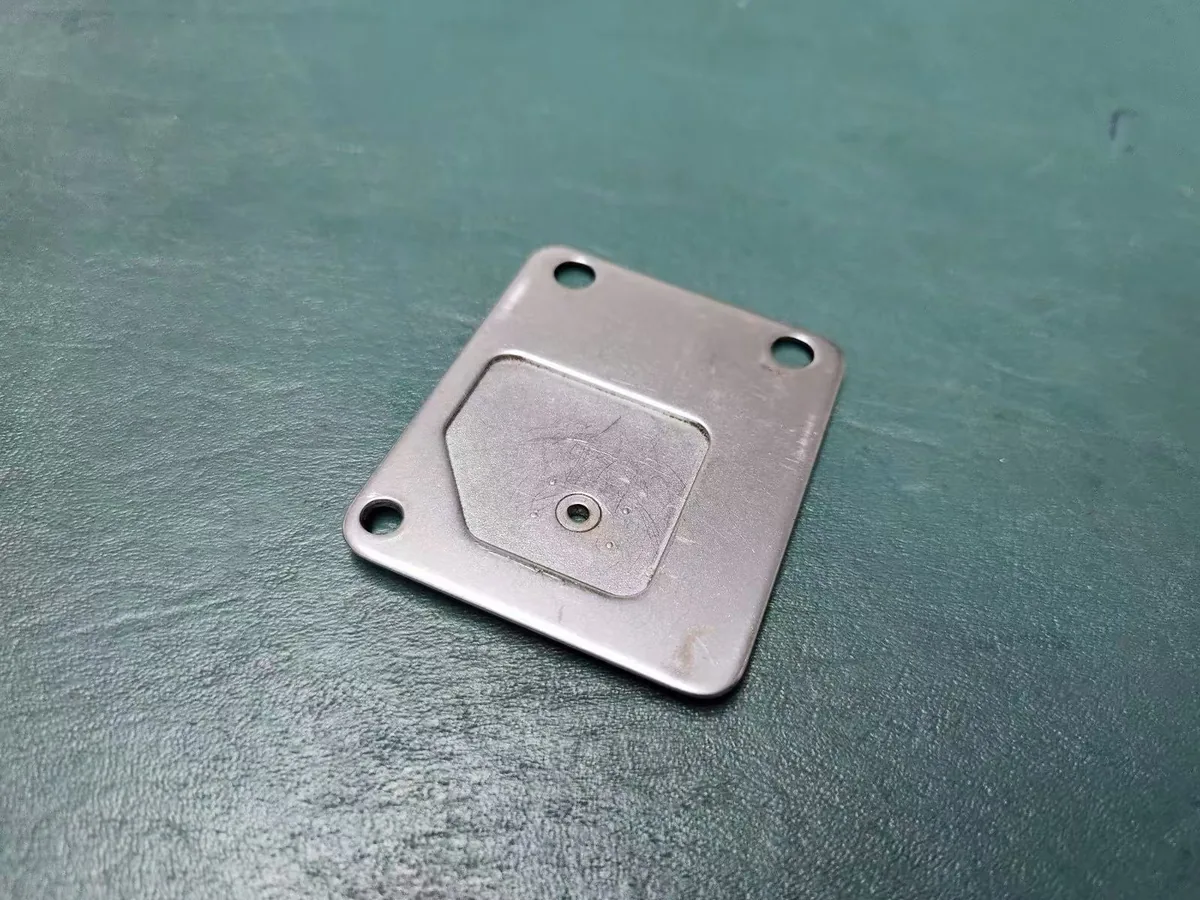
The plate is two pieces because of how it was originally produced, not because the function requires it. A thin stamped plate cannot carry a thick local boss around the needle hole, so the volume solution is to stamp the plate, turn or form the pad separately, and join them — with the tooling cost spread across tens of thousands of units. At replacement quantities that arithmetic inverts: a stamping die alone would cost more than an entire order of thirty plates.
So we cut it from one piece of solid stock, and the result is better than the original in three specific ways:
- No joint. The seam between plate and pad is a lint trap and a corrosion path, and on a badly worn plate it is often where the surface starts lifting.
- No assembly stack. Pad height sets the clearance between plate and hook. On an assembled plate that height is the sum of two parts plus however they seated. Machined solid, it is one dimension held in one setup.
- Hole-to-hole position guaranteed. The needle hole and the mounting holes are cut without unclamping, so the needle cannot end up sitting off-centre relative to where the plate bolts down.
This is the general rule for remaking discontinued parts, not a special case: copy the geometry that the machine needs, not the production method the original factory happened to use. The same reasoning applied to castings, extrusions, folded brackets and sintered bushes — with the four cases where the joint has to stay — is set out under copy the geometry, not the production method.
Material, Hardness and the Order of Operations
We measure the hardness of your plate and match it rather than guessing from the appearance. Needle plates run against an abrasive load in a small area, so surface hardness is what decides whether the replacement lasts as long as the original or half as long.
| Grade | Where it fits | Note |
|---|---|---|
| Hardenable stainless (420 family) | Default where the original plate is bright and corrosion matters | Takes a high surface hardness and polishes well |
| Hardened tool steel | Where the original measures harder than stainless will reach | Highest wear life; needs oiling if the machine sits idle |
| Case-hardening steel (8620 / 16MnCr5) | Matches the drive-side parts on the same head | Hard skin over a tough core — see embroidery machine parts |
| 304 stainless | Not suitable for this part | Austenitic — will not harden by heat treatment, so it grooves faster than the plate you are replacing |
| Aluminium (6061 / 7075) | Not suitable for this part | Far too soft at the thread contact; listed here only because we are asked |
The sequence matters as much as the grade. A needle plate is a thin, wide part, and thin wide parts distort when they are hardened:
- Machine first — full geometry cut in the soft state, where accuracy is cheap
- Harden second — the whole plate, so the hole edge is as hard as the face
- Grind and polish last — top face flattened and the needle hole finished after heat treatment, because hardening moves dimensions and a plate that is not flat will not seat on the bed
One Plate Per Head
Every head on a multi-head machine carries the same plate and has run the same hours, so the first plate to groove is a schedule rather than an incident. The one-time work is measuring, reconstructing the geometry and setting up — charged once whether you order one plate or thirty. The full arithmetic is on the embroidery machine parts page; the short version is that we quote 1 piece and tiers at 10, 20 and 30 so you can see where the per-plate price flattens out.
On an Industrial Sewing Machine the Same Part Is Called a Throat Plate
Needle plate, throat plate, needle plate assembly — the same component under three names. On industrial lockstitch, walking-foot, zigzag and double-needle machines it is usually called a throat plate, and it fails in exactly the way described above: the hole opens up, the top face grooves, and the machine starts breaking thread on work it used to run clean.
The buying advice is different, though, and it is worth being blunt about it. Standard industrial throat plates are well supplied. They carry settled part numbers, they come in small, medium and large needle-hole variants, and several stockists hold them in depth. If your plate matches a standard number, buy it from a sewing machine dealer — you will have it in days for a fraction of what a machined replacement costs, and we would be doing you no favours by quoting.
Where it becomes our job is narrower:
- The machine builder is gone, or the model dropped out of support. Older industrial heads and specialist machines — sailmaking, heavy leather, webbing, technical textiles — frequently have no parts channel left at all.
- You need a hole or slot that is not a catalogue option. A needle hole sized for one specific thread, a feed-dog slot arrangement for a particular binder or folder, a plate that carries a gauge marking no standard plate has. This is a genuine custom part, not a replacement.
- The plate is part of a gauge set that was matched to a folder, binder or hemmer which is still in use after the plate wore out.
The measuring rule is identical either way: the needle hole never comes off the worn plate. Standard number, nominal from the catalogue; special hole, nominal from the thread and needle you are running.
Other Embroidery Parts That Have Gone Out of Production
Needle plates are not an isolated case. Dealers publish lists of discontinued items for which they hold no generic or substitute option at all — and those lists are mostly plain machined parts. A representative sample of what falls off the catalogue on an older head:
| Part | What it is | Can it be remade? |
|---|---|---|
| Needle plate | Flat plate, mounting holes, raised pad, needle hole | Yes — milled and ground |
| Rotary hook base cover | Formed cover plate over the hook area | Yes — milled, or laser cut and formed |
| Presser foot cam | Profiled cam driving the presser foot | Yes — profile traced from the original, hardened where the follower runs |
| Roller bracket and roller pin | Bracket plus ground pin | Yes — milled bracket, ground pin to the existing bore |
| Joint members, links and levers | Small machined linkage parts | Yes — usually the simplest jobs on the machine |
| Limit sensors, driver cards, control boards | Electronics | No — go to an embroidery electronics repair specialist or a machine breaker |
The split is consistent: the mechanical population is reproducible and the electronic population is not. On an older head the mechanical side is most of what goes obsolete, which is why a machine that is otherwise sound rarely needs to be scrapped over a parts list. One of those mechanical parts, a toothed-belt pulley with its teeth worn down, is worked through on the case study worn timing pulley from a multi-head embroidery machine: the teeth could not be measured, so the specification came from the belt and the tooth count.
What to Send — and Why We Want Your Best Plate
| Input | What it gives us |
|---|---|
| The worn plate itself | Everything except the nominal hole size — outline, thickness, mounting positions, pad geometry, and the hardness reading. Returned with your order. |
| A second, less worn plate from another head | The most useful thing you can send. The difference between the two plates is the wear map, and the better plate is a far more honest master. |
| A page from the machine manual | The parts diagram shows the part number and how the plate sits among its neighbours — context a photograph cannot give. |
| The part number, if you have it | Lets us check the published nominal hole size and whether a superseding number exists that you should buy instead. |
| Photographs with a ruler in shot | Enough for a budget figure before you ship anything. Both faces, please — the underside shows the pad construction. |
Not sure whether it is worth remaking? Send a photograph and tell us the machine. If the plate is still available somewhere, we will say so and point you at it. See also discontinued embroidery machine parts, reproduction from a physical sample, obsolete and discontinued parts and when the manufacturer no longer exists.
Please note: EKINSUN is not affiliated with, endorsed by, or an authorised dealer for any embroidery machine manufacturer. Machine and brand names appear only to identify the equipment our customers' parts come from, and part numbers only to identify which component is meant. Everything we supply is a compatible replacement component manufactured from your sample or drawing — not an OEM part.
Frequently Asked Questions
| My needle plate is worn and the part number comes back discontinued. Can it be remade? | Yes. A needle plate is a milled and ground part — a flat plate, three mounting holes, a raised pad and a small hole through it. Every dimension needed to remake it is present in the plate you are already holding, except one: the needle hole itself, which has worn. We take that from the published nominal size rather than from your worn part. Send the plate, or photographs plus a few caliper measurements for a budget figure. If your plate is still in production at a parts dealer, buy it there instead — it will be faster and cheaper, and we will tell you so. |
| The dealer offers a different part number as a substitute. Is that the same plate? | Not necessarily, and needle plates are a case where it matters. Superseding numbers are often described as “nearly identical” — and the difference is frequently in exactly the area that touches thread: the raised strip around the needle hole, whether it carries a cut-out, the height of the pad, or the shape of the funnel into the hole. Those are not cosmetic details. They set how the thread is presented to the hook. Read the substitute description carefully before you accept it, and if it says the geometry differs, copying your original is the safer route. |
| How do you get the needle hole size if the hole in my plate is worn oval? | We do not measure it from your plate. A worn needle hole is the one dimension on the part that has migrated away from the specification, so copying it would reproduce the failure. We take the nominal hole size from the published catalogue specification for your plate, or from an unworn plate off another head if you have one, and we machine to that. Everything else — mounting hole positions, plate outline, pad height, thickness — is measured directly from your sample, because those surfaces do not wear. |
| My plate looks like two pieces joined at the factory. Will yours be the same? | No, and that is deliberate. The original is assembled because that is the cheap way to make tens of thousands: stamp a thin plate, turn a thicker pad, join the two. Reproducing that at replacement quantities would mean paying for stamping tooling that never amortises. We machine the plate from a single piece of solid stock instead. There is no joint to trap lint, no assembly tolerance stacking up in the pad height, and the needle hole and the mounting holes are cut in one setup so their positions cannot drift relative to each other. |
| What material and hardness do you use? | We measure the hardness of your sample and match it rather than guessing. Needle plates are typically a hardenable steel taken to a high surface hardness and then polished, because the wear is abrasive — thread dragging across the same few millimetres for thousands of hours. Hardenable stainless such as 420 is a common choice where corrosion also matters. Austenitic stainless like 304 is not suitable here: it will not harden by heat treatment, so a 304 plate would groove faster than the one you are replacing. The sequence matters as much as the grade — machine the geometry, harden, then grind and polish the top face and the needle hole, because a thin plate moves during heat treatment. |
| Can you make the electronic parts as well? | No. Sensors, driver cards, control boards and encoders are outside what a machine shop can reproduce, and we will say so rather than take the order. For those, an embroidery electronics repair specialist or a used machine breaker is the right call. What we make is the mechanical population — plates, gears, hubs, bushings, cams, levers, brackets, shafts, pins and covers — which in practice is most of what goes obsolete on an older head. |
| Do I have to mail you the plate, or are photographs enough? | Photographs and a few caliper measurements are enough for a budget price. Mailing the plate is what turns that into a firm quote, because the mounting hole positions and the pad height have to be right to the tenth of a millimetre or the plate will not sit flat on the bed. If you send one, send the least worn plate you have — on a multi-head machine the heads wear at different rates, and the best plate on the machine is a far better master than the one that finally failed. We return your original with the order. |
| I have an industrial sewing machine, not an embroidery machine. Is a throat plate the same job? | Same part, same failure, same measuring rule — but different buying advice. On industrial lockstitch, walking-foot, zigzag and double-needle machines the part is normally called a throat plate, and standard ones are very well supplied: settled part numbers, small, medium and large needle-hole variants, several stockists holding them in depth. If yours matches a standard number, buy it from a sewing machine dealer — days instead of weeks, and a fraction of the cost of a machined part. Come to us when the builder is gone or the model has dropped out of support, when you need a needle hole or feed-dog slot that is not a catalogue option, or when the plate belongs to a gauge set matched to a folder or binder you are still using. |
| How many should I order for a multi-head machine? | One per head, plus spares on the shelf. Every head on the machine carries the same plate and has run the same hours, so the first one to groove is a schedule rather than an incident. The one-time work — measuring, reconstructing the geometry, drawing it, setting up — is the expensive part, and it is charged once whether you order one plate or thirty. We quote 1 piece and tiers at 10, 20 and 30 so you can see where the per-plate price flattens. |
GET A QUOTE
Send photographs of both faces with a ruler in shot, and the manual page if you have it. CAD and drawings welcome; a photo or the part itself is equally fine. Reply in 12 hours.
Get a Quote → WhatsApp