EKINSUN is a manufacturer that makes replacement parts one at a time, so this question comes up on most jobs: the sample has a seam, a weld or a casting texture, and the buyer asks whether we can reproduce that too. Usually we can. Usually we should not, and this page is the reasoning we send back.
Copying a discontinued part: what changes, and what must not — the sample, the price and the material decisions that come before this one.
Why the original looks the way it looks
Nothing on the table below was a bad decision. Each route was the cheapest way to make that shape at the quantity the original factory was making. A die, a pattern or a jig costs money once and nothing thereafter, so across a production run it disappears into the per-part price. Order twenty spares and the same tooling has nobody to share the cost with: the die alone outprices the whole order.
| How the original was made | Why that made sense then | What replaces it at 1–30 pieces | Keep the original route when… |
|---|---|---|---|
| Stamped sheet + turned pad, welded together | Sheet cannot form a local thick boss, and the press die is free after the first ten thousand | Machined from one piece of plate: the boss is material that was never removed | The two halves need different hardnesses — see the exceptions below |
| Folded sheet with a welded gusset | A press brake is fast and the sheet shop has one; a gusset cannot be folded, so it is welded in | Milled from solid with the gusset formed in, so no weld line sits where bending stress peaks | Quantity climbs to roughly 250–500 — see custom brackets |
| Extruded profile, cut and machined | Extrusion is unbeatable per metre once the die exists, but the die costs money and weeks | Cut from solid, which also allows variable fin heights and pockets an extrusion cannot carry | The section is simple and the quantity justifies a die — see heat sinks |
| Sand, investment or die casting, then machined | Pattern or die cost spread over a run; casting reaches shapes that are slow to cut | Machined from bar or block; the as-cast draft and radii are simply not reproduced | Wall sections are complex, or the run is large enough to pay for the pattern |
| Sintered bronze bush pressed into a steel housing | Sintering makes the porous oil-holding structure; the housing is a separate part for a reason | Often nothing — the bush is catalogue stock. Buy it and machine only the housing | Always, if self-lubrication is the function. A solid turned bush is not porous |
| Assembled gear: hardened ring on a softer hub | Hard teeth on a tough core, and less alloy steel in the part | One piece in 42CrMo4 or C45, case-hardened on the teeth only | The hub must stay ductile while the ring runs at high hardness |
Have an old part to copy? EKINSUN is a custom parts manufacturer: we make the replacement part from your sample to your drawing, sketch or sample — steel, 304 or 316L stainless steel, brass, aluminium or plastics — from 1 piece, quoted in 12 hours and shipped duties paid. If the size is standard, ask anyway — it may be in stock, and the unit price drops as the quantity rises. Custom replacement parts →
What one piece actually buys you
Removing a joint is not a cosmetic gain. Three specific things change, and all three are failure modes we have seen on samples that arrive here:
- No joint. A seam collects debris, holds moisture and is where a coating starts lifting. On a worn sample the surface almost always begins failing at the joint line.
- No assembly stack. Where two parts are joined, a critical clearance is the sum of two tolerances plus however they seated. Machined solid, that clearance is one dimension held in one operation.
- Critical features in one setup. Hole pattern, bore and mounting face are cut without unclamping, so their relationship cannot drift. On an assembled part it drifts by however well the jig was set that morning.
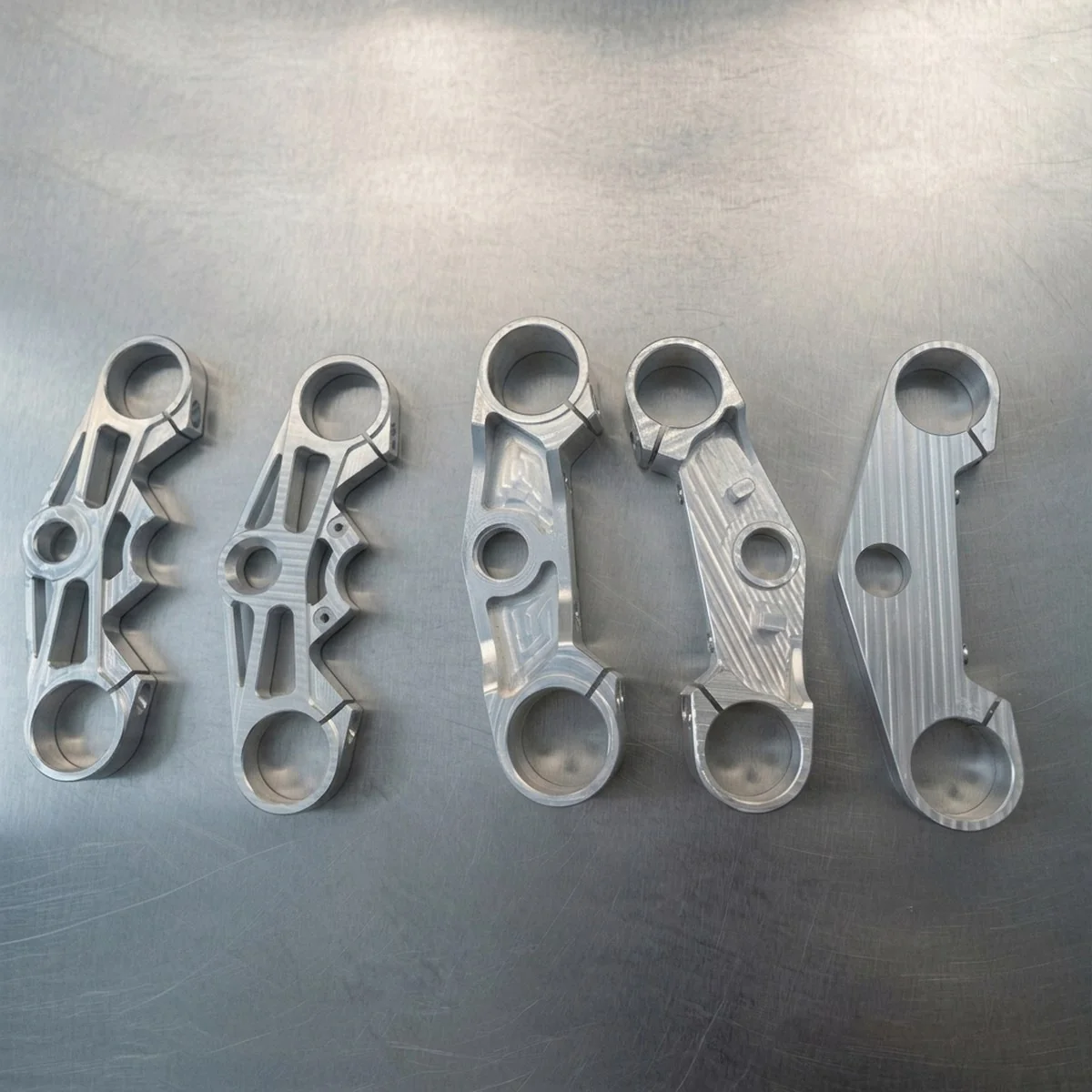
When the joint is a requirement, not a cost decision
The rule has a clear boundary, and it is worth stating before anyone machines a part that should have stayed in two. The question to ask is about the two sides of the seam: do they have to be different?
| What differs across the joint | Keep it in two pieces? | Why |
|---|---|---|
| Two hardnesses — hard running surface, tough core | Yes | One material cannot be at two hardnesses in the same section unless the geometry allows local hardening |
| Two materials — bronze against steel, plastic against metal | Yes | The pairing is the function; making it monolithic changes what runs against what |
| A replaceable wear insert | Yes | The joint exists so that one cheap piece can be renewed instead of the whole part |
| An elastic element against a rigid one | Yes | Damping and preload come from the joint itself |
| Nothing — both sides are the same steel | No | The seam is a manufacturing artefact; reproducing it reproduces the weak point |
| Only the shape is awkward to cut in one piece | No | Awkward is a machining problem, not a design requirement, and it is ours to solve |
| Only that a die was cheaper at the original volume | No | That arithmetic belonged to the original run and does not survive to a batch of twenty |
Where the original method wins again
This page argues for machining because of the quantity, so it has to say where the quantity turns back. Folding and welding beat milling on a bracket from roughly 250 to 500 pieces, and further up the scale stamping, casting and extrusion win outright — a die pays for itself several times over once the run is long enough. If your annual need is in the thousands, the honest answer is that a tooled route is better and cheaper than anything we can machine, and we will say so instead of quoting it. The same applies to parts that never needed making at all: a sintered bush to ISO 3547, a standard bearing, a catalogue O-ring — those are stock items, and buying is the right answer.
Materials we use when the route changes: 6061 and 7075 aluminium where the original was a light casting, 1.4301 or 1.4404 stainless where the original was plated steel, C45 and 42CrMo4 where the original was a forging. The reconstruction is on which surface to measure on a worn part, and the parts we most often do this for are under replacement parts.
A real job of this kind: A Modified-Car Trim Run — Dozens of Identical Plastic Parts — several dozen identical plastic housings vacuum-cast from a machined master instead of a steel mould.
Frequently Asked Questions
We can, and usually we advise against it. Ask first whether the two sides of the weld need to be different — different hardness, different material, a replaceable insert, an elastic element. If they do, the joint stays. If both sides are the same steel, the seam was a production decision made at a quantity you are not ordering, and machining the part from solid removes a debris trap, an assembly tolerance stack and a setup change.
Not for the reason people expect. A forging has grain flow that follows the shape and a machined part does not, which matters in high-cycle fatigue parts such as con rods and crane hooks. For housings, brackets, plates and most machine parts the governing factor is section and material, and solid bar in 42CrMo4 or 7075 is stronger than the cast alloy it replaces. Where the part is a fatigue-critical forging, we say so.
For a folded and welded bracket the crossover is around 250 to 500 pieces. For stamping, casting and extrusion it is higher but the logic is the same: the tooling cost divides by the run. Below the crossover, machining wins because there is no tooling to pay for; above it, tooling wins and we will point you to it rather than quote against it.
No, unless something fits against them. Draft exists so that the part can leave a mould, and generous radii exist so metal flows; neither is a function of the machine the part runs in. We reproduce the mating faces, bores, thread positions and envelope, and leave out the features that only the casting process required. If a cast face seats against another part, that face is reproduced as it sits.
The shape yes, the material behaviour no. Sintered bronze holds oil in its pores and feeds it back to the shaft; a turned bronze bush is solid and lubricates differently. If the original was a self-lubricating bush, check the catalogue first, because sintered bushes to ISO 3547 are stock items and cheaper than anything turned. Where the size is off-catalogue we turn one in CuSn12 and specify the lubrication that goes with it.
Yes, and deliberately so. A machined part has tool marks instead of casting texture, sharp defined edges instead of draft, and no weld bead. Every dimension that touches another part is reproduced; the surface character is not. If the part is visible on a machine and appearance matters, tell us and we will match the finish as a separate operation.
Send the part, or a photo of it
Tell us what the part does and which faces touch something else. We reconstruct the geometry that matters, choose the route that suits your quantity, and put the drawing in front of you before cutting. MOQ 1, quote in 12 hours.
Send the pitch, not a guess
Thread designation or a pitch-gauge reading over ten threads, the across-flats and height it must fit, quantity, material. Posting the shaft end or the old nut works too. One piece minimum, quote within 12 hours.