Where the Parts Dealer Stops
The embroidery parts trade is well served for anything in production. Dealers stock belts, hooks, needles, motors, boards and hundreds of mechanical items, and if your part is on their shelf you should buy it there — it will be faster and cheaper than anything we can do.
The problem starts one step later. Search a part number long enough and you eventually land on a listing marked discontinued, limited stock remaining, or contact us for options. That is where the supply chain ends: the dealers are distributors, not manufacturers, so when the last box is gone there is no next box. The machine, meanwhile, is fine — it needs one worn component.
Discontinued means nobody is producing it anymore. It does not mean it cannot be produced. Almost every mechanical part in an embroidery head is a turned, milled, hobbed or ground component, and every dimension needed to remake it is present in the part you already have.
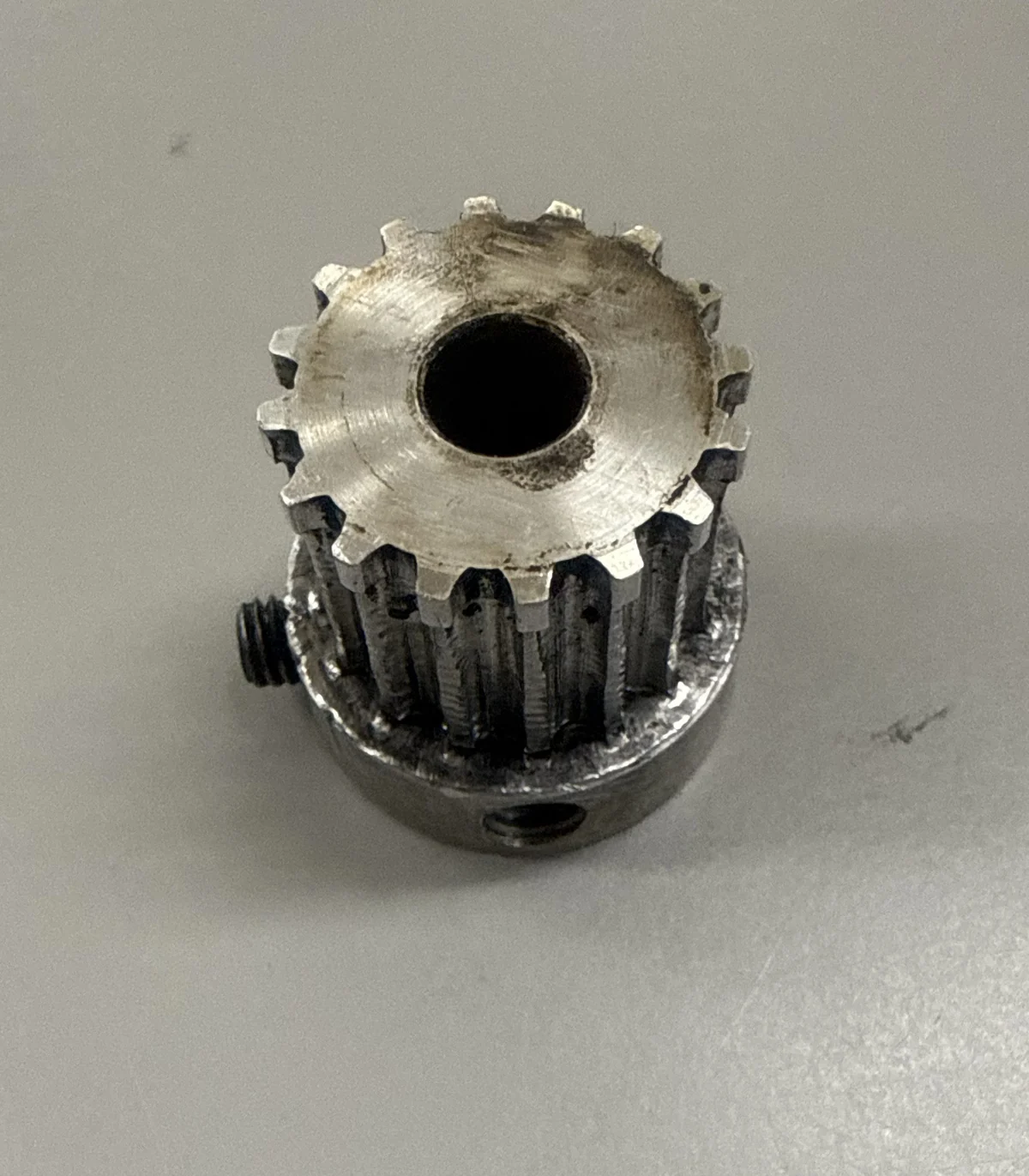
What the Dealer Can Supply — and Where We Take Over
| What you need | Parts dealer | EKINSUN |
|---|---|---|
| Current production part, in stock | Ships from shelf | Buy it from them — faster and cheaper, honest advice |
| Discontinued, no stock, no successor | "Contact us for options" | Remade from your sample |
| Part number superseded, new version does not fit your generation | Sells the new one anyway | We copy the part that fits |
| Assembly sold only as a complete module | Module price only | Just the worn component, or the set |
| Sets for all heads at once | Stock-limited | One batch, tiered pricing |
| Harder material than the original | Not offered | Specified from the wear pattern |
Multi-Head Machines Turn One Failure Into a Batch
This is the part most operators work out the expensive way. On a multi-head machine every head carries the same components — so when one gear or hub fails after some years of running, the identical part on every other head has done the identical hours. The first failure is not an incident; it is a schedule.
Which is why the sensible order is rarely one piece. A 12-head machine usually means 12 to 15 sets: one per head plus spares on the shelf. And that quantity works in your favour, because the expensive part of remaking a discontinued component is the one-time work — measuring the sample, reconstructing the geometry, drawing it, setting up. Spread across 20 or 30 sets, the per-set price falls to a fraction of what a single piece costs.
Practical consequence: if you are already pulling one head apart, it is worth measuring the same part on a second head before you order. If both show similar wear, order for the machine — not for the failure.
Parts We Remake for Embroidery Machines
Drive & take-up gears
Spur gears reconstructed from tooth count and outside diameter, case-hardened and ground
Hubs & collars
Brass or steel hubs with set-screw seats, bores matched to your shaft
Bushings & sleeves
Bronze or steel, sized to the shaft you have rather than to nominal
Cams & levers
Profile traced from the original, hardened where the follower runs
Shafts & pins
Ground to fit existing bearings and bushings
Assembled units
Gear, hub, bushing and screws supplied as a finished set
Needle plates
Hole cut back to nominal rather than to the worn oval, top face ground and polished
If the item you need is not on this list, it is still worth asking — the deciding factor is whether the geometry can be recovered from the sample, not what the part is called.
Needle plates are the one item on this list with a trap in it, and they get their own page: the needle hole is the single dimension that must not be measured off your sample, because the hole is exactly where the wear went.
Machines These Parts Come From
Multi-head embroidery machines share the same basic mechanical architecture regardless of who built them: a driveshaft running the length of the bridge, one head per station, and inside each head the same small population of gears, hubs, cams, levers and bushings. Customers send us parts from Tajima, Barudan, SWF, Happy, ZSK, Ricoma and Brother machines, along with older machines whose badge has long since stopped meaning anything because the company behind it changed hands or closed.
The make matters less than you would expect. What decides whether a part can be remade is whether the geometry can be recovered from the sample — not whose name is on the frame. A part number printed in your manual helps us keep track of what we made for you; it is not something we need to look up in anyone's catalogue.
Please note: EKINSUN is not affiliated with, endorsed by, or an authorised dealer for any machine manufacturer named on this page. Brand and model names appear only to identify the machines our customers' parts come from. Everything we supply is a compatible replacement component manufactured from your sample or drawing — not an OEM part.
Matching Case-Hardened Steel
Embroidery drive components are commonly AISI 8620, a carburising steel: soft tough core, hard wear-resistant skin. Its equivalents are 16MnCr5 (1.7131) and 21NiCrMo2, and we use them interchangeably depending on what is available in the required section. The full cross-reference with compositions, from 8620 to 20NiCrMo2-2, 20MnCr5 and SCM420, is on the case-hardening steel equivalents chart.
The sequence matters more than the grade name:
- Machine first — full geometry cut in the soft state, where accuracy is cheap
- Carburise and harden second — case depth specified from the wear surface, not applied blindly to the whole part
- Grind last — running surfaces finished after heat treatment, because hardening moves dimensions
If you know the surface hardness, tell us. If you do not, the wear pattern on your sample usually says enough: a part that has polished smoothly has a sound case, while one that has pitted or spalled was under-specified for the load — and that is worth correcting rather than copying.
What to Send Us
You do not need a drawing, a CAD file or the original part number. In order of usefulness:
| Input | Why it helps |
|---|---|
| The worn part itself | Best possible input — we measure everything, including features you would not think to mention |
| A page from the machine manual | The parts diagram shows the part number and how the component sits among its neighbours — context no photograph can give |
| Photographs with a ruler in shot | Both ends, one side view, one angled view, one close-up of the bore |
| A few caliper measurements | Outside diameter, bore diameter, overall height — plus tooth count if it is a gear. Enough for a budget figure |
| The mating part | Lets us verify fits and clearances instead of assuming them |
You do not have to mail anything to get a price. Photos, a manual page and three or four measurements are enough for a budget number. Shipping the sample comes afterwards — once the figure works for you — and turns that budget number into a firm one. We measure it, send you a dimensioned drawing for approval, and only then cut metal.
What You Get Back Before Anything Is Machined
Photographs alone are not a manufacturing input — but they are enough to start. Before you ship anything, we turn what you sent into a drawing and send it back for you to check. Getting the shape confirmed on paper is far cheaper than discovering a misunderstanding after the metal is cut.
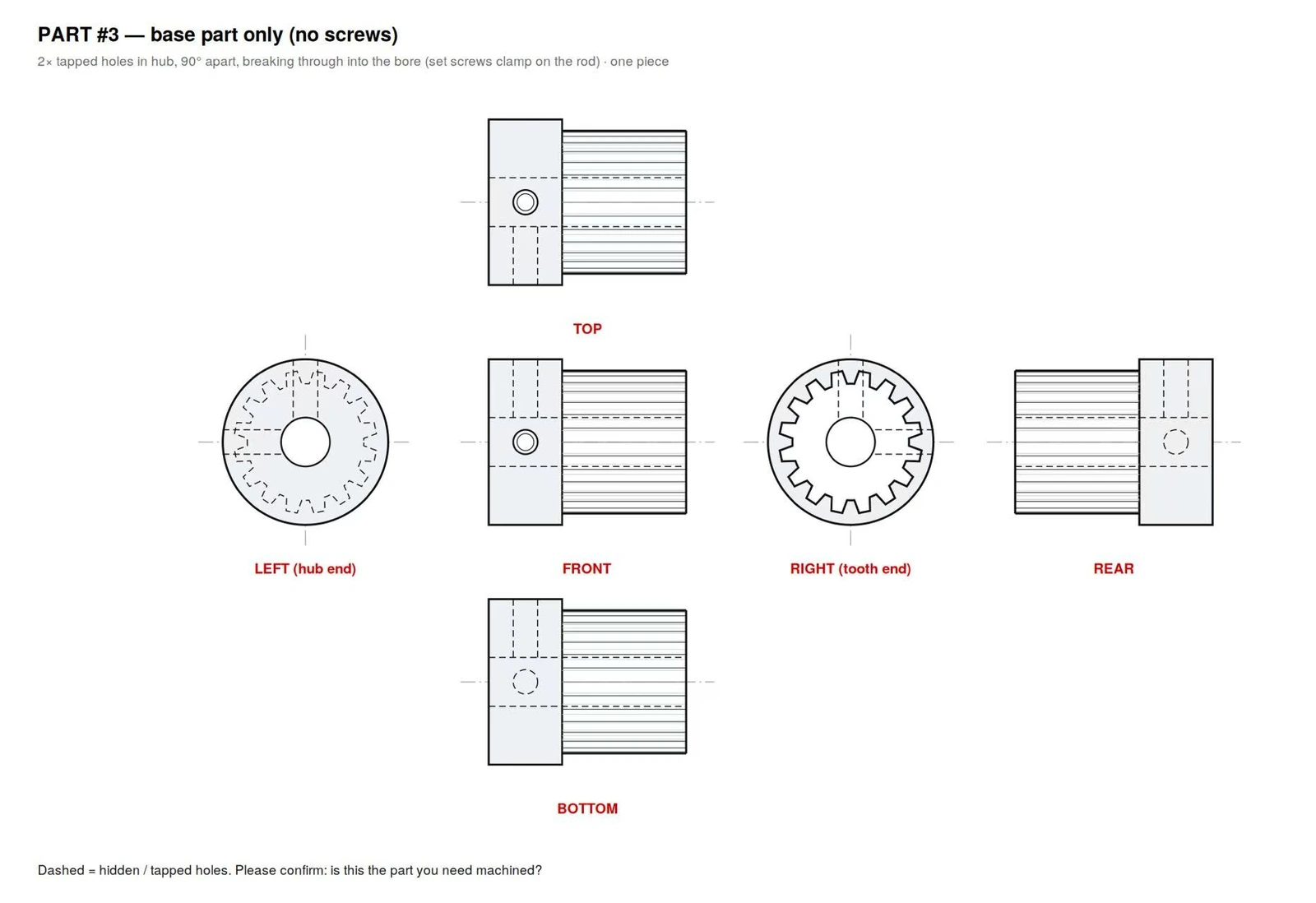
This costs you nothing and commits you to nothing. If the drawing is wrong, you tell us and we redraw it. If it is right, it becomes the basis for the quote — and shipping the sample afterwards is what turns estimated tooth data and bore fit into measured ones.
Typical Situations
"The part is discontinued and the dealer has none left. The machine is otherwise perfect."
The usual case. Send the worn part or the manual page; we reconstruct the geometry and quote sets for as many heads as you run. A twenty-year-old machine in good mechanical order is worth keeping alive for the price of a component.
"One head failed. I would rather not do this again in three months on head seven."
Then order for the machine, not the failure. We quote 1 piece, and tiers at 10, 20 and 30 sets so you can see exactly where the per-set price flattens out and decide with the numbers in front of you.
"I have five identical machines to recommission and one obsolete component blocking all of them."
Reconstruct once, produce for all five. The drawing stays on file, so the next batch is a repeat order rather than a new project.
Not sure whether it is worth remaking? Send a photo and tell us what the machine is. If the part is still available somewhere, we will say so and point you at it. See also obsolete and discontinued parts, reproduction from a physical sample and when the manufacturer no longer exists.
A real job of this kind: A Batch of Steel Spur Gears, Cut to Match the Original — obsolete spur gears rebuilt from the worn original’s tooth count, module and pressure angle, cut in C45 or 42CrMo4.
Frequently Asked Questions
| The parts supplier says the part is discontinued with no stock left. What now? | Discontinued means nobody is producing it anymore — not that it cannot be produced. A gear, hub, bushing or cam is a machining job, and the geometry is contained in the part you already have. Send us the worn original, clear photographs, or the page from your machine manual showing the part, and we measure it, draw it and remake it. No original drawing or CAD file is needed. For parts still in stock at a parts dealer, buy them there — it is faster and cheaper, and we will tell you so. |
| How many pieces should I order for a multi-head machine? | Usually one set per head, plus spares. This is the point most people miss: on a multi-head machine every head carries the same components, so a single failure means the same part is about to wear out on every other head too. A 12-head machine typically means 12 to 15 sets. That quantity works in your favour — setup and drawing cost is spread across the batch, so the per-set price at 20 to 30 sets is a fraction of the one-off price. We quote tiered pricing so you can see the break points. |
| The part is case-hardened 8620. Can you match it? | Yes. AISI 8620 is a standard carburising steel; its European equivalents are 16MnCr5 (1.7131) and 21NiCrMo2, which we use interchangeably depending on availability. The sequence matters more than the grade name: we machine the geometry first, carburise and harden second, and grind the running surfaces last, so the finished dimensions are correct after heat treatment rather than before it. Tell us the surface hardness if you know it — otherwise we specify from the part function and the wear pattern on your sample. |
| Can you work from a page of the machine manual? | Yes, and it is one of the most useful things you can send. A parts diagram gives us the part number, how the component sits in the assembly, and which neighbouring parts it has to fit — context a photograph alone cannot show. Manual page plus a few caliper measurements is often enough for a budget figure before you ship anything. Send the manual page, the part number if printed, and photographs of each end of the part with a ruler in shot. |
| Do I have to mail you the original part? | Not to get a price. Photographs, a manual page and a handful of caliper measurements — outside diameter, bore diameter, overall height, and tooth count if it is a gear — are enough for a budget quote. Mailing the sample comes afterwards, once the figure works for you, and it is the step that turns a budget number into a firm one. We measure the sample, send you a dimensioned drawing for approval, and only then start production. |
| The part is an assembly of several components. How is that quoted? | Per complete set, not per component. Many embroidery machine parts that look like one item are a steel gear, a brass hub, an inner bushing and a pair of set screws. We quote the assembled unit — all components machined, heat treated where required, assembled and inspected — so the number you compare against the OEM price is for the same thing you would have bought from them. |
| My sample is worn. Will the copy be worn too? | No — we reconstruct the original dimensions rather than copying the worn ones. Wear is not uniform: on a gear the tooth tips wear far less than the flanks, and on a shaft or bushing the unloaded side stays close to nominal. We measure the least worn surfaces, compare against the mating parts, and restore the intended geometry. Where wear was the reason the part failed early, we can suggest a harder material or a different surface treatment for the replacement. |
GET A QUOTE
Send a photo of the part and the manual page if you have it. CAD, drawing or part number all welcome — none of them required. Reply in 12 hours.
Get a Quote → WhatsApp