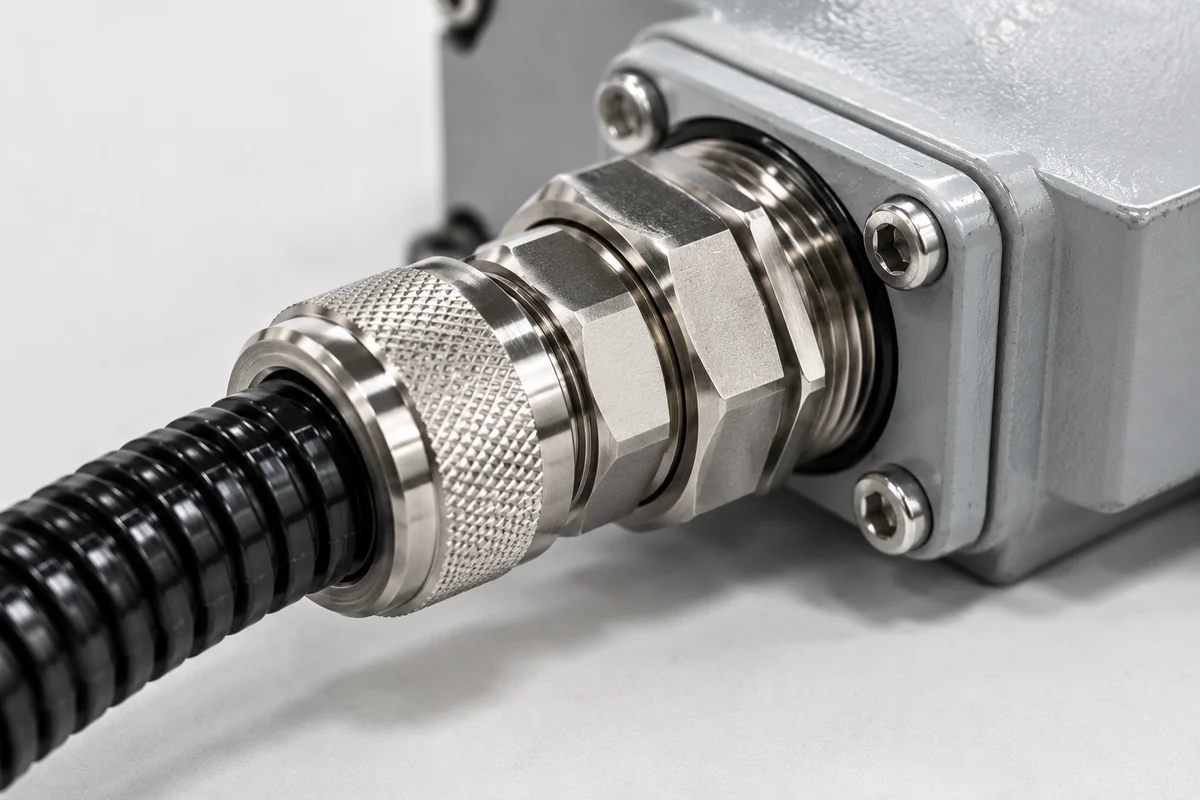
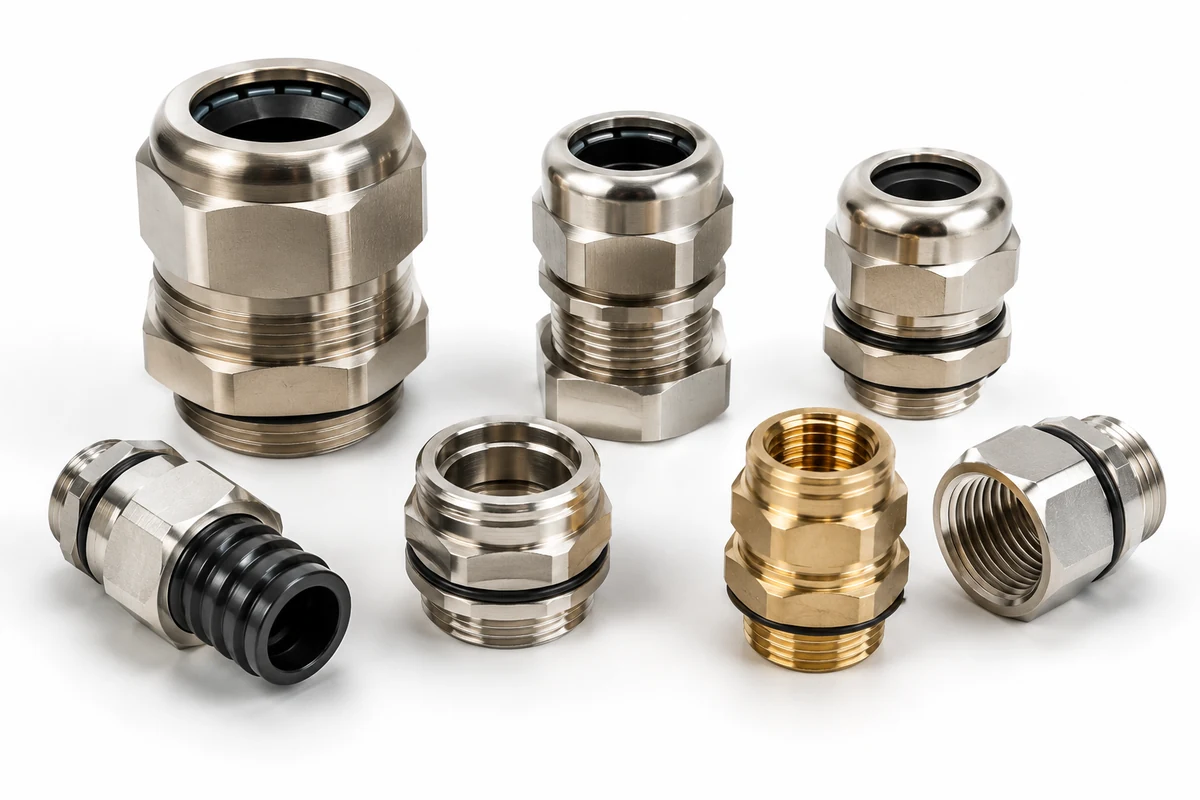
For joining industrial connectors, motor terminal boxes, cable glands and protective conduit fittings when the two threads do not match — and no catalogue adapter is short enough, small enough or the right size.
[✓]Bridging different threads — including non-standard and fine pitches
[✓]Shortest possible body for confined installation space
[✓]Reduced hex when the standard across-flats fouls something
[✓]From 1 piece — from a drawing, a photo or the old part
Every one of these is turned to your dimensions. The configuration is whatever the two mating parts need — there is no catalogue to work around.
// 01
Female to Male
The common case: connector thread on one end, gland or conduit thread on the other.
// 02
Female to Female
Joins two male fittings that were never meant to meet.
// 03
Male to Male
Double-ended nipple between two threaded housings or entry plates.
// 04
Connector to Cable Gland
Plug or receptacle thread converted to the gland's entry thread.
// 05
Bulkhead / Panel Entry
With locknut face and panel shoulder for enclosure walls.
// 06
Short-Length
Cut to the minimum the thread engagement each side allows.
// 07
Reduced Hex
Smaller across-flats, or two spanner flats, when clearance is tight.
// 08
Obsolete Replacements
Copied from the old adapter when the original is no longer supplied.
Materials
→Nickel-plated brass — the default for gland and conduit hardware
→Stainless 316L — marine, chemical, washdown
→Stainless 304 — general outdoor and indoor use
→Aluminium 6061 — where weight matters; 7075 when it must also be strong
→Carbon steel, zinc- or nickel-plated
→PA66, POM and PTFE for insulating adapters
Thread Standards
→Metric M6–M63, coarse and fine pitch
→Non-standard metric — M15×1 and similar odd sizes
→PG 7–48 (older German gland sizes)
→NPT / NPSM 1/8″–2″
→BSP / G parallel and taper
→UN / UNF / UNEF
→Left-hand and any custom pitch
Typical Applications
→Industrial and geared electric motors
→Motor terminal boxes and junction boxes
→Drives and frequency converters
→Control cabinets and panel entries
→Sensors and instrumentation
→Pumps, compressors, conveyors
→Mining, marine and offshore equipment
Where These Parts Go
Five installations, five different reasons the catalogue part did not work — the entry was crowded, the hole was already drilled, the connector thread was not in any gland range, the conduit was levering on the joint, or brass would not survive the environment. Tell us which one is yours and the material and length follow from it.
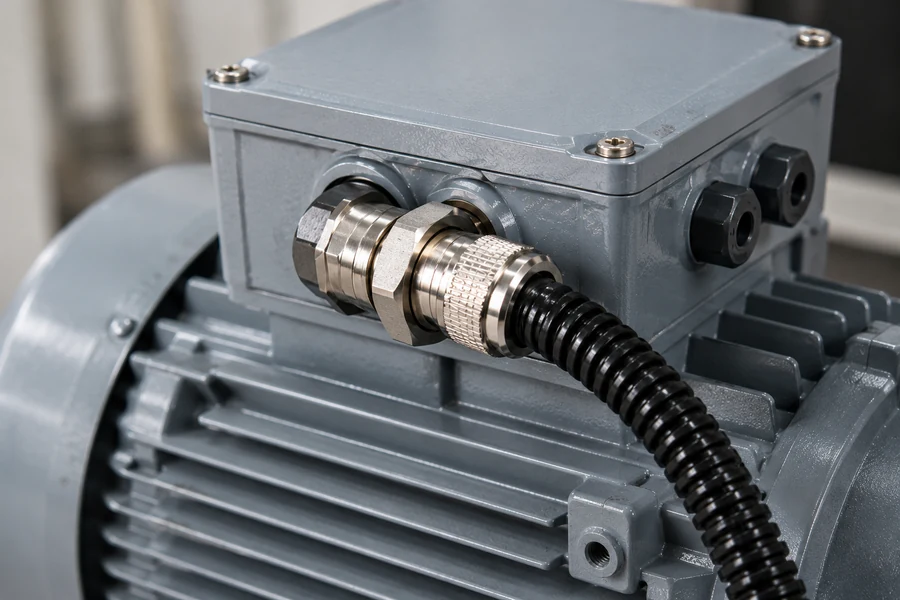
Industrial Motor Junction Box ConnectionCast housing ribs and the fan shroud crowd the entry — M16→M20 enlarger, nickel-plated brass, body kept short.
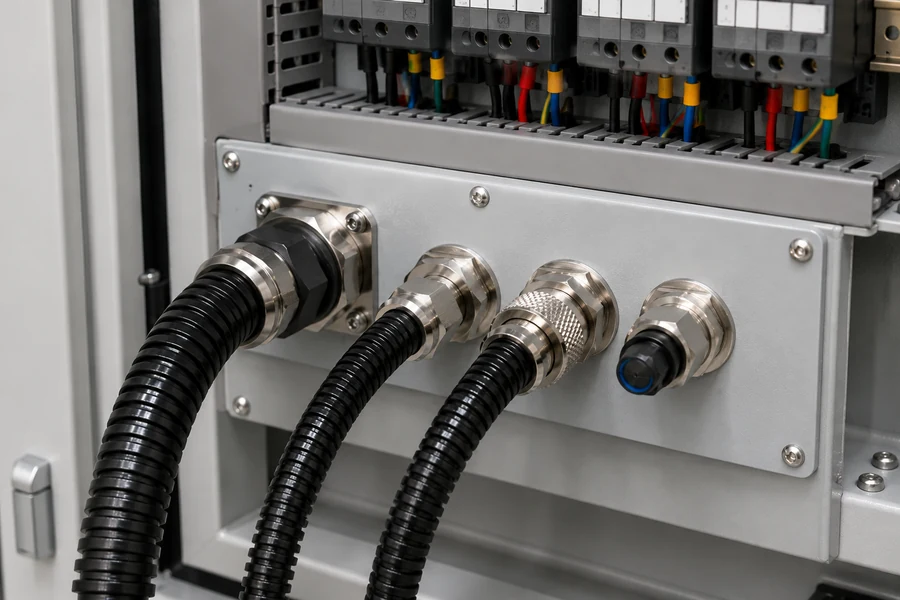
Control Cabinet Cable EntryGland plate already drilled for the previous build — M25→M20 reducer with locknut face, mixed sizes in one order.
Connector on Automation EquipmentConnector thread no gland range carries — M15×1 and similar pitches, cut to match the part in hand.
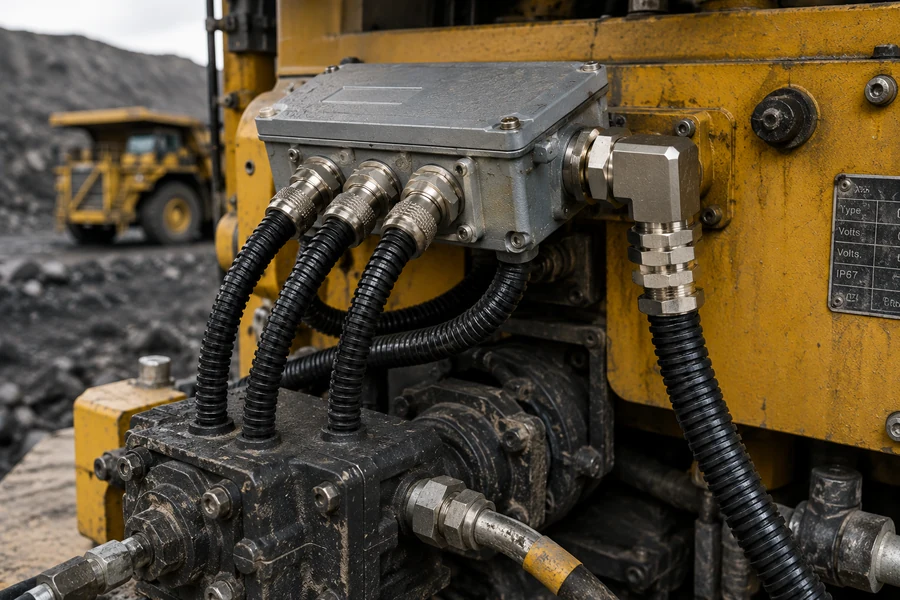
Mining Equipment Cable Gland ConnectionDust, impact and armoured conduit levering on the joint — heavier wall, full hex, steel or 316L.
Marine & Offshore Cable EntrySalt air rules out brass and plated steel — 316L throughout, sealing face specified on the drawing.
When Standard Adapters Do Not Fit
Standard gland reducers exist in quantity and cost a couple of euros. If one of them fits your job, buy it — we would rather tell you that than sell you a machined part you do not need. What follows is the list of situations where they run out, and those are the ones we handle:
The connector and the conduit fitting carry different threads, and no reducer covers that pair
One side is a non-standard or fine pitch that is not part of any gland range
Every available adapter is too long for the space between the connector and the housing
The standard hex fouls a neighbouring gland, cable or casting rib
The original adapter is discontinued and only the old part remains
You have a photo or a sample, not a drawing
You need 10 or 20 pieces, and the custom suppliers you asked want hundreds
The specification calls for nickel-plated brass or 316L and the stock part is only nylon
An existing sealing arrangement must be retained exactly as it is
Sizes We Convert Most
Two directions, two names. A reducer takes a larger entry down to a smaller one; an enlarger opens a small entry up to a bigger gland. Both are turned from solid here — and either can be male-to-female, female-to-female or male-to-male, whichever the two mating parts need. British spelling adaptor and American adapter mean the same part.
Conversion
Direction
Where it usually comes up
M12×1.5 → M16×1.5
Enlarger
Sensor or small connector entry into a standard gland
M16×1.5 → M20×1.5
Enlarger
The most common single step on motor terminal boxes
M20×1.5 → M25×1.5
Enlarger
Cable thicker than the original entry allows
M25×1.5 → M20×1.5
Reducer
Oversized knockout in an enclosure, smaller cable
M20×1.5 → M16×1.5
Reducer
Panel hole drilled for the previous gland size
M25×1.5 → M32×1.5
Enlarger
Retrofit to armoured or larger multicore cable
M32×1.5 → M25×1.5
Reducer
Existing gland plate reused for a smaller run
M40×1.5 → M32×1.5
Reducer
Drive and converter cabinets
PG16 → M20×1.5
Standard change
Older German equipment being re-glanded to metric
PG21 → M25×1.5
Standard change
Same, one size up
PG29 → M32×1.5
Standard change
Larger legacy conduit entries
1/2″ NPT → M20×1.5
Standard change
US-built machine installed under metric wiring practice
3/4″ NPT → M25×1.5
Standard change
Same, one size up
M15×1 → M16×1.5
Connector to gland
Connector thread that no gland range carries — see below
PG 13.5 → PG 16
PG to PG
Staying in PG, one size up — nobody stocks this
PG 16 → PG 13.5
PG to PG
Oversized legacy entry, smaller cable
PG 21 → PG 16
PG to PG
Same, on the larger sizes
PG 16 → M16×1.5
PG to fine metric
Legacy entry, modern gland two sizes smaller
PG to PG deserves its own mention. Changing size within the PG family — PG 13.5 up to PG 16, PG 21 down to PG 16 — is a part almost nobody stocks, because the standard is treated as legacy and the ranges have stopped being extended. It is nonetheless a real, recurring request: the enclosure is PG, the replacement gland the maintenance team could source is PG, and the two are simply different sizes. Cutting a PG thread on each end is no harder for us than cutting metric.
This list is what recurs, not a catalogue. Any pair of the threads in the panel above can be cut, in either direction, with a male or female end as required. If your combination is not shown, it is not a special case — state the two ends and we quote it the same way.
A Live Example — M15×1 Female to M16×1.5 Male
This is a request that reached us in July 2026 from a German drive and motor manufacturer. We are reproducing the technical content because it is a textbook version of the problem, and because it shows exactly what we need in order to quote.
Requirement
As stated by the customer
Female thread
M15×1, with 10 mm usable thread length
Male thread
M16×1.5, thread length under 8 mm
Hex
As small as possible — SW 22 mm suggested
Overall length
As short as the threads allow
Material
Nickel-plated brass preferred, 316L acceptable
Quantity
14 pieces
Function
Join an industrial connector to a protective conduit gland
Wanted first
A drawing for approval, then the price
Three things in that list are the whole reason a catalogue part cannot do the job:
M15×1 is not a cable gland size
Gland entry threads run M12, M16, M20, M25, M32 and the PG equivalents. M15×1 belongs to the connector, not to the gland world, so no gland-reducer range contains it. Single-pointing that thread on a lathe costs the same as cutting any other — it is only a program and a gauge.
Ten millimetres of usable thread is a real constraint
"Usable thread length" is not the same as thread length. Runout at the end of a female thread, and the chamfer at its mouth, both eat into what the mating part can engage. When a customer states 10 mm usable, the drawing has to show full-form thread over 10 mm and put the runout beyond it — otherwise the connector bottoms out two turns early.
Short body and small hex pull against each other
The male side needs under 8 mm of thread, the female side 10 mm of usable thread. Those two plus the wrench flats set the minimum overall length; there is nothing else to remove. The hex is the other lever: SW 22 across flats leaves enough wall around an M16×1.5 male thread to take assembly torque, and it clears more than the SW 24 or SW 27 a standard part would carry.
What we do not claim: an adapter on its own does not carry an IP rating. Ingress protection belongs to the finished assembly — connector, adapter, seal, gland and conduit — and only a test on that assembly can establish it. What the part can guarantee is a flat, properly finished sealing face, correct thread engagement so the joint pulls up tight, and an O-ring groove if you want one.
Nickel-plated brass — the default material for gland and conduit hardware
PG, Metric and NPT — Why Threads That Measure the Same Do Not Fit
This is the trap that sends most people looking for an adapter in the first place. PG (Panzergewinde, DIN 40430) is the older German steel-conduit thread and it is still all over installed equipment. Several PG sizes come out within half a millimetre of a metric gland thread on the caliper — and none of them will screw together. The pairs that catch people out most are PG13.5 against M20 and PG16 against M22.
PG size
Thread OD
Pitch
Panel hole
Cable range
Nearest metric gland
PG 7
12.5 mm
1.27 mm
12.7 mm
3.0–6.5 mm
M12×1.5
PG 9
15.2 mm
1.41 mm
15.5 mm
4.0–8.0 mm
M16×1.5
PG 11
18.6 mm
1.41 mm
19.0 mm
5.0–10.0 mm
M20×1.5
PG 13.5
20.4 mm
1.41 mm
20.8 mm
6.0–12.0 mm
M20×1.5
PG 16
22.5 mm
1.41 mm
22.8 mm
10.0–14.0 mm
M25×1.5
PG 21
28.3 mm
1.59 mm
28.6 mm
13.0–18.0 mm
M25×1.5
PG 29
37.0 mm
1.59 mm
37.3 mm
18.0–25.0 mm
M32×1.5
PG 36
47.0 mm
1.59 mm
47.3 mm
22.0–32.0 mm
M40×1.5
PG 42
54.0 mm
1.59 mm
54.4 mm
30.0–41.0 mm
M50×1.5
PG 48
59.3 mm
1.59 mm
59.6 mm
32.0–44.0 mm
M50×1.5
The PG 13.5 / M20 trap: PG 13.5 measures 20.4 mm across the thread, M20 measures 20.0 mm. Four tenths of a millimetre apart — but PG runs a 1.41 mm pitch on an 80° flank angle and metric runs 1.5 mm on 60°. They cross-thread, they do not join. Forcing one into the other wrecks both. The same near-miss happens at PG 16 against M22. This is the single most common reason a "wrong" adapter turns up on our desk.
Seeing them lined up makes the other half of the problem obvious: the sealing arrangement. A gland is not one piece — it is a body, a sealing insert, a clamping claw, a dome nut and a washer or O-ring. When an adapter goes in between, it has to preserve whichever of those parts does the sealing, or the IP rating goes with it. Tell us what seals today — a flat washer, an O-ring in a groove, or the taper itself — and the adapter is designed around it rather than in spite of it.
Metric cable gland threads are the simple case by comparison: M12, M16, M20, M25, M32, M40, M50 and M63 all run a 1.5 mm pitch under EN 60423, so the only variable between sizes is diameter. NPT is different again — it is tapered, sealing on the thread flanks themselves, which is why an NPT entry usually wants a shoulder and washer on the metric side rather than thread sealant alone. Tell us which of the three standards is on each end and whether the existing seal is a washer, an O-ring or the taper itself.
Designed for Confined Installation Space
Most of the value in a machined adapter is length that is not there. A catalogue part has to serve a whole size range, so it carries thread engagement, wall and wrench length for the worst case in that range. A part cut for one interface carries only what that interface needs. In practice we work these four levers:
Lever
What it buys you
What limits it
Thread engagement
Length off each end
Enough turns to carry the load and seal; we will not cut below what the joint needs
Across-flats
Radial clearance to neighbours
Wall thickness around the larger thread
Wall thickness
Smaller outside diameter
Assembly torque and, on brass, the plating process
Shoulder / seal face
Keeps the existing sealing arrangement
Must stay flat and square to the thread axis
Send the maximum length and maximum across-flats you can live with. We will tell you whether it is achievable, and if it is not, exactly which of the four is in the way.
What the Equipment Usually Dictates
The thread pair is only half the brief. Where the part is going decides material, length and how much wrench room you have.
Equipment
What usually drives the design
Typical spec
Motor terminal box
Cast housing ribs and the cooling fan shroud sit close to the entry, so the hex has to clear them and the body has to be short
M16/M20/M25, nickel-plated brass, reduced hex
Geared and servo motors
Entries clustered on a small face; a standard across-flats fouls the neighbouring gland
Short body, two spanner flats instead of a full hex
Drives & frequency converters
Bonding and screening continuity through the joint matters; plastic is often ruled out
Nickel-plated brass or 316L, metal-to-metal seat
Control cabinet gland plate
Holes already drilled for the previous build; the new gland does not match the hole
Reducer or enlarger with locknut face and panel shoulder
Sensors & instrumentation
Small threads, tight torque limits, sometimes an insulating requirement
M12/M16, or PA66 / POM / PTFE where isolation is needed
Pumps, compressors, conveyors
Vibration works fittings loose; washdown attacks plating
316L, O-ring groove, locking provision
Mining & heavy plant
Impact and dust; armoured conduit is heavy and levers on the joint
Heavier wall, full hex, steel or 316L
Marine & offshore
Salt air rules out brass and plated steel over time
316L throughout, sealing face specified
Legacy / retrofit equipment
Original entry is PG or an obsolete size; the replacement gland is metric
PG-to-metric in one body, copied from the old part
If you are re-glanding an older machine, the fastest route is usually to post us the fitting that is coming off. We measure the thread on it directly rather than working from a size you had to guess at — and a wrong guess on pitch is the most expensive mistake in this whole exercise.
What to Send Us
Six lines are enough for a firm quote. Use the form on this page or email [email protected]:
Both threads — size and pitch, and whether each end is male or female
Usable thread length needed at each end
Maximum overall length available at the installation point
Maximum across-flats, if something is in the way
Material and finish — or describe the environment and we will propose one
Quantity and delivery country
A photo with a caliper against the part covers most of that on its own. No CAD file is needed, and we issue a dimensioned drawing for your approval before anything is machined.
Where the Gland Adapter Catalogue Stops
Standard metric enlargers and reducers in ×1.5 are stocked by every gland supplier. These are the ones that are not.
What you need
In the catalogue?
How we machine it
A standard ×1.5 metric enlarger or reducer
Stocked
Buy it off the shelf. Gland suppliers carry the whole common range.
A pitch that is not ×1.5 — for example M15×1
No
Legacy and instrument entries use other pitches. Single-point cut to the pitch you measured.
PG against metric, either direction
Thin
Legacy Panzergewinde plates meeting modern metric glands. Cut to the PG form on that end.
NPT or NPSM against a metric entry
Rare
Imported equipment with an inch entry in a metric enclosure.
A usable thread length you specify per end
No
For example 10 mm female engagement with the male end under 8 mm.
The smallest hex the thread allows
No
Catalogue hex corners are what foul the neighbouring gland. State the across-flats you need.
Shortest possible overall length
No
Stock adapters stack length you may not have behind the plate.
PA66 or another insulating material
Rare
Machined rather than moulded, so the size does not have to exist as a mould.
Conversions and pitches above are the ones this page already tabulates.
See also bulkhead fittings for the other part that passes through a panel.
Yes, and it is one of the most frequent requests. PG (Panzergewinde, DIN 40430) is the older German steel-conduit thread still fitted to a great deal of installed equipment. It cannot be mated to metric even where the diameters look identical: PG 13.5 measures 20.4 mm across the thread against 20.0 mm for M20, but PG runs a 1.41 mm pitch on an 80° flank angle while metric runs 1.5 mm on 60°. They cross-thread rather than join. We cut PG on one end and metric on the other in one body — common pairs are PG16 to M20×1.5, PG21 to M25×1.5 and PG29 to M32×1.5, in either direction.
A reducer takes a larger entry down to a smaller thread — an M25 knockout down to an M20 gland, for instance. An enlarger goes the other way, opening a small entry up to a bigger gland when the cable turns out thicker than the original entry allows, for example M20 up to M25. Mechanically they are the same part with the two ends swapped, and both are turned from solid here. Either can be male-to-female, female-to-female or male-to-male depending on what the two mating parts present.
Price depends on material, both thread sizes and quantity, so we quote per job rather than publish a rate. Two things are fixed: no tooling charge and no minimum quantity. Every quote carries price breaks — typically 1, 10, 50 and 200 pieces — so you can see where the setup cost stops dominating. On a part like this the setup is most of the cost at one piece and close to negligible by fifty. Send both threads, the usable lengths, the maximum overall length and the quantity, and you will have a firm figure — price and lead time — within 12 hours.
Yes. Non-standard and fine-pitch metric threads are the normal case here, not the exception. M15×1 is a good example: it is not a common cable gland size, so no catalogue adapter exists for it. We single-point the thread on a CNC lathe to your stated pitch and usable thread length, and check it with a thread gauge before shipping. The same applies to PG sizes, obsolete threads and any combination of metric, BSP, NPT and UN/UNF.
Yes, and this is one of the main reasons customers come to us. A catalogue adapter is built to cover a size range, so it carries more length than any single application needs. When we machine one part for one interface, the overall length comes down to the thread engagement each side requires plus the wrench flats. Tell us the maximum length available at the installation point and the usable thread length each end needs.
Yes. The across-flats dimension is a free parameter as long as enough wall thickness remains around the larger thread. If the standard hex fouls a neighbouring gland, cable or housing rib, give us the maximum across-flats you can accept and we work to it. Where space is tight we can use two spanner flats instead of a full hexagon.
Yes. Nickel-plated brass is the usual choice for cable gland and conduit hardware: it machines cleanly, the nickel layer resists corrosion and it matches the finish of most standard glands. Stainless steel 316L is the alternative for marine, chemical or washdown environments. We also machine 304, aluminium and zinc- or nickel-plated carbon steel.
An adapter on its own cannot carry an IP rating. Ingress protection is a property of the complete assembly — connector, adapter, sealing washer or O-ring, gland and conduit — and it is verified by testing that assembly, not a single part. What we control is the part: sealing face flatness and finish, a groove for an O-ring where you want one, correct thread engagement length, and a shoulder that seats squarely. Tell us which sealing arrangement you intend to keep and we machine to suit it.
Yes. No CAD file is needed. Photographs with a caliper laid against the part, a hand sketch with dimensions, or the old adapter posted to us are all workable starting points. We measure, produce a dimensioned drawing and send it for approval before any metal is cut.
No. A turned adapter needs no dedicated tooling, so there is neither a tooling charge nor a minimum quantity. Batches of 10 to 50 pieces are typical for this kind of part, single replacements are routine, and the quote shows price breaks so you can see where the per-piece cost drops.
Yes. We machine in Guangdong, China, so delivery to a Chinese address is a domestic shipment — usually the fastest and cheapest option. This comes up when a European OEM is commissioning equipment at a plant in China and needs the parts locally rather than shipped out and back. We also ship worldwide by courier with tracking.
Send Your Dimensions
Both threads, usable lengths, maximum overall length. Our engineers reply within 12 hours.