When the Metric Combination Isn't Stocked
A coarse M30×3.5 on one side and a fine M24×2 on the other is the point where the catalogue runs out. Standard metric reducers cover the obvious steps — and almost always within one pitch family; the moment your two ends differ in both diameter and pitch, the stock range ends. The threads are both perfectly standard; the part that joins them simply isn't a stock item, and bushing kits or hydraulic reducers won't help because those are built around sealing standards, not a plain mechanical link.
EKINSUN single-points each end to its own diameter and pitch on one body. We make custom metric thread adapters — mixed-pitch reducers, double-male studs and male-female adapters — in carbon steel, alloy steel or 304/316 stainless, with a hex or wrench-flat body so you can torque them. A single piece is normal work; there's no tooling cost on a machined adapter.
If your conversion is a standard one (BSP/NPT/metric in the usual sizes) start at thread adapters; if it's a gauge or transducer port, see sensor thread adapters. This page is for the non-standard, mechanical, mixed-pitch metric parts no one stocks.
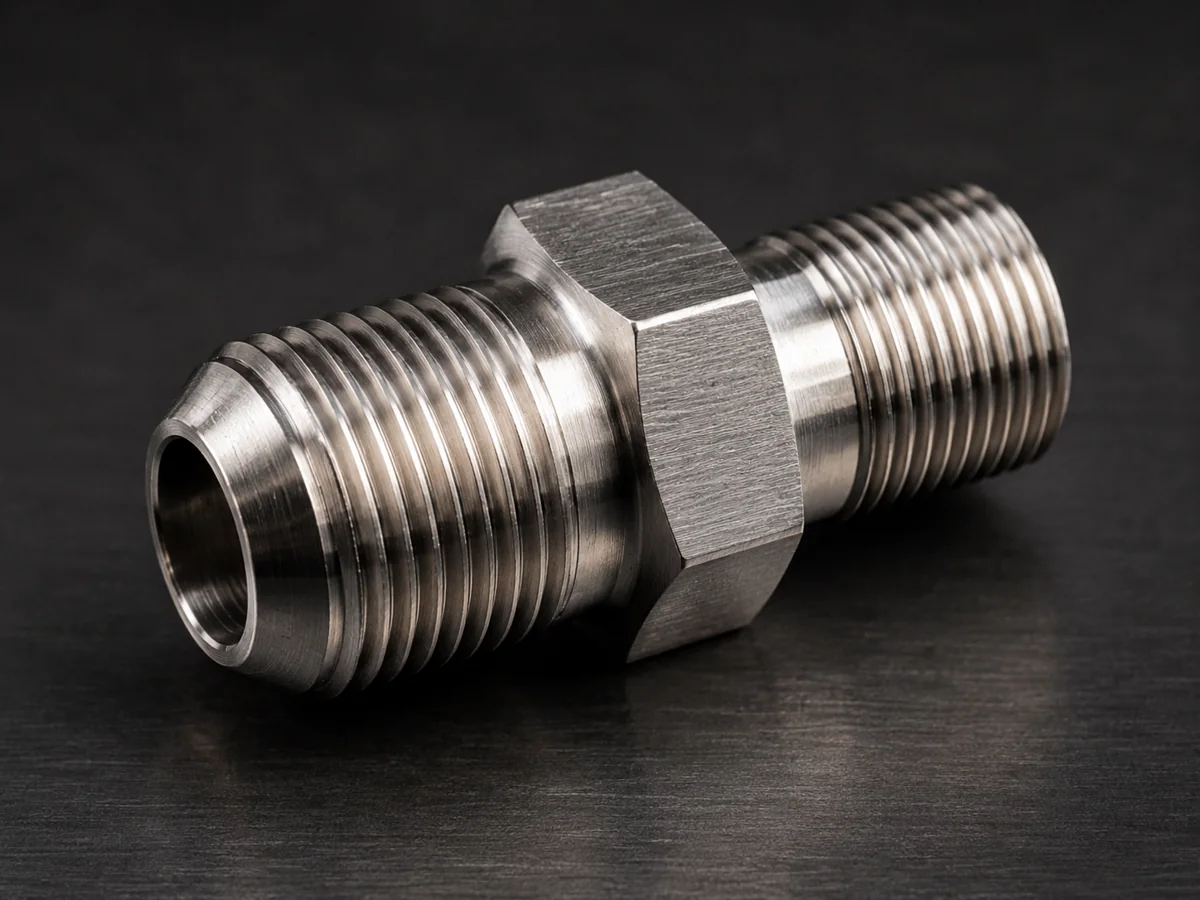
A Real Job: M30×3.5 ↔ M24×2, Two Forms
Two short adapters, both 60 mm long, M30×3.5 to M24×2, mechanical only (no sealing), with flats for a spanner — a job we were recently asked to quote, and a good example of what this page is for:
Adapter 1 — Male / Female
- End A: M30×3.5 internal (female)
- End B: M24×2 external (male)
- Material: steel or stainless
- Use: mechanical, no sealing
- Body: hex / wrench flats
- Length: 60 mm max overall
- Engagement: 20 mm each end
Adapter 2 — Double Male (stud)
- End A: M30×3.5 external (male)
- End B: M24×2 external (male)
- Material: steel or stainless
- Use: mechanical, no sealing
- Body: hex / wrench flats
- Length: 60 mm max overall
- Engagement: 20 mm each end
Same two threads, two different jobs — one converts a female port to a male stud, the other joins two female components as a stud. Both are single pieces. That's the kind of part we quote in 12 hours; send us your two ends the same way.
Two Forms We Machine
Male-female reducer
Internal thread one end, external the other — converts a female port to a different male thread.
Double-male stud
External thread on both ends — joins two female components, or extends a stud to a new size.
Female-female coupler
Internal both ends — joins two male studs or bolts of different metric sizes. Size pair table, M6 to M64.
Same-size, pitch change
Same nominal diameter but a different pitch each end (e.g. M30×3.5 to M30×1.5).
Extended / standoff
A longer body where you need reach between the two threaded features.
Common Metric Reducing Combinations We Machine
Need a bigger thread? For the M33–M52 range in coarse and fine pitch, see large metric thread adapters.
These are the size steps customers ask for most. The pitches below are the standard coarse forms — but the reason to have one machined rather than bought is the non-standard case: a mixed pitch, an unusual material, an oversized body or a length no stock reducer offers. Standard sizes are simply the starting point.
| Reducing adapter | Standard pitches | Made to order |
|---|---|---|
| M12 → M8 | M12×1.75 → M8×1.25 | The two-step thread reducer skipped by most catalogues — thin-wall, so we machine it with a hex or as a stud type |
| M12 → M10 | M12×1.75 → M10×1.5 | Fine pitches, longer body, stainless |
| M16 → M12 | M16×2 → M12×1.75 | Mixed pitch, hex flats, alloy steel |
| M20 → M16 | M20×2.5 → M16×2 | Fine-pitch ends, custom length |
| M24 → M20 | M24×3 → M20×2.5 | Mixed pitch, 316 stainless, standoff |
| M30 → M24 | M30×3.5 → M24×3 | Incl. mixed-pitch M30×3.5 → M24×2 |
Need a step that isn't listed, or a combination of two pitches that no catalogue stocks? That is exactly what we single-point to order — build your spec below or send the two thread designations and we quote it.
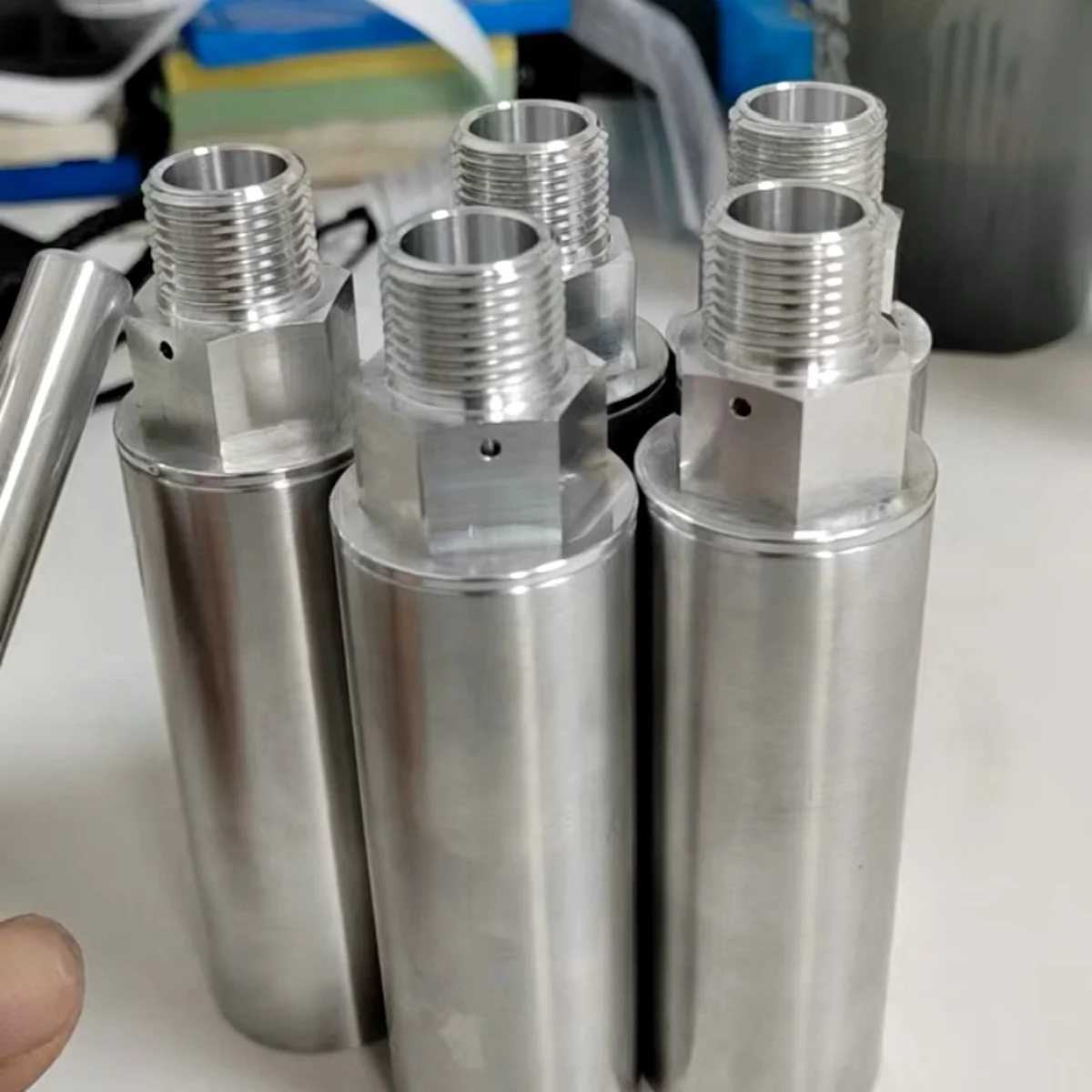
Why a Catalogue Reducer Won't Do It
The detail that defeats off-the-shelf parts is the pitch. Here's how we hold what matters on a mechanical metric adapter:
| What's tricky | How we handle it |
|---|---|
| Different pitch each end | Each thread is single-pointed to its own pitch — 3.5 mm coarse one side, 2 mm fine the other — on the same part |
| Different diameter each end | The body is turned so both major diameters are fully formed without running out of material |
| Hex / wrench flats | Milled across the body, sized to a standard spanner where the diameters allow, so the part can be torqued |
| Engagement & overall length | Effective thread length each end and total length held to your spec (e.g. 20 mm + 20 mm within 60 mm) |
| Fit class | 6g/6H by default; tighter or looser on request for a press, running or hand fit |
| Mechanical vs sealing | No seal feature for a plain mechanical joint; seal face or sealant allowance added only if you need it |
Build Your Adapter Spec — Instant RFQ
Configure your metric adapter below — pick the thread and pitch on each end, the form, body and lengths. It generates clean RFQ text you can copy, or send straight to our engineers — no account, no CAD file.
Metric Thread Adapter Configurator
Define each end's thread & pitch, gender and thread length, plus the body form. We reply with lead time and pricing within 12 hours.
Full thread on this end, runout excluded.
Full thread on this end, runout excluded.
Sets the steel, not just the label — see the grade table below.
Custom metric adapter…
Materials for Mechanical Adapters
Carbon & alloy steel
The default for load-bearing mechanical adapters and studs — C45 or 34Cr4 for class 8.8, 34CrMo4 or 42CrMo4 for 10.9 — strong, easy to torque, can be plated or blackened.
4140 machining →304 / 316 stainless
Where corrosion, washdown or outdoor service matters — 316 for marine and chemical environments.
316 machining →Free-cutting steel
For clean threads and crisp hex flats at a lower cost when high strength isn't required.
Discuss material →Tell us the property class and we cut the part from the steel that carries it. One caveat first: ISO 898-1 gives a class to a fastener made and tested to that standard, marking included — a machined adapter has no head to stamp, so it carries its bar instead. The minima below are the ISO 898-1 numbers; the steel column is what the part is actually turned from. The full bolt grade chart carries the hardness and elongation rows as well.
| Class you specify | Steel we turn it from | Rm min N/mm² | Rp0.2 min N/mm² |
|---|---|---|---|
| 8.8 | C45 (1045), 34Cr4 or 37Cr4 — quenched and tempered | 800 | 640 |
| 8.8, thread above M16 | Same steels, larger section | 830 | 660 |
| 10.9 | 34CrMo4 (4135) or 42CrMo4 (4140) — quenched and tempered | 1040 | 940 |
| 12.9 | 42CrMo4 (4140) or 34CrNiMo6 (4340) — quenched and tempered | 1220 | 1100 |
| A2-70 / A4-70 | 304 / 316 cold-drawn bar — corrosion first, strength second | 700 | 450 |
Two things we say before you order rather than after. At a stud end of M8 or M12 the section is small and 42CrMo4 reaches 10.9 without argument; cut the same steel at a large diameter and it lands a class lower — we tell you the class the part actually makes instead of printing the one that was asked for. And the paperwork: the EN 10204 3.1 mill certificate for the bar comes with series orders, not with a single piece or a sample. If the certificate is the point of the order, say so and we quote the batch that carries it. Marking the part to ISO 898-1 with the full test regime is separate work — ask and we price it.
No Drawing? We Reverse Engineer It
Send the part or the two mating items
An old adapter, or the two components it must join — even worn. Or just the two thread specs.
We measure & draw it
Both threads, pitches, flats and lengths captured; we rebuild the CAD for free. How it works →
Confirm, then machine
You approve the drawing, then we turn, mill the flats and inspect it. Copy from a sample →
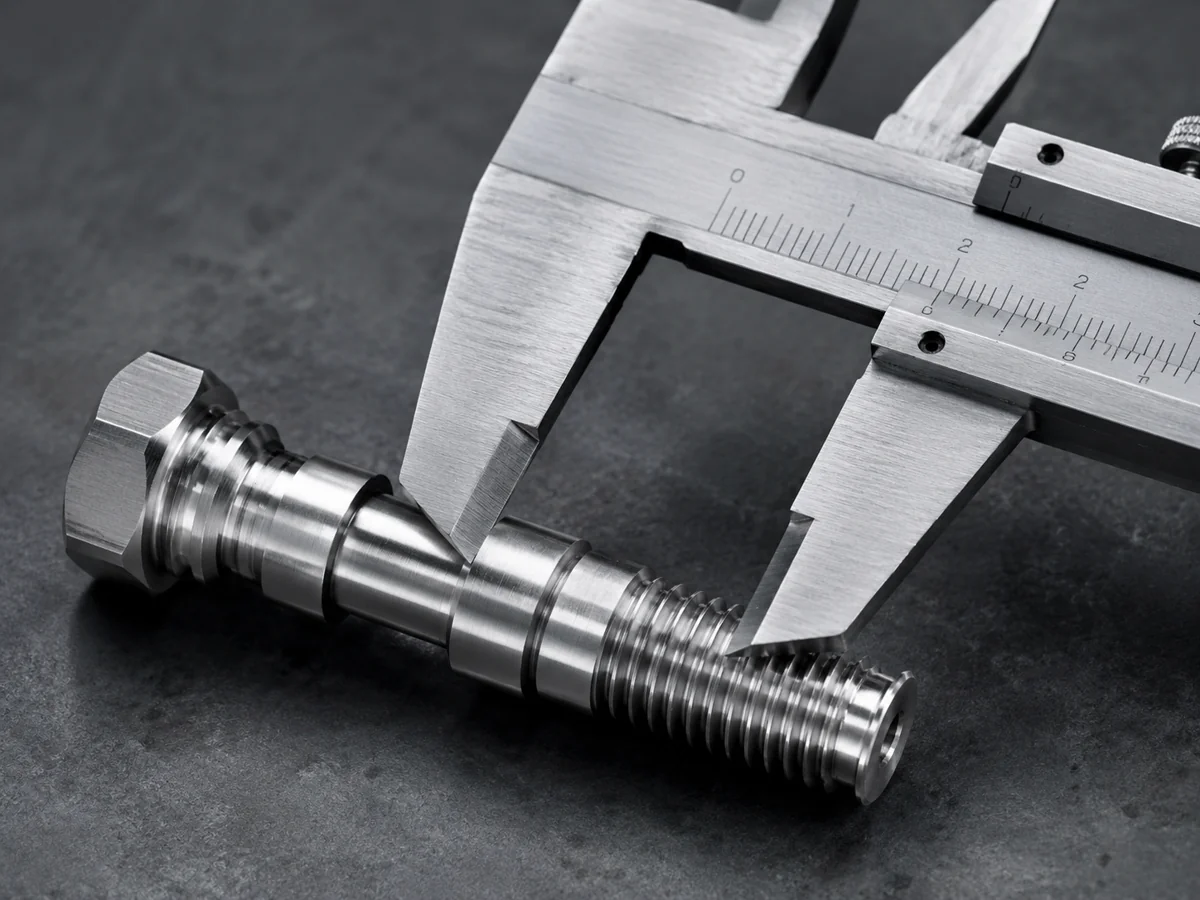
Real example — exactly this combination: a client in France sent a hand sketch for an M30×3.5 female to M24×2 male adapter in a 50 mm hex. We returned a 3D model the same day. See the drawing, the model and how it's machined → M30×3.5 → M24×2 adapter case study.
One family of metric reducers has its own page because the sizes and the sealing are different: cable gland and conduit entries. M12 to M63 all run a 1.5 mm pitch there, the body usually has to be shortened to clear a cast housing, and PG threads sit deceptively close to metric without mating. Sizes, the PG conversion chart and the reducer-versus-enlarger question are on the cable gland & conduit adapter page.
What to Send Us
- The thread & pitch on each end — e.g. M30×3.5 female to M24×2 male (or a sample of each side)
- Whether it's male-female, double-male stud, or female-female
- Mechanical only, or must it also seal (and if so, medium and pressure)
- Body: hex, wrench flats or round — and any spanner size you want to fit
- Overall length and effective thread engagement each end (e.g. 60 mm overall, 20 mm + 20 mm)
- Material preference, quantity (one is fine) and delivery country
No CAD, no problem. Give us the two threads and the lengths — rebuilding the drawing is our job, free, confirmed with you before anything is cut. See how to order with no CAD file.
A pitch outside ISO 261 is machined the same way: the M27×2 to M27×1.75 adapter we built, with pre-planned pairings to M24, M20, G3/4 and M36, is the worked example.
Where the Metric Reducer Catalogue Stops
M12×1.75 → M10×1.5 in plain steel is a stock item; a different pitch on each end, or a two-step reduction such as M12 → M8, is not. Coarse-to-coarse reducing bushes in the common sizes are stock items — the list below is what the stock range cannot do.
| What you need | In the catalogue? | How we machine it |
|---|---|---|
| M12×1.75 → M10×1.5, plain steel | Stocked | Standard coarse-to-coarse bush. Buy it off the shelf. |
| Different pitch on each end | No | Each thread is single-pointed to its own pitch on the same part — 3.5 mm coarse one side, 2 mm fine the other. |
| A two-step reduction such as M12 → M8 | No | Skipping two sizes leaves a thin wall, so it is machined with a hex or as a stud type rather than a plain bush. |
| Fit class tighter or looser than 6g/6H | No | 6g/6H is our default. State press, running or hand fit and we cut to it. |
| Effective thread length held on both ends | No | For example 20 mm plus 20 mm inside a 60 mm overall. Catalogue bushes have one length. |
| Hex flats sized to a spanner you already own | No | Milled across the body to your wrench rather than to a catalogue table. |
| Through-bore for a shaft, cable or fluid | No | Bore and both threads cut in one setup so they stay concentric. |
| Left-hand thread on either end | No | Not stocked at any metric size. |
| 316 stainless or alloy steel at small diameters | Rare | Small stock bushes are plated mild steel. Material is open here. |
Pitches above are the ones this page already lists for each size pair.
See also the fitting thread identification chart with the ISO 6149 / DIN 3852 metric port series, and compression fittings for the DIN 2353 tube-to-port pairings.
Frequently Asked Questions
Yes — that mixed-pitch, mixed-diameter combination is exactly what we machine. Catalogue reducers usually only step between standard sizes within one pitch family, so a part going from M30×3.5 to M24×2 normally isn't sold. We single-point each thread to its own diameter and pitch on one body, so both ends fit as specified.
Yes. We machine both forms from the same drawing — a male-female adapter (internal thread one end, external the other) and a double-male stud (external both ends). Tell us the gender of each end and we cut it that way.
Either way. For a purely mechanical connection — load transfer, mounting, extension — no sealing feature is needed and we control thread fit and concentricity. If the joint must seal, tell us the medium and pressure and we add the right seal face or sealant allowance.
Yes. We mill a hexagon or two wrench flats into the body so it can be held and tightened with a spanner — sized to a standard spanner where possible, or to whatever clearance your assembly allows.
A single piece is welcome. There's no tooling cost on a machined adapter, so prototypes and one-off mechanical parts are normal work. We also quote small and medium batches and keep your drawing on file so reorders are quick.
Get a Metric Adapter Quoted
FINAL PRICE BY QUOTE · VARIES WITH SIZE, MATERIAL & QUANTITY
The two threads and the lengths — that's all we need. Engineers reply in 12h.
// Qty & price
1 pc
Prototype price
No tooling cost
10–50
Unit price drops
Setup cost shared
100+
Best price
All tiers quoted upfront
- →No distributor — you pay the maker directly
- →CAD saved after first order — reorder anytime at lower unit price