Male-female, double-male or female-female — the right adapter is decided by the gender of the two parts you're joining, not the thread sizes. Use the quick table, then get yours machined to your exact two threads — from a sketch, no CAD, one piece up. Describe your two ends →
Pick by what your two parts are
| Your two parts | Adapter to order | Also called |
|---|---|---|
| One male, one female | Male-female adapter | Reducer / converter / extension |
| Two females (tapped holes / ports) | Double-male adapter | Stud / male-to-male / nipple |
| Two males (studs / bolts) | Female-female adapter | Coupling / coupler / union |
Whichever form you choose, when the two ends differ in size or pitch the same piece also reduces between them — for example M30×3.5 on one end and M24×2 on the other.
The three forms
Male-Female Adapter
Threaded externally on one end, internally (tapped) on the other. It extends or converts a single threaded line — screw the male end into a tapped hole, and the female end accepts a different bolt or fitting. The most common form.
→ Real example: M30×3.5 female → M24×2 male, from a sketchDouble-Male Adapter (Stud)
Threaded externally on both ends, with a hex to drive it. It joins two female parts back-to-back, or turns a tapped hole into a projecting stud to hang or mount from. When the two ends differ it's a reducing stud.
→ Real example: M30×3.5 ↔ M24×2 double-male stud, 304 stainlessFemale-Female Adapter (Coupling)
Threaded internally on both ends. It joins two male threads or studs, or reduces between two internal sizes — a reducing coupling. Often a hex or knurled body so it can be tightened by hand or wrench.
→ Configure a custom coupling by your two threadsOther things you can specify
Beyond the form, a custom adapter is defined by a few choices we confirm on a drawing before machining:
| Option | Choices | Notes |
|---|---|---|
| Drive feature | Hex (across flats), wrench flats, knurl, round | Sized to a standard spanner where possible |
| Material | Steel, 304/316 stainless, brass | By load and environment |
| Bore | Solid, or through-bore | Through-bore to pass a shaft, cable or fluid |
| Thread hand | Right-hand (default) or left-hand | Left-hand on either end if needed |
| Sealing | Mechanical only, or sealing face | Tell us medium and pressure if it must seal |
Not sure which form? Tell us what each end screws into — a tapped hole, a stud, an existing fitting — and we'll recommend the right adapter and draw it for you. See how to connect two mismatched threads →
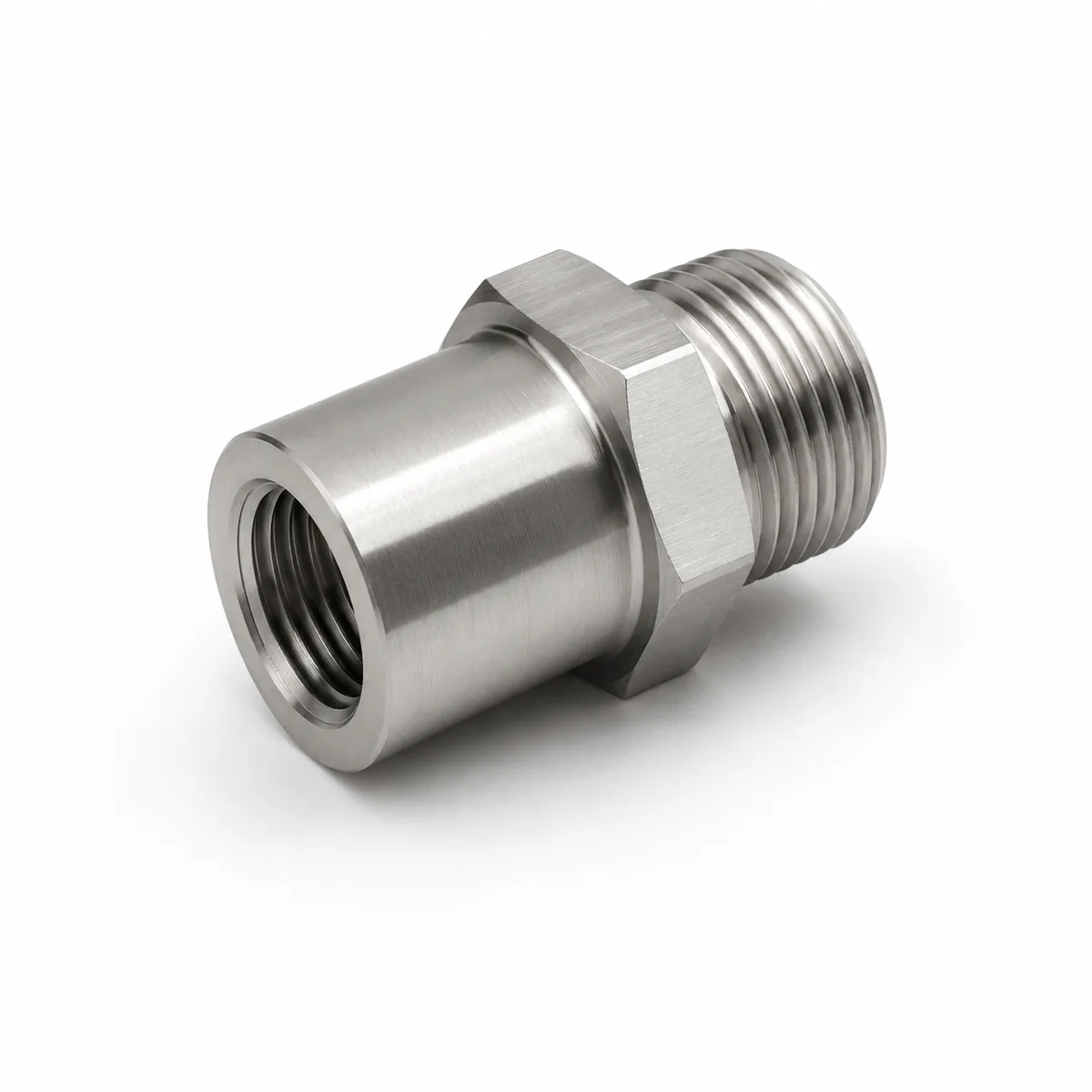
Where the Catalogue Stops for Each Form
Male-female reducers in common metric sizes are stocked. Double-male studs and female-female couplings thin out fast, and everything below is made to order.
| What you need | In the catalogue? | How we machine it |
|---|---|---|
| Male-female reducer, common metric pair, plain steel | Stocked | Buy it off the shelf. |
| Double-male stud joining two tapped holes | Thin | Male on both ends is a stud, not a bush. Far fewer sizes are stocked and almost none in mixed pitch. |
| Female-female coupling joining two studs | Thin | Same reason. Any size pair, either pitch. |
| Through-bore to pass a shaft, cable or fluid | No | A solid bush cannot be bored afterwards. We bore it as part of the turning. |
| Left-hand thread on one or both ends | No | Not a catalogue item in any form. |
| Knurl instead of a hex, for hand tightening | No | Knurl form and depth to suit finger grip rather than a wrench. |
| A sealing face added to a mechanical adapter | No | Tell us the medium and pressure and we add the seat or O-ring groove. |
The three forms and the options above are the ones already listed on this page.
All three forms can carry a hexagon body — hex nipple, hex bushing, hex coupler. The across-flats table and the naming traps live on custom hex thread adapters.
See also the fitting types chart, threaded elbows and threaded tees for the forms with a corner or a third port.
Frequently asked
What's the difference between a male-female and a double-male adapter?
A male-female adapter is external on one end and internal on the other — it extends or converts a single line. A double-male (stud) is external on both ends, so it joins two female parts or makes a tapped hole into a stud. Choose by the gender of your two parts.
What is a female-female adapter called?
A coupling or coupler — internally threaded both ends, joining two male threads. When the two internal threads differ it's a reducing coupling.
Can a custom adapter have a hex for a spanner?
Yes — a hexagon or two wrench flats, sized to a standard spanner where the diameters allow, so it can be held and torqued.
Ready to order? Send a sketch or the two thread sizes and the gender of each end. We'll confirm the form, draw it free, and quote — usually within 12 hours. Get a quote → or browse custom metric thread adapters.