Why Obsolete Parts Are the Hardest — and Why We Do It
When a part goes obsolete, every failure becomes a crisis. There is no part on a shelf, no OEM to call, no cross-reference to a current equivalent. The machine sits idle and the cost accumulates by the hour. Customers come to us specifically because the normal supply chain has no answer.
We reproduce obsolete parts regularly. The process is direct: measure what survives, reconstruct what doesn't, confirm the geometry with you, manufacture, and ship.
Two boundaries, stated up front. What you receive is the part, not a CAD file or a scan: the drawing we rebuild is a step on the way to the machined replacement and is sent to you for approval, but modelling by the hour is not a service here. And the parts are mechanical — bearing housings and seats, shafts, glands, gears, bushings, fasteners — not obsolete PLCs, drives or boards, which belong with an obsolescence distributor. For UK plants: 5 working days for one to a few dozen pieces, 15 working days for 50–500, then 5–7 working days by DHL, DDP with GBP invoicing on request.
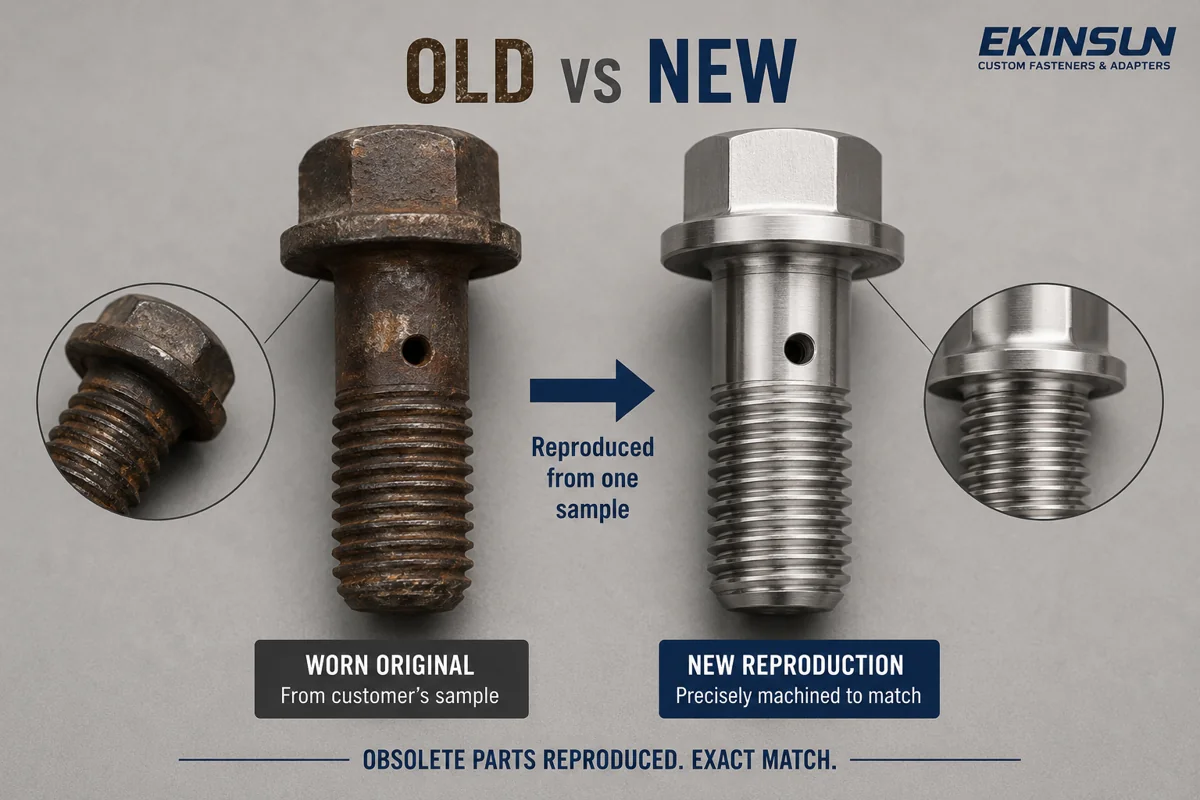
When No Original Part Survives
The most difficult scenario is when there is nothing left to measure — the part failed and was discarded, or was never retained. We work through this systematically:
- Mating parts — the bore it sat in, the shaft it drove, the housing it sealed against. From these we derive the missing dimensions.
- Exploded diagrams and spare-parts manuals — older equipment often has parts books with proportional diagrams. We use these scaled to known reference dimensions.
- Similar models — the same machine in a later variant may have updated but compatible parts. We use these as a baseline and adjust.
- Failed fragments — even heavily broken parts carry geometry: cross-sectional profiles, bore positions, wall thickness, thread starts.
Should You Upgrade When Reproducing?
| Original failure mode | Upgrade option | Result |
|---|---|---|
| Worn bearing surface | Case harden or hard chrome the journal | Longer service life at same geometry |
| Cracked at a stress point | Increase fillet radius, switch to ductile iron or alloy steel | Eliminates the original failure mode |
| Corroded in service | Upgrade to 316 stainless or bronze | Resists environment that destroyed the original |
| Plastic worn or broken | Machine in bronze or acetal (Delrin) | Longer wear life |
| Exact OEM replica needed | No change — reproduce exactly | Drop-in replacement, fully interchangeable |
Restorers of vintage cars and machinery face this choice on almost every part — our classic car restoration parts page walks the reproduce-or-upgrade call for that world specifically, and what changes when you copy a part, and what must not covers the general rule, including the cases where the original material has to stay.
Make spares while you're at it. Once we have the CAD for a previously obsolete part, making 2–3 spares from the same setup costs a fraction of the first piece. It means the next failure doesn't put you back to square one. We recommend it for every obsolete part job — how the price moves with quantity.
Process
Tell us the situation
What failed, what equipment it came from, what you still have — part, photos, mating assembly, manual pages. We assess the best reconstruction route.
We gather all evidence
Measurement of the sample or mating parts, photograph analysis, manual interpretation. All sources are used and cross-checked.
Reconstruct — noting all assumptions
CAD model built. Every dimension derived from inference (not direct measurement) is flagged in the drawing for your review. Nothing is hidden.
You confirm
Review the drawing. Correct any inferences you recognise from knowledge of the machine. Specify upgrades if desired. We revise and confirm before cutting.
Manufacture, inspect, ship
Part made, inspected to the approved drawing, shipped with inspection report and CAD file. Spares from the same run at marginal cost.
Obsolete Parts We Have Reproduced
Parts that no OEM or aftermarket supplier could provide — reproduced from worn samples, fragments, mating parts or period diagrams:
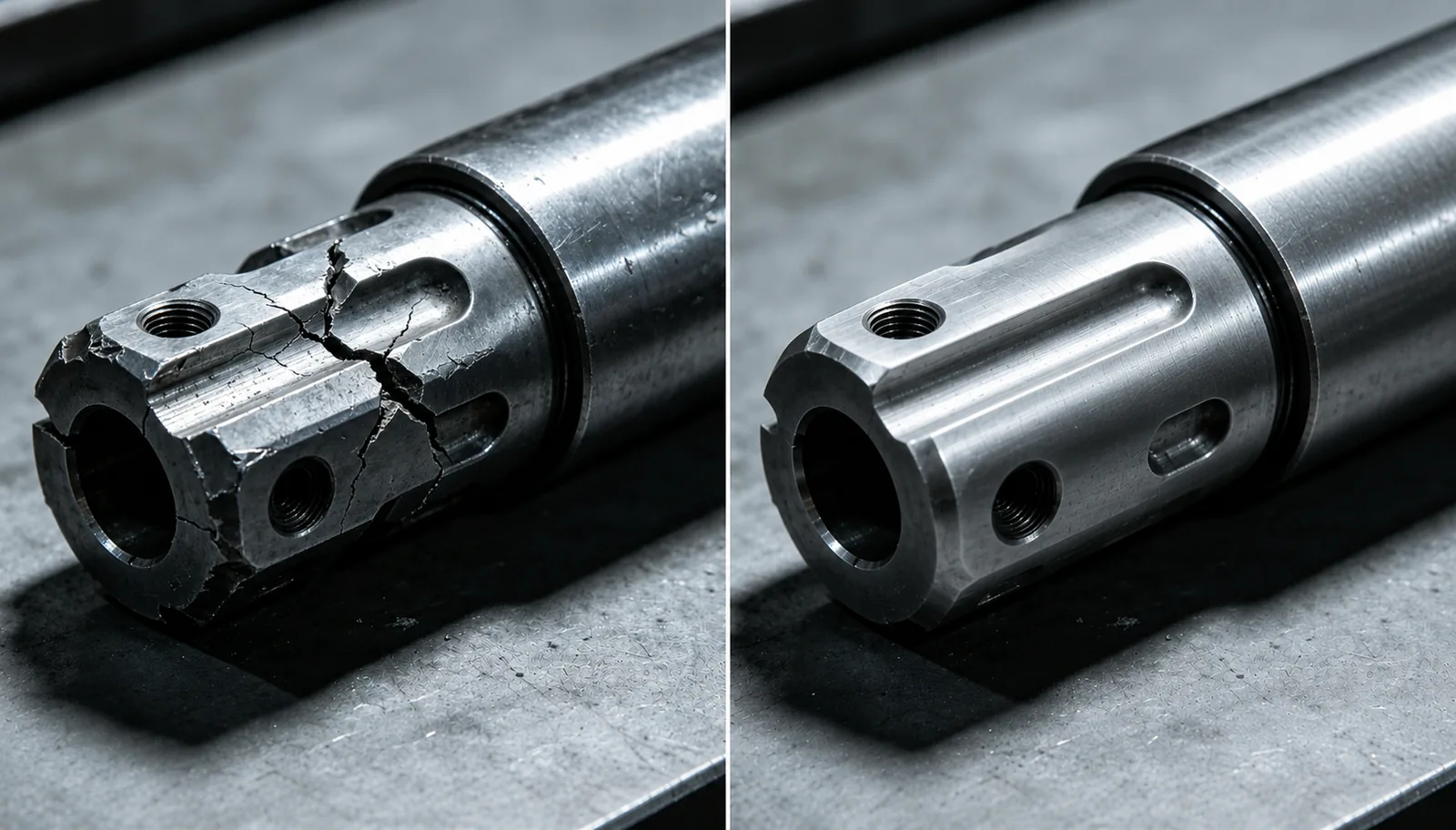
Obsolete Bearings: What We Reproduce — and What We Don't
Reverse engineering a bearing from a worn part is among the most common obsolete-part requests we receive, so here is the honest breakdown of how obsolete bearing reverse engineering works in practice. Rolling-element bearings (ball and roller cartridges) are almost never worth remaking — a modern standard bearing is metallurgically better and cheaper. What goes obsolete is everything around the rolling elements, and that is exactly what we reverse engineer from the worn part — the full breakdown, including how to identify an obsolete bearing from its surviving dimensions and when a repair sleeve beats a new bearing, is on our dedicated bearing reverse engineering page:
- Plain bearings, bushings and journal bearings — bronze, sintered or polymer-lined, measured from the worn original with wear compensated back to the design fit
- Bearing housings, carriers and pillow-block bodies — discontinued castings reproduced as machined billet parts
- Adapter sleeves and conversion bushings — so a current standard bearing fits the seat of an obsolete one, often the fastest and cheapest fix
- Wear rings, thrust washers and seal carriers — recovered from fragments or the mating surfaces when the original is gone
If your bearing failure sits inside a pump, see our pump parts reverse engineering; for gearbox and spindle applications, see machine parts. Where the obsolete part is a fitting or a two-piece connector that has to hold pressure, the sealing land has to be measured off the sample rather than guessed — see custom sealed metal parts.
The same obsolete logic applies one level down: when the unobtainable item is not the housing or shaft but the special bolt, stud or vintage-thread fastener holding it, we gauge and remake that too — BSW, BSF, BA and odd metric pitches included.
The Two Rules of Measuring a Worn Part
Rule one: a worn surface is never measured for its dimension — it is measured to prove it is worn. A bearing journal that mikes at 24.87 mm was never a 24.87 journal. It was a Ø25 seat that has lost 0.13 mm to the inner ring. Copy the 24.87 and the new part arrives pre-worn, with the same loose ring the old one died of. The dimension comes from the unworn evidence — the shoulder the ring seated against, the same journal at the other end of the shaft, or the catalogue nominal.
Rule two: on anything that carried a standard component, the component’s number is the specification. A shaft that carried a 6205 bearing has a Ø25 seat by definition, because 6205 has a 25.000 mm bore — and the seat tolerance follows from the fit, not from the tape measure: k6 on Ø25 is +0.002 to +0.015 mm. Bearing numbers, seal numbers and circlip grooves survive on parts long after every drawing is gone; they are the densest measurement data on the part.
Choosing Fits When No Drawing Exists
The original drawing carried tolerances; the worn part does not. They are reconstructed from function, and the defaults below cover most of what passes through this work. The numbers are the ISO 286 values at Ø25 so the scale is visible — the full ranges are on our limits and fits tables.
| The surface’s job | Default fit | At Ø25 that means |
|---|---|---|
| Rolling-bearing seat on the shaft (inner ring rotates) | k6 | +0.002 / +0.015 mm |
| Bearing housing bore (outer ring stationary) | H7 | +0.021 / 0 |
| Shaft sliding in a plain bush | g6 in H7 | shaft −0.007 / −0.020 — 7 to 41 µm running clearance |
| Pressed-in bush or ring | p6 in H7 | bush +0.022 / +0.035 — 1 to 35 µm interference |
| Location spigot, hand assembly | h6 in H7 | 0 / −0.013 |
| Keyway width | DIN 6885 P9 for a one-off | keeps the new key from rocking in a fresh slot |
Where the mating part still exists and is itself worn, the fit is cut to the real bore, not the nominal — that is the one case where measuring the worn part is the right answer, and it is the mating part being measured, not the dead one.
Identifying the Material When There Is No Certificate
Stated: we do not run laboratory spectroscopy on every sample, and for a replacement part that level of certainty is rarely what the job needs. What settles the material in practice: a magnet separates austenitic stainless (1.4301/304, 1.4404/316L — non-magnetic) from hardened or plain steel in one second; a file test separates a soft C45 shaft (a file bites) from a case-hardened or through-hardened one (a file skates above roughly 58 HRC); where it lived tells the rest — salt spray argues 1.4404, a gearbox interior argues 42CrMo4 or case-hardened steel, a bush that outlived its shaft argues bronze. The replacement is then quoted in a named grade with its condition stated — 42CrMo4 quenched and tempered, C45 normalised, CuSn12 — so you are approving a material, not a guess. When the duty demands the original alloy confirmed, we say that a lab analysis is the missing step rather than pretending the file told us.
What Still Exists in a Catalogue — and What Is Truly Gone
| Component | In the catalogue? | What happens then |
|---|---|---|
| The rolling bearing itself (6205, 30205…) | Yes — always | Buy it. A modern standard bearing is metallurgically better than anything remade |
| Seals, O-rings, circlips | Yes, by dimension | Buy them; we quote the metal parts around them |
| The shaft the bearing sat on | No | Machined — seats to k6, sealing surfaces reground, keyways to DIN 6885 |
| The housing or cartridge around it | No | Machined — bore to H7, spigots re-established from the unworn faces |
| Adapter sleeves, withdrawal nuts, lock plates for dead series | Mostly gone | Machined from the bearing maker’s published dimensions |
| Imperial-bore parts on pre-metric machines | Gone | Machined; the imperial dimension is kept, not converted, so the next standard part still fits |
Plates from discontinued machines are remade from the old plate or from its mating holes; see custom machined plates.
An obsolete part with a circlip groove is checked against the circlip groove size chart first: a groove that matches no DIN 471 or DIN 472 row was cut for an inch ring or a ring made by the machine builder.
Frequently Asked Questions
Yes. We reproduce the part from your sample, from mating components, from old manual diagrams, or from whatever remains. We do not need the original manufacturer's cooperation, drawings or tooling.
We work from the components the part interfaces with — the bore it sat in, the shaft it drove, the housing it sealed. Dimensions are derived indirectly and confirmed against the assembly before we manufacture. This works for a surprising proportion of lost originals.
Often worth considering. If the original failed in a predictable way — wear on a specific surface, corrosion in a particular area, cracking at a stress concentration — we can address it in the reproduction. Switching from cast iron to ductile iron, plastic to bronze, or adding a hard-chrome surface are common upgrades at negligible extra cost. The swap runs the other way just as often: a bronze bush replaced by cast nylon to lose the grease line, or a steel wear part replaced by PE-UHMW, which outlasts the steel it replaced on a sliding face.
One piece. There is no minimum order on machined parts. We recommend making 2–3 spares from the same setup so the next failure doesn't put you back to square one, but one is a valid order.
Yes — obsolete bearing reverse engineering covers the parts around the rolling elements. We reverse engineer a bearing housing, plain or journal bearing, adapter sleeve, wear ring or seal carrier from the worn part, measuring the original and compensating wear back to the design fit. Modern rolling-element cartridges themselves we'd fit as standard rather than remake, and we tell you which path is cheaper for your case.
Obsolete Part — Get a Quote
Describe the situation. Engineers reply in 12h.
// Qty & price
1 pc
Sample price
Confirm fit before a run
10–50
Unit price drops
Setup cost shared
100+
Best price
All tiers quoted upfront
- →No distributor — you pay the maker directly
- →CAD saved after first order — reorder anytime at lower unit price
REVERSE ENGINEERING