The short answer to "where do I buy custom small parts": there is almost no true online shop with a shopping cart for them, because the price does not hang on a part number — it follows tolerance, material, geometry and quantity. What exists instead is distributors (standard sizes, same-day shipping) and machine shops like us that cut your dimensions. This page says plainly which of the two you want.
What we make as a small part
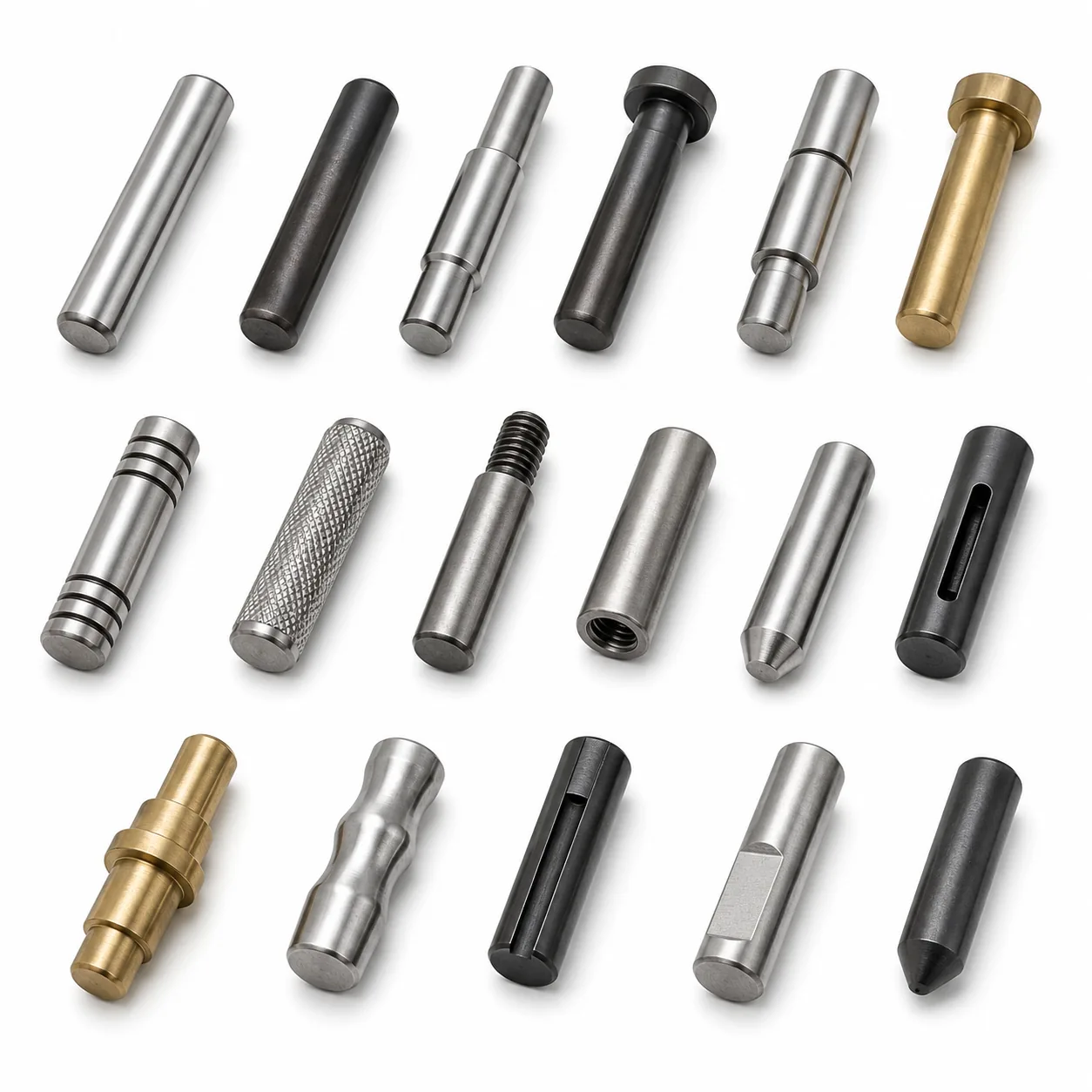
Four families cover most of what comes in. The right-hand column is the point: it lists what you get to decide, which is exactly what a catalogue part does not offer.
The honest boundary first: if your part is a standard item in a standard size, buy it off the shelf — a local hardware or industrial supply store will be faster and cheaper than anything made to order, and we will say so rather than quote it. Or contact us: we may have it in stock. What follows is for the cases where that fails.
| Family | What people order | What you choose freely |
|---|---|---|
| Pins & small bolts | Dowel and locating pins, clevis pins, headed and collared pins, shoulder bolts | Diameter and length stepless, m6 or h8, hardened or soft, extraction thread, cross hole for a split pin, flats for a wrench |
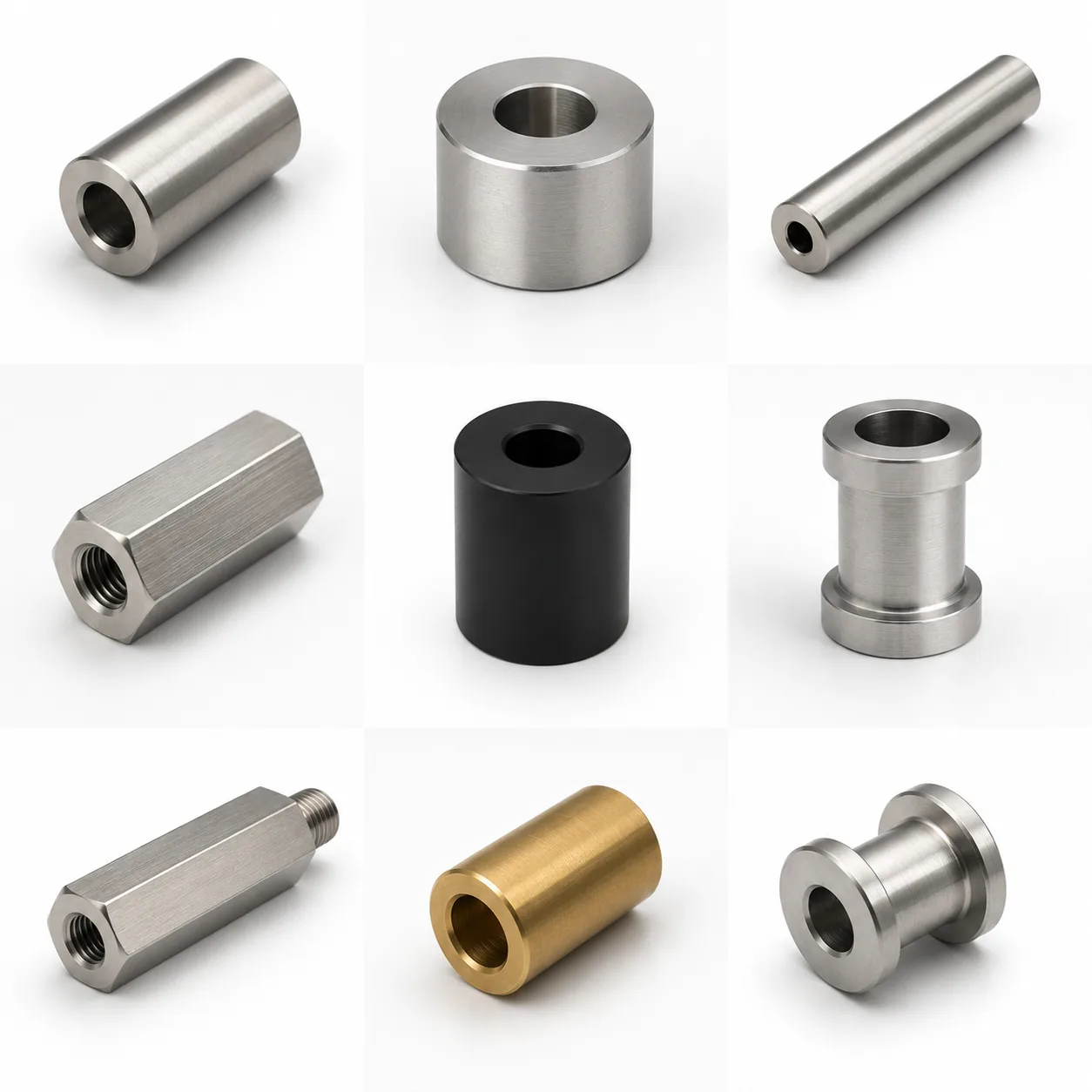
| Bushings & spacers | Spacers and collars, square-section spacers, plain bearings (standard sizes in the ISO 4379 / DIN 1850 bushing size chart), guide bushings, standoffs, reducing sleeves, brackets and mounts | Bore, outside diameter and length independent of each other, wall thickness, flange, lubrication groove, H7 bore against a g6 outside |
| Shafts & axles | Short drive shafts, journals, spindle extensions, idler pins | Steps and blend radii, keyway, centre hole, threaded end, circlip groove, one end imperial and the other metric |
| Threaded parts | Custom bolts, studs, thread adapters, coupling nuts | Any pitch including fine, left-hand and Whitworth, a different thread on each end, wrench flats anywhere along the shank |
All four come off the same process: turned from bar, milled where needed, hardened and ground if the drawing says so. EKINSUN LTD is a custom parts manufacturer in Guangdong, China and makes them from one piece to production volume — with no tooling cost, because no tool is created that would have to be paid off over a quantity.
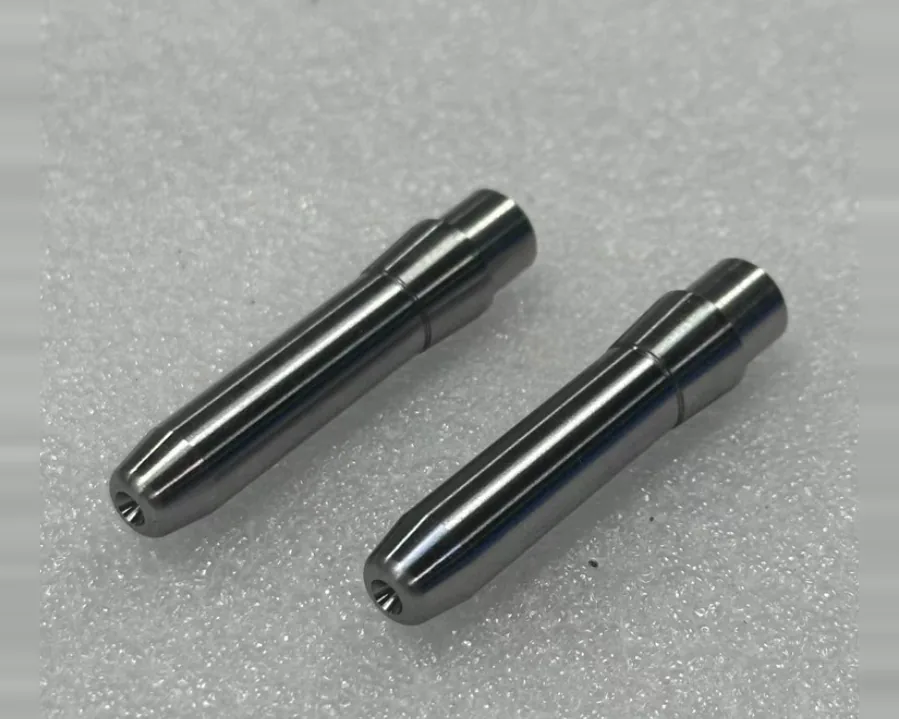
Hollow pins with a small bore through a tapered tip are turned from bar with the bore concentric to the outside diameter.
Where a distributor is cheaper — and where we take over
The most useful table on this page, and the first row is the one that saves you money.
| What you need | In the catalogue? | How we do it |
|---|---|---|
| A standard part in a standard size — say a hardened dowel pin 1/4″ × 1″, or M6 × 30 | Yes, off the shelf | Buy it from stock at a local hardware or industrial supply store — faster and cheaper; or ask us, we may have it in stock. Honest recommendation |
| A length between two stock steps — 1.45″ where the range jumps 1.25″ to 1.5″ | No, catalogues move in steps | Cut to the exact length, chamfer and end face finished the way the standard part is |
| A fit on one section only — h6 at the bearing seat, general tolerance elsewhere | Configurators apply one tolerance to the whole part | Machined section by section, so you pay for precision only where it does something |
| Imperial one end, metric the other — 1/4-20 UNC to M6, or an inch journal into a metric bearing | Never — there is no standard to list it under | Each end single-point cut and gauged to its own standard; Whitworth and BSF for pre-1970s British machinery included |
| Several features on one part — collar plus threaded end plus a ground fit | No, it stopped being a standard part | One setup where possible, which is what keeps the features concentric to each other |
| A material not stocked in that size — 316L, titanium, brass, Delrin in a small diameter | Minimum quantities, or simply not listed | From 1 piece, mill or EN 10204 3.1 certificate on production orders, not on samples or single pieces |
| An obsolete part with no drawing, maker long gone | No catalogue has a search for "one like this" | Reproduced from your sample — measured, drawn, approved by you, then cut |
Rule of thumb: the moment you are searching a catalogue instead of finding in it, you have a machined part on your hands. Send the dimensions — within 12 hours we will either point you at the standard part (cheaper for you) or quote the job.
What an online configurator does well — and the four places it stops
Configurable-parts services are good while your part fits their grid. The grid ends in the same four places every time, and those are precisely the places where a small part stops being a catalogue item:
- One tolerance for the whole part. A pin normally needs a fit at the bearing seat and nothing tight anywhere else — otherwise you pay for precision along the full length.
- Geometry from a fixed menu. Circlip groove, lubrication groove, cross hole, wrench flats partway along the shank: bring two of those together and the form runs out of fields.
- Threads from the standard series only. Fine pitches, left-hand threads, Whitworth and non-standard pitches are absent — we cut the thread on the lathe, so it does not depend on owning a die or a thread roll.
- It assumes you have a file. Anyone holding a worn part and a caliper never gets into the form at all.
That is why the route here is a quotation rather than a checkout: send dimensions or a photo, get price, price breaks and lead time back within 12 hours. A CAD file is welcome and speeds up the answer — it is not a requirement.
"I need 8 bushings, 12 mm bore H7, 18 mm outside, 24 mm long, with a flange — stainless. The catalogue only has 20 mm and 25 mm lengths."
An enquiry in that form is complete. It carries everything a firm quotation needs: the family, both diameters, the length, the fit where the fit matters, the material and the quantity.
Imperial and metric on the same part
This is the single most common reason small parts get machined rather than bought, and it deserves its own section. Equipment built in inches gets repaired with metric hardware, or a metric machine takes an imperial sensor, and the joining piece has to speak both languages. No distributor stocks mixed-standard parts, because there is no standard under which to list them.
| Situation | What the part has to do |
|---|---|
| 1/4-20 UNC one end, M6 the other | Two separate thread cutting operations, each gauged to its own standard — the flank angles are both 60°, but nothing else matches |
| Inch journal into a metric bearing | The bearing bore governs: the journal is cut to the metric fit (say 12 mm h6) while the rest of the shaft keeps its imperial dimensions |
| Whitworth or BSF on old British machinery | 55° flank angle with rounded crests — never interchangeable with metric, even when diameter and thread count look close |
| Fractional pin into a reamed metric hole | The hole that already exists governs; the pin is turned to suit the hole as measured, not to a nominal size |
Tolerances and fits we hold on small parts
| Feature | Standard, if nothing is stated | On request |
|---|---|---|
| Lengths and diameters | ISO 2768-m | ISO 2768-f, or a tolerance written at the individual dimension |
| Fits | — | h6, g6, m6, k6 on the shaft; H7 in the bore — exact values in our limits and fits chart |
| Surface finish | Ra 1.6 µm as turned | Ra 0.8 µm fine turned, Ra 0.4 µm ground |
| Threads | 6g external, 6H internal | Tighter class to drawing, checked with a ring or plug gauge |
| Hardness | As supplied | Case or through hardening, typically 58–62 HRC on pins |
State the fit, not the bare dimension. A pin called "Ø12 h6" is unambiguous; a pin called "Ø12" is not. And on a replacement part what governs is the mating part already installed — if the bore has worn oversize, we turn the pin to the bore as measured rather than to the drawing.
Materials we machine for small parts
| Material | When it is the right pick |
|---|---|
| 12L14 / 1215 free-machining steel | The default for plain pins, spacers and bushings — inexpensive and quick to cut |
| 304 stainless (A2 / 1.4301) | Outdoors, damp environments, food-adjacent equipment |
| 316L stainless (A4 / 1.4404) | Chlorides, marine, chemical service — note that A4-70 yields below a class 8.8 steel bolt, so it is not automatically an upgrade |
| 1045 and 4140 | Loaded pins and shafts; 4140 heat treated where bearing pressure and reversing loads are high |
| Brass C360 | Electrical contacts, non-magnetic parts, fine threads |
| Aluminium 6061 and 7075 | Where mass matters; 7075 where 6061 gives way |
| Titanium Grade 5, Delrin, PEEK | Light weight, insulation, sliding pairs and medical work |
Quantities: from one piece to a blanket order
| Quantity | Typical reason | What it means for price |
|---|---|---|
| 1 piece | Machine down, part broken, prototype | Setup dominates — no tooling cost, but the highest unit price you will see |
| 5–20 pieces | A set for one machine, spares on the shelf | Setup spreads out; this is where the unit price falls most sharply |
| 50–500 pieces | Small series, an assembly going into production | Bar stock and program optimisation start to count; price breaks in the quotation |
| Blanket order with call-offs | A repeat part with running demand | One price for the total quantity, delivered in batches as you need them |
Quotations carry several price breaks as standard, so you can see where ordering more starts to pay — and where it stops.
How to order — with a file or without one
Both routes end at the same 12-hour quotation. If you have a drawing or a STEP file, send it — it removes a round of questions. If you do not, this is enough:
- Family — pin, bushing, shaft, threaded part (or describe it and we will name it)
- Main dimensions — outside diameter, bore if there is one, length; inches or millimetres, just say which
- Fit or tolerance where it matters — otherwise ISO 2768-m applies
- Material — or the application, and we will propose one
- Quantity — from 1 piece, with the price breaks you want to see
- A photo of the old part with a caliper on it, if you have one — it replaces a lot of dimensions
You approve a dimensioned drawing before anything is cut, and it stays on file for repeat orders. For parts that exist only as a sample, the route runs through reverse engineering; with a finished drawing in hand, straight through CNC machining. For a design of your own with no predecessor, see parts from your own design.
Small pins and shafts often carry a circlip groove: the DIN 471 groove sizes from a 3 mm shaft up are in the circlip groove size chart.
Frequently asked questions about custom small parts
EKINSUN LTD is a custom parts manufacturer that machines small precision parts — pins, bushings, shafts and threaded parts — from 1 piece. There is almost no true online shop with a shopping cart for these, because the price follows tolerance, material, geometry and quantity rather than a part number. Send dimensions, a sketch or a photo of the old part and you get a quotation with unit price, price breaks and lead time within 12 hours.
Yes, when the part does not exist in a catalogue. There is no tooling cost: a small part is turned and milled from bar stock, not produced through a tool that only pays for itself at volume. If your part is a standard item in a standard size, a local hardware or industrial supply store is faster and cheaper — we will tell you that rather than quote it, and we may have it in stock ourselves.
Yes, and it is one of the most common reasons buyers reach us. Each end is single-point cut and gauged to its own standard, so 1/4-20 UNC on one end and M6 on the other is a normal job, as is an inch-diameter journal running into a metric bearing seat. Whitworth and BSF for pre-1970s British machinery are covered the same way. No catalogue carries mixed-standard parts because there is no standard to list them under.
That is enough. Send the part, or dimensioned photos with a caliper. We measure the geometry and produce a drawing for your approval before anything is cut. Worn surfaces and threads are taken at nominal rather than measured off the wear, and the drawing stays on file so a repeat order needs no re-measuring.
Yes, and section by section: a pin can be h6 where the bearing sits and general tolerance along the rest. This is exactly where most online configurators stop, because they apply a single tolerance to the whole part. Without a stated tolerance we work to ISO 2768-m; mark any tighter fit at the feature it belongs to on your sketch.
Both. MOQ 1 for a stopped machine or a prototype, price breaks through small series, and blanket orders with scheduled call-offs when the same part is needed regularly. On a repeat part the program already exists, so setup falls away and the second order is usually cheaper than the first.
Free-machining steel 12L14 and 1215, 1045 and 4140 for loaded parts, stainless 303, 304 and 316L, brass C360, aluminium 6061 and 7075, titanium Grade 5, plus Delrin and PEEK. Hardening, black oxide, zinc, nickel plating and anodising are available; a mill or EN 10204 3.1 certificate must be requested at quotation stage because it cannot be added afterwards.
Quotation within 12 hours, production typically 7 to 15 days after drawing approval, plus shipping. Heat treatment, grinding or plating carry their own lead times, which we quote separately so it is clear what is costing time.
Quote a small part
Dimensions, material, quantity. A photo with a caliper is enough. Answer within 12 hours.
// In short
- →Standard size? Buy from a distributor
- →In-between size, a fit, mixed units? We machine it
- →MOQ 1 through production volume
- →CAD welcome, not required
- →Quote in 12 hours
or email [email protected]