Need a bracket that does not exist in any catalogue — odd angle, thick section, holes that have to land on a mating part, or just four of them? Angle brackets, gusseted brackets, mounting plates, motor and sensor mounts, in stainless, aluminium or steel. MOQ 1, no tooling cost, quote in 12 hours.
Two ways to make a bracket — and most suppliers own only one
Search for a custom bracket manufacturer and nearly every result is a sheet metal shop. That is not a coincidence and it is not wrong: for most brackets in most quantities, laser cutting a flat blank and folding it on a press brake genuinely is the right answer. It is also the only answer those shops can give, because a press brake is what they own.
The machine shops have the mirror-image problem. Ask them and the bracket gets milled from solid, whatever the quantity, because that is what their spindles do.
We work through qualified manufacturing partners on both sides — CNC machining and sheet metal fabrication — so the recommendation costs us nothing either way. Below is the honest version of how the decision actually goes.
Machined from solid, or laser cut and folded?
Quantity decides it more often than geometry does, and the crossover is not where most people guess.
| Question | Machined from solid | Laser cut & folded |
|---|---|---|
| Quantity 1 to 250 | Usually the winner — no bend sample, no brake setup, so one piece is genuinely economic | Setup and a first-article bend have to be paid for before the first good part exists |
| Quantity 250 to 500 | Still competitive; depends on how much metal has to come off | Starts pulling ahead |
| Quantity 1,000+ | Rarely justified unless the geometry forces it | Almost always cheaper per part, geometry permitting |
| Tolerance across the whole part | ±0.025 mm | ±0.1 mm on the cut profile, ±0.25 to 0.5 mm across a bend |
| Thick sections, deep pockets, bearing bores | Yes | No — the part is one sheet thickness throughout |
| Integral gusset (not welded in) | Yes | Impossible — a brake bends, it cannot add material |
| Fatigue under cyclic load | Uninterrupted load path, no heat-affected zone | Bend lines and welds are stress raisers and crack-initiation sites |
| Material waste | High — most of the billet becomes chips | Low — the blank is close to the finished shape |
The rule of thumb we actually use: if the bracket is a bent shell of uniform thickness and you need more than a few hundred, fold it. If it has thick sections, a gusset, a precision bore, or you need under a hundred, machine it. Everything in between we quote both ways and send you the two prices.
The gusset is where the two routes really split
This is the clearest example of a feature that decides the process on its own, rather than the other way round.
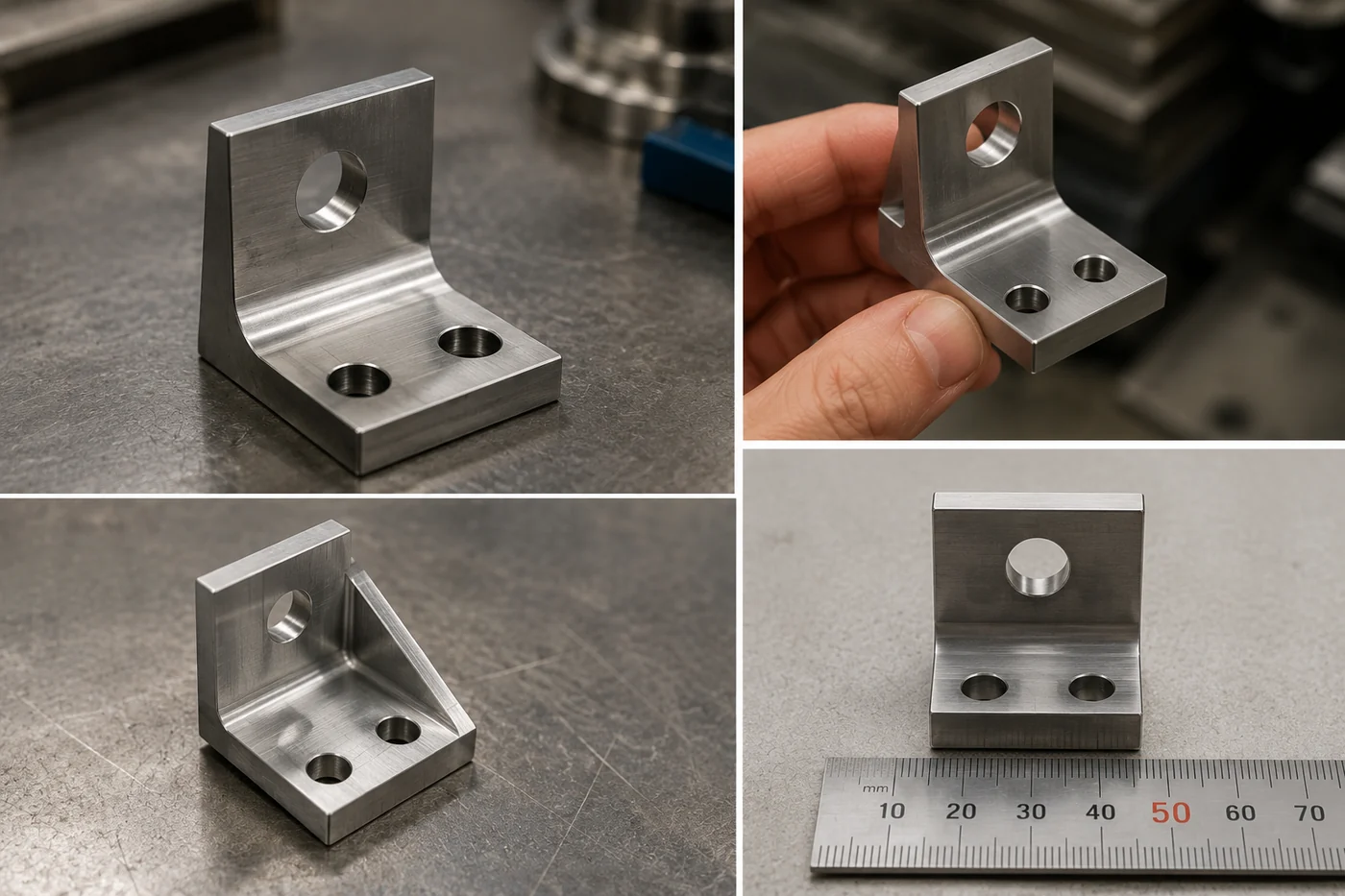
A press brake bends a flat blank. It cannot create material that was not in the blank, so a folded bracket that needs stiffening gets its gusset as a separate triangle welded into the corner — which puts a weld bead exactly where the bending stress peaks, and leaves a heat-affected zone in the same place.
Machined from solid, the gusset is simply the part of the block that was never cut away. There is no joint, no filler, no heat, and the grain runs continuously from the base into the leg. On a bracket that carries a real load or lives with vibration, that usually matters more than the price gap does.
The bracket above also shows the other machining-only detail: the base holes are counterbored, so the cap screws sit below the surface and the bracket beds flat against whatever it mounts to. Punching or laser-cutting a counterbore into sheet is not possible in one operation.
Where the catalogue stops
Stock brackets exist in enormous variety and are very cheap. It is worth being clear about where they stop being an option, and where they are still the right buy.
| What you need | In the catalogue? | What we do |
|---|---|---|
| An angle other than 90° — 30°, 45°, 112° | No — stock brackets are square or occasionally 45° | Any included angle, machined or folded to your drawing |
| Hole pattern that has to match an existing machine | No — stock hole spacing is on its own grid | Holes placed from your dimensions, or picked off the old part |
| Integral gusset with no weld in the corner | No | Machined from solid — see above |
| 316L (1.4404) for coastal or washdown service | Rarely — stock stainless brackets are usually 304 | 316L bar or sheet, EN 10204 3.1 certificate on request |
| 8 mm or 12 mm thick leg for a real load | No — stock brackets are thin pressed sheet | Any thickness; machined from plate or billet |
| Counterbored or countersunk fixing holes | Occasionally countersunk, almost never counterbored | Either, to the screw head you are actually using |
| A 2 × 2 inch 90° L-bracket for a bookshelf, quantity 20 | Yes — every hardware store and marketplace has them | Buy it off the shelf. On a standard size at that quantity, stock will always beat anything made to order |
Materials for custom brackets
Brackets are structural, so the choice is mostly about load and environment rather than machinability. Both routes run in all of these.
| Material | Designation | Choose it when | Watch out for |
|---|---|---|---|
| Stainless | 304 / 1.4301 (A2) | General outdoor, damp, food-adjacent — the default stainless bracket | Tea-stains in coastal air; springs back noticeably when folded |
| Stainless | 316L / 1.4404 (A4) | Coastal, marine, pools, road salt, washdown, chemical | Costs more and machines harder than 304 |
| Aluminium | 6061-T6 | Weight matters and the load is moderate; anodises well | Beds down under bolt preload — check the clamp load |
| Aluminium | 7075-T6 | High load at low weight | Poor corrosion resistance for 6061; not suitable for folding in T6 temper |
| Steel | 1045 (C45) | Maximum strength per unit cost, indoor or painted | Must be plated or painted; will rust bare |
| Steel | Mild steel S235 / 1018 | The usual choice for folded brackets — bends easily, welds easily | Same corrosion caveat |
The material comparison in depth is on our 304 vs 316 stainless and 6061 vs 7075 aluminium pages, and the general trade-off is covered in aluminium vs stainless for machined parts.
What each route actually holds
The number that catches people out is not the tolerance on a face — it is the tolerance across a bend, which is roughly ten times looser than anything else on the part.
| Feature | Machined | Folded | Why the folded figure is what it is |
|---|---|---|---|
| Outline / profile | ±0.05 mm | ±0.1 mm | Laser kerf and beam taper |
| Hole position within one face | ±0.025 mm | ±0.1 mm | Cut flat, before any bending |
| Hole position across a bend | ±0.05 mm | ±0.25 to 0.5 mm | Springback varies with thickness, temper and rolling direction |
| Included angle | ±0.1° | ±0.5° to 1° | Same springback problem, expressed as an angle |
| Inside corner radius | Any, down to the cutter radius | Not below one material thickness | Tighter than that and stainless cracks on the outside of the bend |
| Flatness of the mounting face | 0.05 mm | Sheet flatness as supplied | Nothing in folding flattens the blank |
| Surface finish | Ra 1.6, or brushed / bead blasted | Mill finish, or brushed after folding |
The practical fix when a folded bracket is right on price but the hole across the bend has to be accurate: fold first, then drill that one hole afterwards, in a fixture. You keep the sheet metal price on the body and buy machined accuracy only where it is needed. Ask for it and we will quote it that way. Fit and tolerance classes are set out on our limits and fits reference.
Brackets like these end up mostly in industrial equipment and machine building — motor mounts, sensor and guard mounts, panel supports, and the fittings that hold one subassembly onto another. Where a bracket has to space something away from a surface as well as hold it, it usually arrives paired with a square spacer.
What to send for a quote
No CAD file is needed. Any of these is enough to start:
- A dimensioned sketch — leg lengths, thickness, hole sizes and positions, and the angle if it is not 90°.
- A photo of the old bracket with a rule or a caliper in the frame. We take the geometry off it and redraw. This is the no-CAD route, and it works well on brackets.
- A cardboard template you have cut and folded by hand. Not a joke — for an awkward angle it is often more informative than a drawing.
- A STEP or DXF file if you have one. Faster, but not required.
Then tell us four things: quantity, material or the environment it lives in, what it bolts to, and which dimension is critical if any single one is. That last one is what decides the route, and it is the question most quote forms never ask.
For a one-off or a proof-of-concept bracket, see low-MOQ custom parts; for the machining side in general, CNC milling.
Frequently asked questions about custom brackets
Should my bracket be machined from solid or laser cut and folded?
Quantity decides it more than anything else. Below roughly 250 to 500 pieces, machining from solid is usually comparable in cost or cheaper, because folding needs programming, tool setup and a first-article bend sample before the first good part exists. Above about 1,000 pieces, folding almost always wins on unit price where the geometry allows it. Geometry can override quantity in both directions: a part of uniform thickness that is really a bent shell wants the press brake even at low volume, while thick sections, deep pockets, precision bores or an integral gusset force machining even at high volume.
Can you make a bracket with a gusset?
Yes, and this is the clearest place the two routes separate. A press brake bends a flat blank, so it cannot form a gusset — a folded bracket gets its gusset as a second piece welded in, which adds a weld line exactly where the stress is highest. Machining from solid leaves the gusset as part of the original block, with no joint and no heat-affected zone anywhere in the load path. If the bracket carries a real load or sees vibration, that difference usually matters more than the price difference.
What tolerance can you hold on a bent bracket?
On the flat profile, laser cutting holds about ±0.1 mm, so hole positions within one face stay accurate. Across a bend is the problem: ±0.25 to 0.5 mm is realistic, because springback varies with the sheet's thickness, temper and rolling direction. Stainless springs back noticeably more than mild steel. If a hole in the upstanding leg has to land within a tenth of a millimetre of a mating part, either machine the bracket or leave that hole to be drilled after bending.
Can I order just a few brackets?
Yes, the minimum is 1 piece and there is no tooling cost on either route. At those quantities we will normally machine rather than fold, because a machined bracket needs no bend sample and no press brake setup, so a single piece is genuinely economic. Send the drawing and the quantity and you get the price both ways where both are possible.
Should an outdoor stainless bracket be 304 or 316L?
304 (1.4301) is enough for ordinary outdoor use, rain and general damp. Move to 316L (1.4404) where chlorides are present — coastal and marine air, swimming pools, road salt, food processing washdown and most chemical service. 316L costs more and machines slightly harder, but it is the difference between surface tea-staining and actual pitting. Both are supplied with an EN 10204 3.1 mill certificate on request.
Do you need a CAD file to make a custom bracket?
No. A dimensioned sketch, a photo of the old bracket with a rule beside it, or a flat cardboard template you have cut and folded by hand are all workable starting points. We redraw the part as CAD, send it back for your approval, and only then cut metal. If you do have a STEP or DXF file it speeds things up, but its absence has never stopped a job.
Who makes custom stainless steel brackets in small quantities?
Most bracket suppliers are sheet metal shops, so they fold everything and decline very small runs; most machine shops mill everything and never mention folding. EKINSUN LTD runs both routes through qualified manufacturing partners, which is why we can tell you which one your bracket actually wants instead of selling you the one we happen to own. Send the drawing, a sketch or the old part, from 1 piece, and you get price and lead time within 12 hours.
See also: custom small machined parts for pins, bushings and short shafts, square spacers for the block that spaces a bracket off its mounting face, and CNC machining for the wider capability. German version: Winkel nach Maß, French version: équerre sur mesure.
CUSTOM BRACKET QUOTE