The 30-Second Answer
It's a normal part
Brackets, housings, plates, spacers, fixtures, enclosures. Cheaper, faster to machine, weldable, more corrosion resistant, anodizes predictably. The right default 90% of the time.
Load or weight is the spec
Aircraft-style fittings, racing and drivetrain parts, stressed clamps and links, thin sections that must not flex. Near-double yield strength buys real margin — at real cost.
The Numbers That Matter
| Property (T6 temper) | 6061-T6 | 7075-T6 |
|---|---|---|
| Yield strength | 276 MPa | 503 MPa |
| Tensile strength | 310 MPa | ~572 MPa |
| Hardness | ~95 HB | ~150 HB |
| Density | 2.70 g/cm³ | 2.81 g/cm³ |
| Main alloying | Mg + Si (6xxx) | Zn + Cu (7xxx) |
| Weldability | Good | Effectively none |
| Corrosion resistance | Very good | Lower (Cu content) |
| Machinability | Excellent | Fair — slower, harder on tools |
| Bar cost | baseline | ~50–100% higher |
Strength-to-weight is where 7075 earns its keep: nearly twice the yield for a 4% density penalty. That's an aerospace trade. But notice the rest of the column — welding gone, corrosion worse, cost up. 7075 is a specialist, not an upgrade.
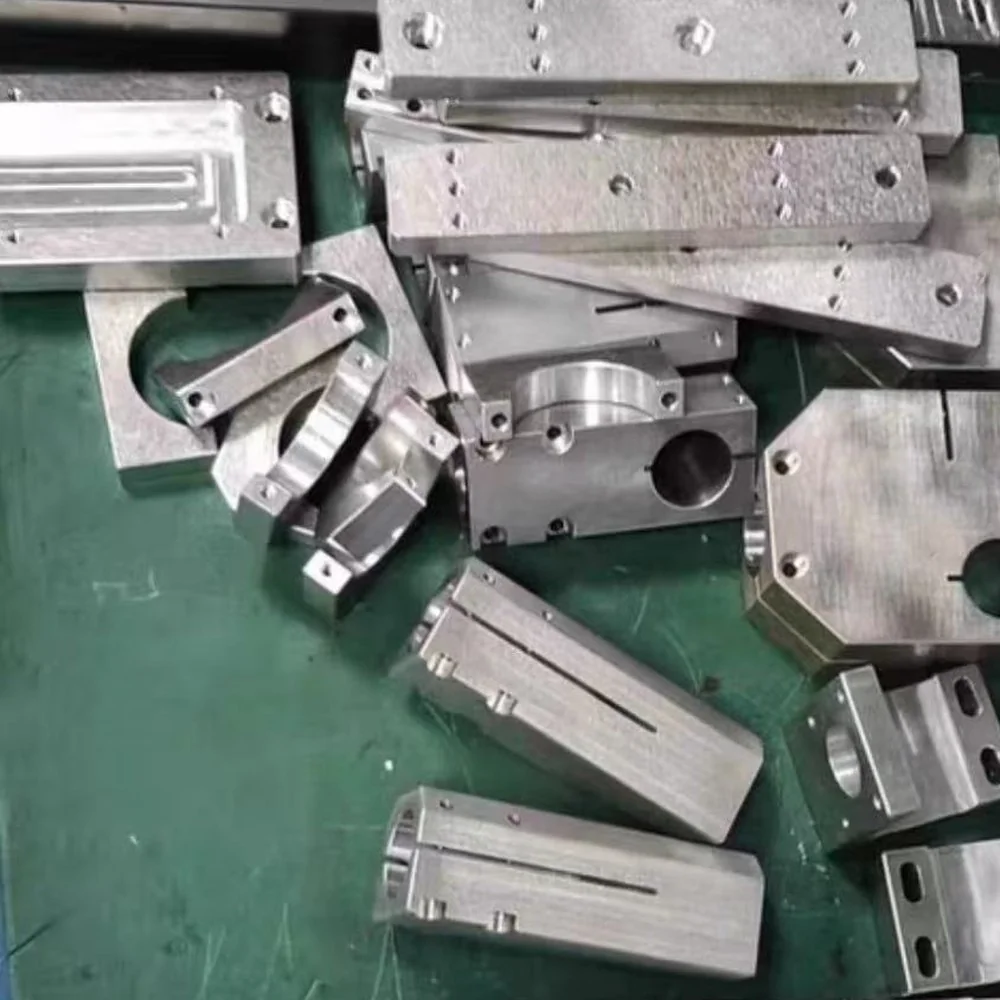
On the Machine: How They Cut
6061 is the alloy our shop is dialled in for — high surface speeds, clean chips, fine finishes, quick cycles. Its main vice is the built-up edge on dull tooling, solved with sharp polished carbide and good coolant. 7075 is harder (~150 HB), slightly abrasive, and produces springier chips; it gives a crisp finish, but cycle times run longer and tooling wears faster. The practical consequence for buyers: a 7075 part costs more than the bar-stock premium alone suggests — figure roughly 20–50% over the same part in 6061 once machining time is counted. We quote both side by side on request; the delta is often smaller than expected on chunky parts and larger on long-cycle ones.
Anodizing, Welding, Corrosion
- Anodizing: both take Type II and Type III hardcoat well. Color response differs slightly — 7075's zinc/copper chemistry anodizes a touch darker/yellower — so don't mix alloys within one visible anodized assembly.
- Welding: 6061 welds routinely; 7075 does not (hot cracking). A design with welded tabs decides the question by itself.
- Corrosion: 6061 is happier outdoors and in humid service. Bare 7075 needs anodize or coating protection, and is more prone to stress-corrosion cracking in the wrong temper/environment.
- Threads & wear: both are soft compared to steel — for frequently re-fastened threads in either alloy we recommend inserts, or a stainless part where it matters; see our stainless fasteners in aluminum guide and grades like 304 stainless for the mating hardware.
Decision Guide by Part
- Enclosures, panels, general brackets, jigs → 6061. Full stop.
- Heat sinks, thermal parts → 6061 (better thermal conductivity, easier fins).
- Welded frames and tanks → 6061 — 7075 can't be welded.
- Racing/drivetrain clamps, suspension links, high-load levers → 7075, anodized.
- Aircraft-style fittings, thin loaded sections → 7075 (it's what the alloy was made for).
- Marine or chemically exposed parts → 6061 hard-anodized; if strength still falls short, consider stainless steel instead of pushing 7075 into a corrosive job.
Copying an existing aluminum part? We identify the alloy of worn or unmarked samples as part of reverse engineering — so the replacement matches the original's strength, not just its shape.
What We See in Real Orders
The most common correction runs in both directions. Buyers spec 7075 "to be safe" on parts that see almost no load — we point out the 6061 price and they switch. And occasionally the reverse: a 6061 lever or clamp that keeps bending gets requoted in 7075-T6 and the problem disappears for a few dollars more. This is exactly the conversation an instant-quote platform can't have with you. Deep-dive property pages: 6061 machining · 7075 machining · all aluminum grades. One 7075 order documented in full: a one-off motorcycle suspension link from a notepad sketch.
6061 vs 7075 — FAQ
Yes — in T6 temper, yield is ~503 MPa vs ~276 MPa, close to double, with better fatigue performance. Most everyday parts simply don't need it.
6061, — faster cutting, cleaner chips, cheaper cycles. 7075 machines fine but slower and harder on tooling, which shows up in the part price.
Anodized yes (slightly different color response than 6061); welded effectively no — hot cracking rules out conventional welding. Welded designs mean 6061.
Bar stock 50–100% more, machining somewhat slower — typically 20–50% more on the finished part. We quote both grades side by side so you see the real number for your part.
Usually not — you'd pay more for a part that corrodes faster and can't be welded. Use 6061 unless load, weight or fatigue demands 7075.
Quote It in Both Alloys
Send your drawing, sketch or sample — we quote 6061 and 7075 side by side so the price decides with you.