A Hex Bar With Two Opinions
A coupling nut is the simplest joining element there is — a long nut that swallows two rod ends. UK catalogues sell the same part as a connector nut or joint connector nut; whatever the label, as long as both rods share one thread, hardware stores have you covered. But threaded assemblies grow over decades: a European actuator meets an American frame, a fine-pitch adjuster meets a coarse anchor, a turnbuckle needs opposite hands. Then the nut you need has two different threads — and two-thread combinations multiply far beyond what anyone can stock.
We machine the body, cut both internal threads in one setup so they're exactly coaxial, and gauge each end. Any combination, one piece minimum.
The Four Nuts People Actually Search For
Names first, because this part gets searched under at least four of them. A coupling nut, a thread coupler and a female-female coupler are one and the same body: a long hex with an internal thread running in from each end. Catalogues reserve coupling nut for the same thread at both ends — that is DIN 6334 — so searching under that name alone hides every reducing size, which is most of what this page is about. Two things the word coupler also means elsewhere: in hydraulics and pneumatics it is usually a quick-disconnect fitting, and on site a rod coupler or all-thread coupler is a plain same-size sleeve for threaded bar. If what you need is two different threads joined in one body, you are in the right place under any of those names.
Extension nuts, special spec
Same thread both ends, but longer, wider across flats, in 316, brass or titanium, or with a sight hole to verify rod engagement — the "standard" nut in a non-standard suit.
Reducing coupling nuts
Two diameters in one hex — join a heavy anchor rod to a lighter adjuster. Stock covers a handful of imperial pairs; every metric pair and every odd pair gets machined.
Metric ↔ imperial transitions
The cross-system nut that officially doesn't exist — joining metric equipment to imperial structure (or vice versa) without re-threading either side. Also BSW for vintage gear.
Left-hand / right-hand nuts
Opposite hands each end: turning the nut draws both rods in — the turnbuckle principle in a compact hex. Matching LH/RH studs machined as a set.
One more name from the search box: a threaded rod adapter. What people mean by it is the reducing coupling nut above — one hex body that joins two threaded rods of different diameter or pitch, each thread gauged to its own standard.
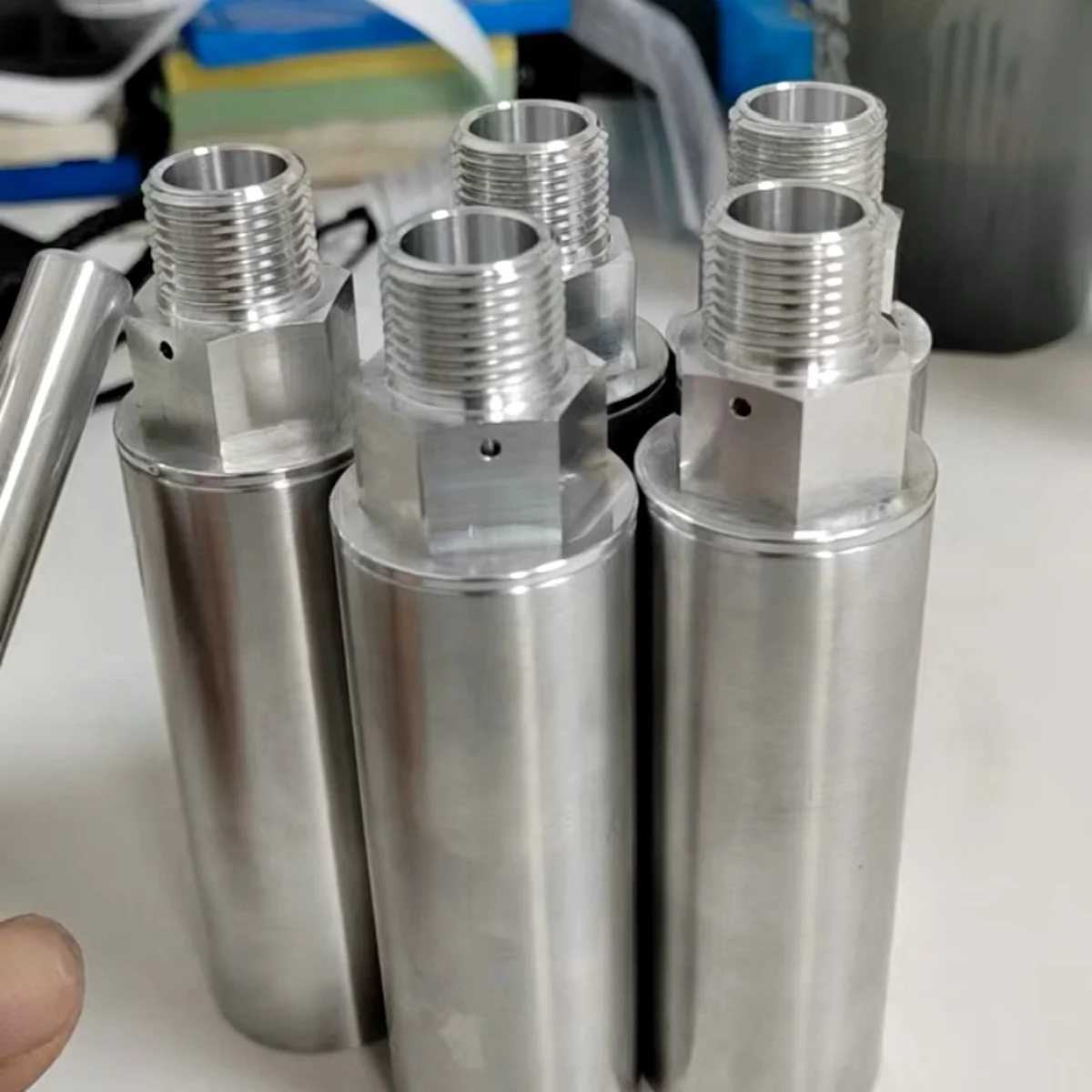
Body Styles & Options
| Option | Detail |
|---|---|
| Hex body | Across-flats to your wrench or clearance — not limited to DIN 6334 increments |
| Round body, knurled | For hand adjustment or where a hex can't swing |
| Length | Sized for full engagement both ends (≥1×d per side) or to your stack-up |
| Sight hole | Center hole to verify both rods reached depth — spec for safety-critical rigging |
| Locking | Nylon patch, jam-nut shoulder or drilled for locking wire |
| Materials | Stainless 304/316, brass, titanium Grade 5, C45 and 42CrMo4 with 3.1 certificate |
A coupling nut joins two threads, so measure two threads. Both rods have to be read before the nut is ordered: ten crests on a steel rule, divided by ten, for each rod, and the hand of each. Standard coupling nuts are stocked for the coarse pitch on both sides; a rod that reads 40 mm over ten pitches where the catalogue expects 60, or a rod in inch where the other is metric, has no stock coupling nut. That is the nut we machine — two pitches, two hands or two diameters in one hex body, each thread cut to the rod it will meet and gauged against it. How to read the pitch on either rod →
Where They Land
Machine Installation
Joining leveling rods and tie rods when metric equipment meets imperial building steel
Rigging & Adjustment
LH/RH nuts as compact turnbuckles on brace rods and tensioners
Marine & Outdoor
316 and titanium couplings that outlive the zinc-plated rest of the joint
Electrical
Brass coupling nuts joining busbar studs and earthing rods
Legacy Equipment
Whitworth-to-metric transitions keeping old machines bolted to new parts
Male-to-male instead of female-to-female? If you need to join two internal threads — a stud with two different male ends — that's a thread adapter, and we make those too: see adapters & fittings and double-end studs. A coupler with two different threads and a hexagon body is a hex thread adapter.
For the plain long nut in stainless, M2 to M24 at any length from 10 to 100 mm, see the 304 stainless coupling nuts page; the reducing and mixed-thread forms stay here.
Frequently Asked Questions
Yes — different diameters (M12→M8), different pitches, metric to imperial (M12→1/2-13), or metric to Whitworth. Stock reducing nuts cover a few imperial pairs; everything else gets machined.
Yes — right and left hand threaded coupling nuts are a standard job here: right-hand one end, left-hand the other, both cut in one setup so they're coaxial. Matching LH/RH studs available as a set.
Any — length for full engagement both ends, AF to your wrench clearance, round knurled bodies where a hex won't fit, sight holes on request.
Stainless 304/316, brass, titanium Grade 5, and C45/42CrMo4 steel with EN 10204 3.1 certificates.
Yes — connector nut, joint connector nut, extension nut and long nut are all trade names for the same part: a long internally-threaded hex that joins two rods. If the connector nut you need has an odd size, two different threads or a special material, that's what we machine.
Yes — rods and nuts machined in the same material, threads gauged against each other, shipped as one package so the odd combination is guaranteed to fit.
One piece. Custom coupling nuts are machined from hex or round bar to your two threads and length — no tooling involved, so a single nut, a repair pair, or a production batch all quote the same way. Fixed price within 12 hours.
Get Coupling Nuts Quoted
Tell us both threads. Engineers reply in 12h.
// Qty & price
1 pc
Sample price
Confirm fit before a run
10–50
Unit price drops
Setup cost shared
100+
Best price
All tiers quoted upfront
- →No distributor — you pay the maker directly
- →CAD saved after first order — reorder anytime at lower unit price