The hardware store has fifty hose barbs — and not the one your machine needs: a metric thread, an odd hose ID, stainless instead of brass, or a barb that grips a thick-wall silicone hose. We machine hose barb adapters to the hose and port you have: 304/316 stainless, any thread, barb OD cut to your hose ID. MOQ 1 through to production volume · CAD optional. Get a quote →
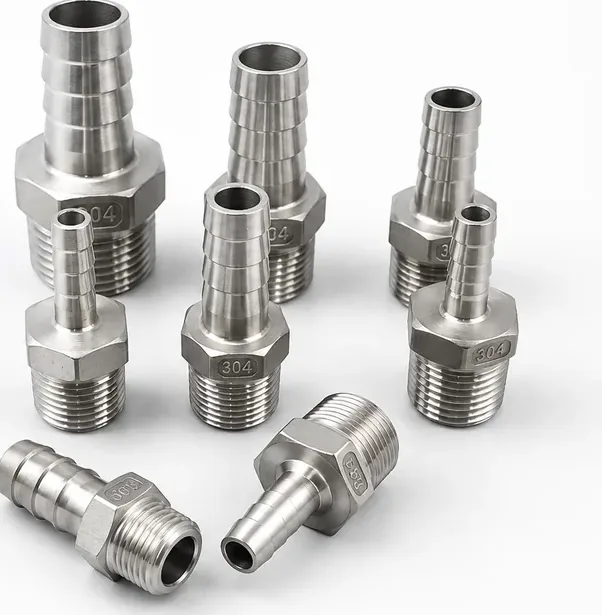
The catalog problem: barbs are only "standard" in inches
Hose barbs look like commodity hardware until the day your combination isn't stocked. The catalogs run male NPT × inch-hose tails in brass, a shorter list in 304, shorter again in 316 — and that's roughly it. The gaps are exactly where machines live: metric ports (M12×1.5, M14×1.5, M20×1.5, M22×1.5) on pumps and coolant systems, BSPT and ZG threads on imported equipment, female-thread barbs, metric hose IDs (8, 10, 12, 16, 19, 25 mm), reducing tails between two hoses, bulkhead barbs, and any of it in stainless. Each is one turned part for us — machined complete with the barb profile matched to your hose, not a nominal chart.
Barb geometry is the whole product
A barb holds because its widest diameter is larger than the hose bore — roughly 10–20% interference depending on hose hardness — and because the profile bites in the pull-off direction. Get either wrong and the joint weeps or the hose walks off under pressure spikes. That's what "custom" fixes: we cut the barb for the hose you measure, not the size printed on the label.
SINGLE BARB + CLAMP LAND
One sharp barb with a flat land for a worm-drive or ear clamp behind it. The industrial default for rubber and PVC hose.
MULTI-BARB / ANNULAR
Stacked rings grip soft silicone and push-on hose without a clamp — the profile in our lineup photo above.
BEAD END
A single raised bead for thick-wall hose with spring clamps — common on coolant and marine wet-exhaust lines.
What we machine
| Feature | Standard range | Notes |
|---|---|---|
| Thread end | NPT · BSP/G · BSPT · ZG · metric M8–M33 (e.g. M12×1.5, M20×1.5) | Male or female, left-hand on request |
| Barb end | Hose IDs 4–50 mm (5/32"–2") | OD cut to measured hose, single/multi/bead |
| Forms | Straight · reducer barb-to-barb · bulkhead · Y and tee bodies | Tee/elbow bodies machined or fabricated |
| Material | 304 stainless steel (default) · 316 stainless | Brass C360 · 6061 / 7075 aluminum (dry/pneumatic) · POM & nylon for lab and food-line barbs |
| Bore | Full flow bore | Restrictor orifice on request |
| Finish | Machined, deburred, crevice-blended | Polished for food/potable duty |
| Marking | Size + alloy on the hex | Your part number on request |
Measure the hose, not the label. Hose ID with a caliper, wall thickness, hose type (rubber / PVC / silicone), the thread callout or a photo of the port with a ruler — that's a complete RFQ. Unsure on the thread? We identify it from the photo as part of the free drawing.
Where custom barbs earn their keep
- Coolant & cutting-fluid lines — metric-threaded pump ports to standard shop hose without three stacked adapters.
- Food, beverage & brewing — stainless barbs with smooth transitions; pair with our tri-clamp adapters for the sanitary end.
- Marine & washdown — 316 barbs where zinc-plated or brass hardware streaks and pits.
- Fuel & pneumatic systems — 6061 aluminum tails where weight matters, odd IDs where AN hardware doesn't reach.
- Equipment repair — replacing a broken plastic barb on an obsolete machine with a one-off stainless copy — send the broken part.
Related pages
Where the Hose Barb Catalogue Stops
Standard barb-to-thread fittings are stocked everywhere. These are the ones that are not.
| What you need | In the catalogue? | How we machine it |
|---|---|---|
| A standard barb size against a standard thread | Stocked | Buy it off the shelf — it is a commodity fitting. |
| A barb sized to a hose ID that is between stock sizes | No | Turned to your actual hose bore rather than the nearest catalogue step. |
| A metric thread on the fitting end | Thin | Stock barbs assume NPT or BSP. Metric ports come to us. |
| More or deeper barbs for a hose that keeps blowing off | No | Retention profile cut to the pressure and clamp you use. |
| 316 stainless rather than brass | Rare | Small barbs on the shelf are almost always brass. |
| A barb on one end and a ferrule, flange or odd thread on the other | No | Both features on one turned body, no joint to leak. |
| A bore that does not restrict flow through the barb | No | Opened to suit the line rather than the thread. |
Materials and sizes above follow the ranges already listed on this page.
See also the fitting types chart for every fitting form by ports and standard, threaded elbows and brass pipe fittings. A barb with a garden hose thread on the other end is on the garden hose thread adapters page, with the 3/4-11.5 NH dimensions.
Frequently asked
Why won't a standard barb grip my hose?
Barbs seal by interference — the barb's widest point should exceed the hose bore by ~10–20% depending on hardness. Catalog barbs assume nominal inch hose; metric, thick-wall or worn hose gets the wrong interference and weeps. We machine to the hose you measure.
Can you make a hose barb with a metric thread like M12×1.5 or M20×1.5?
Yes — metric-threaded hose tails are the most common catalog gap. Any metric, BSPT, ZG or left-hand thread, male or female, with the barb sized to your hose, in 304 or 316 stainless.
What materials?
304 stainless steel default; 316 for salt water and chemicals; brass C360 on request; 6061 or 7075 aluminum for lightweight dry and pneumatic duty; POM and nylon for lab lines. Food-contact parts get polished, crevice-free transitions.
Single barb or multi-barb?
Single barb + clamp land for clamped rubber/PVC hose; multi-barb for soft silicone and push-on service; bead for spring clamps on thick-wall hose. Send hose type, wall and pressure — we choose and note it on the free drawing, no CAD needed.
One odd barb or a production batch. "M20×1.5 male to 16 mm ID silicone hose, 316, coolant at 80 °C, qty 4" is a complete RFQ. Free drawing, quote in 12 hours. Get a quote →