Stainless Is Easy to Buy — Until Your Size Isn't There
Catalogue stainless connectors cover the mainstream: common pipe sizes, standard lengths, the usual thread pairs. Real installations are less polite. The tank wall is thicker than any bulkhead's thread reach. The instrument is metric fine and the line is BSP. The old connector sealed on a face the new standard doesn't have. You don't need a different catalogue — you need the one connector nobody lists.
EKINSUN machines custom stainless steel connectors from 304, 316 or 316L bar stock: threaded couplers, bulkhead connectors, unions, reducers and standoff connectors, with the threads, lengths and sealing features your installation has — from one piece, quoted in 12 hours. Where the connector has to hold pressure, see custom sealed metal parts and the 316 sealed pair we made, with the contact check we run before dispatch.
Converting between two thread standards? Start at thread adapters. Clean-bore lab and medical fluidics live at precision machined fittings. This page is the material-first view: when the non-negotiable is stainless.
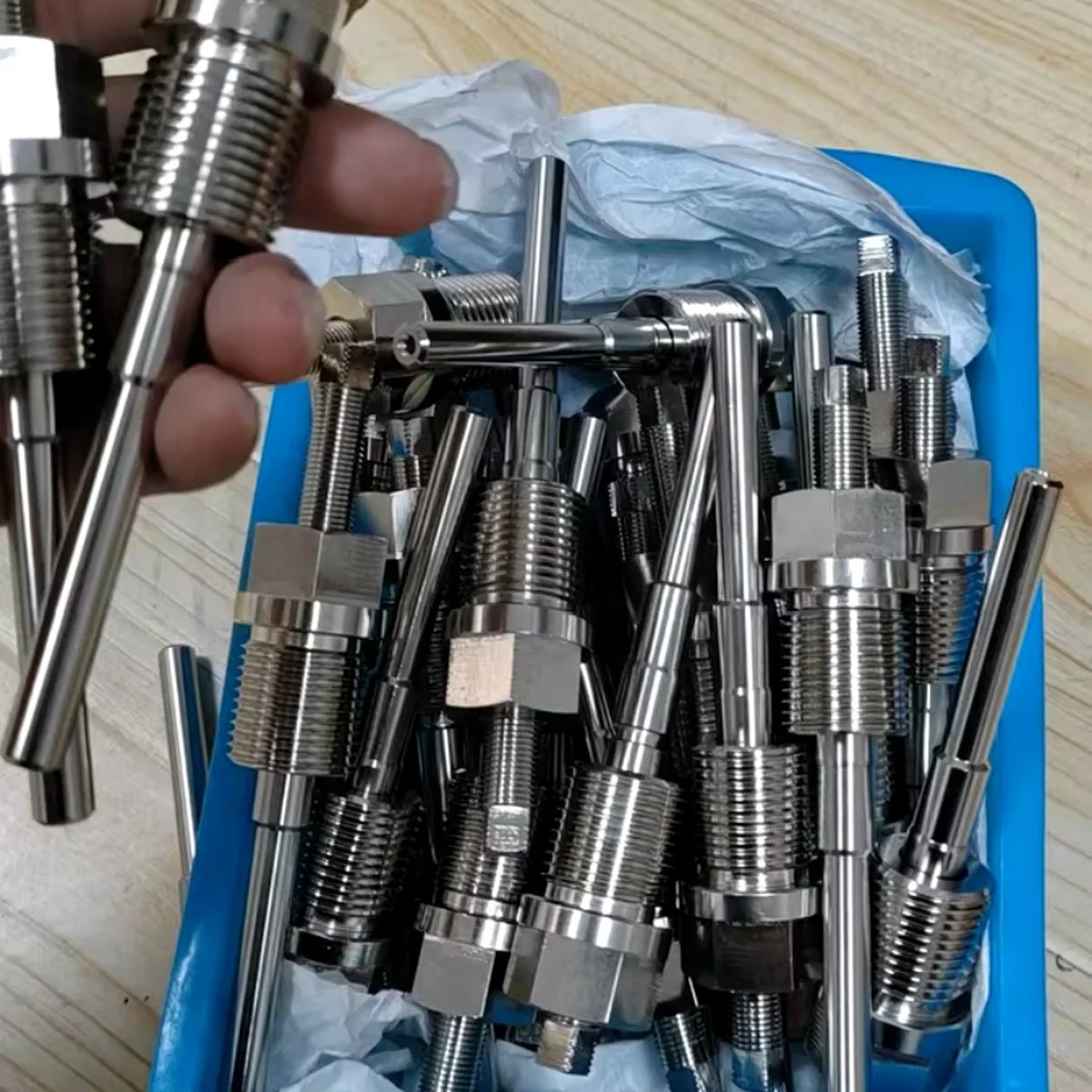
Connector Types We Machine
Threaded couplers
Female-female and male-male joiners — same thread both ends, or two different standards.
Bulkhead connectors
Through-wall connectors with thread reach matched to your actual panel or tank thickness.
Reducers & enlargers
Size steps the catalogue skips, with the wall thickness kept honest at the thin end.
Unions & standoffs
Three-piece unions and threaded standoff connectors for panels and instruments.
Hose & barb connectors
Machined barbs and hose tails in stainless for chemical and washdown duty.
Replacement connectors
Corroded or obsolete connectors copied from the sample — threads gauged, seals matched.
304, 316 or 316L — Match the Grade to the Medium
The grade question decides how long the connector lasts, and it's cheap to get right at the quote stage:
| Environment / medium | Grade | Why |
|---|---|---|
| Indoor, fresh water, general washdown | 304 | Fully adequate, best cost |
| Coastal or marine air, salt spray, de-icing salt | 316 | Molybdenum resists chloride pitting |
| Pool & spa chemistry, food-plant CIP chemicals | 316 | Chlorinated cleaners attack 304 over time |
| Connector will be welded into an assembly | 316L | Low carbon avoids weld-zone sensitisation |
| Strong acids, hot chlorides, aggressive process media | Ask us | Duplex or titanium may suit better |
Machined from bar, not cast. Bar-stock connectors have no casting porosity, so threads and sealing faces cut clean and dense — and every batch can ship with an EN 10204 3.1 material certificate naming the exact heat of steel. That's the difference buyers feel years later, not at the invoice.
The Bulkhead Problem Nobody Warns You About
Bulkhead connectors are the most-machined type for a simple reason: catalogue bulkheads assume a wall thickness, and your wall wasn't consulted. Too thick, and the thread runs out before the locknut lands; too thin, and the shoulder bottoms before the seal compresses. We machine the thread reach, shoulder and seal groove to the wall you measure — tank, panel, enclosure or hull — so the connector clamps and seals the way the designer of a catalogue part only hoped it would.
What to Send for a Fast Quote
- The connector type and the two ends — threads, tube or hose sizes, male or female
- The medium, temperature and environment, so we confirm 304 vs 316 vs 316L
- For bulkheads: your actual wall thickness
- A sample if you're replacing one — corroded is fine, threads still gauge
- Quantity and delivery country
No CAD, no problem. A sketch with the two ends, a photo with a caliper, or the old part in an envelope — we rebuild the drawing free and confirm before machining. See how to order with no CAD.
Where the Stainless Catalogue Stops
Stainless connectors in standard sizes are easy to buy and you should. These are the ones that are not.
| What you need | In the catalogue? | How we machine it |
|---|---|---|
| A standard 304 or 316 connector, common size | Stocked | Buy it off the shelf. A stockist will beat us on a catalogue item. |
| 316L specifically, because it will be welded into an assembly | Thin | Low carbon avoids weld-zone sensitisation. Stock lists rarely separate 316 from 316L. |
| A bulkhead connector cut to your panel thickness | No | Catalogue bulkheads come in one length and often will not clamp your plate. |
| Two different standards, one on each end | No | BSP against metric, or either against NPT, in one turned body. |
| An O-ring groove or flat seal face added | No | Cut to your cord size rather than the nearest stock seat. |
| A grade chosen for the medium rather than what is on the shelf | n/a | Tell us the environment and we advise 304, 316 or 316L before quoting. |
| Left-hand thread on either end | No | Not a catalogue item in stainless at any size. |
Grade guidance above follows the environment table already on this page.
See also the fitting types chart, bulkhead fittings and threaded tees in 304 and 316L.
Stainless gas-cylinder adapters in 316L: CO₂ cylinders (TR21-4, CGA 320, W 21.8 × 1/14) and argon and nitrogen cylinders (CGA 580, W 24.32 × 1/14, G 5/8).
Frequently Asked Questions
304 handles rain, washdown and most fresh-water duty. Step up to 316 when chlorides are involved — coastal and marine air, salt spray, pool chemistry, food-plant cleaning chemicals — or a mildly acidic medium. 316L is the choice when the connector will be welded afterwards. Tell us the medium and we'll recommend.
Yes — that's the point of machining one. Catalogues cover common pipe and tube sizes; we cut the odd ones: metric fine to BSP, an in-between length, a non-standard hex, or a combination of two ends that isn't sold as one part.
Yes — with the thread reach matched to your actual wall thickness, locknut included, sealing by O-ring or washer as the job needs. Real walls rarely match the catalogue's assumption, which is why bulkheads are so often machined to order.
For critical service, usually yes. Bar-stock connectors have no casting porosity, so threads and sealing faces come out clean and dense — certifiable with an EN 10204 3.1 certificate. Cast is fine for rough plumbing; machined is what you want under pressure, vacuum or hygiene rules.
Yes. Send the old connector — corroded or worn is fine — and we gauge the threads, measure the body and sealing features, rebuild the drawing free, and machine replacements. From one piece up.
Get a Stainless Connector Quoted
The two ends and the medium — that's enough to start. Engineers reply in 12h.
// Qty & price
1 pc
Sample price
Prove fit & seal first
10–50
Unit price drops
Setup cost shared
100+
Best price
All tiers quoted upfront
- →No distributor — you pay the maker directly
- →CAD saved after first order — reorder anytime at lower unit price