Buy It Stamped, or Have It Machined?
Thin standard flat washers are stamped by the million and cost pennies — an honest supplier tells you to buy those, not machine them. Here's the line we draw before quoting:
Buy stamped, off the shelf
A thin standard flat washer in a common bore — DIN 125, ISO 7089, ordinary steel or 304. Washer makers stamp these by the thousand — buy them from stock at a local hardware or industrial supply store, far cheaper than any machined part, or contact us: we may have them in stock.
Have it machined — our lane
A thick, load-spreading washer (DIN 7349 style), a large OD beyond catalog DIN 9021, a non-standard bore, a shoulder / stepped / spherical washer, a precision shim to an exact thickness, or an exotic material — titanium, 316L, brass, PEEK. Turning and milling jobs, not stamping.
Prefer to order from a sketch with no CAD? That route is covered on our machined washers from a sketch service page — same shop, same quality, just the no-drawing workflow.
Washer Types We Machine
| Type | What it does | Standard referenced |
|---|---|---|
| Flat washer | Spreads clamp load, protects the surface | DIN 125 / ISO 7089 |
| Large-OD (fender) | Wide OD spreads load on soft, oversized or slotted holes — see standard clearance hole sizes | DIN 9021 and beyond |
| Thick / heavy-duty | Heavy section for high clamp loads and reworkable faces | DIN 7349 style |
| Shoulder / stepped | A machined step locates a bearing, seal or spacer | To drawing |
| Spherical / conical seat | Self-aligning seat for angular clamping | DIN 6319 style |
| Precision shim washer | Turned to an exact thickness for setting end-float or gaps | To drawing, ±0.01 mm |
Tooth and Star Lock Washers — External, Internal, Countersunk and Serrated
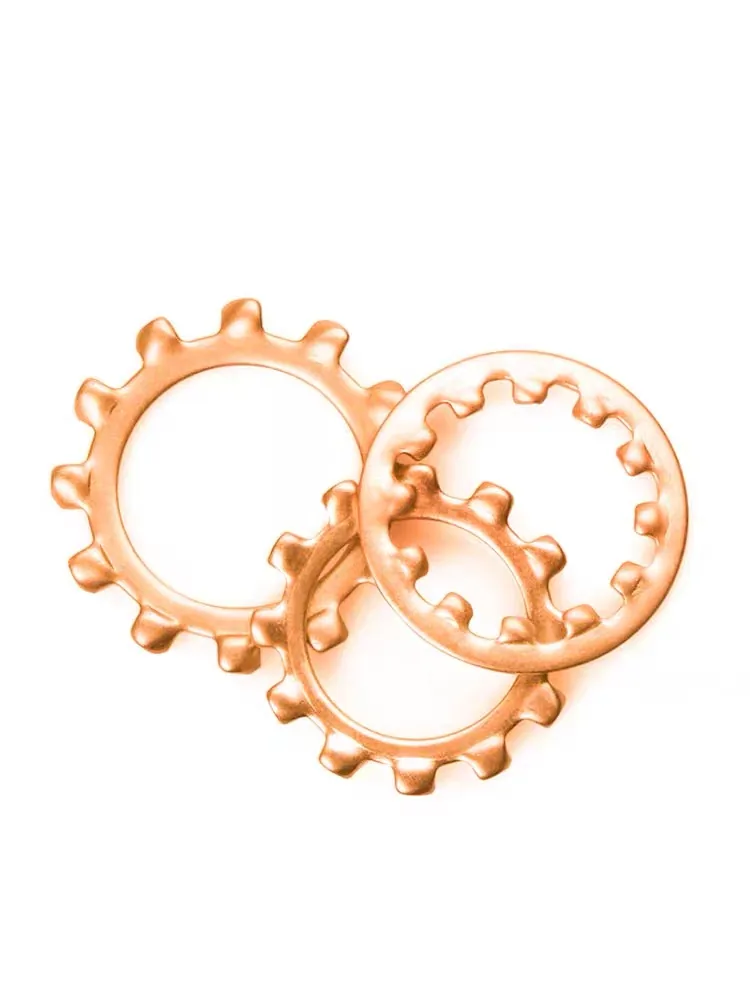
A tooth lock washer, also called a star washer, is a stamped ring whose teeth are twisted alternately up and down. Under the nut the teeth flatten and bite into both faces, so the joint resists loosening by friction and by a mechanical key, which a plain spring washer does not give. It is not machined: the blank is stamped and the teeth set in a die, then the part is hardened and tempered. Three forms cover almost every job, and the choice is set by what the washer must not touch.
| Form | Teeth | Where it is used | Standard | Stock range |
|---|---|---|---|---|
| External tooth (type A) | on the outside diameter | the general case: the largest tooth circle, the strongest bite, under hex nuts and bolt heads | DIN 6797 A / ASME B18.21.1 type A | M2–M33 |
| Internal tooth (type J) | on the bore | where the teeth must stay hidden under a small head or inside a counterbore, and where a sharp outer edge would cut wiring or a hand | DIN 6797 J / ASME B18.21.1 type B | M2–M33 |
| Countersunk (type V) | on the bore, dished to 90° | under countersunk and raised-countersunk screws, where a flat washer would sit proud | DIN 6797 V | M3–M16 |
| Serrated (types A / J / V) | many fine teeth, same three forms | a softer bite spread over more teeth: painted or plated faces, thin sheet, brass and aluminium fittings | DIN 6798 A / J / V | M2–M33 |
Stock forms are made in spring steel (zinc-plated), stainless 1.4310 / A2 and, for earthing and electrical assemblies, in copper alloys such as phosphor bronze, where the teeth cut through paint or oxide to make the ground path. Standard sizes: buy it from stock, and we say so when asked. What is made here to drawing is the washer no catalogue stocks: an odd bore or outside diameter, a tooth count or tooth height to suit a specific face, a non-magnetic or high-temperature material, or a small quantity of an obsolete size for a repair, blanked by laser or wire cutting and set in a simple tool.
| What you need | In the catalogue? | What we make |
|---|---|---|
| External, internal or countersunk tooth washer, DIN 6797 or DIN 6798, M2–M33, spring steel or A2 | Yes — every fastener catalogue | Buy it from stock; we say so instead of quoting. |
| The same washer in phosphor bronze or copper for an earth connection, standard size | Yes — electrical and earthing suppliers | Buy it from stock where the size is listed. |
| A tooth washer in an odd bore or outside diameter, a set tooth count, or a non-magnetic, high-temperature or obsolete size | No | Blank laser- or wire-cut to drawing, teeth set in a simple tool, hardened where the material allows; small quantities. |
| A locking washer for a vibrating joint on aluminium or a painted face | Not this type | A wedge-lock pair, tab washer or prevailing-torque nut instead, machined to size where the catalogue stops. |
Where a tooth washer does not work. The bite needs a face it can key into. On a steel nut and a steel plate it holds; on aluminium 6061 the teeth embed, the preload relaxes and the joint loosens anyway; on a painted or plated face the teeth break the coating and the scar corrodes. For repeated disassembly the teeth have flattened by the second tightening, and for a vibrating joint on soft metal a wedge-lock pair, a tab washer or a prevailing-torque nut is the safer choice, as set out on the washer types chart.
Which Material? Weight, Cost & Where Each Wins
A washer is a simple ring, which makes it the clearest place to see how material choice changes weight, cost and function. The same 40 mm washer weighs three times more in 316L than in aluminum, costs a fraction of what titanium does, and behaves differently in a corrosive or electrically live joint. Start from the job:
| Material | Density | Why choose it for a washer |
|---|---|---|
| Aluminum 6061 | 2.70 g/cm³ | Lightest metal option, cheap, anodizes — weight-sensitive and cosmetic use |
| Aluminum 7075 | 2.81 g/cm³ | Aircraft-grade strength where a light washer still carries load |
| Stainless 304 | 7.9 g/cm³ | General corrosion resistance, food and outdoor use |
| Stainless 316L | 8.0 g/cm³ | Marine, washdown and chemical joints |
| Brass C360 | 8.5 g/cm³ | Electrical conductivity, decorative, non-sparking |
| Alloy steel 4140 | 7.85 g/cm³ | Highest clamp loads, heat-treatable, plated for corrosion |
| Titanium Gr5 | 4.43 g/cm³ | ~45% lighter than steel with high strength — weight-critical assemblies |
| Delrin / PEEK | 1.3–1.4 g/cm³ | Electrical insulation, damping, chemical resistance, no marring |
Rather than guess, put your washer's dimensions into the calculator and read the exact weight and relative material cost of every option side by side:
The Jobs That Land on Our Bench
"We need thick 10 mm washers, 60 mm OD, to spread bolt load on a slotted plate."
That's a thick large-OD washer — a turning job, not a stamping. We machine them from plate or bar in the exact OD, bore and thickness, in steel or 316L, with spares in the run.
"Titanium washers to shave weight off the assembly — M8, 20 mm OD."
Titanium washers are a routine turning job here. The calculator above shows the weight saved versus steel; we machine them Grade 5, deburred and passivated, one-off or in a set.
"Insulating washers with a 12.5 mm bore — PEEK, exact thickness."
Non-metallic washers to a precise thickness and odd bore are machined, not stamped. We turn them in PEEK or Delrin to ±0.01 mm so they set the gap and insulate the joint.
"We need 50,000 thin washers a year, but in a 10.3 mm bore nobody stocks."
Here the catalogue has no such bore and machining is the wrong answer at that volume — this is the case for a stamped washer on a purpose-made die, which we quote through the partner press shop we use for stamped work. Send bore, OD, thickness and annual volume and we quote the die and the piece price together. Below roughly 10,000 a year the die will not pay for itself; we will say so and turn them instead.
Matched hardware: washers rarely travel alone — we machine the matching bolts, nuts, shaft collars and spacers in the same material and finish, so a joint arrives as one consistent, certified set.
See also the washer types chart — spring, tooth, wave, disc, wedge-lock, tab and sealing washers by DIN number and stock range.
Two cases this page hands on: a washer or shim below 0.3 mm, which is etched or laser-cut rather than turned, on thin washers and precision shims; and a washer that must insulate or must not corrode, chosen by material on plastic and insulating washers.
Two washers that are not machined rings: white nylon thrust washers for excavator bucket pins, Ø 30 to 120 mm, cut to the measured side play; and graphite-filled spiral wound gaskets, ID 20 to 800 mm, for hot flange joints.
Washers and shims cut from sheet, from 0.03 mm thick and in any outline — round, square, slotted or with tabs: laser-cut shims, washers and thin parts 0.03–10 mm.
Under a DIN 912 M3 head the DIN 9021 washer 3.2 × 9 × 0.8 mm gives 1.8 times the bearing area of DIN 125; sets of screw, washer and pre-applied threadlocker are on pre-applied threadlocker screws.
Frequently Asked Questions
Not well. A tooth lock washer holds by biting into both faces, which works on steel against steel. On aluminium 6061 the teeth embed, the preload relaxes and the joint can still loosen; on a painted or plated face the teeth cut the coating and the scar corrodes. For a vibrating joint on soft or coated metal use a wedge-lock washer pair, a tab washer or a prevailing-torque nut; use a serrated washer (DIN 6798) only where a light bite on a clean face is acceptable.
Thin standard flat washers are stamped and cost pennies — buy those from stock at a local hardware or industrial supply store, or contact us: we may have them in stock. Machine a washer when it's thick, large-OD, an odd bore, a shoulder or shim washer, or in titanium, 316L or PEEK. At low quantities, machined washers also avoid the stamping-die cost a custom stamped size would need.
Depends on load, environment and weight: 6061 light and cheap; 304/316L corrosion; 4140 for high clamp load; titanium to save weight; Delrin/PEEK to insulate. Use the calculator on this page to compare weight and relative cost for your exact size.
Yes — the most common request. We turn the bore and OD to your drawing, including in-between sizes, tight-tolerance shims and large fender washers beyond DIN 9021.
One piece. No tooling charge — a single thick 316L washer with an odd bore is a normal order. Unit price falls on batches.
Outside diameter, bore and thickness, the material or environment, and quantity — or the old washer. No CAD needed; a sketch or sample is enough. Quote in 12 hours.
Get Washers Quoted
OD, bore, thickness and material — or the old washer. Engineers reply in 12h.
// Qty & price
1 pc
Sample price
Confirm fit before a run
10–50
Unit price drops
Setup cost shared
100+
Best price
All tiers quoted upfront
- →No distributor — you pay the maker directly
- →CAD saved after first order — reorder anytime at lower unit price