When Corrosion Resistance Has to Be Serious
316 is 304's tougher sibling. The key difference is 2–3% molybdenum, which transforms resistance to chloride attack and pitting — the failure modes that destroy ordinary stainless in salt water and aggressive chemicals. That single addition makes 316/316L the standard for marine hardware, chemical processing, pharmaceutical and many surgical and food-contact parts. It costs more than 304 and machines a little slower, so it's the right choice specifically when the environment demands it.
316 Mechanical & Physical Properties
| Property | Typical value (316, annealed) |
|---|---|
| Ultimate tensile strength | ≥515 MPa |
| Yield strength (0.2%) | ~205 MPa (316L min ~170) |
| Elongation at break | ~40% |
| Hardness | ~79 HRB (~150–170 HB) |
| Density | 8.0 g/cm³ |
| Elastic modulus | 193 GPa |
| Composition | ~16–18% Cr, 10–14% Ni, 2–3% Mo |
| Magnetism | Essentially non-magnetic (annealed) |
| Machinability | ~36% — work-hardens |
316L's low carbon (≤0.03%) resists weld-zone (intergranular) corrosion, so it's preferred for welded assemblies. We machine to certified mill spec and supply certs on request.
316 Chemical Composition
316 is an austenitic stainless whose defining ingredient is molybdenum — it's what lifts chloride/pitting resistance above 304. Nominal composition (balance iron):
| Element | Content | Element | Content |
|---|---|---|---|
| Chromium (Cr) | 16.0–18.0% | Manganese (Mn) | ≤2.0% |
| Nickel (Ni) | 10.0–14.0% | Silicon (Si) | ≤0.75% |
| Molybdenum (Mo) | 2.0–3.0% | Phosphorus (P) | ≤0.045% |
| Carbon (C) | ≤0.08% (316L ≤0.03%) | Sulphur (S) | ≤0.030% |
How We Machine 316
316 behaves like 304 but cuts a little harder and holds heat, so discipline matters even more:
- Sharp, rigid tooling with positive feeds to stay under the work-hardened layer
- Strong coolant to carry heat away and protect tool life
- Tolerances: ±0.025 mm (±0.001 in) on critical features — verified on inspection
- We avoid cross-contamination with carbon steel so the corrosion resistance isn't compromised
Tooling, Speeds & Feeds — Starting Points
Same golden rule as 304 — never let the tool dwell or rub — but 316 is more demanding: lower machinability (~36%), more heat retained, faster tool wear. Cut firmly, flood it, and keep tool engagement constant. Typical starting points (tuned per part):
| Parameter | Typical for 316 / 316L |
|---|---|
| Tooling | Coated carbide — TiAlN / TiCN for heat & wear |
| Cutting speed | ~50–70 m/min (165–230 SFM) carbide end mills — a touch below 304 |
| Feed / chip load | 0.15–0.35 mm/rev — positive & consistent, never trailing off |
| Depth of cut | Stay below the previously work-hardened layer each pass |
| Coolant | High-pressure flood — non-negotiable on 316 |
| Golden rule | Tool always cutting — no dwell, no rubbing |
Finishing 316
- Passivation — essential after machining to restore the protective oxide layer
- Electropolishing — bright, ultra-clean, easy-to-sterilise surface for medical/pharma
- Bead blast / brushed — uniform decorative or matte finishes
316 vs 304 — Quick Comparison
| 316 | 304 | |
|---|---|---|
| Molybdenum | 2–3% | None |
| Chloride / pitting resistance | Excellent | Good |
| Marine / chemical / medical | Preferred | Limited |
| Machinability | ~36% | ~45% |
| Cost | Higher | Lower |
No chloride exposure? 304 is the cheaper default. See all options on our materials overview, or the full 304 vs 316 comparison with decision guide by application.
Typical 316 Parts
- Marine fittings, fasteners and deck hardware
- Chemical and pharmaceutical process parts
- Surgical and medical-device components
- Food and beverage contact parts
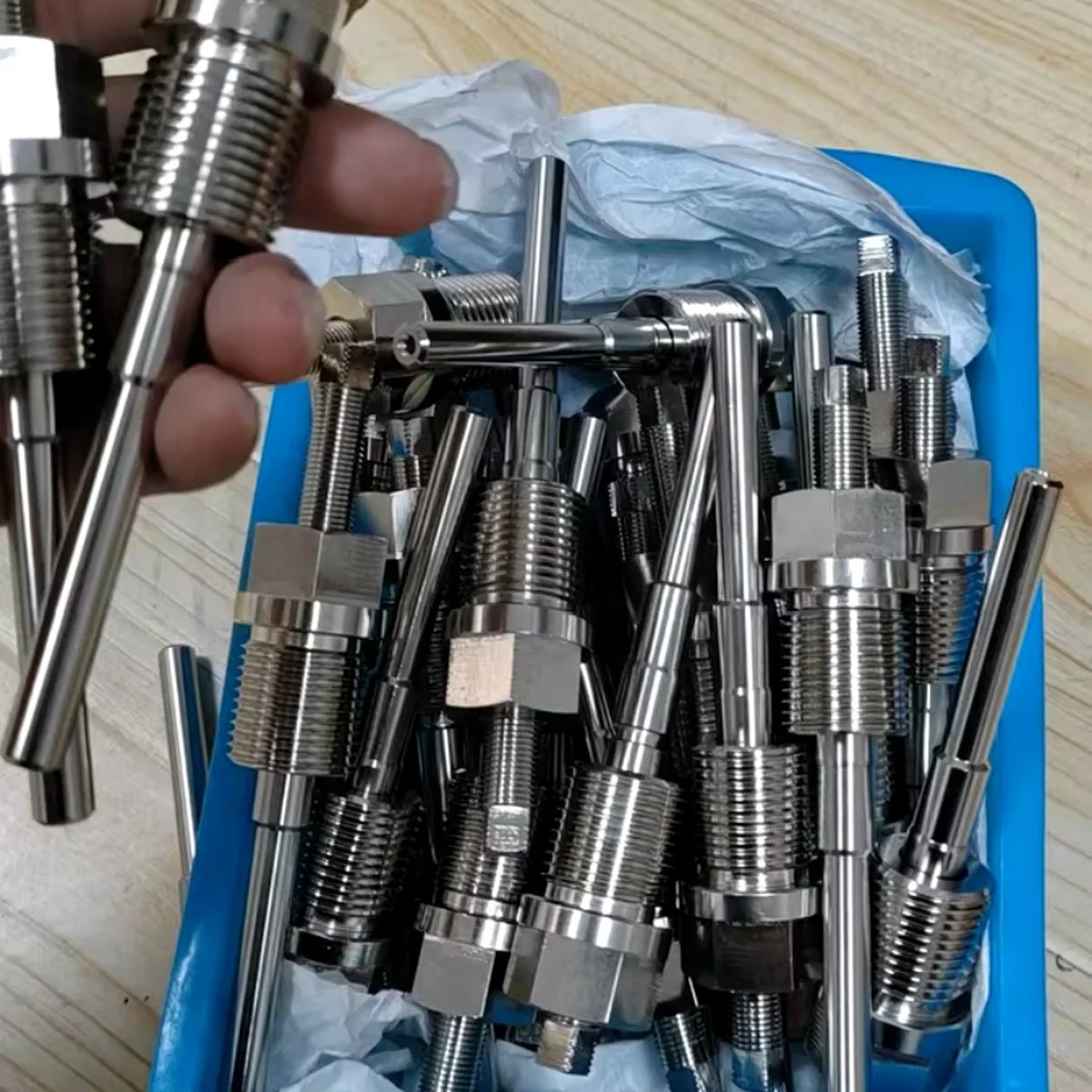
- Sensor and instrumentation fittings — e.g. our stainless fittings batch
316 is our go-to grade for corrosion-critical custom fasteners and adapters & fittings, and for marine replacement parts.
Custom 316 Stainless Parts — Who Orders and Why
The buyers who specify 316 over 304 are usually fighting salt water, chlorides or a wash-down chemical — and they need the molybdenum grade machined and finished correctly, not substituted for cheaper steel.
"A 316 deck fitting corroded/sheared — no drawing, need it remade from the old one"
Send us the broken or worn part. We reverse-engineer 316/316L through-hulls, stanchion bases, cleats, ferrules and nipples from the sample, passivate to maximise pitting resistance, and finish brushed or electropolished. MOQ 1 for one-off replacements; batches for build series.
"Valve and pump parts exposed to chlorides — 304 keeps failing"
We machine custom valve bodies, spindles, nozzles and pump components in 316L for chloride and acid service, supply mill certs to the 316 spec, and electropolish where surface cleanliness matters. Material traceability documented per part.
"Instrument components in 316L — electropolished, biocompatible surface"
We machine custom 316L instrument and implant-adjacent components to tight tolerance, electropolish to a clean passive surface, and hold the process repeatable across batches. Low MOQ for development; scale-up on approval.
"316 fittings and brackets for an offshore install — certs and repeat supply"
We quote tiered pricing, machine a first sample for approval, supply 316 mill certs and traceability, then set up repeat supply. Naval brass or super-duplex available where 316 isn't enough — tell us the chloride exposure.
What 316 Stainless Buyers Search For
Where a guide plate meets chlorides, 316 replaces 304; the finishes for film-contact faces are compared on film guide plates.
316L cylinder adapters with an EN 10204 3.1 certificate for beverage CO₂ and laboratory gas lines: CO₂ cylinder thread adapters (TR21-4, CGA 320) and argon and nitrogen cylinder adapters (CGA 580, W 24.32 × 1/14).
Frequently Asked Questions
316's 2–3% molybdenum gives far better resistance to chlorides and pitting — essential for marine, salt, chemical and many medical parts. Without chloride exposure, 304 is more cost-effective.
316L has lower carbon (≤0.03%) to resist intergranular corrosion at welds — better for welded assemblies. Standard 316 has slightly higher strength for non-welded parts. We stock both.
Slightly — ~36% machinability vs ~45% for 304, and it work-hardens similarly. Sharp rigid tooling, positive feeds and good coolant give clean parts; it just runs slower.
Yes — it's a standard for surgical, pharma and food-contact parts. We passivate and can electropolish to a bright, hygienic surface.
They do different jobs. Passivation is a chemical clean that removes free iron and machining residue so the natural chromium-oxide layer reforms — it doesn't change appearance or surface roughness. Electropolishing electrochemically removes a thin surface layer, leaving a brighter, smoother (lower Ra) finish that resists biofilm and rouging. General marine/industrial parts usually need only passivation; medical, pharmaceutical and high-purity parts typically want both — electropolish then passivate. Tell us the application and we'll advise.
Yes — it's one of our most common marine and chemical jobs. Send the worn, seized or sheared fitting and we reverse-engineer it from the sample (no drawing needed): measure threads, bores and flange faces, rebuild the geometry, machine a new one in 316/316L and passivate. MOQ 1. If the original was specified in EN designations (1.4401 = 316, 1.4404 = 316L) or another standard, tell us and we match it.
316L has lower carbon (≤0.03%), which prevents carbide precipitation at weld zones and so resists intergranular corrosion after welding. 316L is the better choice for welded assemblies; standard 316 has slightly higher strength for non-welded parts. We stock both.
Get a 316 Quote
Any drawing format accepted — sketch, photo or CAD. Reply in 12h.
// Qty & price
1 pc
Sample price
Confirm fit before a run
10–50
Unit price drops
Setup cost shared
100+
Best price
All tiers quoted upfront
- →No distributor — you pay the maker directly
- →CAD saved after first order — reorder anytime at lower unit price