Gland nut seized, galled, cracked — or simply discontinued with the cylinder? We machine a replacement hydraulic cylinder gland nut, threaded head or end cap from your old part or a few measurements: thread gauged, seal grooves cut to standard kit sizes, spanner features as original. No drawing needed, one piece up. Get a quote →
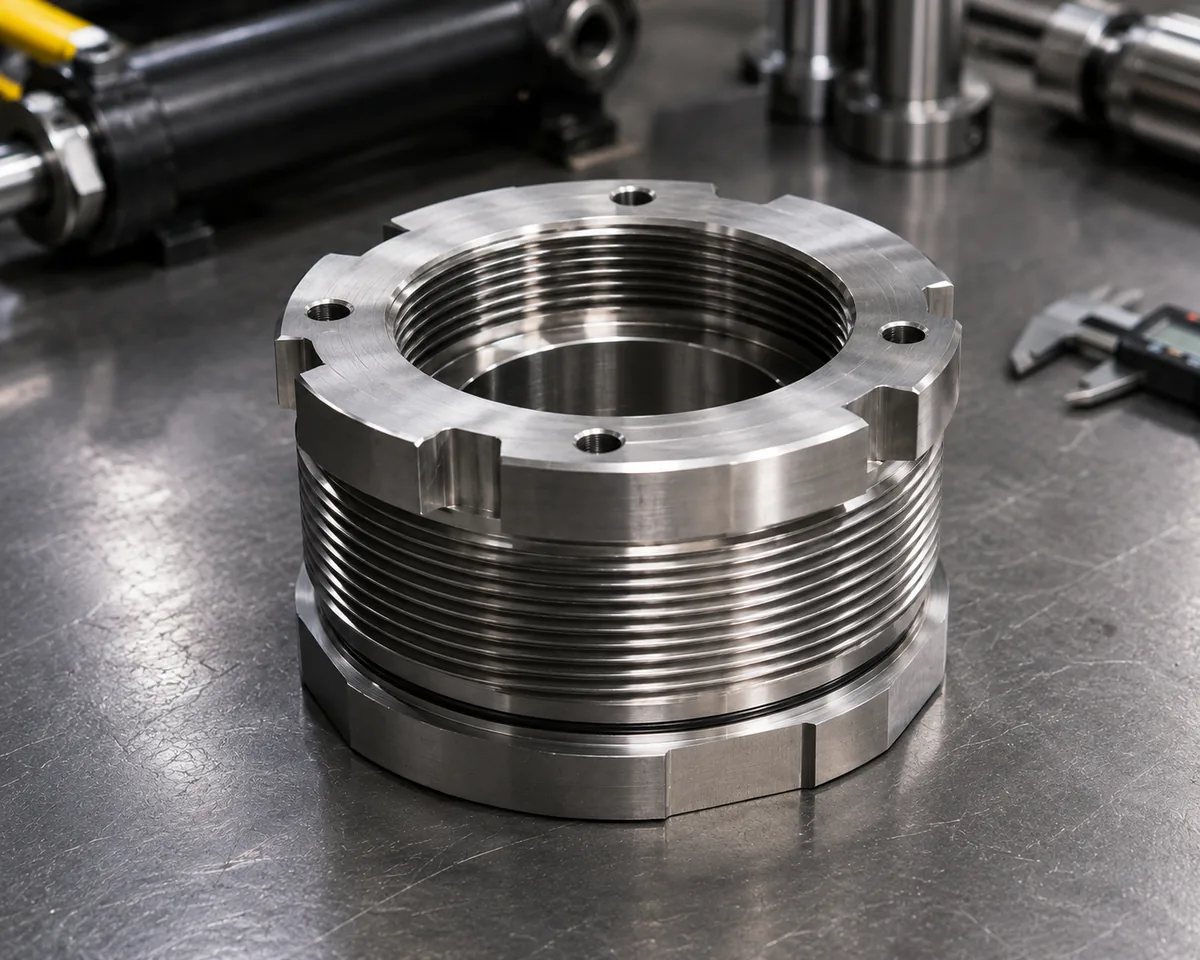
The part that ends a cylinder's life — needlessly
A hydraulic cylinder rarely dies as a whole. What fails is the gland: threads gall when it's removed for resealing, the spanner slots round off under a pipe wrench, corrosion welds it to the tube, or a hard side-load cracks it. The barrel, rod and piston are fine — but if the cylinder is an import, an older model or a discontinued line, the gland nut alone is unobtainable, and a working cylinder gets scrapped over one turned part. That's the job we take: send the old gland (even wrecked), and we machine the replacement.
Gland nut, threaded head or end cap — every form
- 01External gland nut — male thread into the barrel, rod running through the center; the most common repair part.
- 02Internally threaded head — screws over the tube OD; typical on North American welded cylinders.
- 03Castellated / slotted ring nut — driven by a pin spanner or castle tool; slots re-cut true, not rounded.
- 04Packing nut — compresses the rod packing on older and agricultural cylinders.
- 05Threaded end cap — blind cap or ported cap for the base end, solid or with SAE/BSP port.
What we hold, because the cylinder cares
| Feature | How it's machined |
|---|---|
| Barrel thread | M60×2–M120×2 metric fine, or UN imperial (2½"-12, 3¼"-12 …) — gauged against the tube pitch |
| Seal grooves | Rod seal, wiper, O-ring & backup grooves cut to standard catalog seal sizes — kit stated on the drawing |
| Rod bore | Honed running fit to your rod diameter, concentric to the thread so the rod doesn't wear one-sided |
| Drive features | Spanner holes, castellations or wrench flats — as the original, or upgraded if the old ones kept rounding |
| Bearing surface | Wear-band groove where fitted; bronze bushing pressed in on request |
Common sizes & what they weigh
| Thread | Typical cylinder bore | Approx. weight (steel) |
|---|---|---|
| M60×2 | 50–63 mm (2"–2½") | ≈ 0.9 kg |
| M80×2 | 63–80 mm (2½"–3") | ≈ 1.6 kg |
| M100×2 | 80–100 mm (3½"–4") | ≈ 2.7 kg |
| M120×2 | 100–125 mm (4½"–5") | ≈ 4.0 kg |
Exact weight depends on wall, length and features — we state it on the free drawing so freight is never a surprise. Larger than M120, or an odd imperial fine pitch? Send it anyway; large fine threads are our normal work.
Material honesty. A pressurized gland nut is a load-bearing part: we machine it from alloy steel 42CrMo4 (4140) or medium-carbon steel, matched to the original. 304 or 316 stainless steel is for marine and washdown cylinders where corrosion killed the original. 6061 aluminum we reserve for unpressurized dust caps only — we'll tell you if what you're asking for shouldn't be made of it.
From seized part to sealed cylinder
Send the old gland — however it looks
Galled, cracked, cut off in pieces. Photos plus the tube thread measurements work if the part is gone entirely.
We measure & rebuild the drawing, free
Thread size and pitch gauged (M90×2 and 3¼"-12 look identical by eye — we measure), seal grooves mapped to standard kits. How reverse engineering from a sample works →
You approve, we machine & gauge
Turned, milled, thread-gauged and inspected. Seal sizes on the paperwork so you buy a standard kit locally.
Where these repairs come from
- Excavators, loaders & attachments — boom and bucket cylinders whose glands gall at rebuild time.
- Dump trailers, log splitters & farm equipment — imported cylinders with metric fine threads no local shop stocks.
- Presses & industrial machinery — production down over one obsolete threaded head.
- Marine steering & deck hydraulics — corroded glands remade in 316 stainless so it doesn't happen twice.
Related replacement & custom work
Frequently asked
Can you copy a gland nut with damaged or galled threads?
Yes — the most common job. We measure the undamaged section and, ideally, the tube's mating thread, reconstruct the true size and pitch, and cut the new part to gauge. If the old nut was destroyed on removal, photos plus a few tube measurements usually suffice.
Are the seals included?
We machine every groove to standard catalog seal dimensions and state the sizes on your drawing — so you buy an ordinary seal kit locally, now and at every future rebuild.
Which sizes and threads?
M60×2 to M120×2 metric fine and imperial UN fine threads, larger on request — external nuts, threaded heads, castellated rings, packing nuts and end caps, with the drive features of the original.
What material?
42CrMo4 (4140) or carbon steel for pressurized glands; 304/316 stainless for corrosive service; 6061 aluminum only for unpressurized caps. We advise from your working pressure. MOQ one piece, no CAD needed.
Don't scrap the cylinder over one part. Send photos of the gland and cylinder, the rod diameter and any threads you can measure — e.g. "castellated gland, M95×2, rod Ø50, 250 bar". Free drawing with seal kit sizes, quote in 12 hours. Get a quote →