Where the Catalogue Stops, We Start
Stock metric thread adapters largely run out around M24–M30. Above that — the M33 to M52 range used on heavy hydraulics, machine-tool spindles, large glands and big sensors — an off-the-shelf adapter rarely exists, and almost never in a fine pitch. Because each end is turned independently on a lathe, we machine the exact two threads you need: reduce one large metric to another, convert a large metric to imperial, or change pitch on the same diameter.
For smaller reductions (M10–M30) see custom metric thread adapters and the M30→M24 size page; below is the large end of the range.
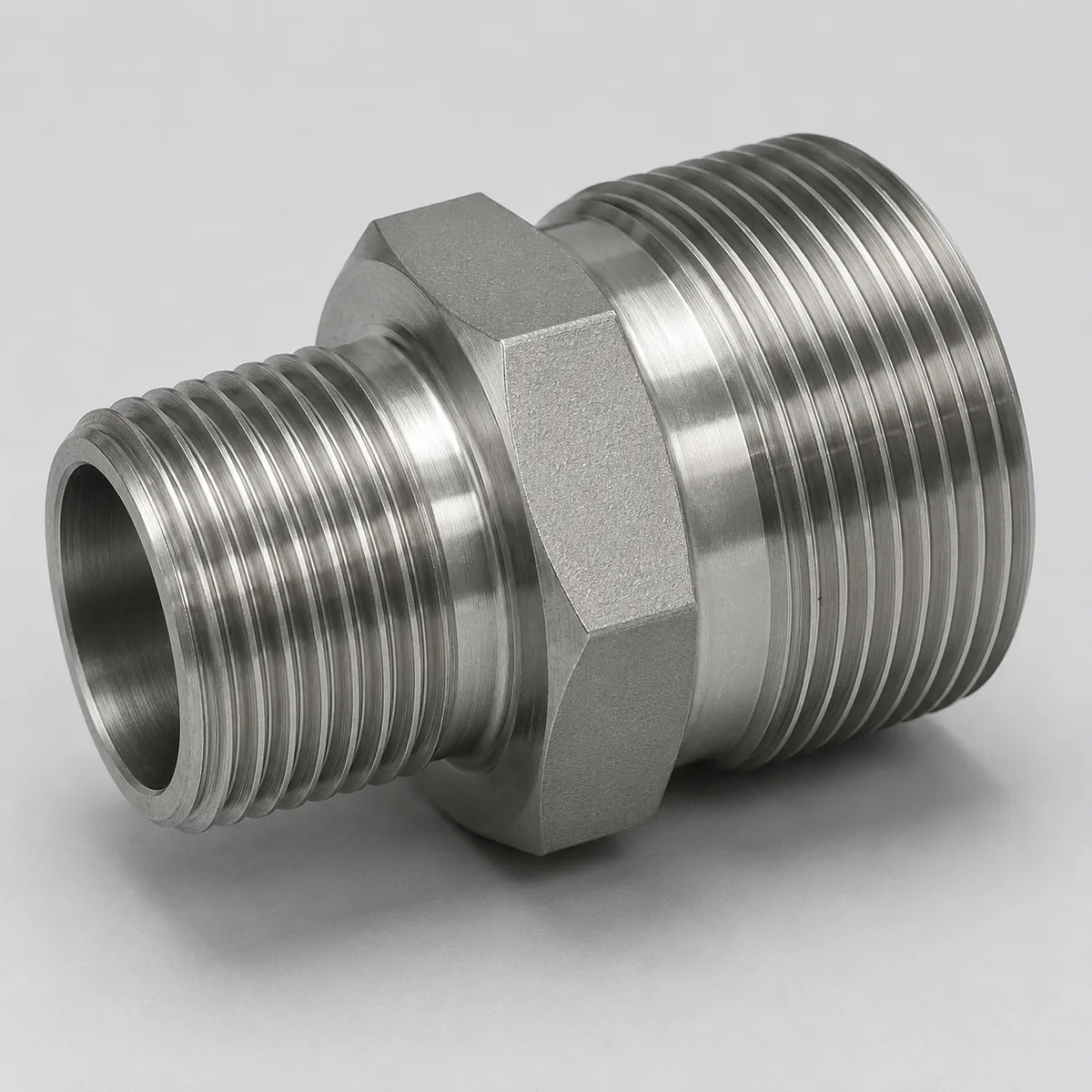
Large Metric Sizes & Pitches We Machine
| Size | Coarse pitch | Common fine pitches |
|---|---|---|
| M33 | M33×3.5 | M33×2, M33×1.5 |
| M36 | M36×4 | M36×3, M36×2, M36×1.5 |
| M39 | M39×4 | M39×3, M39×2 |
| M42 | M42×4.5 | M42×3, M42×2, M42×1.5 |
| M45 | M45×4.5 | M45×3, M45×2, M45×1.5 |
| M48 | M48×5 | M48×3, M48×2, M48×1.5 |
| M52 | M52×5 | M52×3, M52×2, M52×1.5 |
Any size on the left to any other, or to a smaller metric, or to a UNF/BSP/NPT thread — cut to ISO 261 profiles and ISO 965 tolerance classes (DIN 13). Sizes above M52 are machined to your drawing; for the cable-gland and conduit range (M50–M100 to 1½"–4" NPT) see large metric to NPT adapters. Below M50, cable entries are their own problem — PG threads that measure almost the same as metric but will not mate, and glands that have to clear a cast housing: see cable gland & conduit thread adapters.
Worked Examples From the Bench
"M42×3 gland into an M48×2 port — both fine, nothing off the shelf."
A large double-ended adapter, M42×3 male one end, M48×2 female the other, in 4140 for the pressure, with a central hex across flats to torque it. Both threads gauged before it ships.
"An M48×1.5 fine spindle nose has to take an M39×3 collet fitting."
Fine-to-fine on large diameters is pure turning: M48×1.5 one end, M39×3 the other, concentric to a tight runout so the tool runs true. Alloy steel, hardened seat if the drawing calls for it.
"Same M36 diameter, but we need to go from M36×4 coarse to M36×3 fine."
A same-diameter pitch-change adapter — M36×4 female to M36×3 male — so a coarse-threaded body accepts a fine-threaded insert without re-cutting either part.
"A big process sensor is M33×2; the vessel boss is M42×4.5."
An M33×2 to M42×4.5 adapter in 316L, sealed on a bonded washer, so the fine-thread sensor seats cleanly into the coarse structural boss.
Which Material at Large Sizes?
| Material | Density | Why choose it at M33–M52 |
|---|---|---|
| Alloy steel 4140 | 7.85 g/cm³ | The workhorse — high strength for large clamp loads, heat-treatable |
| Carbon steel (zinc) | 7.85 g/cm³ | General hydraulic and structural large threads, low cost |
| Stainless 304 | 7.9 g/cm³ | The most common all-round stainless — general corrosion at large sizes |
| Stainless 316L | 8.0 g/cm³ | Marine, chemical, washdown at size |
| Aluminum 6061 | 2.70 g/cm³ | Light large adapters at moderate load — anodizable, easy to machine |
| Titanium Gr5 | 4.43 g/cm³ | ~45% lighter than steel where a large thread must stay light |
| Brass | 8.5 g/cm³ | Large electrical or low-load fluid work only |
EN 10204 3.1 material certificate and a dimensional report on request.
No drawing, just the old adapter or the two parts? Send them — we gauge both large threads (size and pitch) and reproduce from the sample. Large fine pitches are easy to mis-read by eye, so we measure rather than guess.
Will it fit? Large metric checks before you order
At M33 and above the fine pitches are the common ones, and that is where the near misses live. An M36×3 fine nut will not go onto an M36×4 coarse rod, and an M42×2 hydraulic-cylinder rod thread will not take an M42×4.5 coarse coupling. Nominal size alone does not specify the part: an M36 to M30 adapter is M36×4 or M36×3 or M36×2 on one end and M30×3.5, ×2 or ×1.5 on the other, and each combination is a different piece of steel.
What do I need to connect an M30 part to an M36 thread?
An adapter with an M36 end at the measured pitch and an M30 end at yours — M36 female × M30 male to fit an M30 stud into an M36 bore, M36 male × M30 female to put an M30 fitting onto an M36 rod end. Measure both pitches with a gauge; at this size a wrong guess is an expensive piece of 4140.
Same large adapter, but 20 mm longer, in 316L, or with a fine pitch
Extra length to clear a flange, 316L or titanium instead of 4140, M42×2 instead of ×4.5 on one end, or spanner flats on the body — each is a variant of the same drawing, one piece and up, quoted in 12 hours.
Where the Catalogue Stops for This Size Pair
Above M33 almost nothing is a shelf item, which is why this size class reaches us as a drawing.
| What you need | In the catalogue? | How we machine it |
|---|---|---|
| A plain coarse-to-coarse reducer in this size step | Sometimes stocked | If a stockist lists it, buy it off the shelf. We are worth calling when the pitch, length, material or form is not on their page. |
| Any pairing above M33 | No | Fastener catalogues thin out fast at this diameter. Turned from bar to your two pitches. |
| Different pitch on each end | No | Each thread single-pointed to its own pitch on the same bar. |
| Double-male stud instead of a bush | Thin | Male on both ends; far fewer sizes stocked and almost none in mixed pitch. |
| Female-female coupling | Thin | Joins two studs rather than reducing a hole. Any pitch pair. |
| Hex flats sized to a spanner you already own | No | Cut to your wrench, not to a catalogue table. |
| Through-bore for a shaft, cable or fluid | No | Bore and both threads cut in one setup so they stay concentric. |
| Shortened body for a crowded plate | No | Catalogue parts come in one length. State the space you have. |
| Left-hand thread on either end | No | Not stocked at any size. |
| 316 stainless or alloy steel instead of plated mild steel | Rare | Material is open; no tooling cost at these sizes. |
One frequent large-metric visitor: M33×3.5, the modern wood lathe nose. Converting it to an inch nose — or to a nose no chart lists — is covered on wood lathe spindle thread adapters.
Frequently Asked Questions
M33 to M52 and beyond — M33, M36, M39, M42, M45, M48, M52 — in coarse and fine pitch. Catalogue adapters stop around M24–M30, so these are made to order.
Yes — each end is turned independently. Reduce M42×3 to M36×3, convert a large metric to UNC/UNF/BSP/NPT, or change pitch on the same diameter.
The diameter looks standard but the fine pitch (M42×3, M48×1.5) isn't stocked as an adapter. Spindles, glands and heavy sensors use fine pitches — only a turned adapter bridges them.
Alloy steel 4140 for high load, carbon steel for general, 316L for corrosion, titanium to save weight. We advise for your torque and environment.
The thread and pitch each end (e.g. M42×3 to M36×3), male or female, parallel or tapered, length, material — or the old adapter. Quote in 12 hours.
Large threads usually carry high load, so carbon steel or alloy steel 4140 (heat-treatable) is the workhorse; 316L for corrosion; titanium where weight matters at size. Brass is used at large sizes mainly for electrical or low-load fluid work. We advise on material for the torque and environment.
Get a Large Adapter Quoted
FINAL PRICE BY QUOTE · VARIES WITH SIZE, MATERIAL & QUANTITY
Tell us the two large threads and pitches, and the material. Engineers reply in 12h.
// Qty & price
1 pc
Sample price
Confirm fit before a run
10–50
Unit price drops
Setup cost shared
100+
Best price
All tiers quoted upfront
- →No distributor — you pay the maker directly
- →CAD saved after first order — reorder anytime at lower unit price