Two threads measure the same diameter but won't screw together past a turn or two — because the pitch is different (one coarse, one fine, like M20×2.5 and M20×1.5). You can't force it; coarse-into-fine jams and strips. The clean fix is a custom adapter cut to each pitch. Here's how to confirm it and get the exact part made — from a sketch, no CAD. Skip ahead and send your two threads →
Why same-diameter threads still won't mate
An M20×1.5 bolt will not enter an M20×2.5 hole even though both measure the same outside diameter: a thread only engages when both the diameter and the pitch agree. It's easy to catch a diameter mismatch — an M16 obviously won't enter an M20. The sneaky one is when the diameters are identical but the pitch differs: a caliper reads the same outside diameter, the bolt starts to thread, and it feels right for a turn… then it binds. That's a pitch mismatch, and it's one of the most common reasons a "right-size" part still won't fit.
Don't run it in. Coarse threads have steeper, wider crests than fine threads at the same diameter. Driving one into the other shaves the flanks off the softer part — it feels seated, then strips under the first real load. Once that happens both parts are scrap. Stop at the first sign of binding.
Coarse vs fine: the common metric pairs
M12 is coarse at 1.75 mm and fine at 1.5 or 1.25 mm; M16 coarse 2.0, fine 1.5; M20 coarse 2.5, fine 1.5 or 1.0; M24 coarse 3.0, fine 2.0 or 1.5. On metric threads the coarse pitch is the unmarked default; a fine pitch is always called out explicitly (the number after the ×). These same-diameter pairs are the usual culprits:
| Diameter | Coarse (default) | Common fine pitches |
|---|---|---|
| M12 | M12×1.75 | M12×1.5 · M12×1.25 |
| M16 | M16×2.0 | M16×1.5 |
| M20 | M20×2.5 | M20×1.5 · M20×1.0 |
| M24 | M24×3.0 | M24×2.0 · M24×1.5 |
| M30 | M30×3.5 | M30×2.0 · M30×1.5 |
If your two parts sit on the same row but in different columns, that's your problem — and a stock adapter (which is built around standard pairs) won't fix it.
How to tell which pitch you have — 3 steps
Gauge the pitch on each side
Press a thread pitch gauge onto the thread until a blade drops in with no gap. No gauge? Lay a steel rule along the crests and measure across several threads, then divide by the count — that's the pitch in mm.
Confirm the diameters really match
Measure the outside diameter of the male thread (or across the crests of the female). If both read ~20 mm but the pitches differ, you've confirmed a pure pitch mismatch — not a diameter problem.
Write both callouts
Note each as diameter × pitch and gender — e.g. "M20×2.5 male" to "M20×1.5 female". Not sure? Send photos or the parts and we identify them with gauges. How we identify threads without a drawing →
The fix: one adapter, a different pitch on each end
The reliable solution is a short adapter turned with the coarse pitch on one end and the fine pitch on the other, with a hex in the middle to drive it. Because it's machined to order, the two ends don't have to belong to any standard pair — each is single-point cut to mate with one of your parts and gauged with a thread ring or plug before it ships. Same diameter or different, coarse-to-fine, metric-to-imperial — whatever the two parts actually are.
One nuance worth clearing up: deliberately putting two pitches on one axle to get a fine linear adjustment is a differential screw, a mechanism in its own right. If that's what you're after, we make those too. But if you simply have two existing parts whose pitches happen to differ, you don't need a mechanism — you need an adapter that mates each side. See the broader guide to connecting two different threads →
Real examples
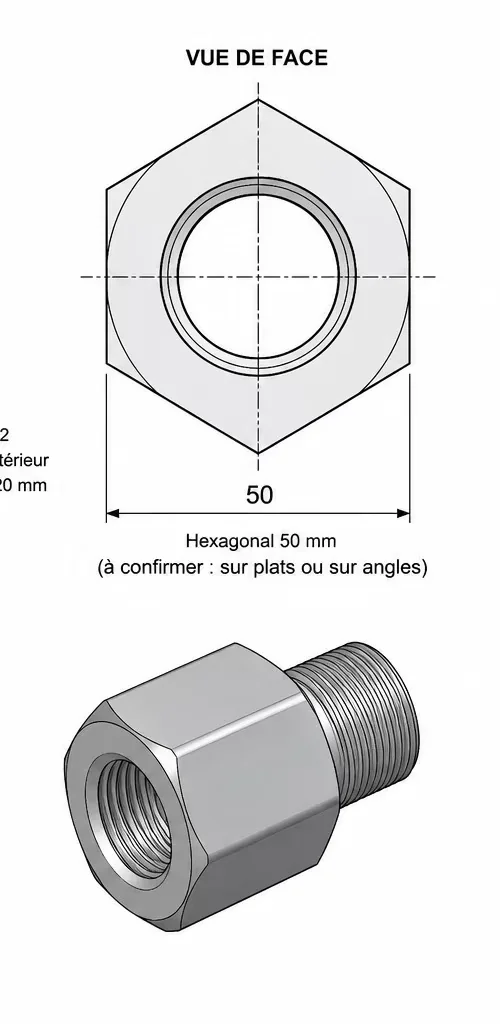
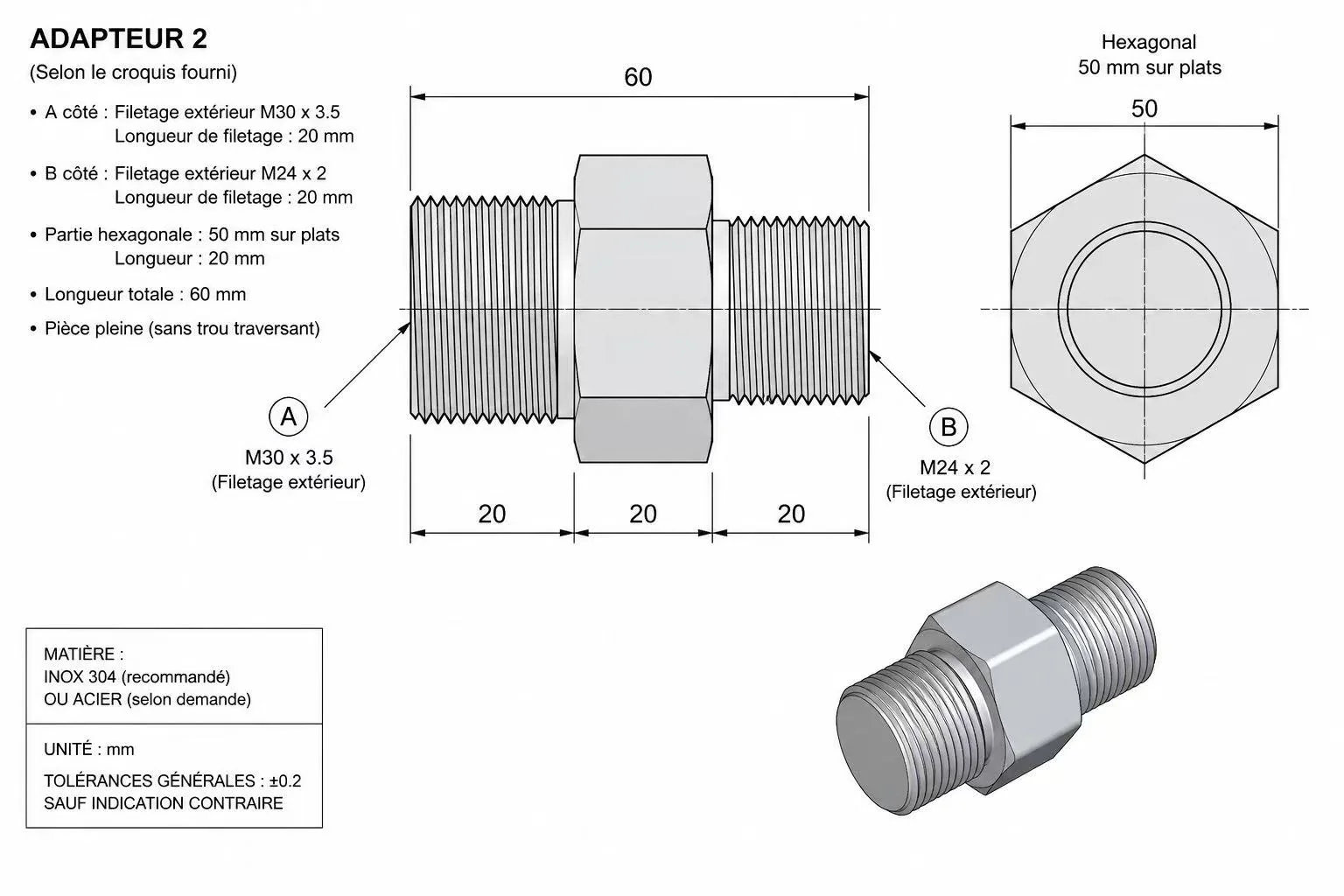
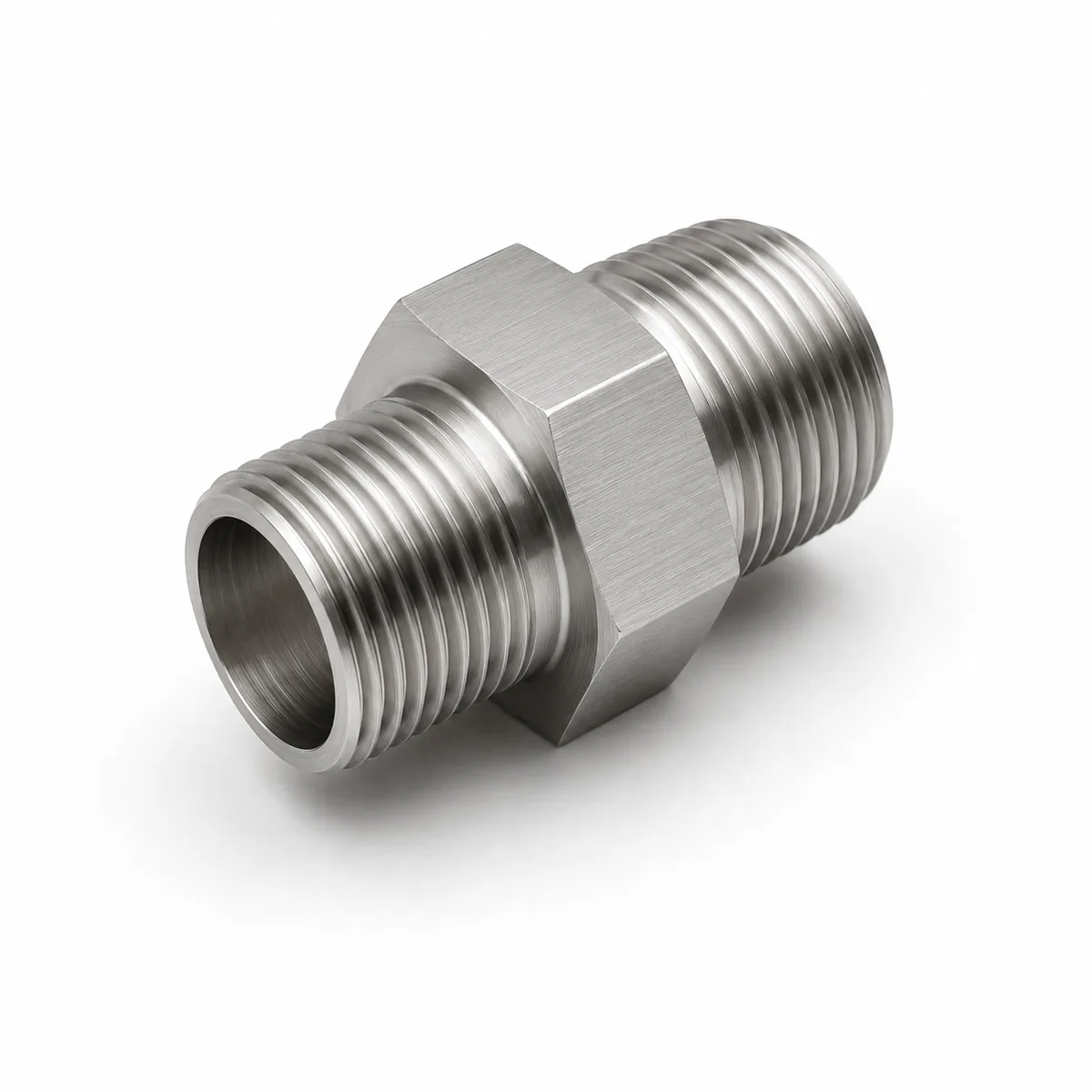
Both of these were machined to order from a hand sketch — a thread combination, including mixed pitch, that isn't sold anywhere:
The textbook case of this problem is electrical: PG 13.5 measures 20.4 mm across the thread and M20 measures 20.0 mm, yet PG runs a 1.41 mm pitch on an 80° flank against metric's 1.5 mm on 60°. Same diameter to the eye, will not engage. See the full PG-to-metric conversion chart on the cable gland adapter page.
Same Diameter, Different Pitch — What the Catalogue Covers
Coarse-to-coarse reducers are stocked. Coarse-to-fine at the same diameter is not, because it is not a reducer at all — it is a pitch converter.
| What you need | In the catalogue? | How we machine it |
|---|---|---|
| A plain coarse-to-coarse reducer, two sizes apart | Stocked | Buy it off the shelf. |
| Same diameter, coarse one end, fine the other | No | There is no size step to build a catalogue part around. Both ends single-point cut to their own pitch. |
| Two different fine pitches at the same diameter | No | For example the same nominal size with two different fine pitches on sensor and instrument threads. |
| A pitch that is not on the ISO coarse or fine list | No | Machine-tool and legacy equipment pitches are cut to the value you measured. |
| You are not sure which pitch you have | n/a | Send the part or a photo of a pitch gauge on it. We identify it before quoting. |
| Left-hand at either pitch | No | Not a catalogue item. |
| A hex or flats so the converter can be torqued | No | Sized to a standard spanner where the diameter allows. |
The coarse and fine pitch values above are the ones already tabulated on this page.
See also the fitting thread identification chart and replacement fittings from a sample.
Frequently asked
Will a coarse thread screw into a fine thread of the same diameter?
No. Same nominal diameter but different pitch — for example M20×2.5 into M20×1.5 — won't engage. It lines up for a turn or two, then binds and strips the softer part. They aren't interchangeable, even though a caliper reads the same outside diameter.
How do I tell a coarse thread from a fine one?
Use a thread pitch gauge, or count crests over a measured length. Fine threads pack more crests into the same distance. On metric parts, coarse is the default (M20 = 2.5 mm) and fine is called out explicitly (M20×1.5). Unsure? Send a photo or the part and we gauge it.
Is a differential thread the same as a pitch adapter?
No. A differential screw deliberately uses two pitches on one axle to make fine adjustments, each pitch driving its own nut. A pitch adapter just joins two parts whose pitches differ — each end mates one of your parts. We can make either; tell us whether you need a mechanism or a connection.
Can you make an adapter with a different pitch on each end?
Yes — that's the whole point of a custom adapter. Each end is single-point turned to its own diameter and pitch and gauged before shipping. We also do coarse-to-fine, metric-to-imperial, and male/female combinations no catalog stocks.
Same size, won't thread? Send a photo, a sketch, or just the two callouts (e.g. "M20×2.5 to M20×1.5"). We'll confirm the pitch, draw the adapter free, and quote — usually within 12 hours. Get a quote → or explore custom metric thread adapters.