If two parts won't screw together — different diameter, different pitch, or one's coarse and one's fine — you can't force them. The reliable fix is a thread adapter cut to each thread. Here is how to pin down what you have and get the exact adapter made — from a sketch, no CAD, one piece up. Skip ahead and send your two threads →
First, why it won't fit
Two threads only join when both the diameter and the pitch agree. When they don't, one of these is usually the reason:
Different diameter
An M24 won't enter an M30 — the simplest mismatch. You need a reducer between the two sizes.
Different pitch
Same diameter, but one is coarse and one is fine (e.g. M24×3 vs M24×2). They cross and jam — they don't engage.
Different standard
Metric vs imperial (UNF/UNC), or BSP vs NPT. The forms are incompatible even at a similar size.
Same gender
Two males, or two females, that need to meet — you need a piece that presents the opposite gender to each.
Don't force it. Cross-threading shaves metal off both parts and never holds load or pressure safely. A jammed coarse-into-fine joint feels "almost right" for a turn or two, then strips. The correct answer is always an adapter cut to the real threads.
The fix: an adapter cut to each thread
A thread adapter is a single piece with one thread on each end and a hex in the middle to drive it. Because it's machined to order, each end can be whatever you have — any diameter, any pitch, coarse or fine, metric or imperial — even a combination no catalog stocks. That's the difference between a custom adapter and an off-the-shelf one: the stock part has to match a standard pair; a custom one matches your pair.
How to get the right one — 3 steps
Identify both threads
Get the diameter and pitch of each side — e.g. M30×3.5 and M24×2 — and note whether each part is male or female. Not sure? Send photos or the parts; we identify them with thread gauges and calipers.
Choose the form
Pick male-female (to extend or convert a single line) or double-male / female-female (to join two same-gender parts). If you're unsure, tell us what each end screws into and we'll advise. Compare adapter types →
Send it to be made
A sketch or the two thread callouts is enough. We draw and confirm the adapter, then turn it — each end cut to its own thread and gauged. One piece or a small batch, no tooling cost. How ordering with no CAD works →
Real examples
Both of these started as a hand sketch of a thread combination that isn't sold anywhere — M30×3.5 paired with M24×2 — and were machined to order:
Electrical installations throw up the same problem in a different vocabulary: a connector on one side, a cable gland or protective conduit on the other, and two threads from different standards. That case is covered on the cable gland & conduit adapter page, with the PG, metric and NPT charts.
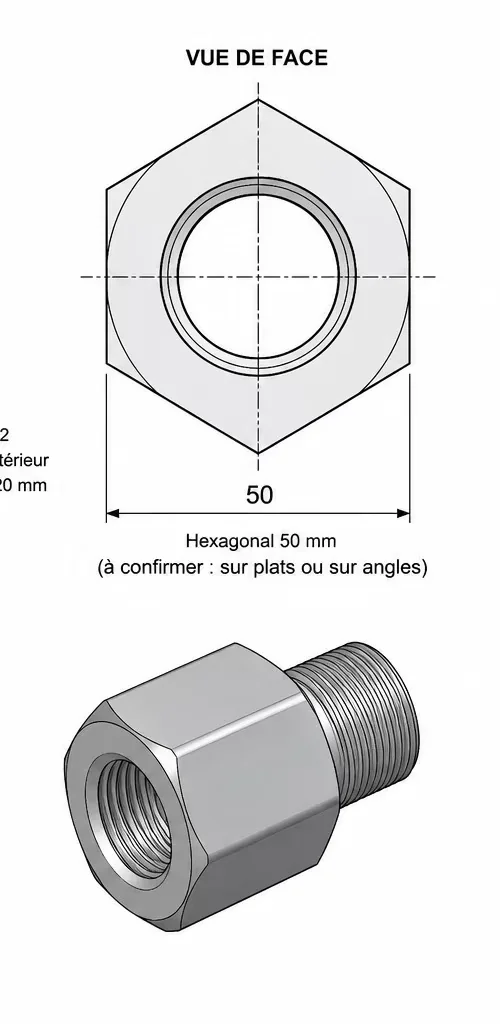
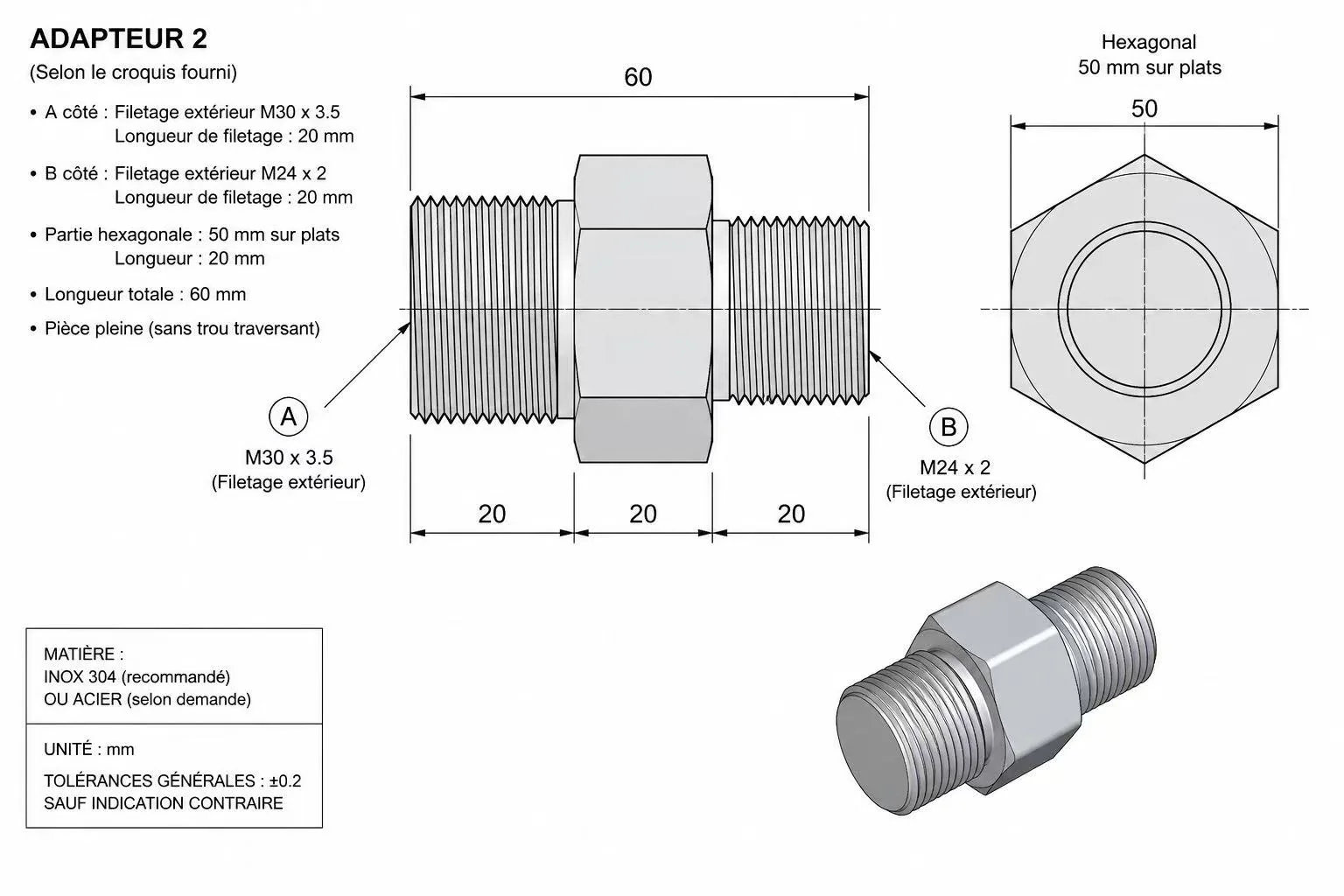
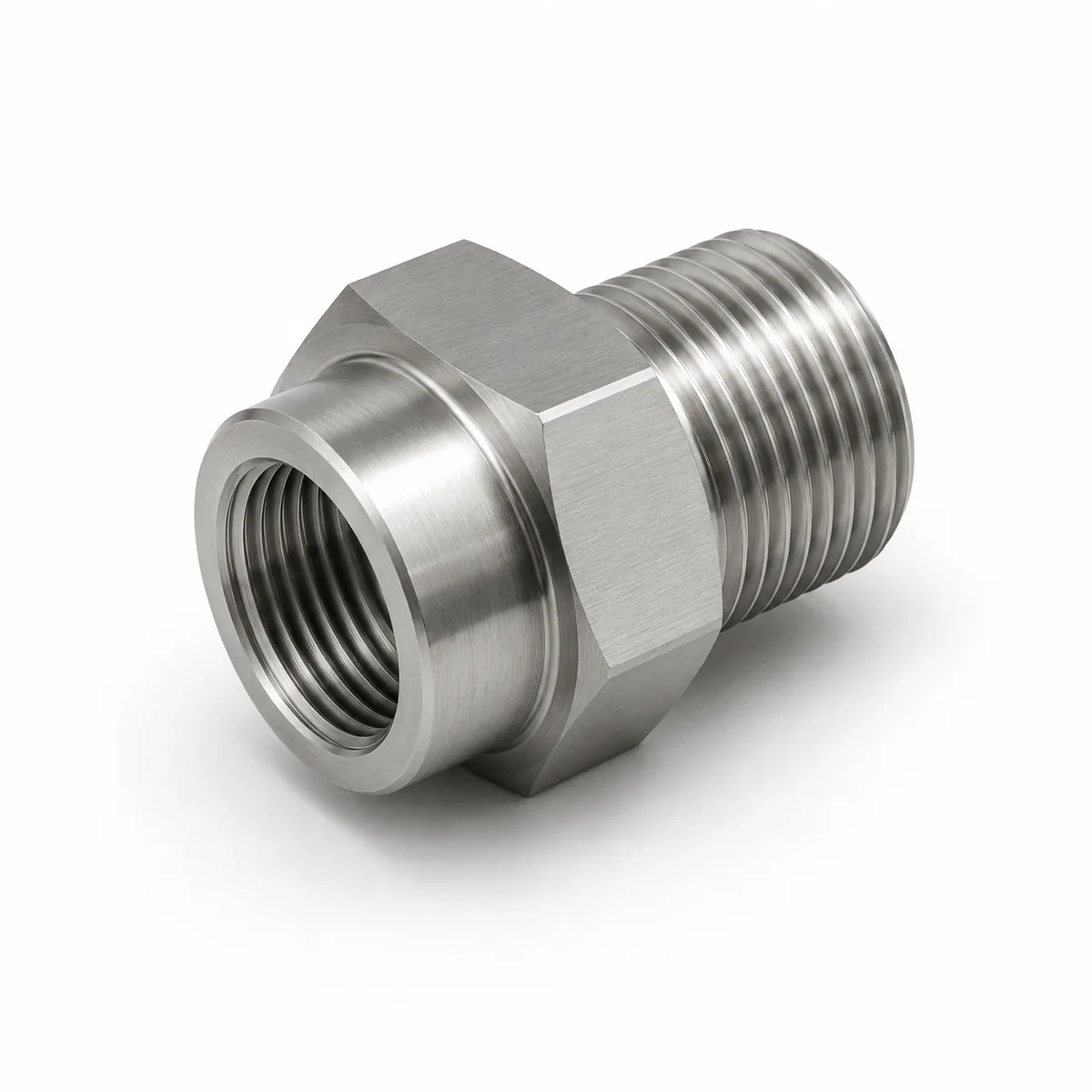
A 3/4-16 oil cooler line against an M20×1.5 radiator port — what to measure
“I have a 1995 Chevrolet C1500 5.7 L. The oil cooler lines look to have a 3/4 by 16 thread on the cooler line that comes to the radiator, however the radiator has an M20 by 1.5 thread count. Do you sell an M20×1.5 male thread to female 3/4×16? Pictures aren’t great but I work late.”
— an enquiry received in September 2026, with the photograph below
Yes, that adapter can be made — but not from the two thread names alone. A 3/4-16 UNF fitting and an M20×1.5 port are 0.95 mm apart in diameter and 0.09 mm apart in pitch: the fitting starts in the port because it is the smaller of the two, runs loose for a few turns, then binds as the pitch difference adds up turn by turn. The adapter that joins them is male M20×1.5 into the radiator and female 3/4-16 UNF for the line — and on this fitting the female end must also seat the O-ring on the fitting’s nose, which no thread name describes. That is why we asked for the full list of readings below rather than two thread names, and why the list is printed here for anyone with the same joint.
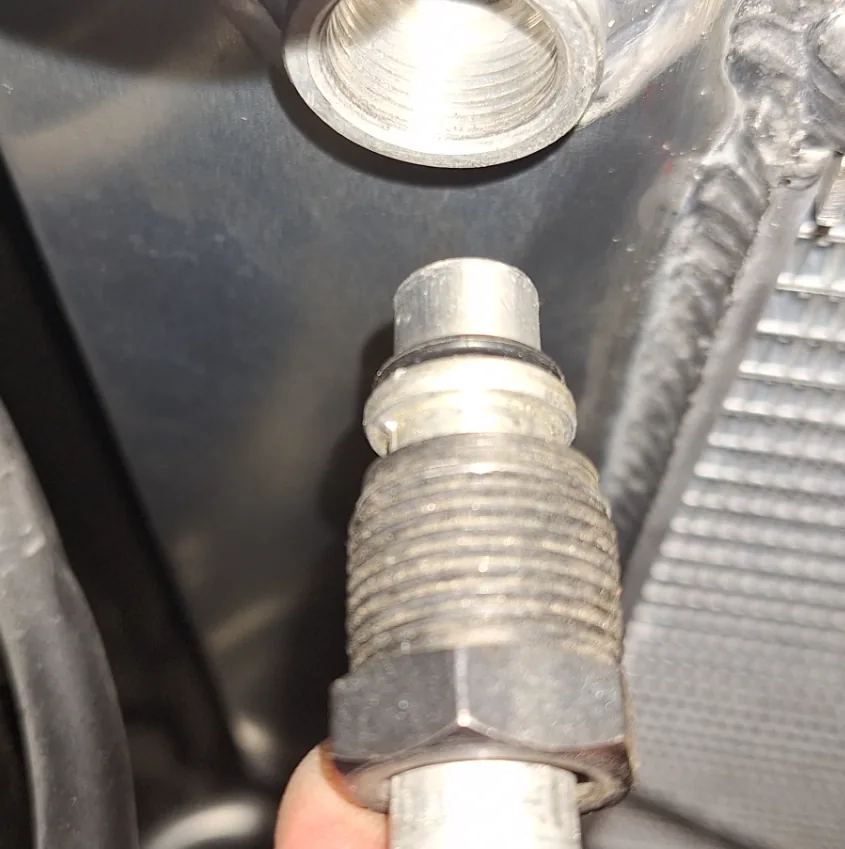
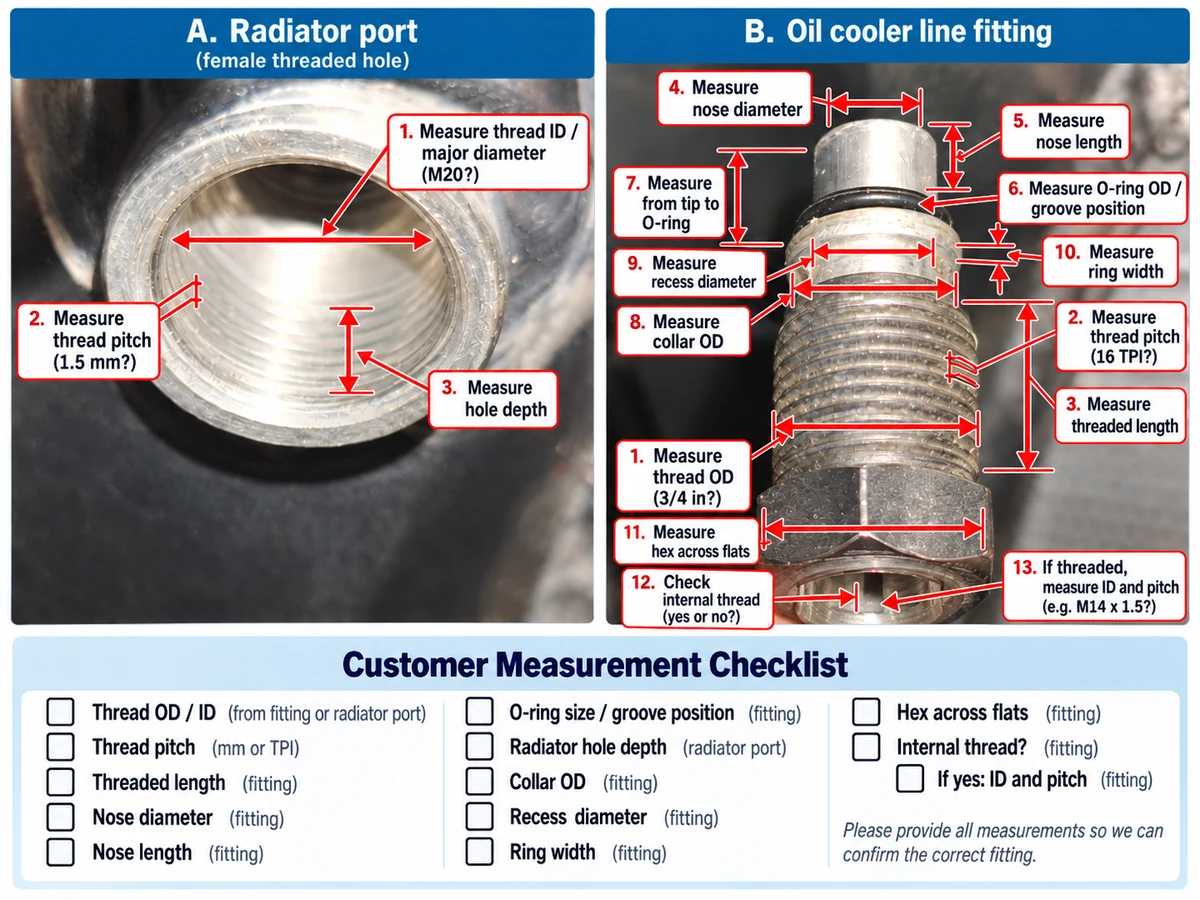
A. The radiator port — marks 1 to 3
- 1 Thread bore. Close a caliper’s inside jaws across the thread. That reads the minor diameter, not the nominal size: about 18.4 mm says M20×1.5, about 17.3 mm says 3/4-16 UNF. A full millimetre apart, so a caliper settles it.
- 2 Pitch. A rule over ten crests is awkward inside a hole, so use a thread pitch gauge, or press modelling putty or soft solder wire into the thread and measure the impression over ten crests: 15.0 mm is a 1.5 mm pitch, 15.9 mm is 16 threads per inch.
- 3 Depth. How far the full thread runs before the hole steps down or opens into the tank. The male end of the adapter is cut shorter than this so it never bottoms. Note also what the port face is like — flat and machined, or chamfered or counterbored — because that face is where the metric end seals, on a bonded washer or an O-ring under the adapter’s shoulder.
B. The line fitting — marks 1 to 13
- 1 Thread OD. A caliper over the crests: 3/4-16 measures 18.9 to 19.0 mm, M20×1.5 measures 19.8 to 20.0 mm.
- 2 Pitch. Ten crests on a rule: 15.9 mm is 16 threads per inch, 15.0 mm is a 1.5 mm pitch. The 0.9 mm between them is easy to see on a steel rule and impossible to see by eye on the thread itself.
- 3 Threaded length. First full thread to last. The female pocket in the adapter is threaded at least this deep.
- 4 Nose diameter and 5 nose length. The smooth pilot ahead of the thread. The bore the O-ring seals in is sized from these two readings, not from the thread.
- 6 O-ring and 7 tip to O-ring. The outside diameter of the ring and where its groove sits on the nose, plus the distance from the tip to the ring. Together they fix how deep the sealing bore must reach before the thread begins.
- 8 Collar OD, 9 recess diameter, 10 ring width. The step between the nose and the thread. The mouth of the adapter either clears this collar or seats on it, so all three are needed.
- 11 Hex across flats. The spanner you will use, and how large the adapter’s own hex can be beside it.
- 12 Internal thread, and 13 its size. Look into the fitting from the line end: is it threaded inside? If so, note that bore and pitch. It tells us how the fitting is built and what bore the adapter must keep open.
A caliper reading to 0.1 mm is enough for every mark; a photo of each reading with the caliper still closed on the feature is better than a list of numbers typed from memory, because it lets us check which feature was measured.
| Readings | What they fix on the adapter |
|---|---|
| Port 1 and 2, fitting 1 and 2 | Which thread each end is cut to: M20×1.5 to ISO 261 into the radiator, 3/4-16 UNF to ASME B1.1 for the line |
| Port 3, fitting 3 | The length of each end: the metric end shorter than the port is deep, the UNF pocket as deep as the fitting’s thread is long |
| Fitting 4 to 7 | The smooth bore beyond the female thread, sized and deepened so the nose O-ring seals in it the way it did in the original port |
| Fitting 8 to 10 | The counterbore at the mouth that clears or seats the collar |
| Fitting 11 | The adapter’s own hex, sized for the spanner and for the room beside the line’s hex |
| Fitting 12 and 13 | The through-bore, no smaller than the line’s |
From those readings we draw the adapter, send the drawing back to be checked against the parts in your hand, and only then cut it. One piece is fine.
| What you measured | What it is | Do this |
|---|---|---|
| Port bore about 18.4 mm and 15.0 mm over ten threads; fitting about 19.0 mm and 15.9 mm over ten | An M20×1.5 port and a 3/4-16 UNF fitting — the pair in the photograph | The adapter is male M20×1.5, female 3/4-16 UNF. If the fitting seals on a 37° cone or a flat face, look for a stock M20×1.5-to-3/4-16 adapter first (3/4-16 is the −8 AN and SAE −8 ORB thread, so that is the name it is listed under); a stock part is cheaper than a one-off and we will say so. If it seals with an O-ring on a nose, as here, the female end also needs the bore from marks 4 to 7, and that is a made-to-order part. |
| Both sides read the same — both 15.0 mm over ten and about 18.4 / 19.9 mm, or both 15.9 mm and about 17.3 / 19.0 mm | The same thread on both parts | Not a thread mismatch. Look for a damaged thread or a missing seal before buying anything. |
| A ten-thread reading that is neither 15.0 nor 15.9 mm — 12.7 (20 TPI), 14.1 (18 TPI), 18.1 (14 TPI), 20.0 (a 2 mm pitch) | A different thread altogether | Send both sets of readings, or the two parts, and we identify them before anything is drawn. |
| A port you cannot get a caliper into | Unknown port | Press putty or solder into the thread for the pitch, measure the impression for the bore, and photograph the port face with a rule across it. |
Two Threads That Will Not Meet — What the Catalogue Covers
Some pairings are stocked and you should just buy them. These are the ones people send us, and each one is a single part with your thread on each end.
| What you need | In the catalogue? | How we machine it |
|---|---|---|
| Two of the same standard, common sizes | Stocked | A plain reducer exists for this. Buy it there, or ask us — we may have it in stock, and the more pieces, the lower the unit price; for one piece today, a local supplier is faster. |
| BSP one end, NPT the other | Stocked in common sizes | Widely available up to about 1 inch. Beyond that, or in mixed forms, it comes to us. |
| Metric M one end, NPT or UNF the other | Thin | The two systems share no thread form. Both ends single-point cut on one bar. |
| JIC 37° or ORFS against a metric port | Rare | Hydraulic hose end meeting a machine port from another system. |
| Same diameter, different pitch | No | The pairing that looks identical until it jams. Each end cut to its own pitch. |
| Left-hand one end, right-hand the other | No | Not stocked in any size or standard. |
| A thread you cannot identify | No | Send the part or the two mating pieces. We measure pitch, major diameter, flank angle and taper, then cut both ends to match. |
| An obsolete port from a machine out of production | No | Copied from the part, not from a chart. |
State both ends and the form you need. If we think a stock part will do the job, we will tell you that instead.
When the two threads are a lathe headstock and a chuck, the joint has an extra rule — the register shoulder does the locating, not the thread. That case is covered on wood lathe spindle thread adapters.
See also the fitting thread identification chart with every G, R, NPT, metric, JIC and ORFS size by diameter and pitch, the JIC and ORB fitting size chart with every hydraulic dash size from -2 to -32, and replacement fittings from a sample.
Frequently asked
Can I force two threads of different sizes together?
No. Cross-threading damages both parts and never holds load or pressure safely. Threads only join when diameter and pitch match. If they don't, you need an adapter that presents the correct thread to each side.
The diameters match but the pitch is different — is that the problem?
Often, yes. Same diameter with a different pitch (coarse vs fine) won't engage and will jam or strip — and it's a common reason a stock adapter won't fit. A custom adapter is cut with the exact pitch on each end. Full guide to connecting different thread pitches →
Do I need to know the exact thread sizes?
It helps but isn't required. Send a photo or the two parts; we identify the diameter and pitch, then draw and confirm the adapter before machining. How we identify threads without a drawing →
How do I tell a 3/4-16 fitting from an M20×1.5 one?
Measure over ten threads with a rule: 15.9 mm is 16 threads per inch, so 3/4-16; 15.0 mm is a 1.5 mm pitch, so M20×1.5. Then check the diameter: a 3/4-16 male measures about 19.0 mm over the crests and an M20×1.5 male about 19.9 mm; inside a female port a caliper reads about 17.3 mm for 3/4-16 and about 18.4 mm for M20×1.5. Both readings have to agree before you name the thread.
What do I need to measure for an oil cooler line to radiator adapter?
Three things on the radiator port — thread bore, pitch and thread depth — and on the line fitting its thread diameter and pitch, threaded length, nose diameter and length, O-ring size and position, collar and recess diameters, ring width, hex across flats, and whether it is threaded inside. From those readings we draw the adapter, male for the radiator and female for the line with a bore that seats the fitting’s O-ring, and send the drawing back for checking before it is cut.
Got two threads that won't meet? Send a photo, a sketch, or just the two sizes (e.g. "M30×3.5 to M24×2"). We'll tell you the right adapter, draw it, and quote — usually within 12 hours. Get a quote → or explore custom metric thread adapters.