Need a male-to-male stud that screws into two different female threads — and the two ends aren't the same size or pitch? That's a double-male thread adapter, and when the combination isn't a catalog item, it has to be machined. Here's a real one — external M30×3.5 to external M24×2 — built from a customer sketch, with the full production drawing. Send your two threads for a quote →
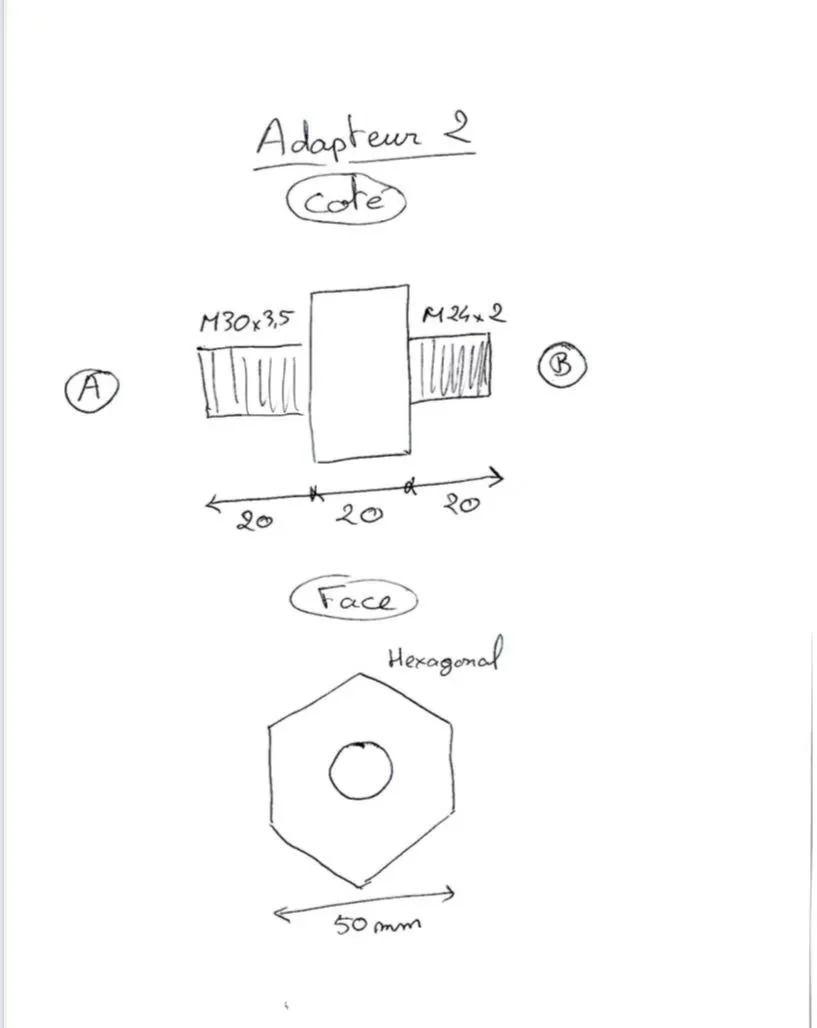
HAND SKETCH · BOTH ENDS EXTERNALLY THREADED · M30×3.5 + M24×2 · 50 MM HEX
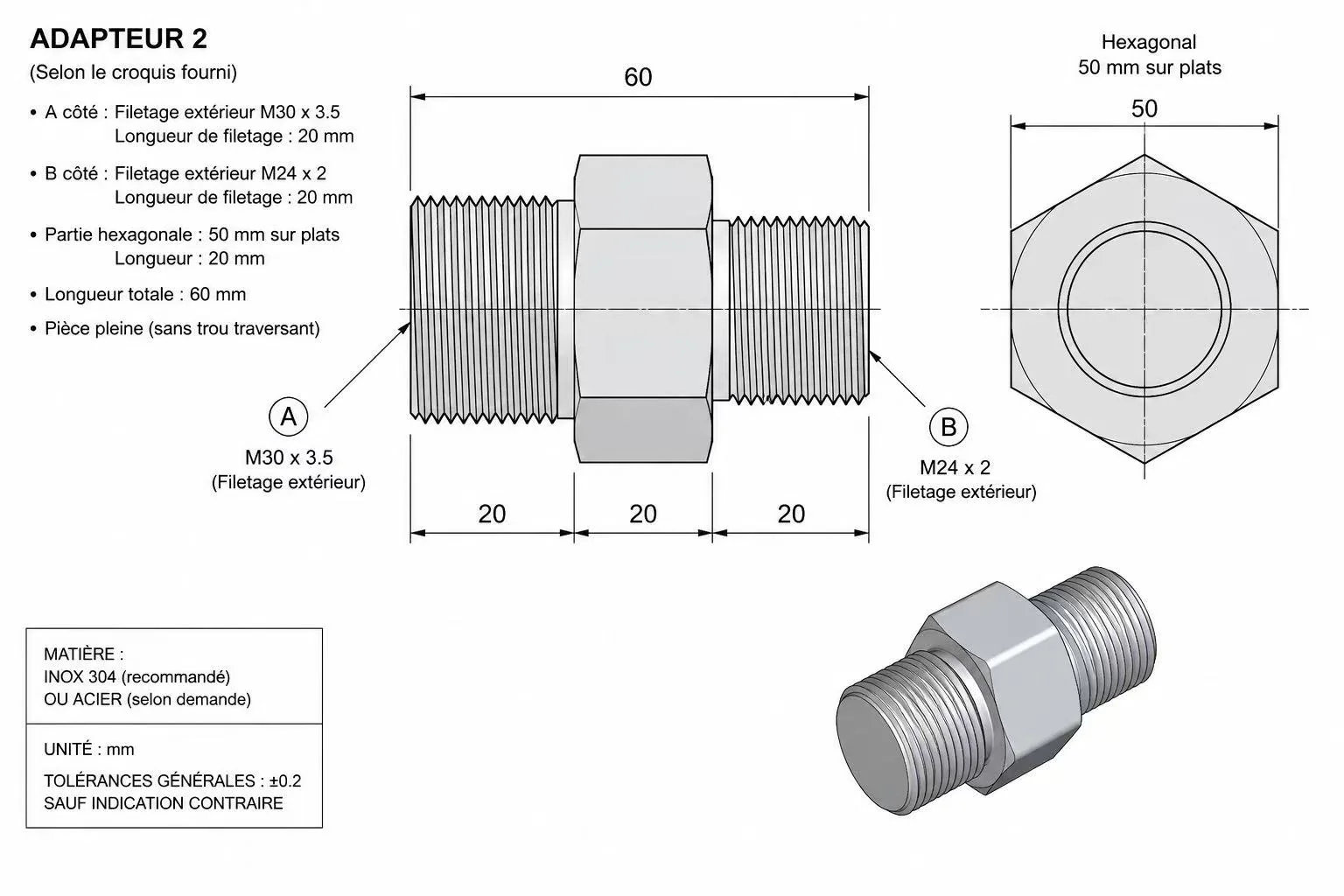
DIMENSIONED DRAWING · 60 MM · HEX 50 ACROSS FLATS · SOLID · 304 STAINLESS · ±0.2 mm
What a Double-Male (Stud) Adapter Actually Does
A double-male thread adapter — also called a male-to-male adapter or simply a stud — is externally threaded on both ends, with a hex or flats in the middle to drive it. Unlike a male-female adapter (which extends or converts a single line), a double-male does one of three jobs:
Join two female ports
Two tapped holes or two female fittings that need to be connected back-to-back — the stud threads into both.
Turn a tapped hole into a stud
Convert an internal thread into a projecting male thread to mount or hang something from it.
Reduce while you join
When the two ends differ — M30×3.5 one side, M24×2 the other — it joins and steps between sizes and pitches in one piece.
This third job is the hard one. A plain double-male stud in a single thread size is sometimes a stock item; a stud that's M30×3.5 on one end and M24×2 on the other almost never is — coarse on one side, fine on the other, two different diameters. That's why this customer in France couldn't buy it and had to have it made.
From Sketch to a Full Production Drawing
The customer sent a hand sketch labelled "Adapteur 2" with the two thread callouts, the 20 + 20 + 20 mm sections and a 50 mm hex. Before quoting, we turned it into a fully dimensioned production drawing — a front view, the hex view and a 3D render — so the customer had something exact to approve. That drawing is where every open question from a hand sketch gets pinned down in writing:
- Hex = 50 mm across flats (not across corners) — so it fits a 50 mm spanner.
- Solid, no through-bore — a stud carrying load, not a passage for fluid or a shaft.
- Material: 304 stainless recommended, steel as an alternative on request.
- General tolerance ±0.2 mm unless a feature needs tighter control.
- Thread engagement 20 mm each end — enough length for a strong, repeatable joint.
Why a drawing, not just a quote: a stud takes torque at both ends. Confirming hex size, material and engagement length on a drawing first is what guarantees the finished part fits the spanner and the mating threads — before any metal is cut.
Specification
| Feature | Specification | Notes |
|---|---|---|
| End A thread | M30 × 3.5 external (male) | Coarse pitch · 20 mm long |
| End B thread | M24 × 2 external (male) | Fine pitch · 20 mm long |
| Body | Hex, 50 mm across flats | 20 mm long · 50 mm spanner |
| Overall length | ~60 mm | 20 + 20 + 20 mm |
| Bore | Solid | No through-bore |
| Material | 304 stainless (or steel) | By application |
| General tolerance | ±0.2 mm | Tighter where specified |
| Quantity | 1 piece and up | No minimum, no tooling cost |
How the Stud Is Machined
A double-male stud is a clean CNC turning job from hex bar:
- Hex bar stock — a 50 mm across-flats hexagonal bar gives the wrench flats straight from the raw material.
- Turn end A — face to length, turn the Ø30 journal and chamfer the lead-in for the M30×3.5.
- Turn end B — turn the Ø24 journal and lead-in chamfer for the M24×2.
- Single-point both threads — each end cut to its own pitch, then verified with a thread ring gauge.
- Deburr & inspect — chamfers cleaned, hex and lengths measured, both threads gauged before packing.
One-off or batch: there's no tooling cost on a machined stud, so a single piece is normal work — and the same setup makes a small batch of spares at a lower price per piece.
Need the Male-Female Version Instead?
The same customer also ordered a male-female adapter in the same thread sizes — internally threaded (tapped) M30×3.5 on one face, external M24×2 on the other. Same approach, different gender on one end. If you're not sure which form you need, tell us what each end screws into and we'll advise.
See the related builds: the male-female M30×3.5 → M24×2 adapter case, or read the full French-language project (both variants) → Adaptateur sur mesure M30×3,5 vers M24×2 (FR). A larger double-male in fine pitch is the M35×1.5 to M30×2 in 316L.
A French drawing says 42CD4, a German one 42CrMo4, a US one 4140: the 4140 / 42CrMo4 equivalents chart crosses the names and gives the +QT strength for a Ø30 shank (Re 750 MPa, not 900).
The Takeaway
A double-male stud that mixes diameter and pitch — M30×3.5 to M24×2 — is exactly the kind of part the catalogs skip and a machine shop makes in an afternoon. Starting from a sketch, the customer got a full production drawing, every detail confirmed in writing, and a one-piece stud in 304 stainless. No CAD file, no catalog hunt, no compromise on the threads you have.
Need a male-to-male stud made? Send a sketch, a photo, or just the two thread sizes (e.g. "external M30×3.5 to external M24×2, 50 mm hex"). We'll draw it, confirm it, and quote. Email [email protected] or message us on WhatsApp.
FAQ
What is a double-male thread adapter?
A double-male thread adapter — also called a male-to-male adapter or a stud — is externally threaded on both ends. It joins two female (tapped) parts together, or converts a tapped hole into a projecting stud. When the two ends have different thread sizes or pitches, like M30×3.5 and M24×2, it also acts as a reducer.
Can you make a double-male stud with two different threads?
Yes. We single-point each end to its own diameter and pitch on one body — for example external M30×3.5 on one end and external M24×2 on the other — with a hex in the middle so it can be driven with a spanner. Catalog studs rarely mix diameter and pitch like this, so it is made to order.
Do I need a CAD file to order a custom stud adapter?
No. A hand sketch with the two thread callouts, the lengths and the hex size is enough. We turn it into a fully dimensioned production drawing for free, confirm the details, and quote. No CAD file is required to start. How ordering with no CAD works →