Where Parts Get Checked
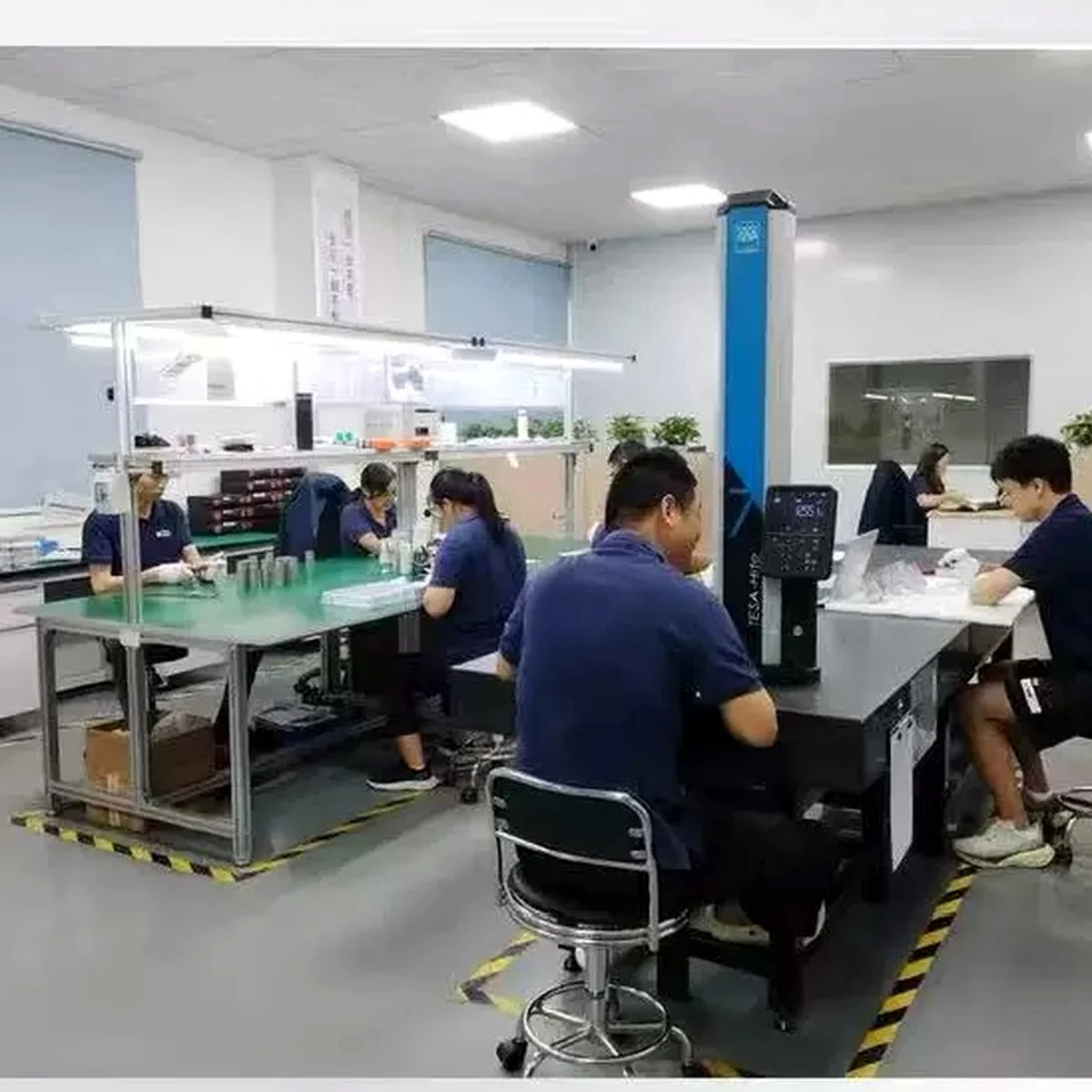
QC INSPECTION ROOM · TESA CMM VISIBLE AT REAR · 6 INSPECTION ENGINEERS
This is our actual inspection room in Guangdong. The blue tower at the rear is the TESA coordinate measuring machine (CMM) — the same equipment used by aerospace and automotive tier-1 suppliers worldwide.
INSPECTION ROOM SPECS
- Temperature controlled: 20°C ±1°C
- TESA CMM — volumetric accuracy ±1.5μm
- 6 dedicated inspection engineers
- Dedicated from machining — no dual roles
Tolerance Capability by Process
| Process | Standard Tolerance | Achievable (precision) | Notes |
|---|---|---|---|
| CNC Turning — diameter | ±0.01mm | ±0.005mm | Specify on drawing; costs more |
| CNC Turning — length | ±0.05mm | ±0.02mm | Shoulder to shoulder |
| CNC Milling — linear | ±0.05mm | ±0.01mm | On critical features |
| CNC Milling — bore | H8 | H7 | Boring head used for H7 |
| Cylindrical grinding | h6 / H7 | h5 / H6 | For bearing fits |
| Surface finish — turned | Ra 1.6μm | Ra 0.8μm | Fine turning inserts |
| Surface finish — ground | Ra 0.8μm | Ra 0.4μm | Precision grinding |
| Flatness (milled face) | 0.05mm/100mm | 0.02mm/100mm | Granite surface plate verified |
| Perpendicularity | 0.05mm | 0.02mm | CMM verified |
| Concentricity / Runout | 0.02mm TIR | 0.01mm TIR | Specified as GD&T callout |
| Thread — metric | 6g / 6H | 5g / 5H | Go/No-Go gauge verification |
| Thread — NPT / BSP | Standard | Standard | Dedicated thread ring/plug gauges |
How to specify tolerance on your drawing: Mark only the dimensions that matter. Dimensions without a tolerance callout are machined to our standard tolerance (±0.05mm for milling, ±0.01mm for turning). Tighter tolerances cost more and take longer — only specify them where the fit or function requires it. For shaft/bore assemblies, spec an ISO fit instead of a raw number — see our limits & fits chart and calculator.
Surface finish follows the same rule: what Ra each process reaches gives the value per process, and dimensions you leave untoleranced fall under ISO 2768 f / m / c / v.
How We Measure
What We Provide
| Document | Standard | On Request | Included With |
|---|---|---|---|
| Packing list | Yes | — | All orders |
| Material mill certificate (MTR) | Yes | — | All metal orders |
| CMM dimensional report | — | Yes | Precision / aerospace / medical |
| First article inspection report | — | Yes | New production parts |
| Thread gauge records | — | Yes | Threaded parts |
| Surface finish report | — | Yes | Ground / polished parts |
| Certificate of conformance | — | Yes | On request |
| RoHS / REACH declaration | — | Yes | EU-market parts |
Specify at time of order which documents you need. For first-time customers, we recommend requesting the CMM report — it gives you direct visibility into the actual measured dimensions of your parts before they ship.
See also the casting tolerance chart (ISO 8062-3 DCTG grades and machining allowance) for cast parts.
Frequently Asked Questions
EKINSUN's standard is ±0.01mm on diameters, ±0.05mm on lengths. For precision turned parts, we hold ±0.005mm on diameters. For ground parts (cylindrical grinding after turning), we achieve h6/H7 fits (±0.006–0.013mm depending on size). Specify tight tolerances on your drawing with explicit callouts.
Standard is ±0.05mm on general dimensions, ±0.01mm on critical features. Precision bores are achievable to H7 using a boring head. Flatness is typically 0.02mm per 100mm. Complex GD&T callouts (profile, true position, angularity) are handled with CMM verification.
Yes, on request. We use a TESA CMM with ±1.5μm volumetric accuracy. Reports list all measured dimensions, nominal values, actual measurements, and pass/fail against tolerance. For aerospace and medical orders we include CMM reports as standard. Request at time of ordering.
As-turned: Ra 1.6μm standard, Ra 0.8μm with fine turning inserts. As-milled: Ra 1.6μm standard. Cylindrically ground: Ra 0.4μm. Mirror polished stainless: Ra 0.2μm. Call out the required Ra value on your drawing — we machine to the specification.
Long slender shafts deflect under cutting forces. We use steady rest support to reduce effective unsupported length, light finishing cuts (0.1mm depth), and cylindrically grind after turning for bearing journals. See our case study on the 480mm stainless shaft (L/D ratio 17:1) where we held h6 tolerance on all 40 pieces.
// Related Capabilities