The Default Stainless Steel
304 (and its low-carbon variant 304L) is the most widely used stainless steel in the world. The "18/8" composition — about 18% chromium, 8% nickel — gives excellent general corrosion resistance, good strength, full weldability and a clean, hygienic surface, which is why it dominates food, beverage, architectural, medical and general industrial parts. It costs less than 316 and covers the large majority of "I need it in stainless" jobs.
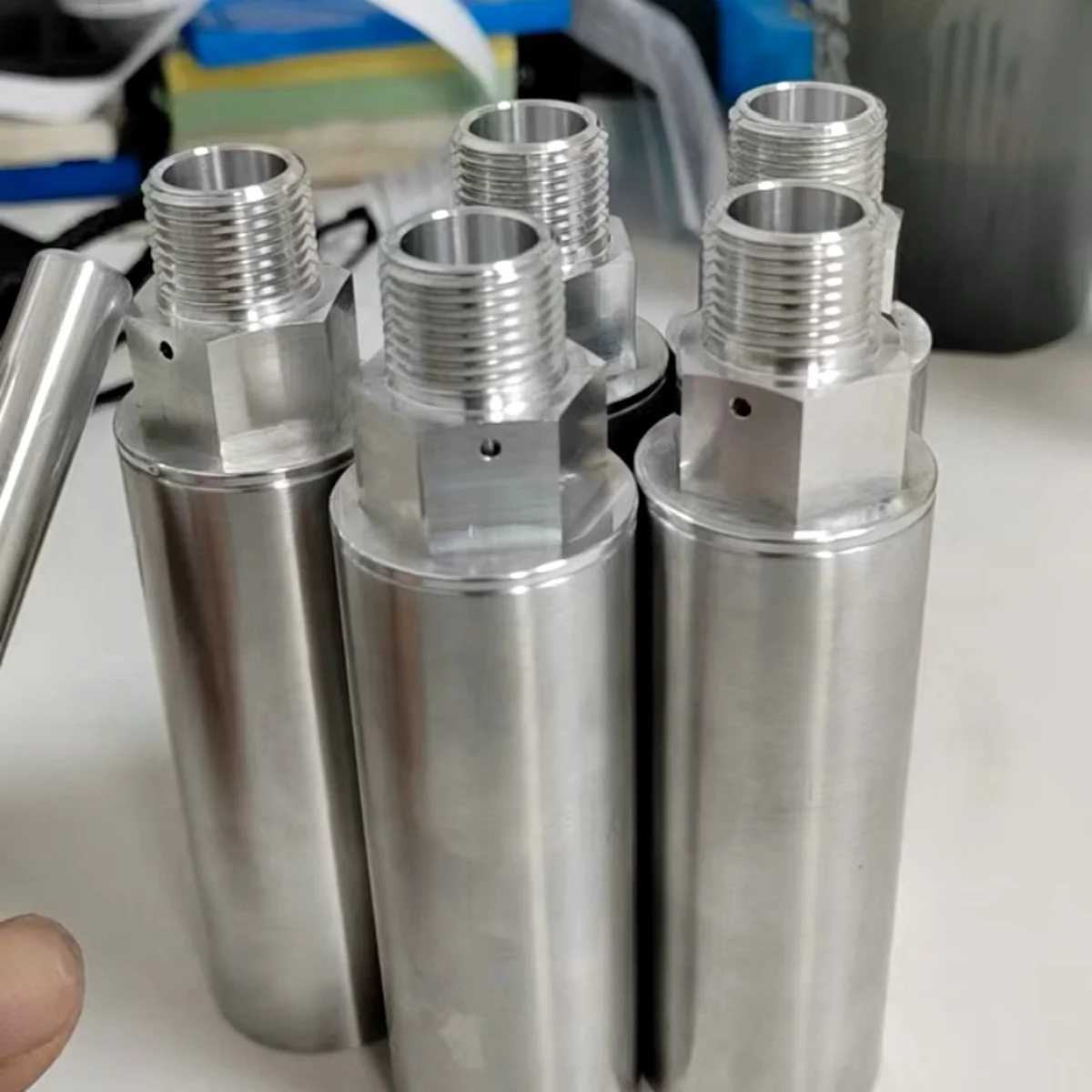
304 Mechanical & Physical Properties
| Property | Typical value (304, annealed) |
|---|---|
| Ultimate tensile strength | ≥515 MPa (often ~580) |
| Yield strength (0.2%) | ~215 MPa (min 205) |
| Elongation at break | ~40–55% |
| Hardness | ~70 HRB (~150 HB) |
| Density | 8.0 g/cm³ |
| Elastic modulus | 193 GPa |
| Composition | ~18% Cr, ~8% Ni |
| Magnetism | Essentially non-magnetic (annealed) |
| Machinability | ~45% — work-hardens |
304L lowers carbon for better weldability and intergranular-corrosion resistance with slightly lower strength. We machine to the certified mill spec and provide certs on request.
304 Chemical Composition
304 is an austenitic 18/8 stainless — chromium forms the passive oxide layer, nickel stabilises the austenitic structure. Nominal composition (balance iron):
| Element | Content | Element | Content |
|---|---|---|---|
| Chromium (Cr) | 18.0–20.0% | Manganese (Mn) | ≤2.0% |
| Nickel (Ni) | 8.0–10.5% | Silicon (Si) | ≤0.75% |
| Carbon (C) | ≤0.08% (304L ≤0.03%) | Phosphorus (P) | ≤0.045% |
| Nitrogen (N) | ≤0.10% | Sulphur (S) | ≤0.030% |
How We Machine 304
304 is tougher to cut than carbon steel or aluminium because it's gummy and work-hardens — if a tool rubs instead of cuts, the surface hardens and tool life collapses. Our approach:
- Sharp, rigid tooling and positive feeds that stay under the work-hardened skin
- Generous coolant to manage the heat 304 holds onto
- Tolerances: ±0.025 mm (±0.001 in) on critical features; turned diameters tighter — see tolerance & inspection
- For free-machining needs we may suggest 303 (adds sulphur) where its slightly lower corrosion resistance is acceptable
Tooling, Speeds & Feeds — Starting Points
The single rule that decides success with 304: never let the tool dwell or rub — 304 work-hardens at roughly twice the rate of plain steel, so the moment a tool stops cutting it glazes the surface and wrecks the next pass and the tool. Cut firmly, keep the feed on, and stay under the hardened skin. Typical starting points (tuned per part):
| Parameter | Typical for 304 |
|---|---|
| Tooling | Coated carbide — TiAlN or TiCN for heat resistance |
| Cutting speed | ~60–75 m/min (200–250 SFM) carbide end mills; coated-carbide inserts can run higher |
| Feed / chip load | 0.15–0.35 mm/rev — positive & consistent, never trailing off |
| Depth of cut | Stay below the previously work-hardened layer on each pass |
| Coolant | High-pressure flood — heat & lubrication are critical |
| Golden rule | Tool always engaged & cutting — no dwell, no rubbing |
Most "304 machining" pages list properties but skip the part that matters on the floor — managing work-hardening with the right speed, feed and coolant. That's where parts succeed or scrap.
Finishing 304
- Passivation — restores the chromium-oxide layer; recommended after machining
- Electropolishing — bright, ultra-clean surface for medical/food
- Bead blast — uniform matte
- Brushed / polished — architectural finishes
304 vs 316 — Quick Comparison
| 304 | 316 | |
|---|---|---|
| Key addition | — | 2–3% molybdenum |
| Chloride / pitting resistance | Good | Excellent |
| Marine / chemical use | Limited | Preferred |
| Cost | Lower | Higher |
| Best for | General, food, architectural | Marine, medical, chemical |
If the part sees salt water or aggressive chemicals, choose 316; otherwise 304 is the cost-effective default. The full 304 vs 316 comparison covers cost impact per part and a decision guide by application.
Typical 304 Parts
- Fittings, couplings and fasteners — e.g. our stainless sensor fittings
- Shafts and spindles — e.g. keyed stainless shaft
- Food and beverage equipment parts
- Architectural hardware and trim
- General industrial brackets and enclosures
Custom 304 Stainless Parts — Who Orders and Why
The buyers who contact us for 304 machining usually have a hygienic part that has to pass cleaning, a corroded fitting to reproduce, an architectural detail nobody stocks, or a batch a catalogue supplier won't quote at low volume.
"I need sanitary fittings and clamps in 304 — must passivate and pass a swab test"
We machine custom tri-clamp ferrules, couplings and spool pieces in 304/304L to 3-A sanitary intent, passivate to restore the oxide layer, and electropolish where a swab-clean surface is required. MOQ 1 for a fit sample; tiered pricing for line quantities. (Dairy, high-salt or acidic product? We'll flag where 316L is the safer call.)
"This 304 fitting corroded out — legacy part, no drawing, nobody stocks it"
Send the failed part or a dimension sheet. We measure it, rebuild the geometry and machine a replacement in 304L to the exact thread form (NPT, BSP, metric). Single reproductions are routine — no minimum order.
"Custom handrail and balustrade fittings in 304 — brushed finish, repeatable"
We machine custom flanges, end caps, standoffs and saddle fittings in 304 to your drawing or sample, finish brushed or bead-blasted to match the rest of the run, and set up repeat supply so every batch matches the first.
"500 304 stainless brackets to our spec — repeat supply, certs required"
We quote tiered pricing (1 / 10 / 50 / 500 pcs), machine a first sample for approval, supply mill certs to the 304 spec, then run repeat batches. Lead time 3–4 weeks for the first run, from 2 weeks on reorders.
What 304 Stainless Buyers Search For
Stainless guide plates that film slides over, bead blasted and electropolished, are on film guide plates.
304 (1.4301) cylinder adapters for nitrogen and argon lines — CGA 580, W 21.8 × 1/14 and W 24.32 × 1/14 — are on argon and nitrogen cylinder adapters.
Frequently Asked Questions
Moderately — machinability ~45% and it work-hardens. We use sharp rigid tooling, positive feeds under the work-hardened layer, and good coolant for clean, accurate parts; it just runs slower than aluminium.
316 adds 2–3% molybdenum for much better chloride/pitting resistance, so it's preferred for marine and chemical use. 304 is the cost-effective choice for general, food and architectural parts.
Essentially non-magnetic when annealed; machining can induce slight surface magnetism. Tell us if non-magnetic behaviour is critical.
Yes — passivation restores the protective oxide layer and is recommended after machining, especially for food, medical or wet-environment parts. Electropolishing is also available.
It depends on whether the part is welded. 303 is the free-machining version of 304 — added sulphur breaks the chips so it cuts roughly twice as fast, which lowers cost on turned parts, but it can't be welded and has slightly lower corrosion resistance. 304 produces long stringy chips and work-hardens, so it's a little slower to machine, but it welds well and is the choice for food, sanitary and corrosion-sensitive parts. Rule of thumb: don't need to weld it → 303; need to weld it or need full corrosion resistance → 304. Tell us the application and we'll quote the cheaper suitable option.
Yes — 304/304L is a standard food-contact grade and we machine sanitary fittings to 3-A intent (tri-clamp ferrules, spool pieces), passivated or electropolished. Step up to 316L for dairy, high-salt, acidic products or any salt-water/coastal exposure, where chlorides would pit 304 over time. If the original was specified in EN designations (1.4301 = 304, 1.4307 = 304L) tell us and we match it.
Get a 304 Quote
Any drawing format accepted — sketch, photo or CAD. Reply in 12h.
// Qty & price
1 pc
Sample price
Confirm fit before a run
10–50
Unit price drops
Setup cost shared
100+
Best price
All tiers quoted upfront
- →No distributor — you pay the maker directly
- →CAD saved after first order — reorder anytime at lower unit price