Shafts Built Around the Fits That Matter
A shaft is a deceptively simple part — a row of diameters along a length — but its job lives in a few critical features: the bearing journals, the keyway or spline that transmits torque, the threaded ends, and the shoulders that locate everything. Get those right and the shaft drops into the assembly and runs true; get them wrong and it slips, runs out, or won't go on. We machine shafts around those fits, not just to the outline.
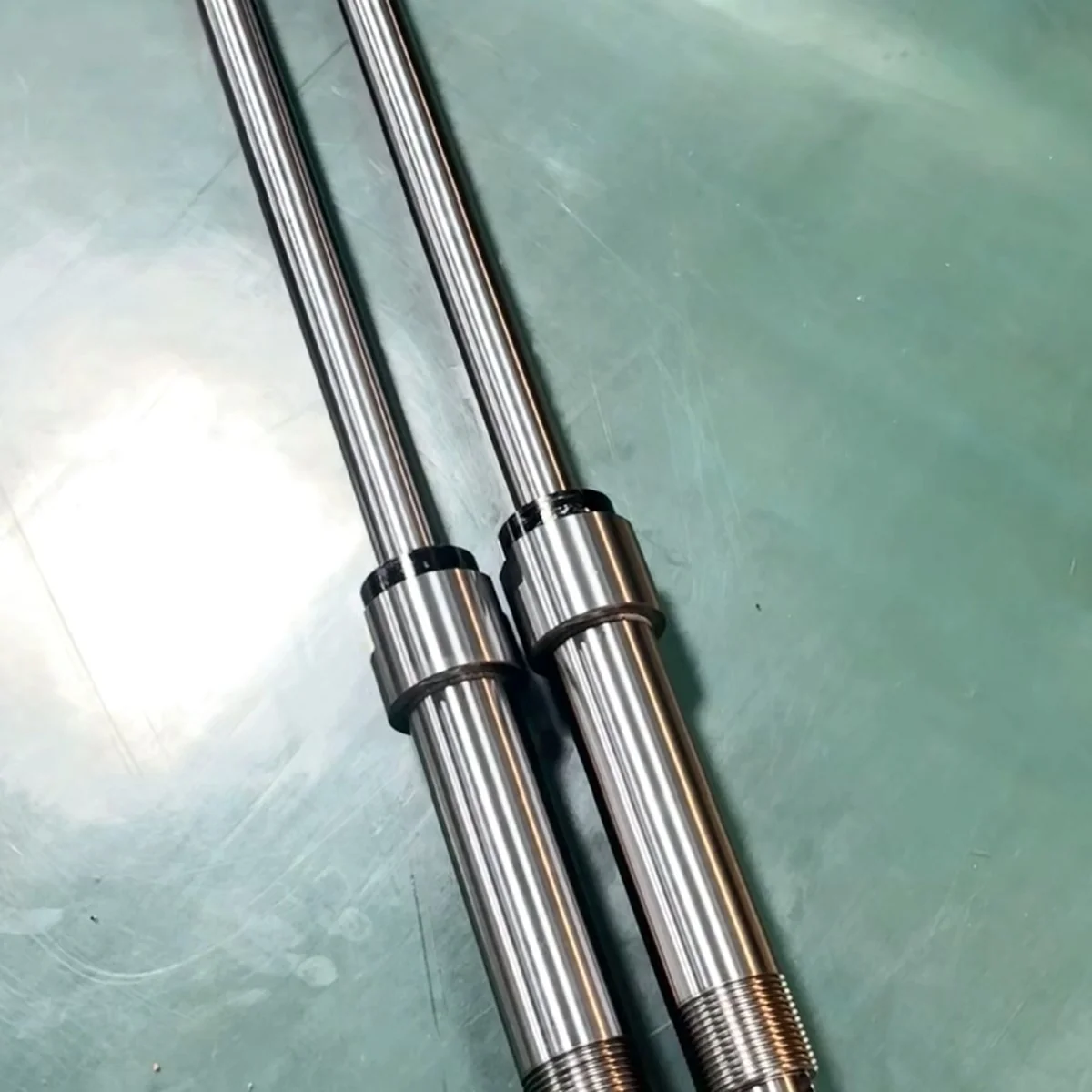
Custom Shaft Specifications
| Attribute | Capability |
|---|---|
| Materials | 1045 / 4140 / 4340 steel, 303/304/316 stainless, aluminium, brass — plus acetal, Delrin, nylon, PEEK for light-duty |
| Diameter range | ~Ø3–200 mm (larger on request) |
| Length | Short pins to long shafts (between-centres grinding) |
| Diameter tolerance | ±0.01–0.025 mm turned; ground to h6/k5/m6 |
| Surface finish | Down to Ra 0.2 µm on ground journals |
| Features | Keyways, splines, threads, cross-holes, flats, tapers, hollow bores |
| Heat treatment | Through-harden, induction-harden, nitride (as required) |
Geometric Accuracy We Hold
On a shaft the diameters are only half the story — what makes it run true is the geometric accuracy: concentricity, straightness and journal runout. This is where many shafts fail and where grinding between centres earns its place:
| Feature | Standard | Tight (ground) |
|---|---|---|
| Concentricity / coaxiality | ≤0.05 mm | ≤0.02 mm |
| Roundness | ≤0.05 mm | ≤0.02 mm |
| Straightness | ≤0.05 mm / 100 mm | ≤0.02 mm / 100 mm |
| Journal runout (TIR) | ≤0.02 mm | ≤0.01 mm |
| Surface finish (journals) | Ra 0.8–1.6 µm | Ra 0.2–0.4 µm |
| Keyway position | ±0.05 mm | ±0.02 mm |
| Thread class | 6g / 6H | 5g / 5H |
Splines & Threads — Cut to Standard
A shaft is only useful if its spline and thread match the mating part exactly — so we cut to the recognised standards (something most shaft pages never state):
- Splines: straight-sided and involute (DIN 5480 / ISO 4156), SAE, plus serrations — internal splines broached, external splines hobbed or milled.
- Threads: metric, UN/UNF, ACME / trapezoidal lead screws, BSP/NPT — cut to class.
- Keyways: to DIN 6885 / ISO 773, sized to the shaft diameter and your key.
Not sure which standard yours is? Send the mating gear, hub or nut — or the old shaft — and we identify and match it.
Shaft Types We Machine
- Stepped shafts — multiple diameters with located shoulders
- Keyed shafts — keyways to DIN 6885 / ISO 773 for torque transfer
- Splined shafts — straight or involute splines
- Threaded shafts & lead screws — metric, UN, ACME and custom threads
- Hollow / deep-bored shafts — gun-drilled, concentric bores (see our deep-hole shaft case)
- Drive shafts & spindles — including reverse-engineered replacements
Shafts, stems and spindles — the names buyers use
A shaft order often arrives under the name of the job it does — valve stem, piston rod, pump shaft, spindle, arbor — and each name comes with its own set of features to machine.
| Name on the order | What it is | Features we machine | Usual material |
|---|---|---|---|
| Stepped shaft | Several diameters with located shoulders | Turned steps, ground bearing seats, DIN 509 undercuts at ground shoulders, centre holes | C45 (1.0503), 42CrMo4 (1.7225), 304 (1.4301) |
| Valve stem / valve spindle | Moves or turns the plug, disc or ball of a valve | Threaded end, cross holes for pins, flats or square drive, packing or O-ring grooves, fine-turned sealing diameter | 304, 316L (1.4404), 17-4 PH (1.4542), brass CW614N |
| Piston rod | Carries the piston of a hydraulic or pneumatic cylinder | Ground rod diameter, threaded ends, wrench flats | 42CrMo4, C45, 304 |
| Pump shaft | Drives a pump impeller | Keyways, sleeve seats, impeller-nut thread, ground bearing journals | 316L, 42CrMo4 |
| Spindle / drive shaft | Carries pulleys, gears or tools in a machine | Keyways to DIN 6885, bearing seats, locknut threads | 42CrMo4, C45 |
| Tooling arbor / stepped mandrel | Locating or holding shaft in a fixture or press tool | Concentric steps and a flange base | Tool steel, 42CrMo4 |
| Probe stem | Long thin stem carrying a probe, barb or nozzle | Hex collar, thread, hose barb, small through bore | 304, 316L |
| Brass control stem | Adjustment or flow-control stem in valves and regulators | Milled flats and slots, cross holes, threaded ends | Brass CW614N / C360 |
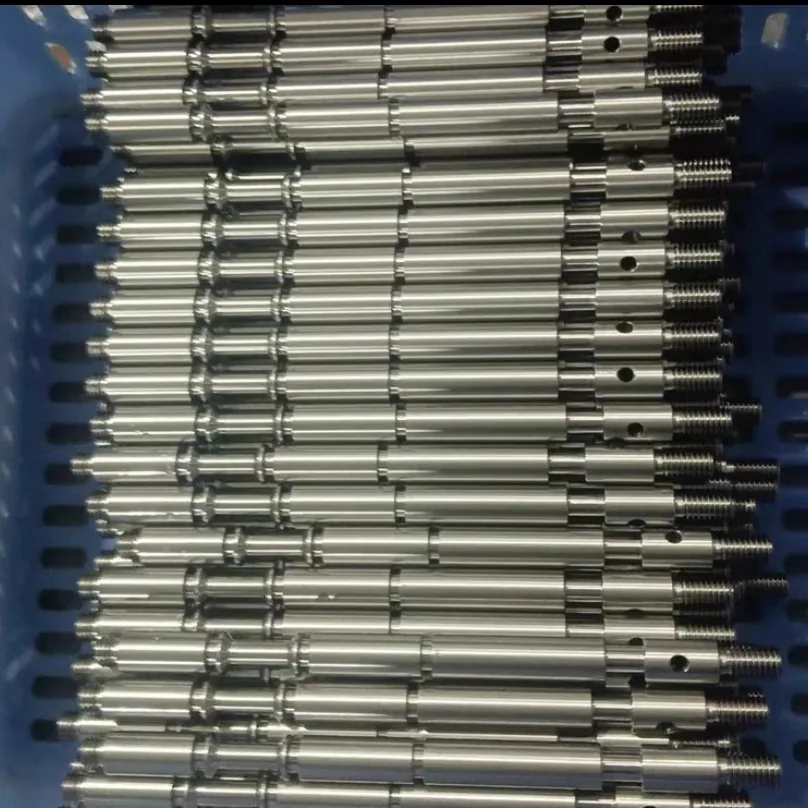
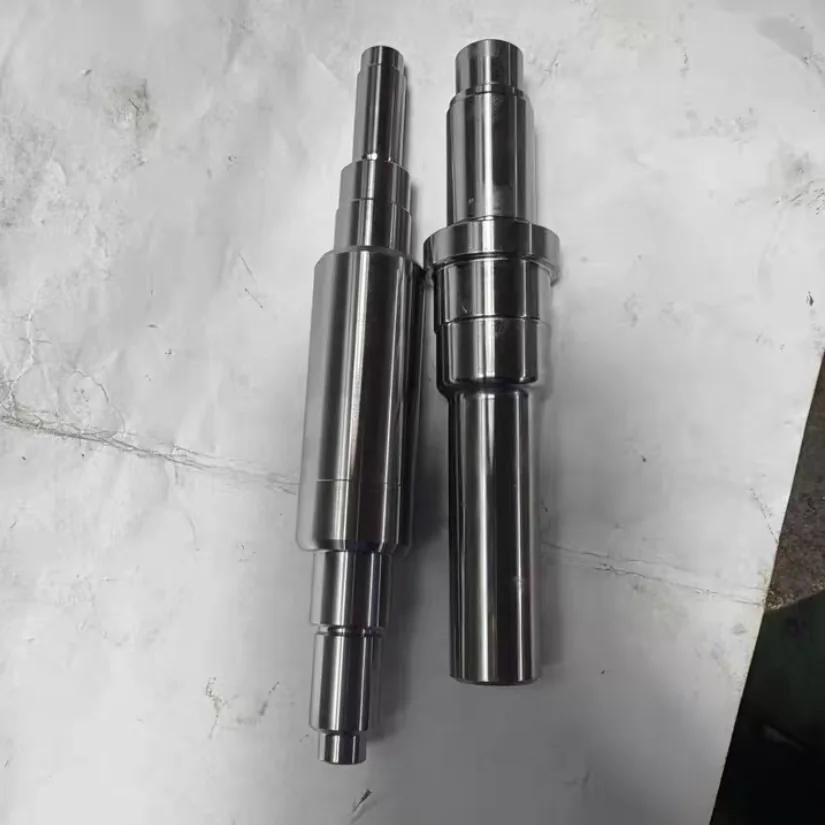
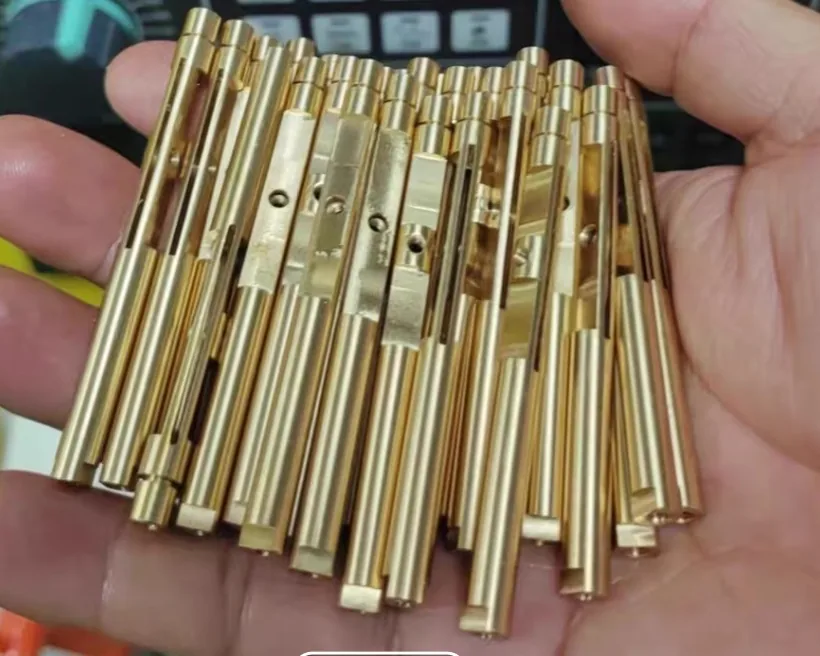
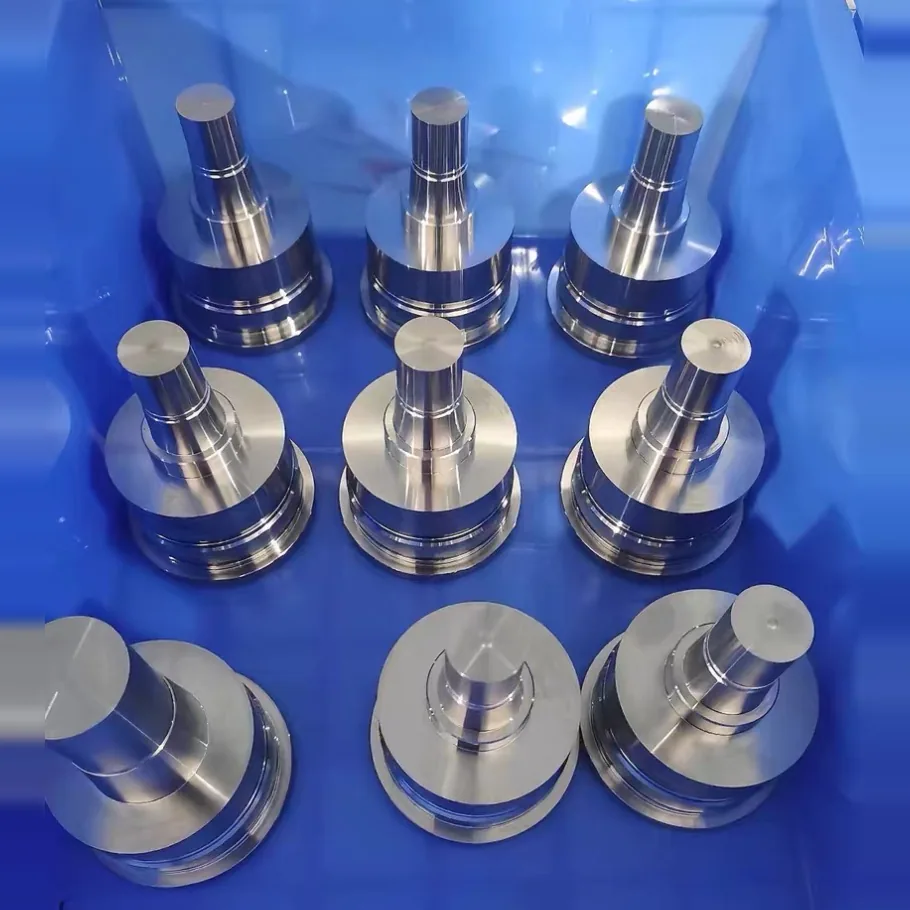
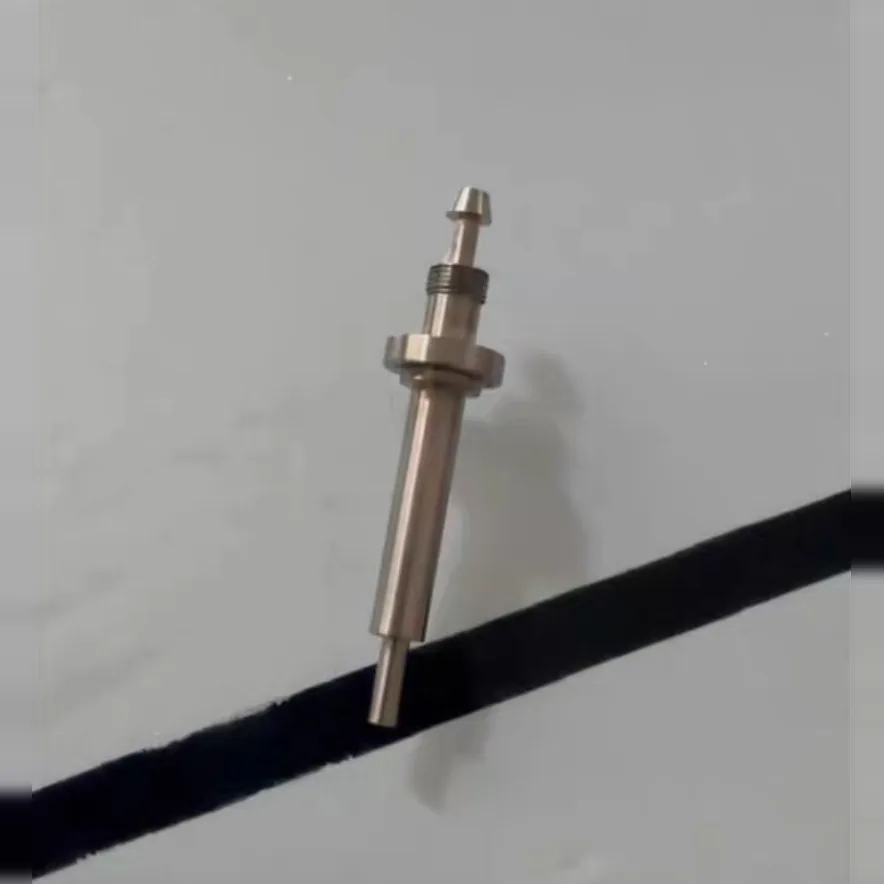
Every ground shoulder on a stepped shaft needs an undercut so the wheel can run out; the sizes by shaft diameter are in our DIN 509 undercut chart.
How We Make Them
Shafts are CNC-turned for the diameters and features, milled for keyways and cross-holes, then ground on critical journals after any heat treatment for final tolerance and finish. For hardenable steels like 4140 we machine soft, harden, then finish-grind. Straightness, concentricity and runout are verified on inspection. See our CNC turning capability for the turning side.
Broken or discontinued shaft? Send it — even snapped in two. We reconstruct journals, keyway, threads and length and machine a drop-in replacement. See the reverse-engineered drive shaft case, or how to reverse engineer a shaft & keyway.
Typical Applications
- Drive shafts, axles and spindles
- Gearbox and conveyor shafts
- Pump and motor shafts
- Lead screws and actuator shafts
- Replacement shafts for discontinued machinery
Shaft Material — Weight, Cost & Where Each Wins
A plain shaft is a solid cylinder, so material choice trades torque capacity, corrosion resistance, rotating weight and cost. Alloy steel 4140 carries the most load and heat-treats; stainless resists corrosion; aluminum cuts rotating inertia on fast or portable shafts; titanium does both at a premium. Start from the duty:
| Material | Density | Why choose it for a shaft |
|---|---|---|
| Alloy steel 4140 | 7.85 g/cm³ | Highest torque and fatigue strength, heat-treatable |
| Mild / C45 steel | 7.85 g/cm³ | General drive shafts, low cost, plated for corrosion |
| Stainless 304 / 316L | 7.9–8.0 g/cm³ | Corrosion, food, washdown and marine shafts |
| Aluminum 6061 | 2.70 g/cm³ | Light, fast-accelerating or portable shafts |
| Titanium Gr5 | 4.43 g/cm³ | ~45% lighter than steel, high strength, corrosion-proof |
Enter a plain shaft's diameter and length to compare the exact weight and relative material cost of each option (steps, keyways and features remove a little more):
What runs on the shaft is cut to the same fit: pulleys to the belt profile and pitch diameter, sprockets to the chain pitch — bore, keyway and tolerance taken from the shaft you already have.
Drawing in S45C, 45 steel, SCM440 or 42CD4? The medium-carbon and 4140 / 42CrMo4 equivalents charts cross the names, and the material grade equivalents hub covers stainless and aluminium shafts too.
Keyed Motor Shaft Ends by IEC Frame — and Sleeves Between Two Frames
An IEC frame 90 motor has a 24 × 50 mm shaft end with an 8 × 7 key in a 4 mm deep keyway and measures 27 mm over the key. When a motor shaft, a gearbox input shaft or a coupling bore has to match a standard motor, these are the numbers; GA is the one you can check with a caliper on the installed shaft.
| Frame | Shaft D | Length E | Key b × h | Keyway depth t1 | D − t1 | Over key GA | Key length |
|---|---|---|---|---|---|---|---|
| 56 | 9 j6 | 20 | 3 × 3 | 1.8 | 7.2 | 10.2 | 14 |
| 63 | 11 j6 | 23 | 4 × 4 | 2.5 | 8.5 | 12.5 | 15 |
| 71 | 14 j6 | 30 | 5 × 5 | 3 | 11 | 16 | 20 |
| 80 | 19 j6 | 40 | 6 × 6 | 3.5 | 15.5 | 21.5 | 30 |
| 90 S / L | 24 j6 | 50 | 8 × 7 | 4 | 20 | 27 | 40 |
| 100 L / 112 M | 28 j6 | 60 | 8 × 7 | 4 | 24 | 31 | 45 |
| 132 S / M | 38 k6 | 80 | 10 × 8 | 5 | 33 | 41 | 63 |
| 160 M / L | 42 k6 | 110 | 12 × 8 | 5 | 37 | 45 | – |
Per IEC 60072-1 and motor makers’ dimension sheets; keys and depths per DIN 6885-1 (the full keyway table is on the keyway size chart). Frame 80 is also built with a 14 mm shaft and frame 90 with 19 mm.
A sleeve from a 19 mm shaft to a 24 mm bore has a 2.5 mm wall; from 28 to 38 mm, 5 mm. Shaft and bore carry different keys, so the sleeve needs a keyway inside and outside, or the joint takes a stepped key; at 1.5 to 2 mm wall there is no material left for an outer keyway.
| Shaft → bore | Wall | Key on the shaft | Key in the bore | How it is keyed |
|---|---|---|---|---|
| 11 → 14 | 1.5 | 4 × 4 | 5 × 5 | wall too thin for an outer keyway: sleeve with a stepped key |
| 14 → 19 | 2.5 | 5 × 5 | 6 × 6 | stepped key, or a sleeve with its own outer keyway |
| 19 → 24 | 2.5 | 6 × 6 | 8 × 7 | stepped key, or a sleeve with its own outer keyway |
| 24 → 28 | 2 | 8 × 7 | 8 × 7 | wall too thin for an outer keyway: sleeve with a stepped key |
| 28 → 38 | 5 | 8 × 7 | 10 × 8 | stepped key, or a sleeve with its own outer keyway |
| 38 → 42 | 2 | 10 × 8 | 12 × 8 | wall too thin for an outer keyway: sleeve with a stepped key |
A keyed shaft or sleeve for one of these frames? Send the frame or shaft diameter, length, key and material. Made from 1 piece in C45, 42CrMo4, 303 or 304 stainless; the more pieces, the lower the unit price. Quote in 12 hours.
Sprockets and pulleys that sit on these shafts with a taper bush, and the bush sizes from 1008 to 4040, are on taper bushes and hubs.
The pillow blocks these shafts run in, UCP 204 to 212 with centre height, bolt spacing and insert bearing, are on bearing housing replacement.
Circlip grooves on a shaft follow DIN 471: the groove diameter, width and minimum distance to the shaft end for each diameter are in the circlip groove size chart.
Frequently Asked Questions
Yes. Send the shaft (even broken) or photos with key dimensions. We measure journals, keyway, threads, splines and length, rebuild it, and confirm critical fits before machining. No drawing needed.
Turned diameters to ±0.01–0.025 mm; ground journals to fit classes like h6/k5/m6 with low runout, finished after heat treatment.
1045/4140 steel (often hardened and ground), 303/304/316 stainless, 4340 for high loads, and aluminium or brass for light duty. Matched or upgraded to your load and environment.
Yes — we gun-drill long straight bores and turn the outside to the bore so the shaft runs concentric, for coolant-fed, drawbar, wiring or weight-saving shafts.
Quote a Custom Shaft
Drawing, sample or sketch — all accepted. Reply in 12h.
// Qty & price
1 pc
Sample price
Confirm fit before a run
10–50
Unit price drops
Setup cost shared
100+
Best price
All tiers quoted upfront
- →No distributor — you pay the maker directly
- →CAD saved after first order — reorder anytime at lower unit price