The Part a Sketch Was Made For
Machinists ordered shafts from dimensioned pencil drawings for a hundred years before CAD existed, because a shaft is geometry a side view captures completely. Every feature sits on one axis; walk along the shaft from left to right and you can write the whole part down: this diameter for this length, then step down, keyway here, thread there, groove at the end.
So when a shaft fails on a machine — bent, sheared at the keyway, journal worn under a bearing — you do not need CAD software or the original manufacturer. You need calipers, a piece of paper, and a shop that machines from what you send. We redraw your sketch as CAD for free, you approve it, and we turn, mill, harden and grind the replacement.
Sketching a Shaft: Walk Along It
Draw the side view, start at one end, and record each feature as you reach it:
Diameters & lengths
Each section's diameter and how long it runs before the next shoulder. These two numbers, repeated along the shaft, are 80% of the drawing.
What mounts on each section
"6205 bearing here, pulley with 8 mm key there, circlip at the end." What mounts matters more than tolerance codes — it tells us the fit each journal needs (k6/js6 for bearing seats, h6 for slide-on parts).
Keyways
Width, depth and length if you know them — or just the shaft diameter, and we size the keyway to DIN 6885 / ASME B17.1 so standard key stock fits.
Threads on the ends
Size and pitch (M20×1,5, 3/4"-16 UNF), male or female (tapped centre), and thread length. Locknut threads and left-hand threads included.
Grooves, flats & holes
Circlip grooves (give the circlip size and we apply the DIN 471 groove), set-screw flats, D-profiles, cross-drilled pin holes with position.
Ends & centres
Chamfers, centre drills if the shaft runs between centres, and overall length last — as a checksum against the section lengths.
Missing numbers are fine. Send what you have and tell us what the shaft does; we ask specific questions rather than guess.
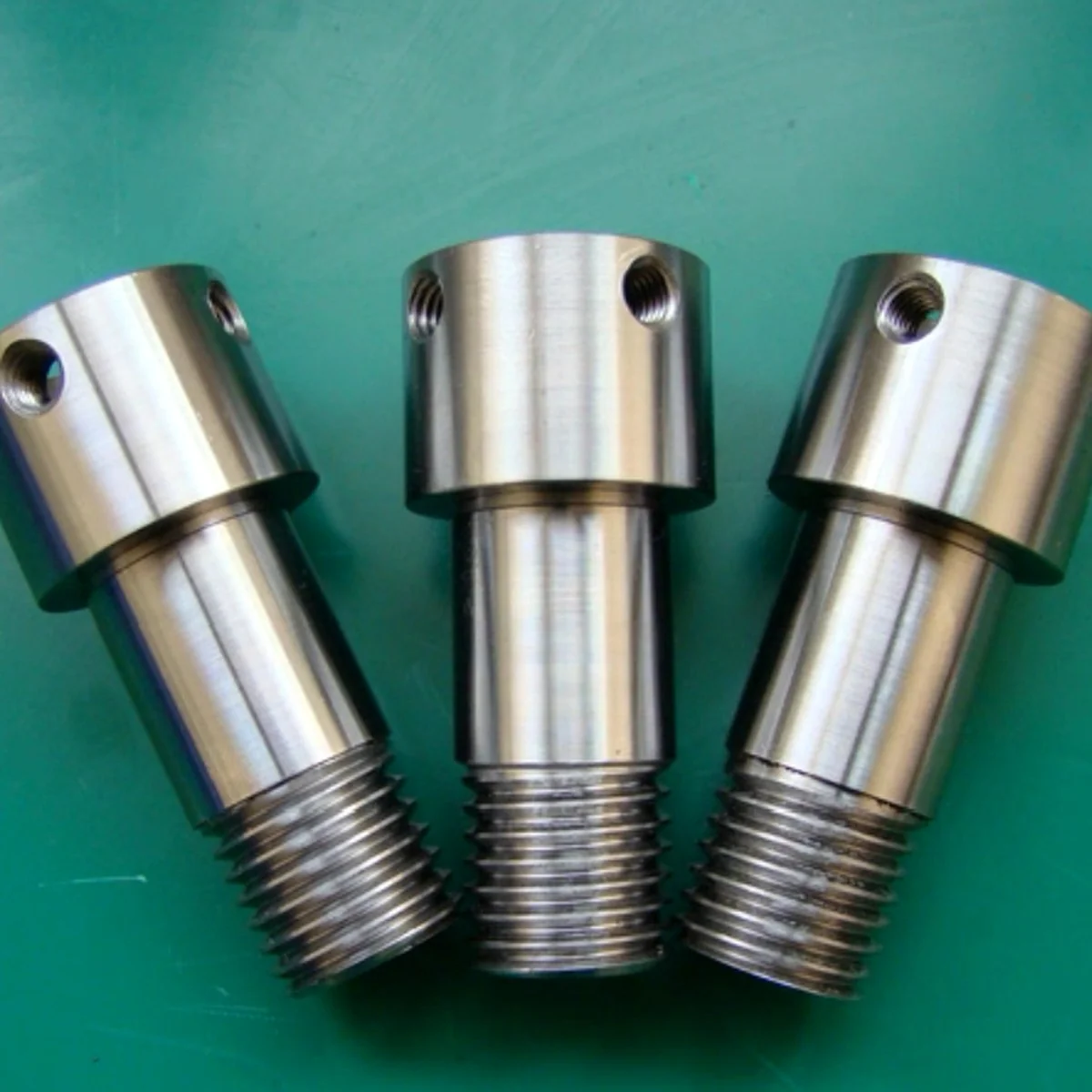
Worn or Broken Original? Two Ways In
Caliper each section and sketch it. Worn journals measure undersize — so also measure an unworn section of the same journal (or tell us the bearing that sits there) and we restore design size, not the worn size. A worn-oversize keyway goes back to the proper DIN dimension on the new shaft.
Send the shaft, even bent or snapped. We measure it end to end, read the design intent from the mating parts and wear pattern, and send you the drawing for approval. Broken-in-two shafts are routine — the two halves carry all the geometry. This is our from-a-sample workflow.
Why not repair the old shaft? Sleeving and welding a worn journal can work — for a while. When the shaft is the cheap component and downtime is the expensive one, a new shaft in better material usually beats a repaired old one. If a repair genuinely serves you better, we say so in the quote.
Shafts We Machine From a Sketch
Drive shafts with keyways
Stepped, keyed and shouldered — motor to gearbox to driven pulley, keyways to standard.
Pump & impeller shafts
Stainless and duplex, seal journals finished fine — partnered with our pump parts RE service.
Threaded-end & lead screws
Locknut threads, left-hand threads, trapezoidal sections — cut to match the nut you already have.
Motor & D-shafts
D-profiles, set-screw flats and cross-pinned shafts for gearmotors and actuators.
Spindle & precision shafts
Ground journals, tight runout, hardened wear zones for machine-tool and roller applications.
Agricultural & heavy shafts
PTO stubs, auger and baler shafts — tough 4140, sized from the failed original.
Materials, Hardening & Grinding
| Material | Best for | Notes |
|---|---|---|
| 1045 carbon steel | General drive shafts | The workhorse — good strength, economical |
| 4140 alloy steel | High-torque, shock loads | Through-hardened or induction-hardened wear zones |
| Stainless 303 / 316 | Food, chemical, washdown, marine | 316 for salt and aggressive media |
| 17-4 PH stainless | Strength + corrosion together | Pump and marine shafts where 316 is too soft |
Induction and case hardening on wear zones, journal grinding after heat treatment, hard chrome on request. Tell us how the old shaft failed — bent, worn, sheared at the keyway — and we recommend the fix in material or treatment, not just a copy of what already failed once.
Frequently Asked Questions
Yes — a shaft is the part a sketch describes best. Walk along the side view writing each diameter and length, plus keyway, threads and grooves. We redraw it as CAD for free and you approve before machining. Dimensioned pencil sketches ordered shafts for a century; they still work.
Tell us what mounts on each journal and we apply the correct ISO fit — typically k6 or js6 for standard ball bearings, h6 for slide-on parts. You don't need fit codes: "a 6205 bearing sits here" is exactly what we need.
Yes — DIN 6885 (metric) or ASME B17.1 (inch), sized to the shaft diameter so standard key stock fits. A worn-oversize keyway goes back to proper dimension on the new shaft.
Measure it yourself (include an unworn section so we can restore design size), or mail us the shaft — we measure it, read the design from the mating parts, and machine to design dimensions, not worn ones. Broken-in-two shafts are routine.
Yes — induction or case hardening on wear zones, through-hardened 4140, and journal grinding to tight tolerance after heat treatment. Say what failed on the old shaft and we recommend the treatment that stops a repeat.
Related: all hand-drawing & sketch machining · spacers & bushings from a sketch · thread adapters from a sketch · knobs from a sketch · CNC turning · reverse engineering
Get a Free Quote
Sketch, measurements or the worn shaft — we reply within 24 hours.
// Qty & price
1 pc
Sample price
Confirm fit before a run
3–10
Unit price drops
Setup cost shared
10+
Best price
All tiers quoted upfront
- →No distributor — you pay the maker directly
- →CAD saved after first order — reorder anytime at lower unit price
Response within 24h · Drawings kept confidential