Need to put a metric cable gland into an NPT enclosure hub — or an NPT conduit fitting into a metric knockout — at M50, M63, M75, M90 or M100, and the catalogs stop at small brass sizes? We machine the large conversion adapter to order: male or female either end, 304/316 stainless or nickel-plated brass, O-ring sealed. From a sketch, no CAD, one piece up. Get a quote →
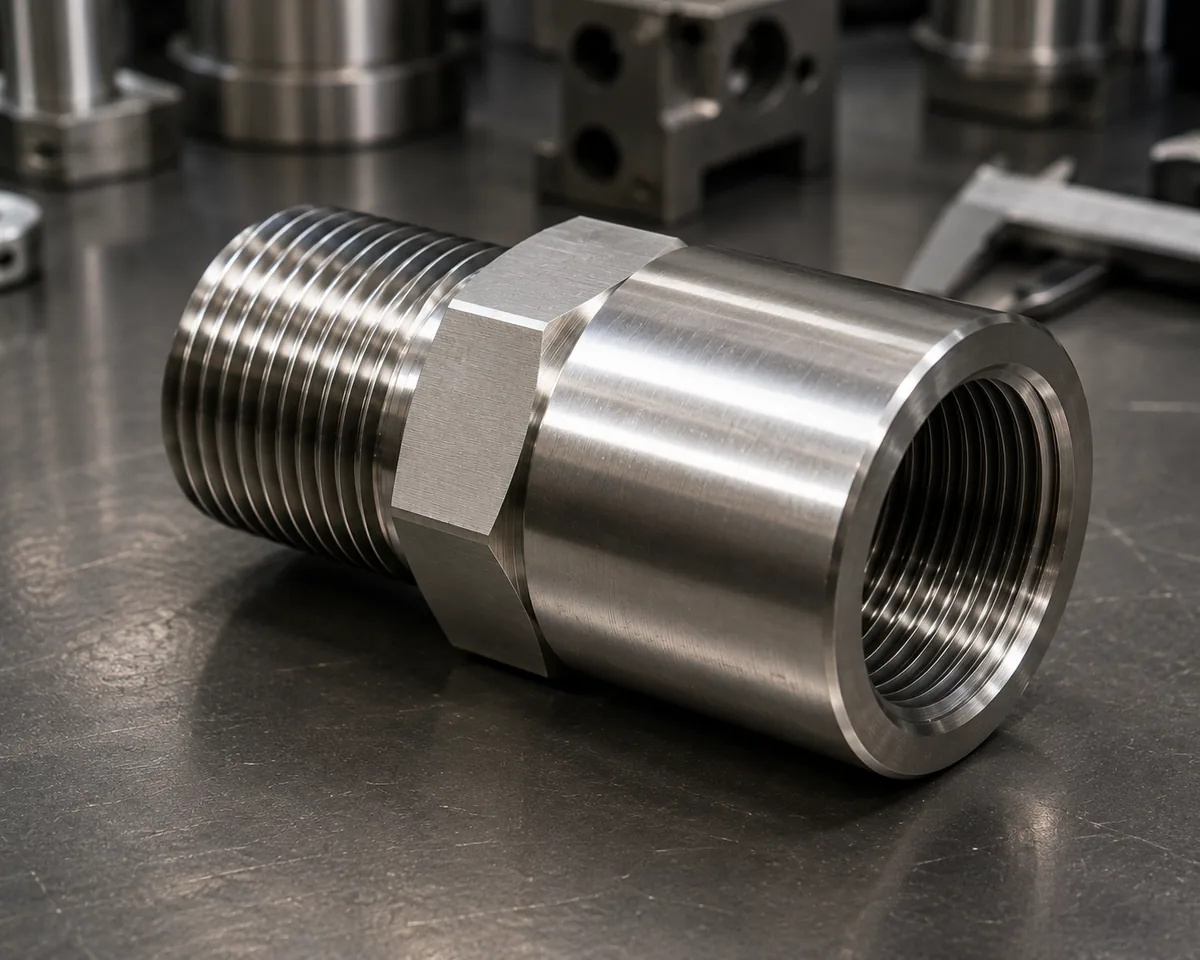
Where the catalogs stop, the lathe starts
Small metric-to-NPT adapters exist as stock items — nickel-plated brass, mostly, and mostly below M63. Go bigger and the choices collapse: M75, M90 and M100 conversions in 316 stainless are not warehouse items, specific male/female orientations are missing, and non-nearest size jumps (an M63 gland into a 3" hub) exist in no catalog at all. American enclosures, NEMA boxes and hazardous-location housings are threaded NPT; European and Asian glands and equipment entries are metric. On large industrial cabinets, packaged skids and machine enclosures, the two systems meet constantly — and at these diameters the adapter is turned from large bar stock in low volume. That is machining work, and it's exactly what we do.
Size crossover & weight table
The dimensionally nearest metric/NPT pairs, with the approximate weight of a typical adapter in 304 stainless — so you know what you're shipping before you ask:
| Metric end | Nearest NPT | NPT thread OD | Approx. weight (304) |
|---|---|---|---|
| M50×1.5 | 1½" NPT | 48.3 mm | ≈ 0.9 kg |
| M63×1.5 | 2" NPT | 60.3 mm | ≈ 1.5 kg |
| M75×1.5 | 2½" NPT | 73.0 mm | ≈ 2.2 kg |
| M90×2 | 3" NPT | 88.9 mm | ≈ 3.2 kg |
| M100×2 | 3½" NPT | 101.6 mm | ≈ 4.0 kg |
Weights vary with length, bore and form — the exact figure goes on your drawing before you order. Non-nearest combinations are just as machinable: M63 male to 1½" NPT female, M75 to 3", M90 to 4", or BSP/G threads instead of NPT on either end. In 6061 aluminum the same parts weigh roughly a third of the stainless figures above.
Above M100? We turn conversion adapters beyond M100×2 and 4" NPT to your drawing or sample — tell us the two threads and the duty. For large metric-to-metric work (M33–M52 coarse and fine pitch), see our large metric thread adapters page.
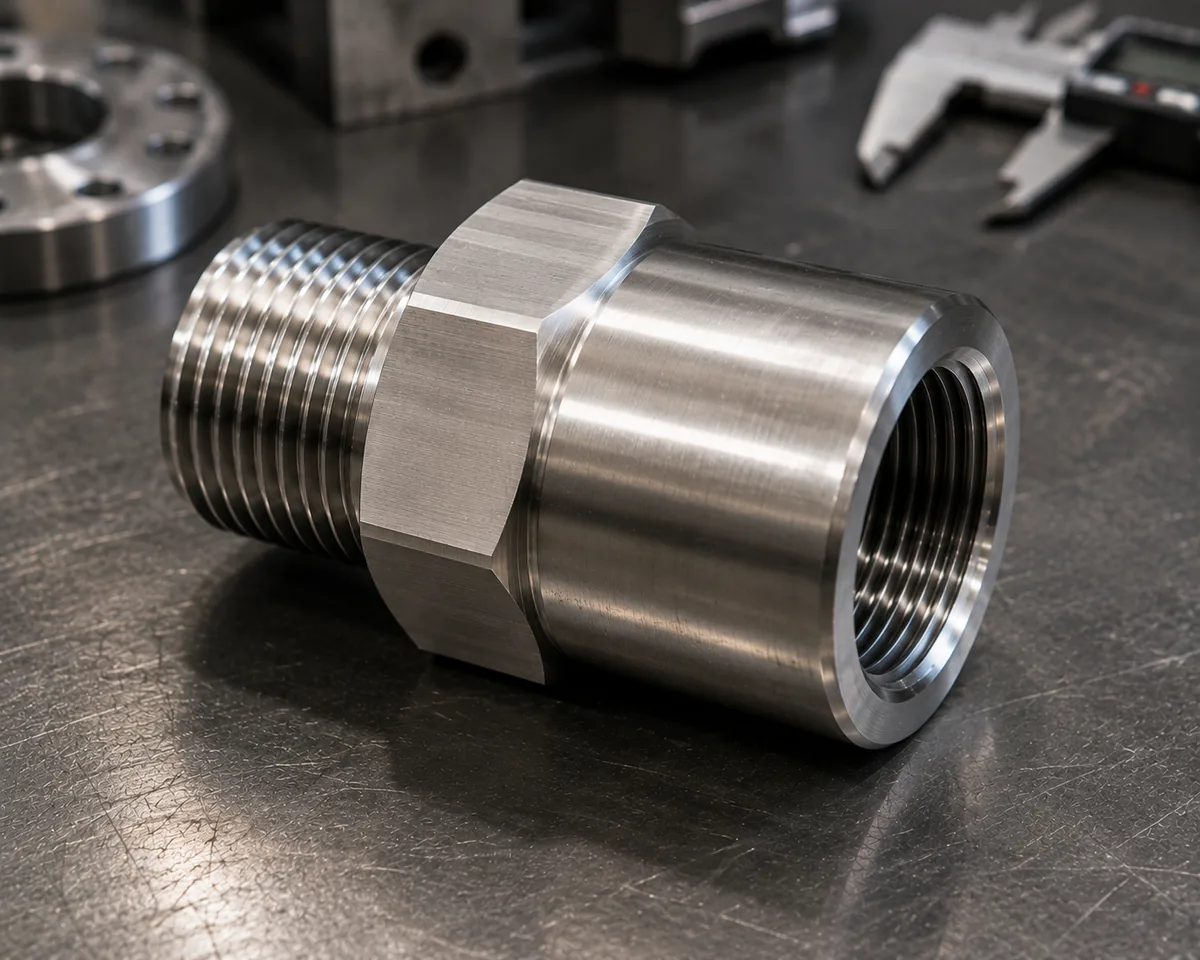
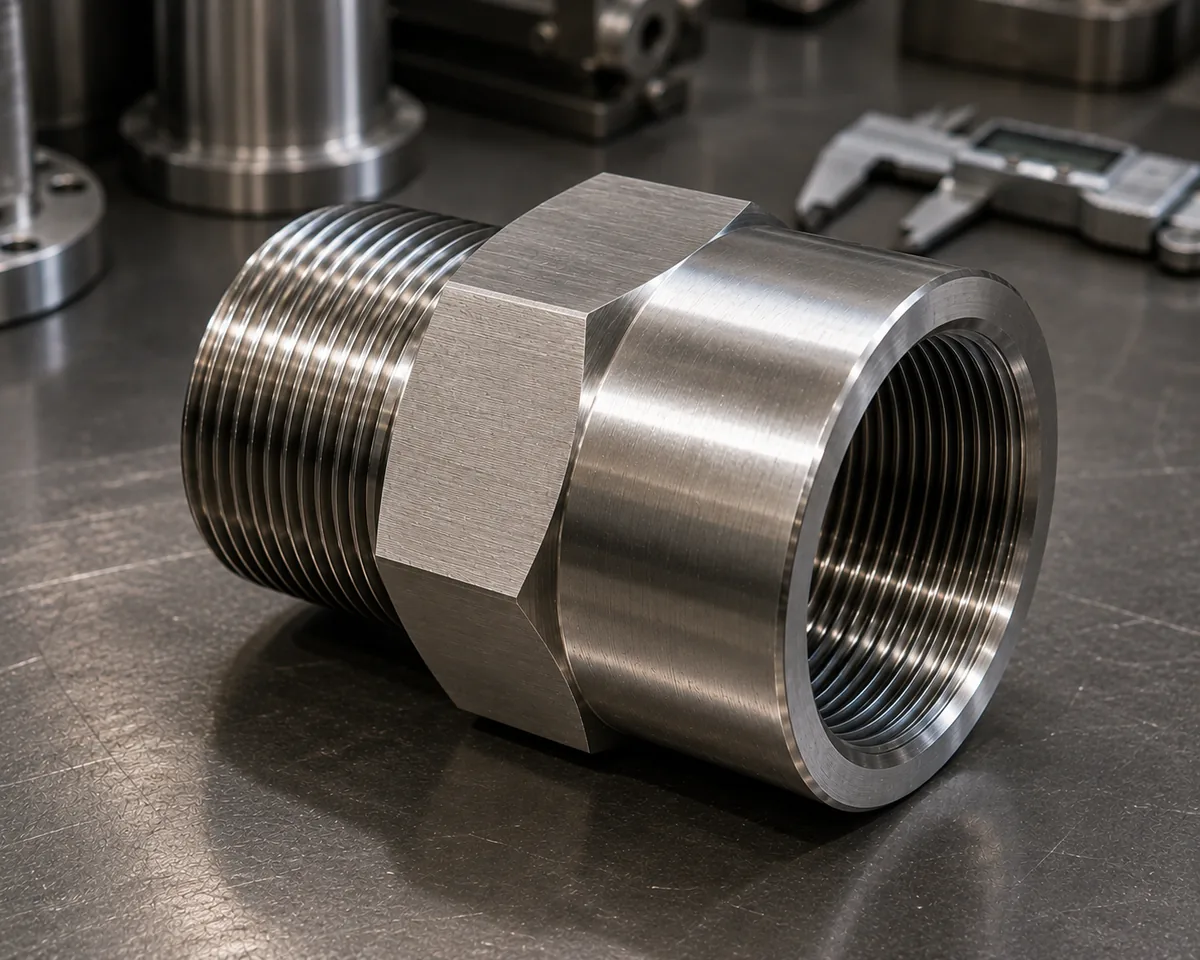
Taper meets parallel: how each end seals
This conversion joins two different sealing philosophies, and a good adapter respects both:
NPT END — SEALS ON THE TAPER
NPT is a tapered thread (ASME B1.20.1): it seals by wedging metal on metal as it tightens, with sealant or PTFE tape per your site practice. We cut the taper to gauge so it makes up hand-tight plus the standard turns.
METRIC END — SEALS ON THE SHOULDER
Metric gland threads (EN 60423) are parallel and never seal on the thread. We machine an O-ring groove or flat gasket face at the shoulder — the same way an IP67/IP68 gland seals against an enclosure wall.
Forms & options
| Option | Choices | Notes |
|---|---|---|
| Direction | Metric male → NPT female · NPT male → metric female | Either way, any pairing |
| Form | Adaptor (same size class) · reducer · enlarger · male-male nipple | Per CMP/gland-industry naming |
| Threads | M50–M100+ (EN 60423 gland sizes) · 1½"–4" NPT · BSP/G on request | Both ends gauged |
| Seal | O-ring shoulder groove · flat gasket face · plain | Keeps the enclosure IP rating |
| Material | 304 stainless steel · 316 stainless · nickel-plated brass · 6061 aluminum | 316 for offshore & washdown |
| Bore | Full through-bore for cable bundles or conduit fill | Sized to your cable OD |
| Body | Hex or octagonal wrench flats · knurled grip ring | Flats sized to standard wrenches |
Where they're used
- Imported machinery on US sites — European cabinets arrive with metric knockouts; site conduit and fittings are NPT. One adapter per entry instead of re-punching panels.
- US enclosures with European glands — NEMA and hazardous-location boxes are NPT; the specified EMC or Ex cable glands are metric.
- Packaged skids & generator sets — large cable bundles entering through M75–M100 glands into NPT-threaded junction hubs.
- Marine & offshore cabinets — 316 stainless conversions that don't gall or streak rust where plated brass fails.
- Pump, valve & instrument housings — large conduit entries adapted to the housing's native thread without modifying a certified casting.
Related adapters we machine
Where the Catalogue Stops for This Size Pair
Large metric to NPT is where stock ranges end — the sizes get big and the combinations multiply.
| What you need | In the catalogue? | How we machine it |
|---|---|---|
| A plain coarse-to-coarse reducer in this size step | Sometimes stocked | If a stockist lists it, buy it off the shelf. We are worth calling when the pitch, length, material or form is not on their page. |
| A large metric port against an NPT line | No | US equipment into a large ISO metric port, or the reverse. Both ends cut on one bar. |
| Different pitch on each end | No | Each thread single-pointed to its own pitch on the same bar. |
| Double-male stud instead of a bush | Thin | Male on both ends; far fewer sizes stocked and almost none in mixed pitch. |
| Female-female coupling | Thin | Joins two studs rather than reducing a hole. Any pitch pair. |
| Hex flats sized to a spanner you already own | No | Cut to your wrench, not to a catalogue table. |
| Through-bore for a shaft, cable or fluid | No | Bore and both threads cut in one setup so they stay concentric. |
| Shortened body for a crowded plate | No | Catalogue parts come in one length. State the space you have. |
| Left-hand thread on either end | No | Not stocked at any size. |
| 316 stainless or alloy steel instead of plated mild steel | Rare | Material is open; no tooling cost at these sizes. |
See also the fitting thread identification chart and valve fittings for metric valve ports on NPT lines.
Frequently asked
Which NPT size matches my metric cable-gland thread?
Nearest pairs: M50 ↔ 1½", M63 ↔ 2", M75 ↔ 2½", M90 ↔ 3", M100 ↔ 3½". Because every adapter is machined to order, non-nearest jumps (M63 → 1½", M90 → 4") are cut the same way when that's what your hardware actually is.
NPT is tapered and metric is parallel — how does the joint seal?
Each end by its own rule: the NPT taper seals metal-on-metal with sealant or tape; the parallel metric end seals on an O-ring or gasket at the shoulder, like any IP-rated gland. We machine both features to their standards (ASME B1.20.1 and EN 60423).
Why can't I buy a large metric-to-NPT adapter off the shelf?
Stock metric-to-NPT adapters are mostly small nickel-plated brass. Large sizes in 316, specific orientations and non-nearest combinations aren't stocked — at M75+ the part is turned from large bar in low volume. More on joining two different threads →
How heavy are these adapters and what materials do you machine?
Roughly 0.9 kg (M50/1½") up to 4 kg (M100/3½") in 304 stainless — exact weight stated on your drawing before you commit. 304 or 316 stainless steel, nickel-plated brass, or 6061 aluminum at about a third of the weight. MOQ one piece, no CAD needed.
Tell us the two ends and the enclosure. A photo of the hub and the gland, or the callouts plus duty (e.g. "M75×1.5 male → 2½" NPT female, 316, offshore cabinet, cable bundle Ø55 mm"). Free drawing with weight stated, quote in 12 hours. Get a quote →