When a Stud Needs Two Different Threads
A standard double-ended stud — catalogues also list it as a stud bolt, engineering stud or double threaded bolt — has the same thread on both ends — that is what you buy off the shelf. The part that stops a job is the one where the two ends are not the same: one end has to thread into an M30×3.5 hole, the other has to accept an M24×2 fitting. Connect a coarse thread on one side to a fine thread on the other. Bridge a metric component to an imperial one.
There is no standard name for that part, and no catalogue sells it — it has to be made. The usual advice online is "you'll need a drawing". You don't. EKINSUN machines these studs from a hand sketch with the two thread sizes, or straight from a sample, turning each end to its own thread on the lathe. One piece is fine.
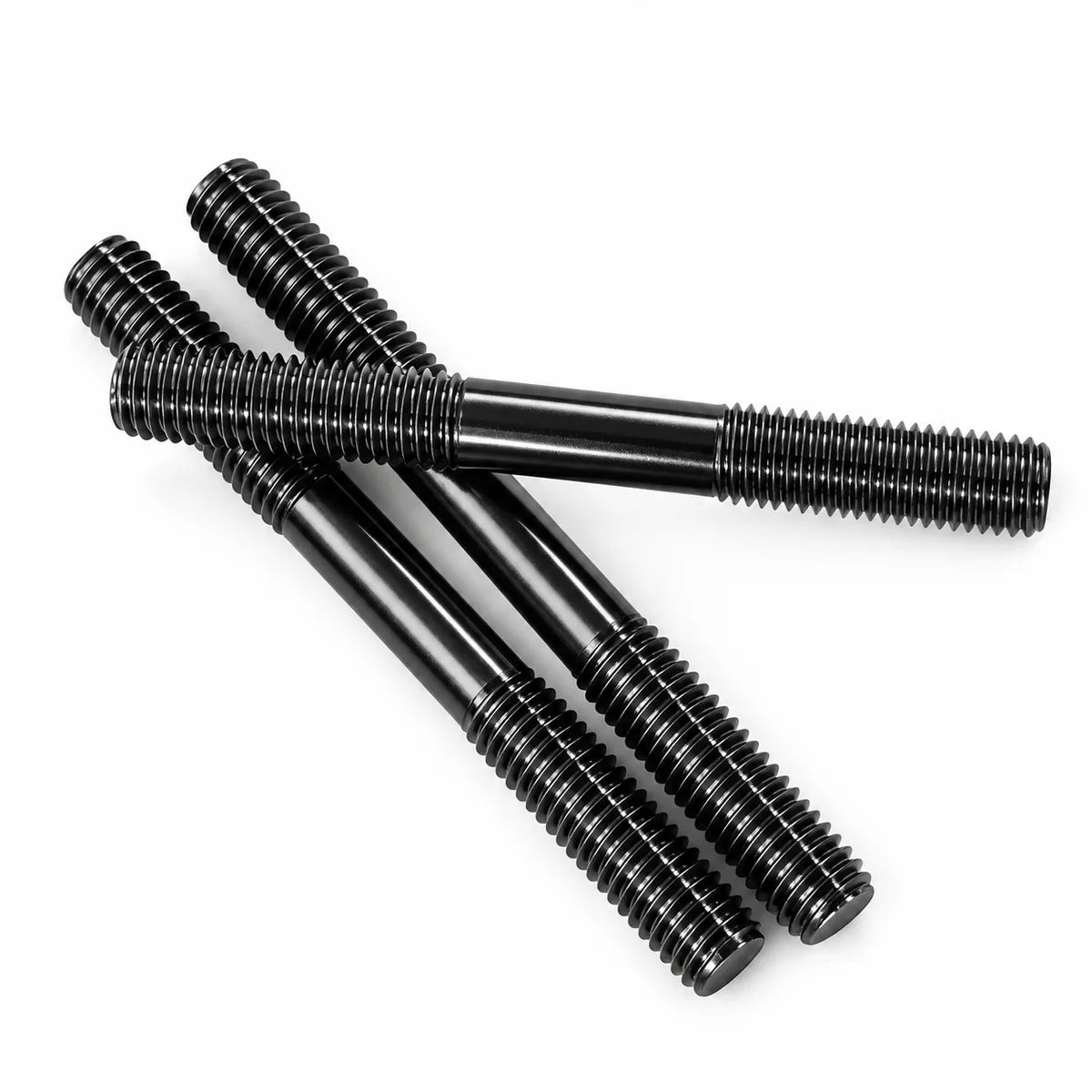
Configurations We Machine
Male–Male (double stud)
Both ends externally threaded — the classic double-end stud, with equal or two different threads
Male–Female
One end external, the other an internal (female) thread — a stud that also receives a fitting
Reducing (two sizes)
A larger thread on one end, smaller on the other — e.g. M30 to M24, or imperial to metric
Mixed pitch
Coarse one end, fine the other — each end cut to its own pitch in the same part
Hex / wrench flats
A hex section or two milled flats so the stud can be tightened by a spanner
Tap-end / unequal reach
Different thread-engagement length on each end — long reach one side, short the other
Not the same as a thread adapter or a special bolt. If you need a screw-in fitting that seals (hydraulic / pneumatic), see thread adapters. If you need an odd thread form — left-hand, Whitworth, ACME — see non-standard thread bolts. This page is for studs threaded both ends, mechanical, often with two different sizes.
A Real One: M30×3.5 to M24×2, From a Hand Sketch
A customer needed a double-male adapter stud to repair a machine — one end M30×3.5 (coarse), the other M24×2 (fine), in steel or stainless, mechanical use only with no sealing required, and a hex section so it could be torqued. No CAD file — just a dimensioned hand sketch: 60 mm overall, 20 mm of thread engagement each end. We turned each end to its own thread, milled the hex, and produced the production drawing from the sketch first for sign-off.
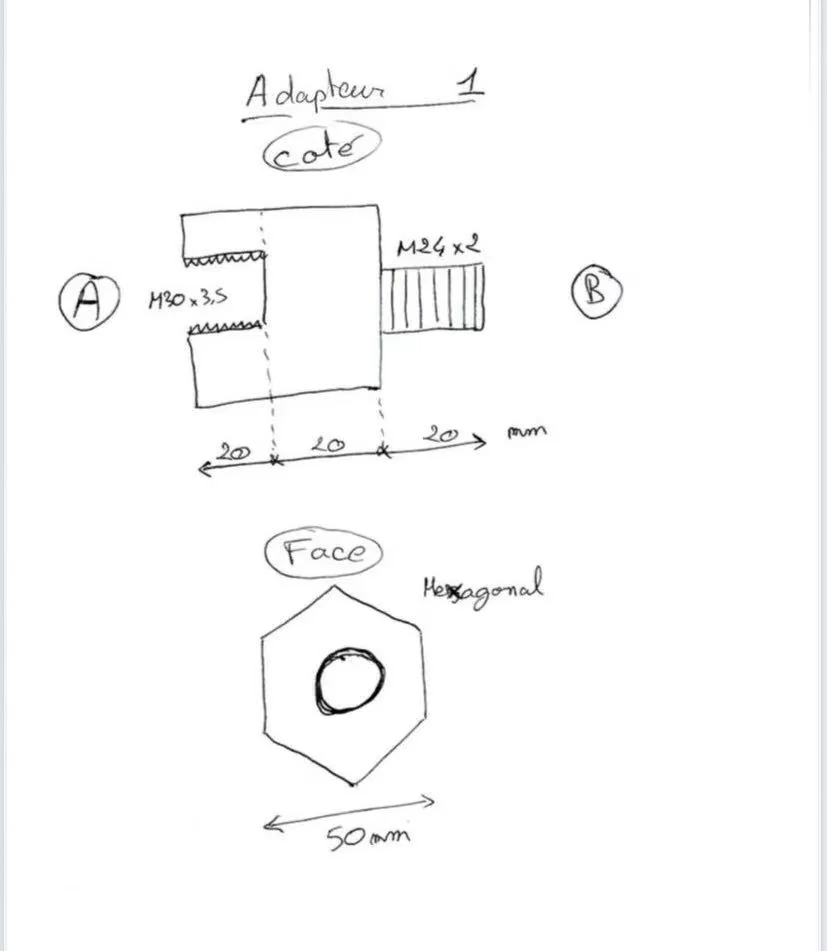
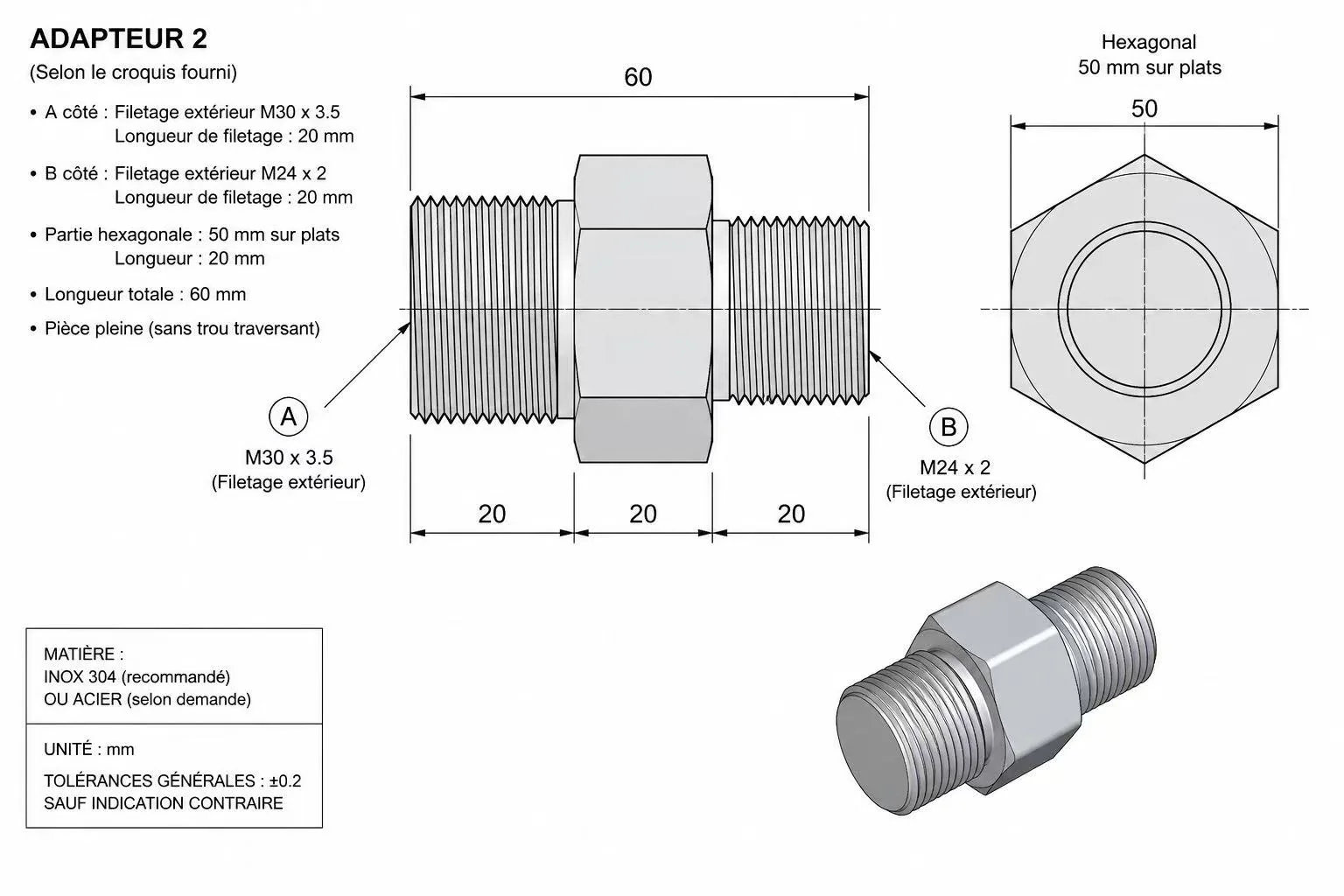
See the full write-up on the French project page: adaptateurs de filetage métrique sur mesure.
Recent Stud Requests, by Specification
Six studs from M3 to 1/2 in and 50 to 200 mm long, quoted in the last month, every one from a sketch, a photo or a one-page drawing rather than a catalogue number. The specification column is what the buyer wrote down; the same three or four numbers are all we need from you.
| Specification | Qty | Material / grade | Where it goes |
|---|---|---|---|
| M7×1 on one end, M7×1.25 on the other; 155, 148 and 65 mm overall | 8 | 42CrMo4, heat-treated | Cylinder and head studs of a vintage side-valve motorcycle engine, to the factory data sheet |
| M6×1 × 130 mm, longer than any catalogue length, thread rolled as the drawing called for | 22 | 42CrMo4 (4140), class 10.9 | Machine assembly on a fixed delivery date |
| Double-threaded stud, class 12.9, 100 mm overall | 10 | Alloy steel, 12.9 | From a one-page drawing |
| Cylinder head studs 1/2" and 7/16"; 200, 100, 106 and 95 mm; ball tip on the block end, broached socket on the nut end | 36 | 8740-type alloy steel | Aluminium engine block, four lengths in one order |
| M3 machine thread 10 mm on one end, Ø3 wood-screw thread 40 mm on the other, 50 mm overall, Ø3 throughout with no head or shoulder | 2 | Steel | Coat hook on a 15 mm wooden disc, pointed end into the wall |
| M6 both ends, measured from a photo of the assembly, no drawing | 1 | Steel | A stud passing right through a housing |
Two of the six are the same part with two different threads, one is a head stud for an aluminium block with its own engagement length, one is a long stud no catalogue lists. None of them needed a CAD file. A stud like any of these is quoted from 1 piece; the 36-piece order and the 1-piece order were priced the same way.
Thread & Size Range
Each end is specified independently — give us the two threads (or a sample of each mating part) and we cut both. Typical range:
| System | Examples we cut |
|---|---|
| Metric coarse | M6×1, M8×1.25, M10×1.5, M12×1.75, M16×2, M20×2.5, M24×3, M30×3.5 |
| Metric fine | M12×1.25, M16×1.5, M20×1.5, M24×2, M30×2 — finer pitches on request |
| Imperial UNC / UNF / UNEF | 1/4-20, 5/16-18, 3/8-16, 1/2-13, 9/16-18, 5/8-11, 3/4-16, 13/16-28 |
| Mixed on one part | Any of the above on one end, a different one on the other — incl. metric↔imperial |
Measure both ends — separately. A stud with two different threads fails twice as often, because the buyer measures one end and assumes the other. Lay a rule across ten crests of each end and divide by ten; then check the hand of each, holding the stud upright and watching which way the threads rise. One end coarse and the other fine, or one end metric and the other inch, is normal on a machine that was repaired once already. If both ends are standard coarse threads in stock sizes, a catalogue stud may exist; if either end is a fine pitch, an inch count or left-hand, the stud is turned here with both threads cut to your readings and gauged. Reading a pitch off a thread you cannot identify →
Thread Engagement and Overall Length, by Size
A stud screws about 1 × d into steel, 1.25 × d into grey cast iron and 2 × d into aluminium: those three ratios are the German stud standards DIN 938, DIN 939 and DIN 835, and they are the difference between a thread that holds and a thread that strips out of the softer part. The nut end carries 2 × d + 6 mm of thread on studs up to 125 mm long. The table gives both lengths for M6 to M30, with the ISO 4032 nut height you add when working out the overall length.
| Thread | Pitch | Into steel (1 × d) | Into cast iron (1.25 × d) | Into aluminium (2 × d) | Nut-end thread (2 × d + 6) | Nut height m |
|---|---|---|---|---|---|---|
| M6 | 1 | 6 mm | 7.5 mm | 12 mm | 18 mm | 5.2 mm |
| M8 | 1.25 | 8 mm | 10 mm | 16 mm | 22 mm | 6.8 mm |
| M10 | 1.5 | 10 mm | 12.5 mm | 20 mm | 26 mm | 8.4 mm |
| M12 | 1.75 | 12 mm | 15 mm | 24 mm | 30 mm | 10.8 mm |
| M14 | 2 | 14 mm | 17.5 mm | 28 mm | 34 mm | 12.8 mm |
| M16 | 2 | 16 mm | 20 mm | 32 mm | 38 mm | 14.8 mm |
| M20 | 2.5 | 20 mm | 25 mm | 40 mm | 46 mm | 18 mm |
| M24 | 3 | 24 mm | 30 mm | 48 mm | 54 mm | 21.5 mm |
| M30 | 3.5 | 30 mm | 37.5 mm | 60 mm | 66 mm | 25.6 mm |
Overall length = engagement + clamped thickness (with washer) + nut height + 2 to 3 pitches showing above the nut. An M12 stud into an aluminium housing clamping a 20 mm flange: 24 + 20 + 10.8 + about 4 = 59, so a 60 mm stud with 24 mm of thread on the housing end and 30 mm on the nut end. Write a stud down as those three numbers and we can cut it without a drawing.
Catalogue studs cover M8 to M16 in steel at 1 × d or 1.25 × d in a handful of lengths; buy it from stock at a local industrial supply store, or ask us, we may have it in stock. Anything else in this table, between its rows, or outside it is machined from 1 piece: a 2 × d end for aluminium with a short nut end, a length between two catalogue steps, M27 or M36, or two different threads on the one bar. The more pieces, the lower the unit price; every tier is quoted within 12 hours.
Send the three numbers on WhatsApp → · or use the quote form on this page
Materials
For mechanical, load-bearing studs the usual choices are:
- Stainless 304 / 316 — corrosion resistance for outdoor, marine, washdown and chemical environments. 316 → 304 →
- Alloy / carbon steel — higher strength, heat-treatable where the joint is loaded. 4140 →
- Brass, bronze, titanium — where conductivity, anti-galling or strength-to-weight matter.
Because the studs are mechanical and not sealing, the thread tolerance is set for a sound, torque-able fit rather than a pressure seal. If your part does need to seal, tell us and we'll advise the right approach.
No CAD, no problem. A dimensioned sketch with the two thread sizes — or the old part itself — is enough. We rebuild the drawing for free and confirm it before cutting. See order with no CAD, order from a sketch, or how we identify an unknown thread.
What to Send Us
- The two threads — size and pitch each end (or a sample of each mating part and we'll gauge them)
- Overall length, and thread-engagement length needed on each end
- Whether you want a hex section or wrench flats, and the across-flats size
- Material and any finish (or the application, and we'll advise)
- Quantity — one spare or a batch — and delivery country
A wood-screw thread on one end instead of a machine thread makes the part a hanger bolt: sizes, pilot holes and wall plugs are on that page, and we make it to order.
Two studs or rods meeting end to end need a coupling nut between them; the coupling nuts for threaded rod page gives the length and engagement by size, and nut and studs are made together.
Frequently Asked Questions
Yes — this is the most common reason people come to us. Off-the-shelf double-end studs almost always have the same thread both ends. We machine one thread on one end and a different one on the other, e.g. M30×3.5 to M24×2, or imperial to metric. Each end is turned to its own thread on the lathe.
Yes. Mixed-pitch studs are routine. M30×3.5 is a coarse pitch and M24×2 is fine; we cut each end to its own pitch in the same part. We are not limited to listed standard combinations — give us the two threads or a sample of each mating part.
Yes. A plain stud has no grip, so for mechanical assembly we machine a hex section or two milled wrench flats in the middle or at one end, to whatever across-flats size suits your spanner.
Yes, MOQ 1. Threads are cut on the lathe with no tooling cost, so a single piece for a repair or prototype is fully viable. Unit price drops on small batches as setup is shared, and we quote all tiers upfront.
Yes. Most of these jobs arrive as a hand sketch with the two thread sizes, or as the worn original. We gauge the threads, diameters and lengths, rebuild the drawing for free, confirm it, then machine. No CAD file or part number needed.
Steel and stainless 304/316 for mechanical, load-bearing studs; alloy and tool steels where higher strength is needed. From small diameters up to roughly M30 / 1" and beyond, in custom overall lengths and custom engagement length per end.
Broadly yes — stud bolt, engineering stud, double threaded bolt and double-end stud all describe a bar threaded at both ends. In pipework, "stud bolt" usually means a fully-threaded B7 flange stud with two nuts; we machine those too, including non-standard lengths, diameters and materials that flange catalogues don't stock.
About 2 × d into aluminium, 1.25 × d into grey cast iron and 1 × d into steel, so an M10 stud needs 20 mm, 12.5 mm or 10 mm of engagement. Those are the DIN 835, DIN 939 and DIN 938 ratios; the nut end gets 2 × d + 6 mm of thread. The table on this page lists both lengths from M6 to M30.
Get Double-Ended Studs Quoted
Two threads, a sketch or a sample — all accepted. Engineers reply in 12h.
// Qty & price
1 pc
Sample price
Confirm fit before a run
10–50
Unit price drops
Setup cost shared
100+
Best price
All tiers quoted upfront
- →No distributor — you pay the maker directly
- →Drawing saved after first order — reorder anytime at lower unit price