The Part Every Joint Wears Out First
Anywhere a machine folds, tilts, steers or clamps, there's a pivot pin doing the rotating — and taking the wear. Given enough cycles the joint develops slop, the pin walks or seizes, and you're left shopping for a plain-looking cylinder that turns out to be nowhere for sale: the OEM offers the whole linkage or nothing, the equipment is old, or the pin was never a catalogue item to begin with.
EKINSUN machines that pin. We make custom pivot pins for industrial hinges, linkages, attachments and machinery — turned to a running fit in your bore, hardened where the joint slides, finished with the retaining features of the original. One pin for a repair or a batch for production, quoted within 12 hours.
If your pin is the headed type locked by a cotter pin through a cross-hole, that's a clevis pin — we machine those too. For press-fit location pins, see dowel pins.
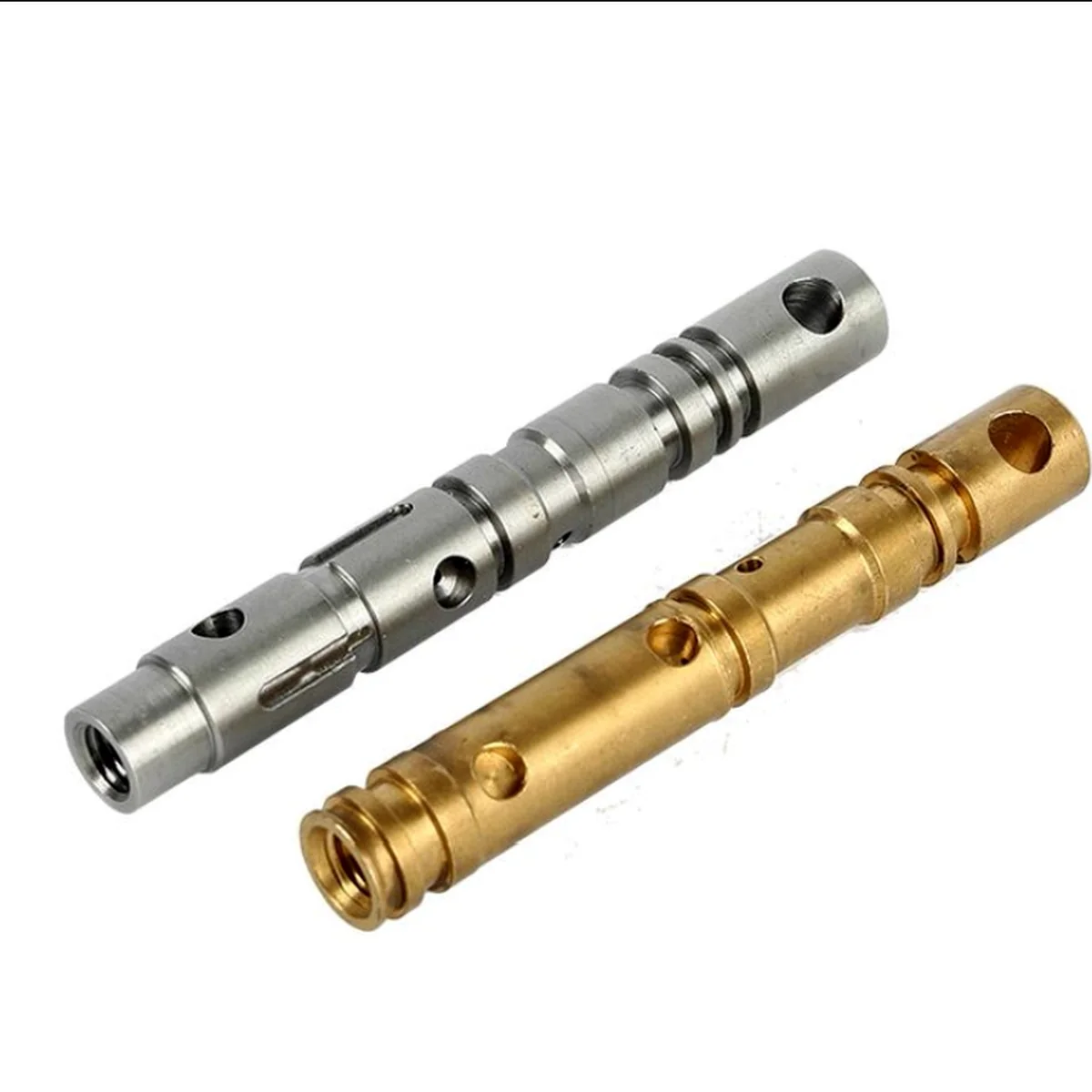
Pin Types & End Details We Machine
Plain cylindrical pins
The basic hinge pin, turned to a running fit — retained by circlips, set screws or end plates.
Headed pivot pins
Integral head one end, groove or cross-hole the other — the working pattern on most linkages.
Snap-ring groove pins
External circlip grooves cut to DIN 471 seat dimensions at each retained end.
Stepped & shouldered pins
Two or more diameters — a bearing surface plus a locating or clamped section.
Grease-drilled pins
Axial passage with cross-holes to the wear surface, tapped for a zerk fitting — drilled within our network.
Threaded-end pins
A thread on one end so the pin bolts in place or takes a retaining nut.
One pattern is left off that list on purpose: the eye-head pin with a collar, the connecting pin on trailers and farm implements. Where its drawing carries no fit it is usually cheaper cast than turned, and we quote it that way — see why a Ø22 × 165 mm eye pin in C45 is cast, not CNC machined.
Size, Tolerance & Hardness
| Attribute | What we machine |
|---|---|
| Diameter | ~3 mm to 100 mm (1/8" to 4"); ground or turned to a running fit — typically g6/f7 against the bore, or to the dimension you measure |
| Length | Short toggle pins up to long through-pins ~1 m; deep axial grease drilling within our network |
| Hardness | Through-hardened & tempered ~28–35 HRC for toughness, or induction case-hardened ~45–58 HRC on the bearing surface over a tough core |
| Surface | Ground or fine-turned bearing zones; black oxide, zinc or phosphate elsewhere for corrosion |
| Retaining features | Circlip grooves, cross-holes for cotter or lynch pins, flats, keeper-plate slots, threads |
Worn Pin? Three Honest Ways to Fix the Joint
A loose pivot joint is rarely just the pin — so before quoting we ask what the bore looks like. The right fix depends on both:
| What's worn | The fix we machine |
|---|---|
| Pin worn, bore still round | Remake the pin to original size — we measure the unworn ends and shoulders to recover the true diameter |
| Pin and bore both worn | Oversize pin to suit a re-bored hole, or pin plus a machined bushing to bring the joint back to spec as a fitted pair |
| Assembly obsolete, pin missing | Measure from the counterpart — the bore, the lugs, the retaining hardware — and rebuild the pin drawing from what remains |
Pin and bushing wear as a pair — replace them as one. Fitting a new pin in a worn bushing throws away most of the repair. We machine the pin and its bronze or steel bushing together, fitted to each other, so the joint goes back to original clearance — see machine replacement parts.
Materials for Pivot Pins
1045 / 4140 steel
The default for load-bearing pins — 4140/42CrMo4 hardened and tempered, or induction-hardened on the wear surface, with 3.1 certificates on request.
4140 machining →Stainless 304 / 316 / 17-4
Outdoor, marine and washdown joints; 17-4 PH where stainless must also be hard — see the condition chart.
304 machining →Bronze & brass (bushings)
Bearing bronze bushings machined to match the pin — the other half of a rebuilt joint.
Brass machining →No Drawing? Start From the Worn Pin
Send the pin — even worn
Post the old pin, or send photos with a caliper reading on the unworn ends. The bore diameter helps too.
We recover the true size
Unworn zones give the original diameter; grooves, holes and hardness are measured and specified. Drawing rebuilt free. How it works →
Turn, harden, grind, ship
Machined, heat-treated, bearing surfaces finished, checked against the drawing before it ships. Copy from a sample →
What to Send for a Fast Quote
- The old pin, or photos with diameter and length — worn is fine, we recover the true size
- The bore condition (still round, or worn oval) so we quote the right fix
- What the joint does — load, movement, outdoor or washdown — so we pick material and hardening
- Retaining details: circlip grooves, cross-holes, threads, grease fitting
- Quantity and delivery country — one repair pin or a production batch
No CAD, no problem. Most pivot pin orders start with a worn pin and a tape measure. We rebuild the drawing and confirm it before cutting — see how to order with no CAD file.
A pivot that is opened rather than left alone needs the other half of the job — the clip and the chain that keep the pin at the joint. Those are set out in lock pins with a retaining chain, with the clip and chain sizes per pin diameter.
A pivot pin held by a circlip needs a DIN 471 groove; the groove diameter, width and minimum distance to the pin end for each pin size are in the circlip groove chart.
Frequently Asked Questions
Yes — it's the most common way these orders arrive. Send the worn pin, or the pin plus its bore. We measure the unworn zones to recover the original diameter, rebuild the drawing free of charge, confirm it with you, then machine the pin — to the original size, or oversize if the bore has worn too.
A clevis pin is a specific headed pin retained by a cotter pin through a cross-hole, standardised in ISO 2341. Pivot pin is the broader term: any cylindrical pin a joint rotates on — plain, headed, stepped, grooved for snap rings or drilled for grease. We machine both; if yours is the headed-with-cotter-hole type, see our clevis pins page.
Yes. Wear pins are usually 1045 or 4140/42CrMo4, either through-hardened and tempered (~28–35 HRC, tough) or induction case-hardened on the working surface (~45–58 HRC, hard skin over a tough core). We recommend based on the joint: case hardening for sliding wear, through-hardening where the pin also sees bending or shear.
Yes — an axial drilling with cross-holes to the wear surface is a standard feature on equipment pivot pins, tapped for a zerk (grease nipple) where the original had one. Deep-hole drilling is done within our network.
Yes, MOQ 1. A pivot pin is a turned part with no tooling cost, so a single replacement for a repair is routine. If the matching bushing is worn as well, we can machine the pin and bushing together as a fitted pair.
Get a Pivot Pin Quoted
The worn pin and two measurements — that's enough to start. Engineers reply in 12h.
// Qty & price
1 pc
Sample price
Repair one joint first
10–50
Unit price drops
Setup cost shared
100+
Best price
All tiers quoted upfront
- →No distributor — you pay the maker directly
- →CAD saved after first order — reorder anytime at lower unit price