Why Brass for CNC Machining?
Brass is the reference standard for machinability. C36000 free-cutting brass has a machinability rating of 100% — the baseline against which all other metals are measured. It cuts fast, produces clean chips, holds tight tolerances, threads superbly, and gives a smooth finish with minimal burring. For fittings, connectors, valves, electrical parts and any part requiring fast CNC production with good surface quality, brass is rarely beaten on process cost.
Brass Grades We Machine
| Grade | Composition | Machinability | Best for |
|---|---|---|---|
| C36000 (Free-Cutting) | Cu 61.5% / Zn 35.5% / Pb 3% | 100% (reference) | Fittings, connectors, valve bodies, shafts — fastest to machine |
| C27000 (Yellow Brass) | Cu 65% / Zn 35% | ~60% | Shells, decorative parts, cold-formed components |
| C26000 (Cartridge Brass) | Cu 70% / Zn 30% | ~50% | Deep drawing, formed parts — better cold formability |
| C46400 (Naval Brass) | Cu 60% / Zn 39.2% / Sn 0.8% | ~40% | Marine fittings, seawater-wetted parts, corrosion resistance |
C36000 is our default for CNC-turned parts. If your application requires marine corrosion resistance, we recommend Naval Brass C46400 or switch to 316L stainless. If lead-free is required for potable water, we can source C69300 (eco-brass) on request.
Mechanical & Physical Properties (C36000-T)
| Property | Typical value |
|---|---|
| Ultimate tensile strength | 469–490 MPa |
| Yield strength (0.2%) | 310–380 MPa |
| Elongation at break | ~18–25% |
| Hardness | ~80–100 HRB |
| Density | 8.50 g/cm³ |
| Electrical conductivity | ~26% IACS |
| Thermal conductivity | ~115 W/m·K |
| Melting range | ~885–900 °C |
| Machinability rating | 100% (reference standard) |
How We Machine Brass
Brass cuts with almost no built-up edge. High surface speeds, sharp tools and relatively light feeds give an excellent surface finish. Practical notes:
- Tolerances: ±0.010 mm on turned diameters is routine; threads to H/h fit classes standard.
- Surface finish: Ra 0.4 µm as-machined is achievable; mirror polish with additional operations.
- Threading: External and internal threads cut cleanly — M, UN, NPT, BSP, BSPT all routinely produced.
- Knurling: Brass knurls precisely and consistently — popular for grip connectors and inserts.
- Deburring: Low burr tendency with sharp tools; parts come off the machine with minimal hand work.
Finishing Options for Brass
- As-machined — natural golden finish, may tarnish over time
- Nickel plating — bright, corrosion-resistant, common for connectors and fittings
- Chrome plating — decorative, hard surface
- Electroless nickel — uniform thickness, good for complex geometries
- Passivation — not applicable to brass (aluminium or stainless process)
- Polishing — bright mirror finish for decorative applications
- Lacquering — clear coat to prevent tarnish
Typical Brass CNC Parts
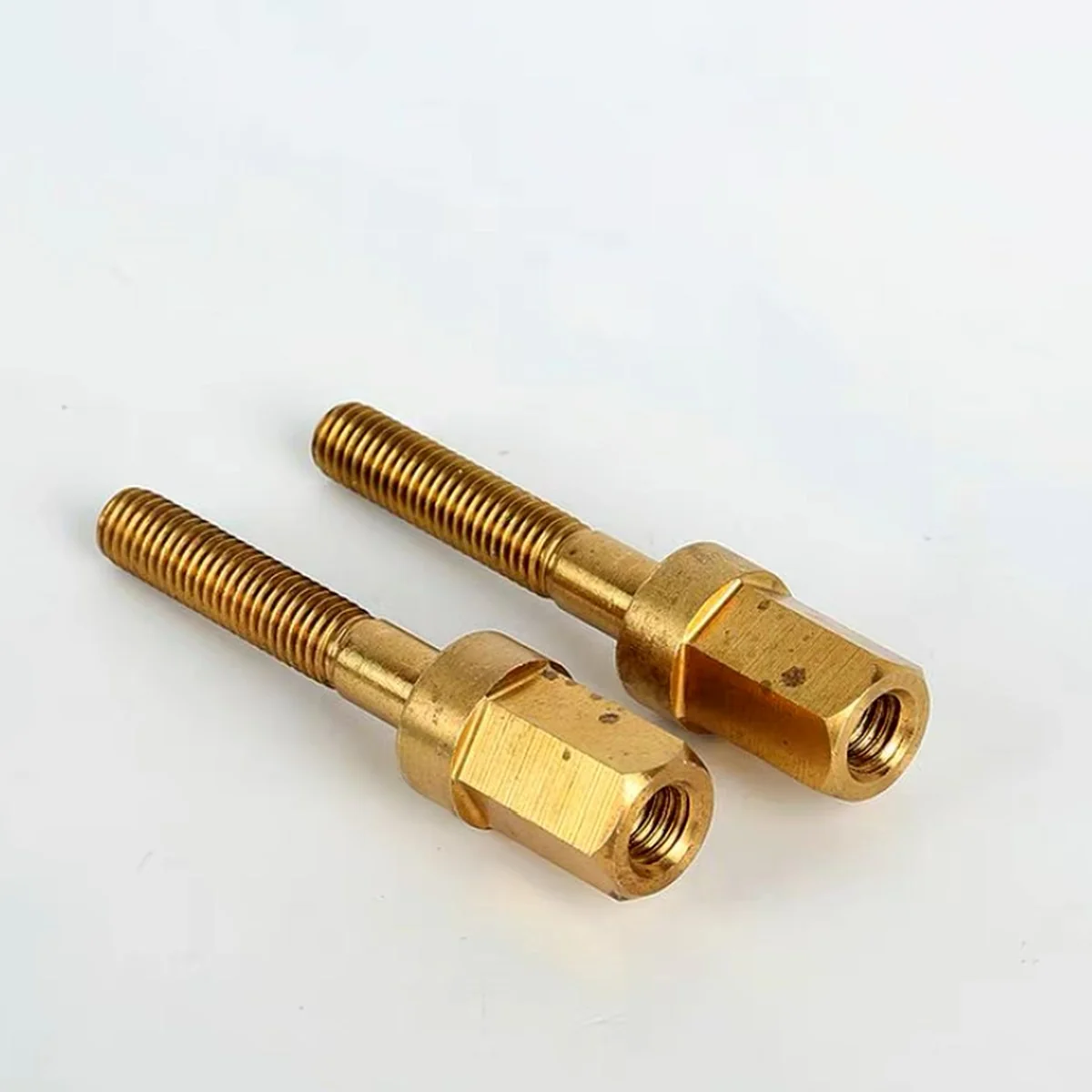
- Fittings and connectors — BSP, NPT, JIC, metric threaded fittings
- Valve bodies and spools — fluid control, pneumatic valves
- Electrical terminals and contacts — plugs, sockets, pins, bushings
- Threaded inserts — press-fit and heat-set inserts for plastic assemblies
- Instrumentation parts — pressure gauge bodies, flow meter components
- Marine hardware — seacocks, through-hulls (Naval Brass grade)
- Replacement fittings — reproduction of discontinued or worn brass fittings from sample
See our adapters & fittings and custom fasteners pages for specific part types we machine in brass.
Replacement brass fittings from sample. Many customers send us a worn or corroded legacy fitting — a pump body, a hydraulic connector, an old valve — and we reproduce it from the worn part itself, no CAD or part number needed. Brass reverse-engineering is one of our strongest services: it measures accurately and machines to exact geometry.
Brass vs Stainless Steel — When to Choose Which
| C36000 Brass | 316L Stainless | |
|---|---|---|
| Machinability | 100% (fastest) | ~45% (slower, harder on tooling) |
| Corrosion resistance | Good (inland), Limited (seawater) | Excellent (seawater, acids) |
| Strength | Moderate | Higher |
| Cost per part | Lower (faster machining) | Higher |
| Best for | Fittings, connectors, general machined parts | Marine, food, medical, chemical |
For marine seawater or chemical environments, use Naval Brass (C46400) or step up to 316L stainless steel. For food contact or high-corrosion, stainless is the correct choice.
Custom Brass Parts — Who Orders and Why
The buyers who contact us for brass machining usually have a non-standard thread combination, a discontinued fitting to reproduce, a need for nickel-plated connectors to spec, or quantities a catalogue supplier won't touch.
"This BSP-to-metric fitting failed — legacy part, nobody stocks it"
Send us the failed fitting or a dimension sheet with thread forms. We machine a replacement in C36000 or C46400 (naval brass for corrosive environments), match the exact thread combination, and ship in 2–3 weeks. No minimum order — single reproductions are routine.
"I need 500 nickel-plated C36000 connectors to our spec — repeat supply basis"
We quote tiered pricing (1 / 10 / 50 / 500 pcs), machine the first sample for approval, then set up repeat supply. Electroless nickel or bright nickel as required. Lead time 3–4 weeks for first run; repeat orders from 2 weeks.
"Through-hull fitting in naval brass — non-standard bore, nothing off the shelf"
We machine custom through-hull fittings and seacocks in naval brass C46400 to any thread standard (BSP, NPT, metric) and flange dimension. One-piece or two-piece — we follow your drawing or dimension sheet. MOQ 1.
"Brass adapters — metric female to BSP male, 10 different sizes, 20 of each"
We machine custom cross-standard thread adapters in C36000 across any combination of metric, BSP, BSPT, NPT, JIC. Send us a spec list with thread forms and dimensions; we quote each size individually and batch-produce. Nickel plating on request.
What Brass Buyers Search For
Frequently Asked Questions
For most CNC-turned parts, yes. C36000 has the highest machinability rating of any commonly stocked brass — it cuts fast, produces clean chips and holds tight tolerances well. If you need lead-free (potable water contact) we use eco-brass C69300; for seawater resistance, Naval Brass C46400 or 316L stainless are better choices.
±0.010 mm on turned diameters is routine. For critical fits we work to ±0.005 mm. Threads cut to standard H/h fit classes. Brass is dimensionally stable after machining — it doesn't spring-back or distort the way harder alloys can.
Yes — this is common. Send us the old fitting (worn, corroded, partial) and we measure it, rebuild the geometry and machine new parts. Brass is particularly good for this: it measures cleanly even when corroded, machines predictably, and the reproduction can be done to the exact thread form of the original (NPT, BSP, BSPT, JIC, metric, BA — whatever was used).
Yes. Nickel plating (bright or matte) is our most common brass finishing request — especially for electrical connectors and hydraulic fittings where tarnish or surface oxidation would be a problem. Electroless nickel is also available where uniform plating on complex internal geometry is needed.
Brass is predominantly copper-zinc; bronze is copper-tin (or copper-aluminium). Bronze generally has better wear and corrosion resistance for bearing and bushing applications, but lower machinability. For most fittings, connectors and valve bodies, brass is the standard choice. We machine both — mention 'bronze' if you need a specific copper alloy (C93200 bearing bronze, C95400 aluminium bronze, etc.).
Get a Brass Machining Quote
Sketch, photo or CAD accepted. Reply in 12h.
// Qty & price
1 pc
Sample price
Confirm fit before a run
10–50
Unit price drops
Setup cost shared
100+
Best price
All tiers quoted upfront
- →No distributor — you pay the maker directly
- →CAD saved after first order — reorder anytime at lower unit price