Designing an LED fixture and the catalog heat sink doesn't fit your board or your wattage? EKINSUN machines a custom aluminum LED heat sink to your exact LED/COB footprint — no extrusion die, from 1 piece. Quote in 12 hours.
An LED Heat Sink Matched to Your Board
Off-the-shelf LED heat sinks come in fixed sizes and hole patterns — great until your COB, MCPCB or star board doesn't line up, or the thermal budget needs a bit more fin. We machine the heat sink to your LED instead: the correct mounting holes, a flat lapped contact face for the thermal pad, and the fin area your drive power requires. Because it's CNC machined, not extruded, there's no die to pay for and the minimum order is one piece — ideal for a prototype fixture that later scales to production.
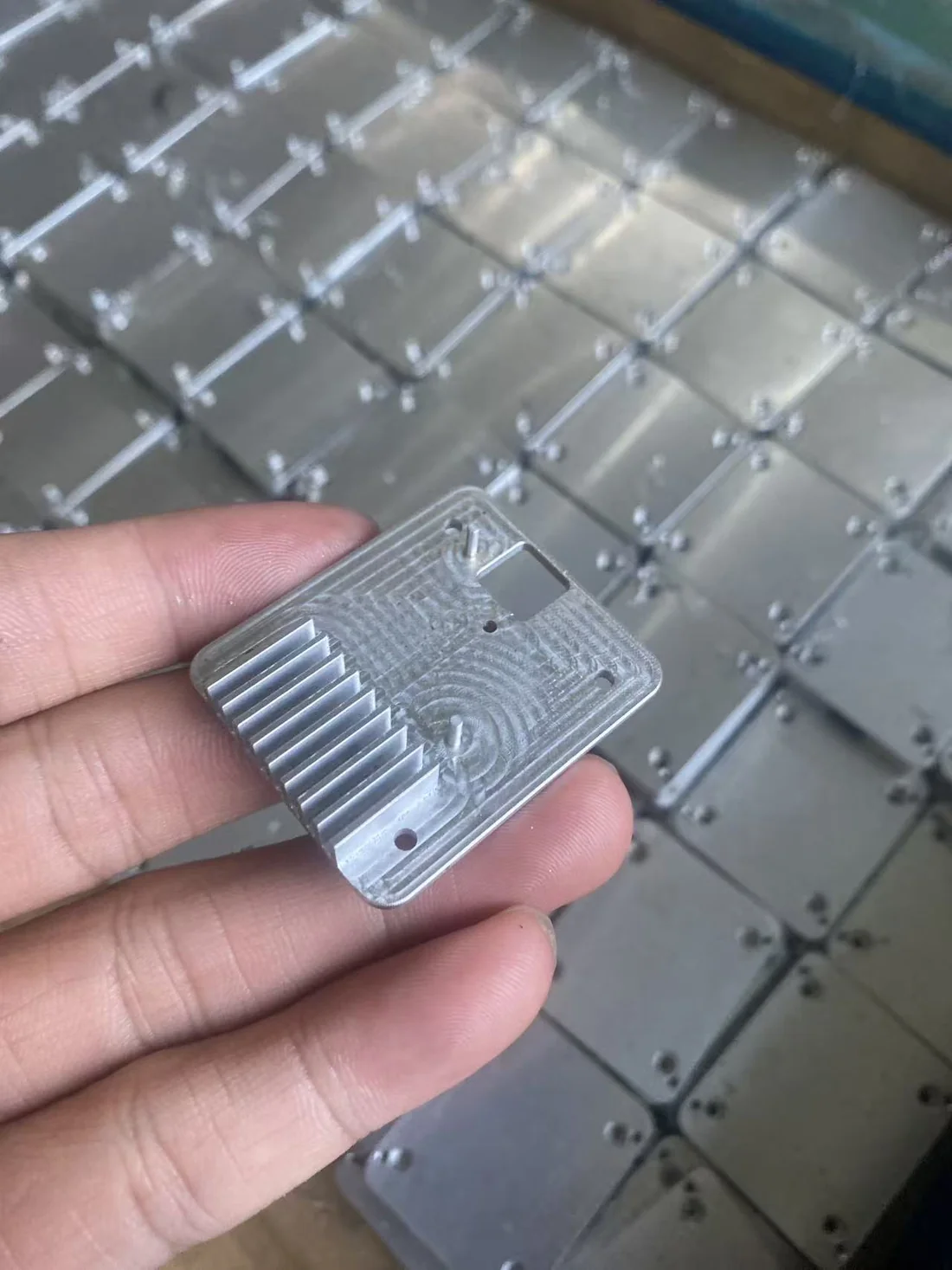
Sizing by LED Power
The right heat sink depends on drive power, ambient temperature, orientation and the target junction temperature — but as a starting point:
| LED power | Typical approach |
|---|---|
| 1–3 W | Small finned block or star heat sink, passive |
| 5–20 W | Finned plate, natural convection, black anodized |
| 20–60 W COB | Larger finned body; pin/blade fins, sometimes active |
| 60–150 W+ | Heavy finned mass or active/liquid — high-bay, streetlight, grow light |
Send us the LED, the power and where it runs, and we'll size and quote it — no thermal-engineer required on your side.
LED Applications We Machine For
COB & high-power LEDs
Cree, Bridgelux, Luminus and generic COBs — heat sink matched to the LES and hole pattern.
Downlights & spots
Round finned heat sinks for MR16, downlight and track fixtures.
High-bay & street lights
Large-mass finned sinks for 50–150W+ outdoor and industrial fixtures.
Grow & UV-LED
Heat sinks for horticulture bars and UV-LED curing modules that run hot and continuous.
Material, Finish & Mounting
- Aluminum 6061 / 6063 — 6063 for fin-dense bodies, 6061 for machined heat sinks with mounting features and driver pockets. Copper for extreme flux.
- Black anodized — raises emissivity for better radiative dissipation and protects the surface; clear and colored also available.
- Flat lapped contact face for the LED/MCPCB thermal pad or paste, tapped holes for the star/COB holder, and an optional pocket for the driver.
Grade choice on an LED sink trades conductivity against strength and machinability. Two grades customers ask for regularly are the wrong answer here:
| Material | Conductivity / density | When it belongs on an LED heat sink |
|---|---|---|
| 6063 | about 201 W/m·K | Highest conductivity of the common structural grades. Use it when the part is mostly fin and the mounting features are plain through-holes. |
| 6061-T6 | about 167 W/m·K · 2.70 g/cm³ | 34 W/m·K less than 6063, bought back in thread strength. Use it when the body carries tapped holes, a driver pocket or a bracket ear. |
| 7075-T6 | about 130 W/m·K · 2.81 g/cm³ | Thermally a step backwards. 130 against 167 W/m·K, and heavier at 2.81 g/cm³. Only justified when the sink is also a loaded structural part. If it is just a heat sink, 7075 costs more and cools worse. |
| Stainless 304 / 1.4301 | about 16 W/m·K · 7.93 g/cm³ | Ruled out on conductivity. Roughly a tenth of 6061-T6 and nearly three times the mass. Correct for an outdoor bracket or a housing that bolts to the sink, never for the sink body itself. |
| Copper C11000 | about 388 W/m·K · 8.96 g/cm³ | COB flux that aluminum cannot spread fast enough. Machinability index 20, so it cuts slowly, and 3.3× the density of 6061 — worth it as a spreader plate under the die, rarely as the whole body. |
What the LED Catalogue Already Covers — and What It Doesn't
Round pin-fin coolers for standard star boards are a solved, stocked product. The gap is a sink matched to a board outline and hole pattern nobody stocks. Where the catalogue wins, buy the catalogue:
| What you need | In the catalogue? | What we do about it |
|---|---|---|
| Round pin-fin cooler, Ø50–Ø90 mm, for a standard star board | Yes — a stock cooler body on a standard star pattern is a catalogue item | Buy the catalogue part. A stock cooler ships from stock and beats a machined one-off on price at any quantity. Don't send us this drawing. |
| Same fixture, but the board is a 46 × 28 mm rectangular COB carrier with holes on no standard pitch | No — a stock cooler is drilled for the pattern it was designed around, not for yours | Machined base to your outline, mounting holes on your pitch, flat lapped contact face for the pad, tapped holes for the holder. MOQ 1. |
| 0.60 mm fins, 20 mm tall (33:1) to fit the fin stack inside a Ø70 mm can | No — extruded profiles start about 1.20 mm and run out near 12:1, with 1–2 degrees draft per side | Not milled either: milled fins stop near 8:1, from about 1.00 mm. Skived fins reach about 40:1 at 0.20–1.00 mm in 6063, 1050, C11000 or C10200; bonded fin passes 50:1 with 0.30–1.00 mm rolled sheet in a machined base, no tooling, from 1 piece. |
| Driver pocket, cable slot and two M4 tapped holes in the back face | No — an extrusion is one constant section, so anything that breaks the section is a second operation on the stock bar anyway | Cut in the same setup as the LED face, so the pocket and the contact face share one datum. |
| 500 pieces a year of a plain finned bar, no back-face features, cut to length | Yes — a standard extruded profile cut to length, stocked deep by Fischer Elektronik, Aavid and Alutronic | You don't need us. At that volume with a constant section, stock extrusion cut to length is cheaper than machining and we say so on the quote instead of taking the order. |
| 5 prototype fixtures now, 300 next year, same geometry | No — not in this outline without cutting a die first | No die, no setup fee, 1 piece. The same program runs the 300 when the fixture ramps. |
| Fin field stepped down on one side to clear a reflector skirt | No — a die produces one constant section end to end | Machined: fin height varies along the body, and the step is cut with the mounting face. |
When not to ask us. If the LED sits on a standard star board and the housing has room for a stock round pin-fin cooler, buy it off the shelf — no machined one-off will match that price. Same answer for a plain extruded bar cut to length in volume with nothing in the back face: buy the profile, which Fischer Elektronik, Aavid and Alutronic stock deep. We earn the money only when the board outline, the hole pattern or the fin geometry is not in anyone's catalogue.
Just have the LED and a target wattage? That's enough. Send the part number or footprint and the drive power — we machine the aluminum heat sink to it, from one piece.
Will it fit the board? LED heat sink checks before you order
An LED heat sink fits by three things the catalogue part rarely has all of: the holder's hole pattern, a flat under the LED to 0.05 mm so the thermal pad actually touches, and enough surface for the power. A sink sized for a 10 W module under a 30 W COB runs the junction past its rating however good the paste is; the fin area scales with the watts, not with the board size. 6063 conducts at about 201 W/m·K against 167 for 6061, so an extrusion in 6063 beats a machined 6061 block of the same size, and either beats stainless (16 W/m·K) by a factor of ten.
What do I need for a 30 W COB on a holder with two mounting holes?
A finned sink with the holder's two holes tapped at their spacing, a lapped flat under the COB, fin area for 30 W at your ambient in natural convection, black anodised for radiation, and a mounting method for the fixture. Send the COB and holder part numbers; the datasheets give the pattern and the heat.
Same heat sink, but 6063, taller fins, or black anodised
A 6063 extrusion profile instead of a machined block, taller or pin fins for the same footprint, a black finish, a second hole pattern for a different holder, or a copper slug under the LED — each is a variant of the same drawing, one piece and up, quoted in 12 hours.
Frequently Asked Questions
Can you make a heat sink for a specific LED or COB?
Yes. Send the LED/COB part number or its footprint, hole pattern and thermal pad size, plus the drive power. We machine the aluminum LED heat sink to match the mounting exactly with the fin area your wattage needs.
What wattage can you cool?
From a 1W indicator to 100W+ COB arrays and high-bay fixtures. We size fin area and mass to your power, ambient and target junction temperature — passive, or active where space is tight.
Should an LED heat sink be black anodized?
Usually yes — black anodizing raises emissivity (better radiative dissipation) and protects the aluminum. Clear/colored also available.
Machined or extruded?
We machine — no die, no tooling cost, MOQ 1, and we match non-standard footprints. For high volumes of a simple profile, extrusion may be cheaper and we'll tell you.
Minimum order?
1 piece, no setup fee. The same program scales to production as your fixture ramps.
Related: which fin type do you need? · all custom aluminum heat sinks · CNC milling · order from a sketch · all custom parts
Get a Free Quote
Send the LED/COB, the wattage and quantity — or a drawing. Reply within 12 hours.
Response within 12h · Drawings kept confidential