Need an M25 to M20 reducer the catalogue does not cover — a non-standard pitch, a shorter body, PG on one side, or 316L instead of nylon? We machine it to order, in nickel-plated brass, 316L or steel, with the sealing arrangement you already have. From a sketch, no CAD, one piece up. Get a quote →
When the catalogue reducer is fine — and when it is not
Being straight about this: M25×1.5 and M20×1.5 are both standard cable gland threads, so a stock brass or nylon M25→M20 reducer exists, costs a couple of euros, and is stocked by every electrical wholesaler. If your job is an oversized knockout, a smaller cable, and nothing unusual — buy the catalogue part. We would rather tell you that than sell you a machined one you do not need.
The machined part earns its keep in a specific set of cases, and they are the ones that keep arriving here:
- The pitch is not 1.5 mm on both ends — a mechanical M25×2.0 or a fine M20×1.0 is nowhere in the gland ranges
- One side is PG, not metric — PG 21 to M20 is the common pair on older German equipment
- Every stock reducer is too long for the gap between the gland and the housing
- The standard hex fouls the neighbouring gland on a crowded entry plate, so the across-flats has to come down
- The specification calls for 316L or nickel-plated brass and the stock part is only nylon
- An existing sealing arrangement must be preserved exactly, so the IP rating survives the extra joint
- The joint carries mechanical load, not just a cable — a thin gland reducer will strip
- You need 10 or 20 pieces in a mix of sizes, on one order and one delivery
Quick test: if both ends are ×1.5, the part is only sealing a cable, and there is room for a standard body — a catalogue reducer does the job. Change any one of those three and you are into a machined part.
Pitch & material options
Each end is single-point turned to its own pitch and gauged with a thread ring or plug, so both sides thread on cleanly.
| Option | Choices | Notes |
|---|---|---|
| M25 end | M25×1.5 (gland standard) · M25×2.0 · M25×1.0 | Male or female |
| M20 end | M20×1.5 (gland standard) · M20×2.5 (coarse) · M20×1.0 | Male or female |
| Instead of M25 | PG 21 · PG 16 · 3/4″ NPT · G 3/4 | Legacy or imported equipment |
| Form | Male-female · double-male · female-female | To suit your two parts |
| Material | Nickel-plated brass · 316L · 304 · steel · 6061 · PA66 | PA66 where isolation is needed |
| Drive | Hex to suit · or two spanner flats | Reduced across-flats for crowded plates |
| Sealing | Flat washer face · O-ring groove · NPT taper | Copied from what seals today |
| Body length | Shortest the thread engagement allows | State the space you have |
All metric gland threads share one pitch. M12, M16, M20, M25, M32, M40, M50 and M63 all run 1.5 mm under EN 60423 — so between gland sizes the only variable is diameter. That is why a gland-to-gland reducer is a stock item, and why anything outside that set is not.
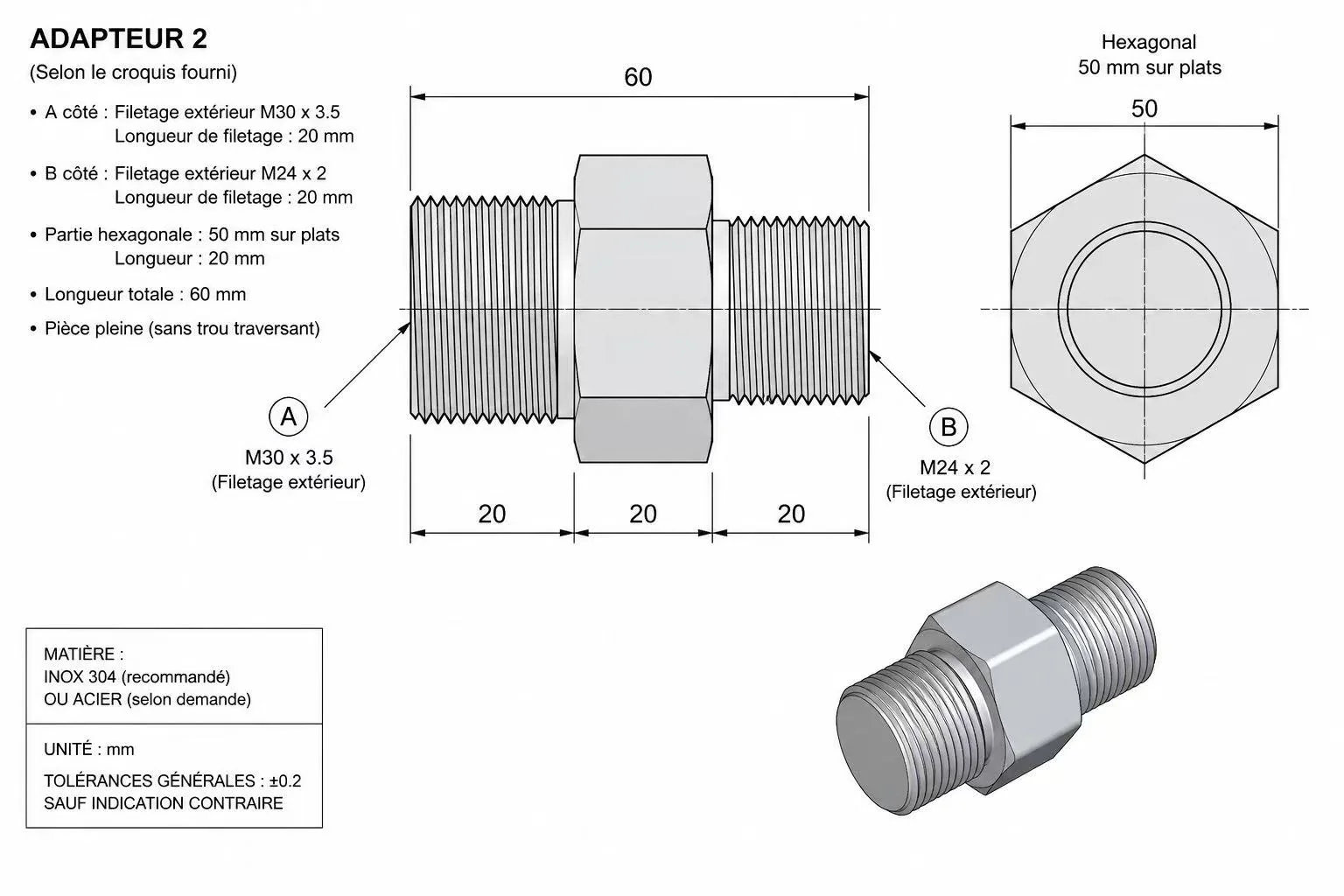
Other size adapters we machine
Three forms we machine
Male-Female
M25 male into the enclosure, M20 female for the gland — the usual gland-plate case.
Double-Male Stud
M25 male and M20 male — joins two female parts through one body.
Female-Female
M25 female and M20 female — a coupling between two male fittings.
How it's made — and what we need
- Turned from bar — nickel-plated brass, 316L or steel; hex bar where a wrench grip is wanted so the flats come from stock.
- Each end cut to its pitch — M25 end and M20 end single-point threaded, chamfered, then gauged.
- Sealing feature machined in — O-ring groove, faced shoulder or taper, copied from what seals on the part today.
- Finished & checked — deburred, edges broken, both threads verified with ring and plug gauges before packing.
- To order it — send a sketch, a photo of the two parts with a caliper against them, or just the callouts (e.g. "M25×1.5 male → M20×1.5 female, nickel-plated brass, body under 18 mm"). We draw it, confirm, and quote. How ordering with no CAD works →
Where the M25 to M20 Catalogue Stops
M25×1.5 to M20×1.5 is a standard gland reduction — buy the catalogue reducer and you are done. This table is for everything that reduction cannot cover.
| What you need | In the catalogue? | How we machine it |
|---|---|---|
| M25×1.5 female × M20×1.5 male, plain | Stocked | Both are standard gland threads. Buy it off the shelf; you do not need us for this one. |
| M25×2.0 or M25×1.0 on the large end | No | Once the pitch is not ×1.5 the stock reducer is gone. Single-point cut to the pitch you measured. |
| PG 21 or PG 16 on one end, M20 on the other | Rare | Legacy Panzergewinde plates meeting modern metric glands. Cut to the PG form on that end. |
| 3/4″ NPT or G 3/4 on one end, M20 metric on the other | Rare | Imported equipment with an inch port in a metric enclosure. |
| Shortest body the thread engagement allows | No | Stock reducers come in one length and often foul the plate behind. State the space you have. |
| Reduced across-flats for a crowded gland plate | No | Catalogue hex is fixed and its corners are what fouls the neighbour. |
| 316L or nickel-plated brass | Rare | Stock reducers are usually plain nickel-plated brass or nylon. |
| PA66 where the gland must stay electrically isolated | Rare | Machined rather than moulded, so the size does not have to exist as a mould. |
| O-ring groove instead of a flat washer face | No | We copy whatever seals on the equipment today. |
| Left-hand thread on either end | No | Not a catalogue item in any gland size. |
Thread options above are the ones this page already lists, including the PG and inch alternatives.
Frequently asked
Is an M25 to M20 gland reducer the same as a machined M25 to M20 adapter?
Often the catalogue reducer is the right answer and you should buy it — both are standard gland threads, so stock parts exist and are cheap. A machined adapter earns its place when the pitch is not ×1.5 on both ends, one side is PG, the stock part is too long or its hex fouls a neighbour, the spec calls for 316L or nickel-plated brass rather than nylon, an existing seal must be preserved, or the joint carries load rather than just sealing a cable.
Which pitches can you cut on an M25 to M20 adapter?
Any combination. The gland default is M25×1.5 to M20×1.5, since all metric gland threads M12–M63 run 1.5 mm under EN 60423. On the mechanical side we also cut M25×2.0, M25×1.0, M20×2.5 and M20×1.0, plus non-standard pitches on request. Both ends are gauged. More on coarse vs fine pitch →
Can you make it as an M20 to M25 enlarger instead?
Yes — reducer and enlarger are the same part with the ends swapped. An M20 to M25 enlarger is what you need when the cable turns out thicker than the original entry allows; an M25 to M20 reducer is for an oversized knockout with a smaller cable.
Can one end be PG instead of metric?
Yes, and PG 21 to M20 is a common request. PG cannot be mated to metric even where the diameters look close — PG 21 measures 28.3 mm with a 1.59 mm pitch on an 80° flank, against metric's 1.5 mm on 60°. We cut PG on one end and metric on the other in one body. Full PG to metric conversion chart →
How is the IP rating preserved through an extra adapter?
By reproducing whatever seals today. A gland is a body, a sealing insert, a clamping claw, a dome nut and a washer or O-ring. Tell us which part does the sealing — flat washer, O-ring in a groove, or an NPT taper — and the adapter is designed around it rather than in spite of it.
What's the minimum order, and do you need CAD?
MOQ is one piece, no tooling cost, no CAD needed. A sketch, a photo with a caliper, or the two callouts is enough. We draw and confirm before machining, keep the drawing for re-orders, and quote with price breaks at 1, 10, 50 and 200 pieces.
Tell us your two threads. Send a sketch, a photo, or just the callouts (e.g. "M25×1.5 male → M20×1.5 female, 316L, shortest possible"). Free drawing, quote in 12 hours. Get a quote → or see all cable gland & conduit adapters.