Bringing an M40 entry down to an M32 gland — and the stock reducer is too narrow to seal properly against thin cabinet sheet? We machine it with the flange face the hole actually needs, in nickel-plated brass, 316L or steel. From a sketch, no CAD, one piece up. Get a quote →
At M40 the problem moves to the panel
The smaller steps in this family are about the thread and the cable. This size is about the hole and the sheet it is cut in. An M40 entry means a hole of roughly 40.5 mm, and in a typical cabinet that hole is in sheet only 1.5 to 2.5 mm thick.
A 40 mm hole takes most of the local stiffness out of that panel. Pull up the locknut and the sheet dishes — so the sealing washer ends up bearing on a curved surface instead of a flat one, and the IP rating you specified quietly stops being true. A narrow stock reducer concentrates the clamping load right at the hole edge and makes it worse.
What we machine can carry a wider, properly faced flange that spreads the clamping load out onto sound metal and stiffens the hole. It is a small change on the drawing and it is the difference between a joint that seals and one that weeps.
When this does not matter: if the entry is in a cast housing, a thick gland plate, or anything above about 4 mm, the panel is stiff enough on its own and a catalogue reducer is fine. Tell us the panel thickness and we will say which case you are in rather than sell you the machined part by default.
The other reasons this size gets machined
- The pitch is not 1.5 mm on both ends — a mechanical M40×3.0 or M40×2.0 is nowhere in the gland ranges
- One side is PG, not metric — PG 36 to M40 is the pair on older German equipment
- The entry is on a bottom gland plate, where standing water makes the sealing face flatness critical
- The specification calls for 316L and the stock part is brass or nylon
- Bonding and screening continuity matters on a drive or converter cabinet, ruling out plastic
- The stock reducer is too long and fouls a busbar, terminal block or duct behind the plate
- An existing sealing arrangement must be preserved so the IP rating survives the extra joint
- You need a mix of sizes — M40→M32 alongside M32→M25 and M25→M20 — on one order
Pitch & material options
At M40 the threads are big enough that a pitch error shows up as wobble across the whole flange face, so each end is single-point cut and gauged — on thin sheet that wobble is the difference between an IP-rated joint and a rattling one.
| Option | Choices | Notes |
|---|---|---|
| M40 end | M40×1.5 (gland standard) · M40×3.0 · M40×2.0 · M40×1.0 | Male or female |
| M32 end | M32×1.5 (gland standard) · M32×2.0 · M32×1.0 | Male or female |
| Instead of M40 | PG 36 · PG 42 · 1¼″ NPT · G 1¼ | Legacy or imported equipment |
| Flange face | Standard · wide face for thin sheet | State the panel thickness |
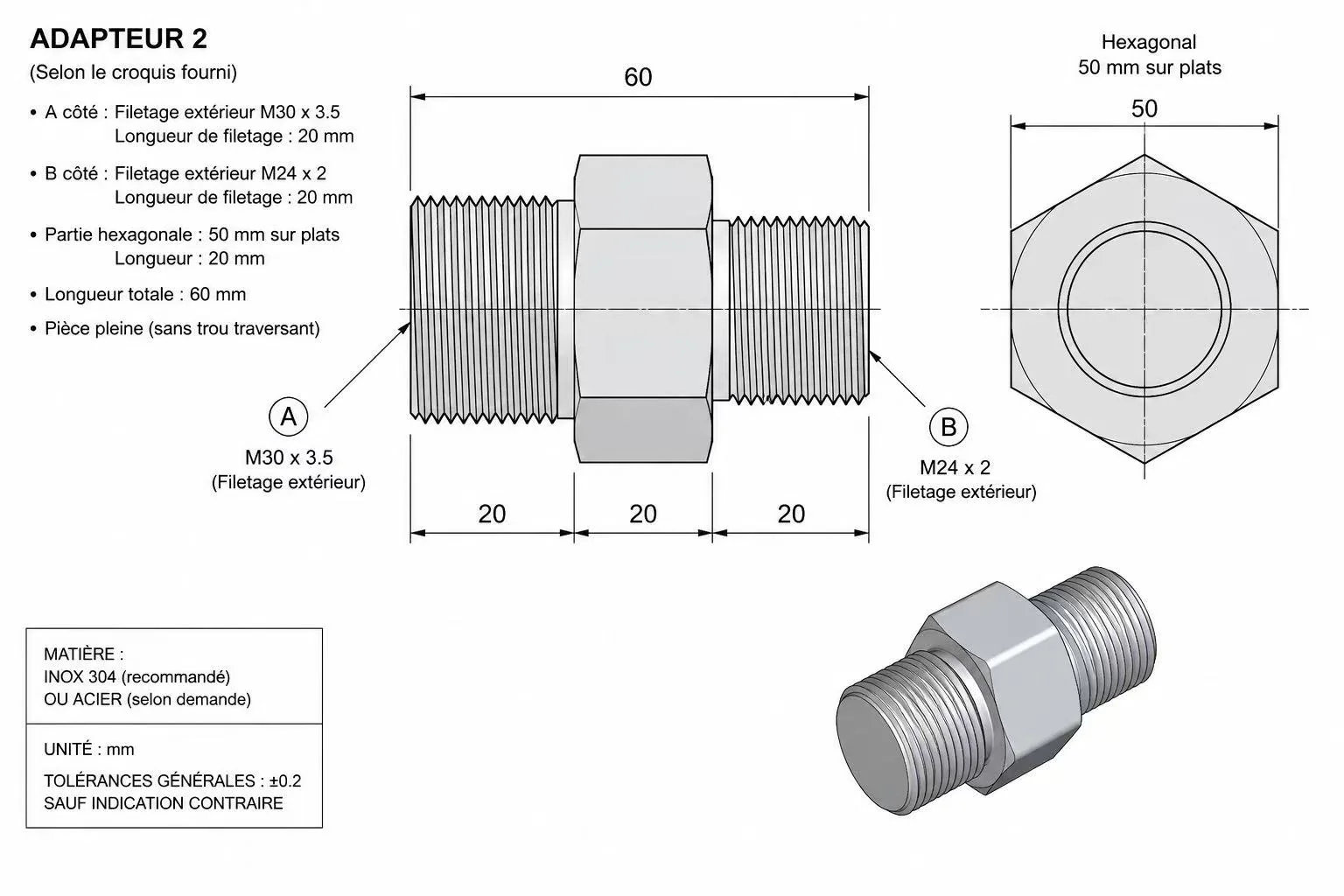
| Form | Male-female · double-male · female-female | To suit your two parts |
| Material | Nickel-plated brass · 316L (1.4404) · 304 (1.4301) · steel | Metal-to-metal seat for screening |
| Drive | Hex to suit · or two spanner flats | Reduced across-flats for crowded plates |
| Sealing | Flat washer face · O-ring groove · NPT taper | Copied from what seals today |
All metric gland threads share one pitch. M12, M16, M20, M25, M32, M40, M50 and M63 all run 1.5 mm under EN 60423 — so between gland sizes the only variable is diameter. Every coarse mechanical pitch at M40 is outside that set, and therefore a machined part by definition.
Other size adapters we machine
Three forms we machine
Male-Female
M40 male filling the legacy cutout, M32 female taking today's gland — the classic oversized-hole rescue.
Double-Male Stud
M40 and M32 male ends through one body — for the bulkhead that was drilled M40 back when, while both sides now carry female hardware.
Female-Female
An M40-female-to-M32-female coupling — at this diameter we machine the spanner flats deep, because these get torqued harder than any smaller size in the range.
How it's made — and what we need
- Turned from bar with a wide flange face — on 1–1.5 mm sheet it is the face diameter, not the thread, that spreads the clamping load onto sound metal.
- Flange face sized to the panel — tell us the sheet thickness and whether the hole is already cut; we set the face diameter to spread the load onto sound metal.
- Each end cut to its pitch — M40 and M32 ends single-point threaded in one clamping and gauged; at 40 mm a thread cut in two setups telegraphs its runout straight into the gland.
- Sealing feature machined in — at this size most enclosures seal on a gasket under the flange rather than an O-ring in a groove; tell us which your box uses and we machine that face.
- Finished & checked — deburred, edges broken, and the M40 ring gauge has the final word: a thread this size that needs force to start is scrap, not “tight”.
- To order it — send a sketch, a photo with a caliper, or the callouts (e.g. "M40×1.5 male → M32×1.5 female, 316L, 2 mm panel, bottom entry"). We draw it, confirm, and quote. How ordering with no CAD works →
Where the Catalogue Stops for This Size Pair
The plain case is sometimes on a shelf. The panel problems this size actually gets bought for are not:
| What you need | In the catalogue? | How we machine it |
|---|---|---|
| A plain ×1.5 reducer M40→M32 | Sometimes stocked | If a stockist lists it, buy it off the shelf — but measure the flange first: stock faces assume flat, sound sheet around the cutout |
| A wide or thick flange face for thin, dented or re-drilled sheet | No | Face diameter machined to spread the clamping load onto sound metal — the classic reason an M40 reducer gets turned |
| Off-pitch ends — M40×2, M40×3, M32×2 | No | Single-pointed to each pitch on one bar, then ring- and plug-gauged |
| Spanner flats deeper than a stamped hex | No | At M40 torque a stamped hex rounds off; we mill the flats to the spanner you name |
| Gasket face instead of an O-ring groove (or the reverse) | No | The sealing face is machined to what your enclosure actually uses, not to a default |
| 316L (1.4404) or alloy steel | Rare | Open material, one-off is fine |
Frequently asked
Why does an M40 to M32 reducer need a wider flange face?
Because of the hole it has to cover. An M40 entry is a hole of roughly 40.5 mm cut in sheet only 1.5 to 2.5 mm thick. That takes most of the local stiffness out of the panel, so it dishes when the locknut is pulled up and the seal bears on a curved surface. A machined adapter can carry a wider faced flange that spreads the clamping load and stiffens the hole. If the panel is thick or the entry is in a cast housing, this matters much less.
Which pitches can you cut on an M40 to M32 adapter?
Any combination. The gland default is M40×1.5 to M32×1.5, since all metric gland threads M12–M63 run 1.5 mm under EN 60423. On the mechanical side we also cut M40×3.0, M40×2.0, M40×1.0, M32×2.0 and M32×1.0, plus non-standard pitches on request. Both ends are gauged. More on coarse vs fine pitch →
Can you make it as an M32 to M40 enlarger instead?
Yes — same part, ends swapped. At this size the reducer is usually the common direction: the cabinet was punched for M40 supply entries and the actual cable came in smaller. The M32→M40 enlarger is for the opposite case, a heavier supply cable going into an entry sized for M32.
Can one end be PG instead of metric?
Yes — PG 36 to M40 is the pair at this size. PG 36 measures 47.0 mm with a 1.59 mm pitch on an 80° flank, against metric's 1.5 mm on 60°, so the two cannot be mated directly. We cut PG on one end and metric on the other in one body. Full PG to metric conversion chart →
Where do M40 entries usually turn up?
Main supply entries into distribution and sub-distribution boards, the bottom gland plates of drive and converter cabinets, larger machine control cabinets, and generator and transformer connection boxes. Many of these are bottom entries, so standing water and the flatness of the sealing face matter more than on a side wall.
What's the minimum order, and do you need CAD?
MOQ is one piece, no tooling cost, no CAD needed. A sketch, a photo with a caliper, or the two callouts plus the panel thickness is enough. We draw and confirm before machining, keep the drawing for re-orders, and quote with price breaks at 1, 10, 50 and 200 pieces.
Tell us the two threads and the panel. Send a sketch, a photo, or the callouts (e.g. "M40×1.5 male → M32×1.5 female, 316L, 2 mm sheet, bottom entry"). Free drawing, quote in 12 hours. Get a quote → or see all cable gland & conduit adapters.