Need to take a female port and bring it out as a smaller male stud — different diameter and pitch on each end? That's a male-female (female-to-male) reducing adapter. Here's a real one: internal M24×2 one end, external M20×1.5 the other, turned from 304 stainless with a wrench hex. Send your two threads for a quote →
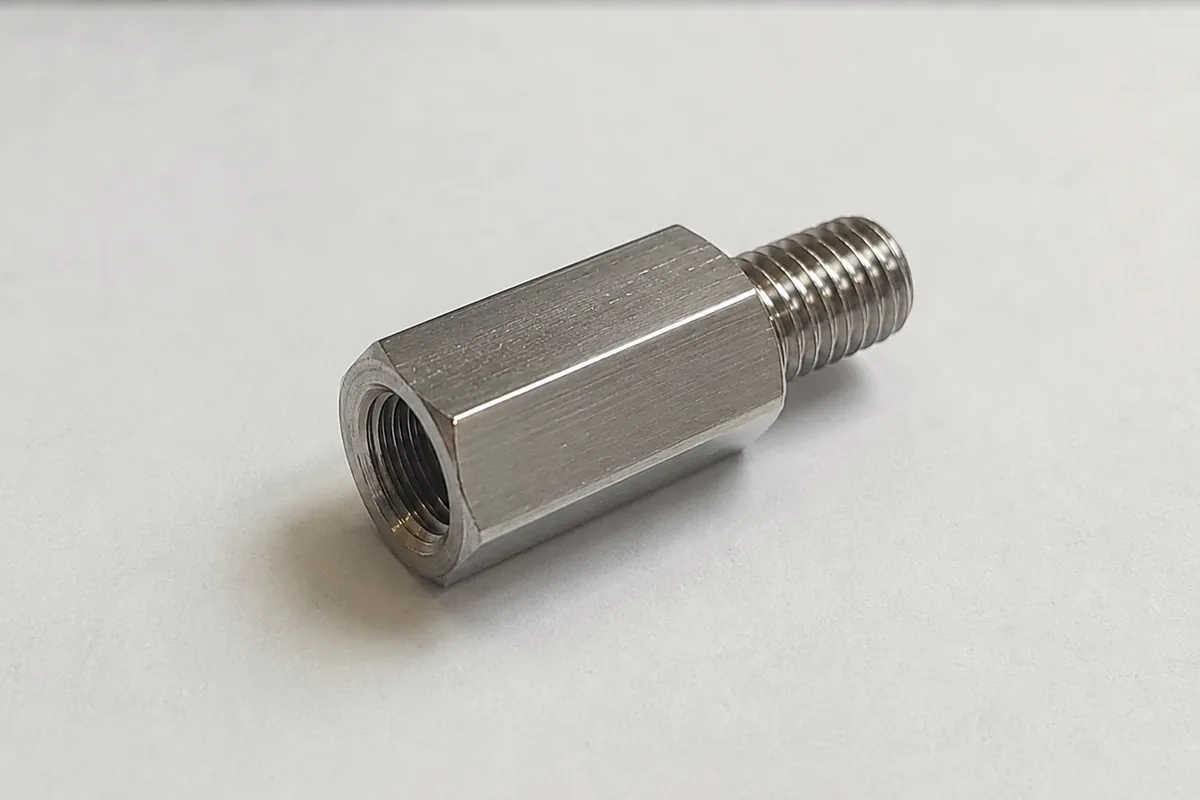
What a Male-Female Reducing Adapter Does
Unlike a double-male stud (male both ends), a male-female adapter has one internal (tapped) end and one external (male) end. It threads onto a male part on one side and into a female port on the other. When the two threads differ — M24×2 female here, M20×1.5 male there — it reduces and converts in a single piece, which is exactly the combination a catalogue rarely carries.
Fit a smaller device
An M24×2 port that needs to accept an M20×1.5 sensor, gauge or fitting without re-tapping the housing.
Reduce a line
Steps a larger female thread down to a smaller male stud in one part, no bushing stack.
Change the pitch
Keeps 2 mm on the female side and 1.5 mm on the male side — each matched to what it screws into.
Specification
| Feature | Specification | Notes |
|---|---|---|
| Female end | M24 × 2 internal (tapped) | Screws onto a male part |
| Male end | M20 × 1.5 external | Fine pitch · screws into a port |
| Body | Hex across flats | Driven with a spanner |
| Bore | Blind or through, to drawing | Through if a passage is needed |
| Material | 304 stainless | 316L, brass, 6061 aluminum or steel on request |
| Thread check | Plug gauge (female) + ring gauge (male) | Each thread gauged |
| General tolerance | ±0.1–0.2 mm | Tighter where specified |
| Quantity | 1 piece and up | No tooling cost |
How It Was Machined
A male-female reducer is a two-operation CNC turning job from hex bar:
- Hex bar stock — the wrench flats come straight from hexagonal raw material.
- Bore and thread the M24×2 female end — drill, bore to the tapping size, then single-point or tap the 2 mm internal thread, chamfered for a clean start.
- Turn and thread the M20×1.5 male end — turn the Ø20 journal, chamfer the lead-in and cut the fine 1.5 mm pitch.
- Gauge both threads — a plug gauge checks the internal M24×2, a ring gauge the external M20×1.5.
- Deburr & inspect — chamfers cleaned, hex and lengths measured before packing.
Female threads take an extra step: an internal thread is bored and tapped or single-pointed, then checked with a plug gauge — which is why a male-female adapter is confirmed on a drawing first, so the tapping depth and bore are right before any metal is cut.
The Takeaway
A male-female reducing adapter that mixes gender, diameter and pitch — internal M24×2 to external M20×1.5 — is the part that lets a larger port accept a smaller device without re-machining the equipment. Turned from 304 stainless with a wrench hex and both threads gauged, it's made to order from a sketch. No CAD file, no catalogue hunt.
Need a male-female adapter? Send a sketch, a photo, or the two thread callouts and which end is female (e.g. "internal M24×2 to external M20×1.5, hex"). We draw it, confirm it, and quote. Email [email protected] or message us on WhatsApp.
The other two forms of the same part: two internal threads, M30×1.5 to M12×1.75 in 316, and two external, M35×1.5 to M30×2 in 316L.
FAQ
What is a male-female thread adapter?
An adapter with an internal (female) thread one end and an external (male) thread the other — a female-to-male adapter. It screws onto a male part and into a female port, converting and, when the sizes differ, reducing. This one goes internal M24×2 to external M20×1.5.
Can the two ends be different pitches?
Yes — female M24×2 and male M20×1.5 here. Each thread is machined independently and gauged separately (plug gauge for the female, ring gauge for the male).
Do I need a CAD file?
No. A sketch with the two thread callouts, which end is female, and the hex size is enough. We produce a dimensioned drawing for free and confirm it before machining. How ordering with no CAD works →