Article Contents
Short answer: For aluminum, anodize (Type II for color, Type III hardcoat for wear). For stainless steel, passivate (and electropolish for a bright finish). For carbon and alloy steel, black oxide, plating or powder coating. If you only need a clean appearance and don't care about chemistry, bead blasting or brushing works on almost any metal. Tell your supplier the environment and the look you want, and they'll match a finish.
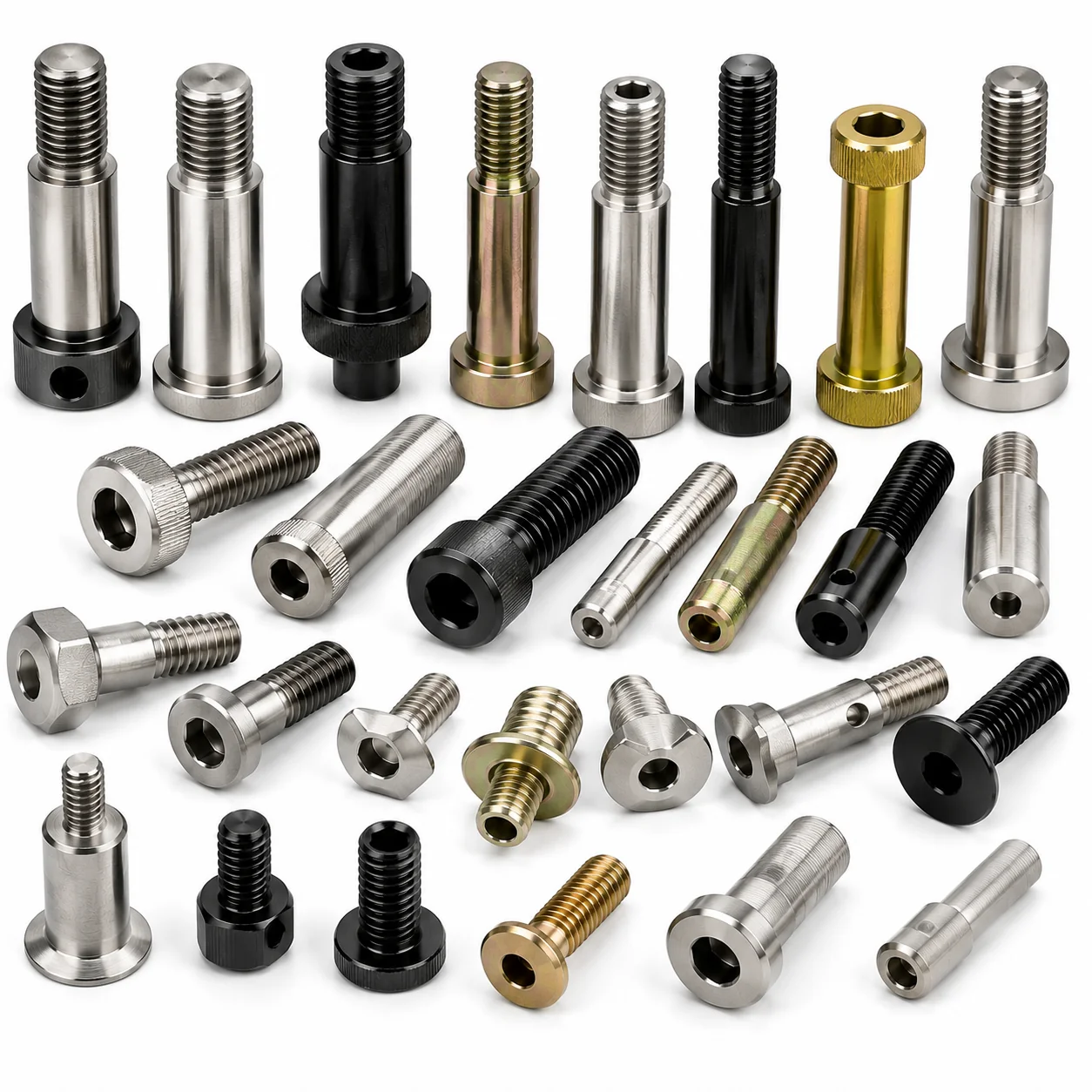
One family of parts, several finishes — black oxide, bright stainless, gold-anodized titanium and bare brass
Finish Cheat Sheet
| Finish | Best for metal | Main benefit | Dimensional change |
|---|---|---|---|
| Anodizing (Type II) | Aluminum, titanium | Color + moderate protection | Very small (few µm) |
| Hardcoat (Type III) | Aluminum | Hard wear surface | Small but must be planned |
| Passivation | Stainless steel | Max corrosion resistance | None |
| Black oxide | Steel, alloy steel | Matte black, low glare | Negligible |
| Powder coating | Steel, aluminum | Tough colored coat | Adds thickness (~50–100 µm) |
| Bead blasting | Any | Uniform matte look | Minimal |
| Electropolishing | Stainless | Bright, ultra-smooth, hygienic | Removes a few µm |
Anodizing
Anodizing is an electrochemical process that grows a hard oxide layer on the surface of aluminum and titanium parts. Because the layer is grown from the metal rather than added on top, it won't chip or peel like paint or plating.
- Type II — a thinner decorative layer that accepts color (black, red, blue, gold and more) and gives moderate corrosion and wear protection. The standard choice for consumer and enclosure parts.
- Type III (hardcoat) — a much thicker, harder layer for serious wear resistance, usually dark grey or black. Used for sliding surfaces, pistons and functional wear parts. Allow for the added thickness on tight tolerances.
Note that the anodized layer is electrically non-conductive. If a part needs grounding or electrical contact, mask those areas. Anodizing pairs naturally with 6061 aluminum and 7075 aluminum.
Passivation
Passivation is the standard treatment for stainless steel. The part is bathed in an acid solution (typically nitric or citric) that removes free iron and machining contaminants from the surface and restores the natural chromium-oxide passive layer. This maximizes corrosion resistance without changing the part's dimensions or appearance.
Passivation is not a coating — it's a cleaning and chemical-restoration step. It's strongly recommended for any stainless part that will see moisture, food, medical or marine service. See 316 stainless machining for grade detail.
Black Oxide
Black oxide is a conversion coating for ferrous metals (carbon and alloy steel). The part is dipped in a hot alkaline bath that converts the surface to a black magnetite layer. It gives a clean matte-black look, reduces light glare (useful for tooling and optics), and adds almost no thickness — ideal where dimensions are tight.
Corrosion protection is mild, so black oxide parts are usually sealed with oil or wax. For heavier protection on steel, choose plating or powder coating instead.
Powder Coating
Powder coating sprays a charged plastic powder onto the part, which is then baked into a tough, durable colored film. It works on steel and aluminum, offers a huge range of colors and textures, and provides good corrosion and impact resistance.
Because it adds a measurable layer (typically 50–100 µm), mask threads, bores and mating surfaces, and allow for the coating thickness on fits. Powder coating is the go-to for enclosures, frames and outdoor steel parts.
Blasting & Brushing
Mechanical finishes change texture rather than chemistry, and work on almost any metal:
- Bead/sand blasting — propels media at the surface for a uniform matte texture that hides tool marks. Often used as a base before anodizing or painting.
- Brushing — creates a directional satin grain, common on visible stainless and aluminum.
- Tumbling/deburring — smooths edges and corners on small parts in bulk.
These are the lowest-cost finishes and are frequently combined with a chemical finish for both look and protection.
Electropolishing & Plating
Electropolishing is essentially reverse plating: it removes a thin surface layer from stainless steel to leave a bright, ultra-smooth, easy-to-clean finish. It's preferred for medical, food and vacuum hardware where hygiene and smoothness matter.
Plating (zinc, nickel, chrome) adds a metal layer for corrosion resistance, hardness or appearance — common on steel fasteners and fittings. Zinc for general corrosion protection, nickel for a bright hard surface, chrome for wear and looks.
- Aluminum / titanium → anodize (Type II color, Type III wear)
- Stainless steel → passivate; electropolish for bright/hygienic
- Carbon / alloy steel → black oxide, plating or powder coat
- Any metal, look only → bead blast or brush
How to Choose
Work backwards from the job the part has to do:
- What's the environment? Indoor/cosmetic, outdoor, marine, chemical, food/medical? This sets the corrosion requirement.
- What's the metal? It rules out incompatible finishes immediately — you can't anodize steel or passivate aluminum.
- Do tolerances matter on the finished surface? If yes, favor finishes with little or no build-up (passivation, black oxide) or plan for the added thickness.
- What should it look like? Color, matte vs bright, glare control.
- Budget and lead time? Blasting and black oxide are cheap and fast; hardcoat anodize and electropolish cost more.
When you request a quote, tell us the metal, the environment and the look you want — we'll recommend a finish and flag any masking needed. For dimensional questions, see CNC tolerances explained and tolerance & inspection.
Which finish suits a face that film slides over is compared on film guide plates, and what each finish does to threads and holes on custom machined plates.
Frequently Asked Questions
Type II is a thinner decorative layer that takes color well with moderate protection. Type III (hardcoat) is a much thicker, harder layer for superior wear and corrosion resistance, usually dark grey or black. Use Type II for appearance, Type III for functional wear surfaces.
Passivation is the standard — an acid bath removes free iron and restores the chromium-oxide layer for maximum corrosion resistance, with no dimensional change. Add electropolishing for a brighter, smoother, more hygienic surface.
It gives mild corrosion resistance and is usually sealed with oil or wax. Its real strengths are a clean matte-black look, almost no dimensional change and reduced glare. For heavy corrosion protection on steel, use plating or powder coating.
No — anodizing only works on aluminum, titanium and a few other non-ferrous metals. For stainless use passivation or electropolishing; for carbon and alloy steel use black oxide, plating or powder coating.
Not sure which finish your part needs? Send us your drawing, photo or description with the environment and the look you want, and our engineering team will recommend the right finish as part of the quote — no charge.