Titanium for CNC Machining — Where It Wins
Titanium's case is simple: it delivers the highest strength-to-weight ratio of any practical structural metal, resists corrosion in almost any environment including seawater and body fluids, and is biocompatible. No other commonly machined metal does all three. The cost and difficulty of machining are the tradeoff — titanium work-hardens rapidly, generates heat at the tool tip, and requires careful tooling selection and slower speeds. At EKINSUN we machine Ti-6Al-4V and Grade 2 CP titanium routinely, and can handle the difficult machining conditions this material demands.
Titanium Grades We Machine
| Grade | Designation | Key properties | Best for |
|---|---|---|---|
| Grade 5 | Ti-6Al-4V | 620–900 MPa UTS, lightweight, heat-treatable | Aerospace brackets, motorsport fasteners, performance components — the most machined titanium alloy |
| Grade 2 | CP Titanium (commercially pure) | ~340–480 MPa UTS, maximum corrosion resistance, biocompatible | Marine, chemical processing, medical implants, orthopedic parts |
| Grade 9 | Ti-3Al-2.5V | Moderate strength, better weldability | Hydraulic tubing, bicycle frames, aerospace fluid lines |
Grade 5 (Ti-6Al-4V) accounts for ~50% of all titanium used in manufacturing. It is our default recommendation unless you specifically need the higher corrosion resistance of CP Ti Grade 2.
Mechanical Properties (Grade 5, Ti-6Al-4V)
| Property | Typical value (annealed) |
|---|---|
| Ultimate tensile strength | 950 MPa (138,000 psi) |
| Yield strength (0.2%) | 880 MPa (128,000 psi) |
| Elongation at break | ~14% |
| Hardness | ~36 HRC |
| Density | 4.43 g/cm³ (57% of steel) |
| Elastic modulus | 114 GPa |
| Thermal conductivity | ~7 W/m·K (low — heat builds at tool) |
| Biocompatibility | Yes (ASTM F136 for implants) |
| Relative machinability | ~22% vs steel reference |
How We Machine Titanium
Titanium's low thermal conductivity means heat generated in the cut concentrates at the tool tip rather than dispersing into the chip. The strategy is: sharp tooling, high coolant pressure directly at the cut, moderate speeds, and generous chip clearance. Practical notes:
- Tolerances: ±0.025 mm on critical features; general dimensions to ISO 2768-m or finer with dedicated setups.
- Tooling: PVD-coated carbide (TiAlN preferred); sharp cutting edges at all times — a worn tool on titanium produces rapid work hardening.
- Coolant: High-pressure flood cooling mandatory — heat removal is critical; dry machining is not viable.
- Speed: Lower than aluminium — roughly 60–120 m/min for Grade 5 — with higher feed per tooth to keep the tool cutting through material rather than rubbing and heat-building.
- Lead time: Titanium machining takes longer than aluminium or steel — we factor this into the quote and timeline.
Surface Treatment for Titanium
- Colour anodizing — titanium anodizes to produce interference colours (gold, blue, purple, green) without dye, by controlling oxide thickness with voltage. Hardness improves slightly.
- Bead blast — uniform matte surface before anodize or as a final finish
- Passivation — titanium is self-passivating and rarely needs additional passivation
- PVD coating — TiN or TiAlN for extreme wear applications (tooling, dies)
- As-machined — acceptable for structural applications; surface is naturally corrosion-resistant
Typical Titanium CNC Parts
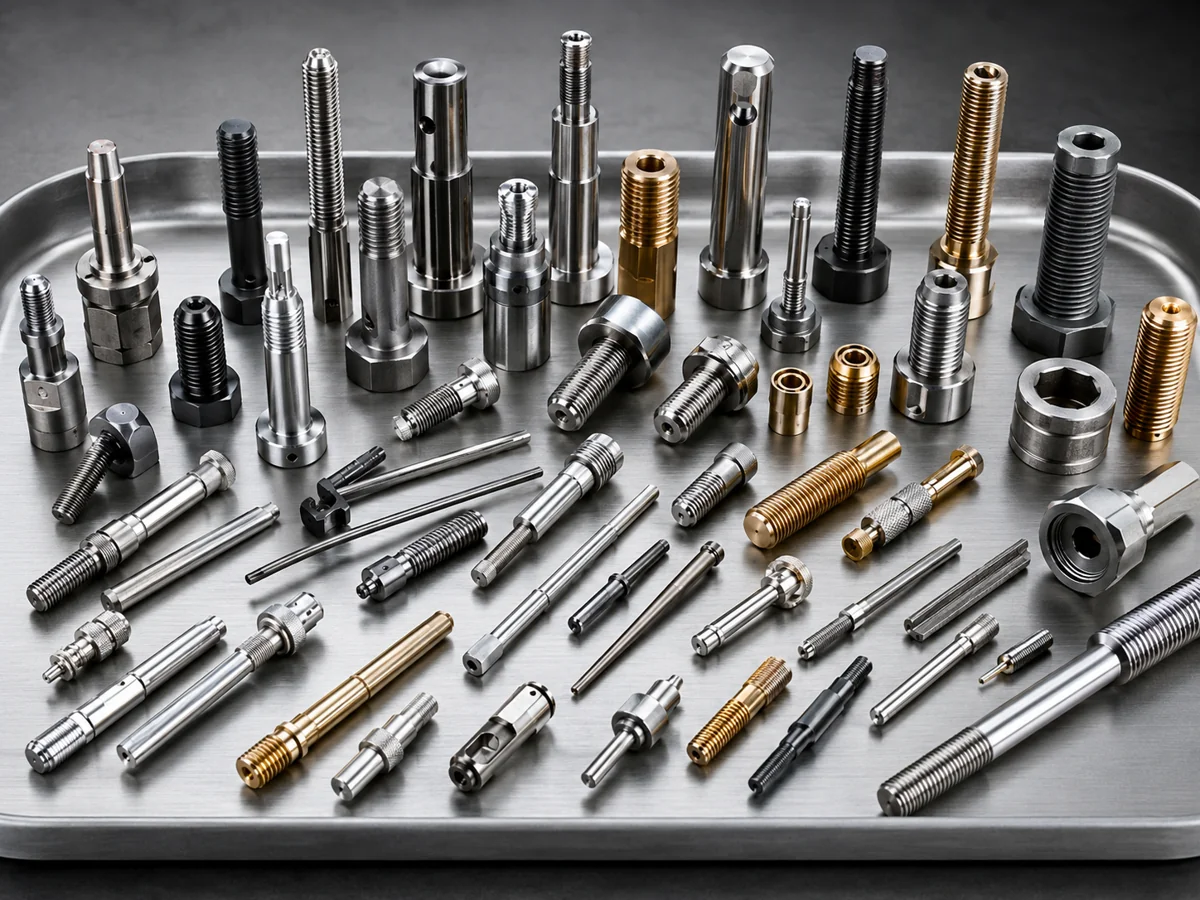
- Aerospace & motorsport fasteners — bolts, studs, lockwire-drilled hex bolts
- Performance brackets and mounts — weight-critical structural parts
- Marine fittings — through-hulls, seacocks, deck hardware (Grade 2 for maximum seawater resistance)
- Medical implants and instruments — Grade 2 CP or Grade 23 (ELI) for surgical implants
- Custom motorcycle bolts — our titanium bolts page covers this in detail
- Bicycle components — stems, handlebar clamps, dropout hardware
- Chemical processing parts — pump impellers and valve bodies in corrosive media
Titanium vs Steel vs Aluminium
| Ti-6Al-4V (Grade 5) | 17-4 PH Stainless | 7075-T6 Aluminium | |
|---|---|---|---|
| Yield strength | 880 MPa | 1170 MPa | 503 MPa |
| Density | 4.43 g/cm³ | 7.78 g/cm³ | 2.81 g/cm³ |
| Strength/Weight | Highest | Moderate | High |
| Corrosion resistance | Excellent | Very good | Good (anodized) |
| Cost | High | Moderate–High | Lower |
Choose titanium when both high strength and low weight are required simultaneously, or when corrosion resistance in aggressive environments (seawater, body fluids, chemical) is mandatory and aluminium is not acceptable.
Custom Titanium Parts — Who Orders and Why
Titanium buyers typically come for extreme weight targets, seawater corrosion requirements, or specific fastener colours that only titanium anodizing can produce. These are buyers who cannot substitute 316L and know it.
"Ti-6Al-4V structural brackets — 5 pcs, weight critical, CAD not ready yet"
Send us a sketch with key dimensions and material spec. We machine Grade 5 Ti-6Al-4V to ±0.025 mm, bead blast as standard. Typical lead time 3–4 weeks for low-volume prototype parts. MOQ 1 through to production volume — CAD helps but is not required to start.
"Gold anodized titanium bolt set for a specific bike model — 100 sets, branded packaging"
We machine Ti-6Al-4V bolt sets to your exact spec, anodize in gold, blue or purple (interference-based colour, no dye), and pack in your branded packaging. OEM supply from 20 sets upward. Sample approval before bulk run.
"Grade 2 CP titanium keel bolts — 50 pcs to spec, material certs required"
Grade 2 CP for maximum seawater corrosion resistance. We machine keel bolts, through-hull fittings and structural marine fasteners to your drawing. Material certs traceable to bar stock available. Lead time 3–5 weeks for 50 pcs.
"Grade 2 or Grade 23 ELI titanium prototype — 2 pieces, must quote single piece"
We routinely machine single titanium prototype parts for medical device development and research. Grade 2 CP and Grade 23 (ELI, extra-low interstitial) available. Lead time 2–3 weeks for prototype quantities. No MOQ.
What Titanium Buyers Search For
Frequently Asked Questions
Yes. We routinely hold ±0.025 mm on critical features in Ti-6Al-4V. Titanium requires careful tooling, high-pressure coolant and lower cutting speeds than aluminium, but it is dimensionally stable after machining and does not spring-back. We flag titanium parts in quoting so the timeline is set correctly.
Titanium anodizes through an electrochemical process that grows a controlled-thickness oxide layer on the surface. Different voltages produce different oxide thicknesses, which create interference colours — gold (~10V), blue (~30V), purple (~60V), green (~80V). No dye is used; the colour comes from light interference. It is decorative and adds a thin hard layer — it is not a structural treatment. Commonly applied to titanium bolts and fasteners.
Grade 2 CP titanium is the standard choice for marine hardware (through-hulls, seacocks, keel bolts, propeller shafts) — it offers better corrosion resistance in seawater and is easier to weld. Grade 5 (Ti-6Al-4V) is stronger but slightly lower corrosion resistance; use it for structural marine parts where strength is critical and immersion is intermittent.
Yes. We reverse-engineer titanium parts from samples, worn originals or photographs the same way we do with steel or aluminium. Titanium is self-passivating so worn titanium parts measure cleanly. We rebuild the CAD from the sample geometry, confirm the drawing with you, and machine the reproduction.
Three reasons: slower cutting speeds (roughly 60–120 m/min vs 300–900 m/min for aluminium) mean longer machine time; titanium is harder on cutting tools, increasing tool consumption; and material cost is higher. A titanium part typically costs 3–5× the equivalent aluminium part. The weight saving and corrosion performance justify this for the right application.
Get a Titanium Machining Quote
Sketch, photo or CAD accepted. Reply in 12h.
// Qty & price
1 pc
Sample price
Confirm fit before a run
10–50
Unit price drops
Setup cost shared
100+
Best price
All tiers quoted upfront
- →No distributor — you pay the maker directly
- →CAD saved after first order — reorder anytime at lower unit price