A Gear Is Math, Not a Tracing Job
The reason a worn gear is one of the most reproducible parts we make is that its geometry is defined by a handful of standard parameters and a mathematical involute tooth form. We don't copy the damaged teeth — we derive the correct gear from its numbers: tooth count, module, pressure angle, face width and bore. Get those right and the new gear meshes exactly with its partner, even if the sample was chipped or missing teeth.
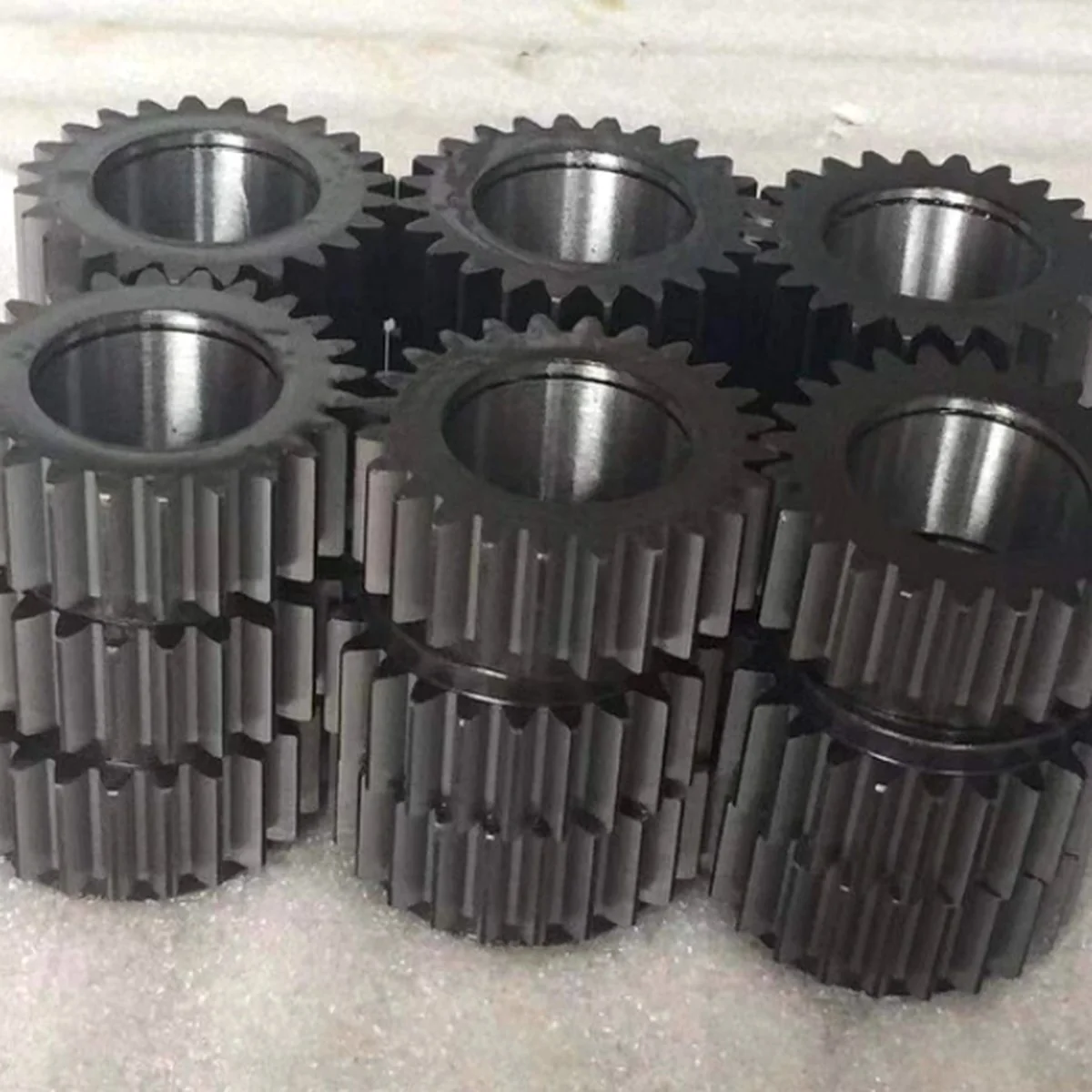
Custom Spur Gear Specifications
| Attribute | Capability |
|---|---|
| Module / pitch | ~0.5–8 module (DP equivalents) |
| Pressure angle | 14.5° / 20° / 25° |
| Materials | 4140 / 8620 / 4340 steel, 303/304 stainless steel, aluminium, brass, bronze, Delrin/nylon |
| Hardening | Case-harden, through-harden, nitride (as required) |
| Bore & keyway | To shaft fit; keyway to DIN 6885 / ISO 773 |
| Quality grade | To AGMA 8–11 / DIN 7–9 (ISO) as the application needs |
| Quantity | One replacement to batch of spares |
Spur Gear Dimensions & Formulas — How to Read a Sample Gear
A spur gear is fully defined by a few numbers, all tied to the module (m) and tooth count (N). The same formulas let you derive a gear's spec from a worn sample — count the teeth, measure the outside diameter, and the rest follows:
| Dimension | Formula (metric module) |
|---|---|
| Module (from a sample) | m = OD ÷ (N + 2) |
| Pitch diameter (PD) | PD = m × N |
| Outside diameter (OD) | OD = m × (N + 2) |
| Root diameter | ≈ m × (N − 2.5) |
| Addendum / dedendum | 1 × m / 1.25 × m |
| Circular pitch | p = π × m |
| Centre distance (two gears) | m × (N₁ + N₂) ÷ 2 |
So to reproduce a gear, we only need tooth count, outside diameter and pressure angle (20° unless it's fine-pitch 14.5° or heavy-duty 25°), plus the bore and keyway. Send the worn gear and we read all of it off; send the mating gear too and we cross-check the centre distance. This is why a gear — unlike most parts — can be reproduced even when the teeth are damaged.
Gear Quality — Spec It by Application
"Custom gear" buyers usually need to state a quality grade (AGMA class, or DIN/ISO) — it sets the tooth-form accuracy, runout and backlash. Higher grades cost more, so match the grade to the job rather than over-specifying. A practical guide:
| Application | Typical module | Quality grade | Material |
|---|---|---|---|
| General machinery / handling | M3–8 | AGMA 6–8 | Case-hardened steel |
| Pumps & drives | M4–10 | AGMA 7–9 | Alloy steel (4140) |
| Machine tools | M2–5 | AGMA 8–10 | Ground case-hardened |
| Precision instruments | M1–3 | AGMA 9–11 | Low-backlash, fine pitch |
Not sure what grade you need? Tell us what the gear drives and how fast — or just send the worn gear — and we'll spec it.
Gear Variants We Also Make
- Pinions — small high-ratio gears
- Cluster gears — multiple gears on one blank
- Gear-shaft combinations — gear integral with its shaft
- Internal gears and racks (see replacing a discontinued gear)
Material & Hardening
For power transmission we usually machine gears in 4140 or 8620 steel and harden them so the new gear matches — or outlasts — the original's wear life. Which European or Japanese grade stands in for 8620 on a drawing is listed on the case-hardening steel equivalents chart. Surface hardening (case-hardening or nitriding) can raise the allowable contact stress roughly 2–3× over a through-hardened gear, so a discontinued gear is a chance to make it last longer. Where corrosion or washdown matters we cut stainless steel gears (303/304); for light, low-inertia drives, aluminium gears. Brass or bronze suits quiet light-duty drives; Delrin and nylon make low-noise plastic gears — we machine them, or mold them for higher quantities as part of being a full custom parts maker. We can also supply metal gear blanks, turned and bored ready to finish. Tooth form and bore are verified on inspection.
Obsolete gear, no drawing? Send the worn gear and its mate if possible. We recover the parameters and cut new ones — one piece or a batch. See our steel spur gear batch case.
See also plastic gears and racks — the same spur geometry in cast nylon and POM, including how to read the module off a broken gear and the extra backlash a nylon gear needs in wet duty.
Gear-blank steels under every name system — C45 / 1045 / S45C / 45, 42CrMo4 / 4140 / SCM440, 16MnCr5 / 8620 — are crossed on the medium-carbon, 4140 / 42CrMo4 and case-hardening steel equivalents charts.
Frequently Asked Questions
Yes. We count teeth and measure OD, pressure angle, face width and bore to derive the module and rebuild the involute form — even a chipped sample yields a perfect gear. Mating gear and centre distance cross-check it.
Module ~0.5–8 in a wide range of diameters and tooth counts. We also make pinions, clusters and gear-shafts.
4140/8620 steel (often case-hardened), 4340 for high load, brass/bronze for light duty, Delrin/nylon for quiet plastic gears — matched or upgraded.
Both — a single replacement or a batch of spares. No minimum order.
Yes — besides 4140/8620 steel, we cut stainless steel gears (303/304) for corrosion and washdown, aluminium gears for light low-inertia drives, and brass or bronze for quiet light duty. We also supply metal gear blanks ready to finish.
Quote a Custom Gear
Worn gear, drawing or specs — all accepted. Reply in 12h.
// Qty & price
1 pc
Sample price
Confirm fit before a run
10–50
Unit price drops
Setup cost shared
100+
Best price
All tiers quoted upfront
- →No distributor — you pay the maker directly
- →CAD saved after first order — reorder anytime at lower unit price