Short answer: BSPP (BSP Parallel) has straight threads and seals on a flat face — using a sealing washer or O-ring. BSPT (BSP Taper) has tapered threads at 1:16 and seals by thread engagement — using PTFE tape or thread sealant. Both have the same 55° Whitworth thread form and the same TPI for each nominal size. You cannot reliably seal one against the other.
BSP is only one of the families that seal somewhere other than the thread. For the full picture — JIC, ORFS, SAE ORB, DIN 3852 and what happens when a joint belongs to no standard at all — see custom sealed metal parts we machine.
What Is BSPP?
BSPP stands for British Standard Pipe Parallel. The threads are straight — the outside diameter of a male BSPP fitting does not change from the back of the thread to the front. The standard is BS EN ISO 228-1.
BSPP is by far the more common of the two types. It is used in hydraulic valves, pneumatic cylinders, manifold bodies, pressure transducers, flow control valves and most hydraulic hose fittings made in the UK, Europe, Asia and Australia. The G-thread designation used on German and Japanese components (G1/4, G3/8, G1/2) refers to BSPP.
The seal on a BSPP joint is made at the face, not in the threads. The female fitting has a flat chamfered face or a small machined recess. A soft sealing washer (bonded seal, fibre or copper) or an O-ring seats in that recess, and when the fitting is tightened, the washer compresses against the flat face to form the seal. The threads carry the clamping load; they are not the seal.
This means BSPP does not need PTFE tape or thread sealant. In fact, applying PTFE to BSPP threads can prevent the fitting from reaching the correct torque, leaving the face seal under-compressed and the joint weeping.
What Is BSPT?
BSPT stands for British Standard Pipe Taper. The threads taper at 1 in 16 on the diameter — identical in principle to the American NPT taper, though not interchangeable because the thread angle is different (BSP uses 55°, NPT uses 60°). The standard is BS 21.
BSPT is less common than BSPP in modern hydraulic and pneumatic systems, but it appears in older UK pipework, some Asian-manufactured equipment, water service fittings, and in situations where the designer specifically wanted a thread-seal joint without a sealing face.
BSPT seals by thread engagement. As the tapered male thread is driven into the port, the interference between the tapered surfaces builds up and creates a metal-to-metal seal. In practice, PTFE tape or anaerobic thread sealant is applied to the threads first — the metal-to-metal interference alone rarely gives a reliable seal at hydraulic pressures without it.
Diagram: BSPP vs BSPT Cross-Section
Left: BSPP — straight thread, seals at face. Right: BSPT — tapered thread, seals in thread engagement zone.
How to Identify BSPP vs BSPT in the Field
Both types look similar at first glance. Here are three reliable ways to tell them apart without instruments:
1. Check the female port face
Look at the face of the female fitting — the surface around the port opening that faces the male fitting being screwed in. BSPP has a flat chamfered face or a small recess where a sealing washer or O-ring sits. BSPT has no such recess — the female port just has clean tapered internal threads, similar in appearance to a NPT port.
2. Measure the male thread diameter
With a calliper, measure the thread outside diameter at the very back (near the spanner flat) and again at the very tip. On a BSPP male fitting, these measurements will be identical — the thread is parallel. On a BSPT male fitting, the tip diameter will be measurably smaller — the taper is 1 in 16 on diameter, so over a 25 mm thread length the difference is about 1.6 mm.
3. Check for the sealing washer
If you are disassembling a joint and find a soft metal washer, bonded seal (Dowty washer) or O-ring between the fitting and the port, you are looking at a BSPP assembly. BSPT joints have no washer — any sealant used is on the threads themselves.
If you are not sure what you have, send us the fitting — we can measure it and tell you. We identify thread types routinely as part of the reverse engineering service. See parts from a sample.
Sealing Methods — What Each Type Needs
BSPP sealing
The seal is at the face. Options:
- Bonded seal washer (Dowty seal) — a soft rubber ring vulcanised into a steel backing ring. Most common in hydraulic systems. Available in NBR (mineral oil), FKM/Viton (hot oil, fuel, aggressive fluids) and EPDM (water/steam).
- O-ring — in a machined recess on the port face. Standard on SAE metric ports and many modern hydraulic valves.
- Copper or aluminium crush washer — for lower pressures, fuel systems and some pneumatics.
Do not apply PTFE tape to BSPP threads. The tape acts as a lubricant and may prevent the fitting from reaching the correct seating torque, leading to under-compression of the face seal and a weeping joint.
BSPT sealing
The seal is in the thread engagement. Options:
- PTFE tape — wrap 2–3 turns around the male thread, starting from the second thread back from the tip. This is acceptable for water, compressed air and low-pressure gas. For hydraulic use, check the fluid compatibility of the PTFE with your hydraulic oil.
- Anaerobic thread sealant (e.g. Loctite 577, Henkel Uniseal 2) — applied to clean threads. More reliable than PTFE tape on hydraulic systems. Cures to a semi-rigid seal that resists vibration.
BSPP vs BSPT Comparison Table
| Property | BSPP | BSPT |
|---|---|---|
| Full name | British Standard Pipe Parallel | British Standard Pipe Taper |
| Standard | BS EN ISO 228-1 | BS 21 |
| Thread form | 55° Whitworth — straight (parallel) | 55° Whitworth — tapered 1:16 on diameter |
| Thread pitch | Same as BSPT for each nominal size | Same as BSPP for each nominal size |
| Seal location | Flat face — washer or O-ring | Thread engagement — PTFE or sealant |
| Sealing material | Bonded seal, O-ring, copper washer | PTFE tape or anaerobic thread sealant |
| Other names | G thread (ISO 228), R p thread, BSP(P) | R thread (ISO 7), taper BSP, BSP(T) |
| Common in | Hydraulic & pneumatic systems, valves, actuators, instruments — UK/EU/Asia/AU/JP | Older UK pipework, water service, some Asian OEM equipment |
| How to identify | Female port has flat sealing face or O-ring recess. Male OD constant. | Female port has plain tapered threads. Male OD tapers to tip. |
When the pairing you need has no catalogue part
Identifying the two threads is the easy half; sourcing the piece that joins them is where it stalls. EKINSUN LTD is a custom parts manufacturer in Guangdong, China and machines that adapter from solid — each end single-point cut and gauged to its own standard, with the sealing method chosen deliberately for each end rather than assumed. From one piece, no CAD file required, quote within 12 hours.
| What you need to connect | Stocked as a fitting? | How we make it |
|---|---|---|
| A common BSP-to-NPT size pair in brass or steel | Yes, widely | Buy the stock fitting — a hydraulics distributor will be cheaper and it is on the shelf. Honest recommendation |
| BSPP male to a metric port with a specific seal form (bonded washer, O-ring, face seal) | Only the popular combinations | Machined with the correct sealing land and groove for each end, since no standard defines a cross-standard joint |
| A length or across-flats that has to fit the space — short body, reduced hex | One length per size only | Body length and hex sized to the installation, so a spanner still reaches |
| Taper thread where the outlet must end up pointing a set way | A taper thread stops where it seals | Taper on the machine side, parallel thread with a seal on the device side, so the part can be oriented and then clamped |
| BSPP or BSPT against Whitworth machinery threads on pre-1970s equipment | Effectively unavailable | Cut to the 55° Whitworth form on one end and the modern standard on the other |
| 316L or brass in a size only stocked in steel | Minimum quantities | From 1 piece, material certificate on request |
Can You Use BSPP and BSPT Together?
They will thread together because the TPI and 55° thread angle are the same. But they will not seal reliably.
- A BSPT male in a BSPP female port: The taper means the fitting will contact the threads before reaching the face. You will not get face-seal contact, and the thread interference alone is not enough. The joint will leak.
- A BSPP male in a BSPT female port: The straight male will not create the thread-interference seal that a tapered male would. PTFE tape may give a marginal seal at low pressure, but it will not hold hydraulic pressure reliably.
This is one of the most common causes of persistent leaks in hydraulic and pneumatic systems — a system that appears to be using BSP fittings throughout, but one adapter or fitting is BSPT where everything else is BSPP. The threads engage and the fitting feels tight, but the joint weeps.
If you are replacing a fitting and are unsure which type is in the system, measure it before ordering.
Is G Thread the Same as BSPP?
Yes. The G designation comes from ISO 228-1 (Fastening of pipe threads where pressure-tight joints are not made on the threads). G1/4, G3/8, G1/2 and so on are the same thread as 1/4 BSPP, 3/8 BSPP and 1/2 BSPP respectively. The G designation is used extensively on European and Japanese fluid power components — Bosch Rexroth, Parker, SMC, Festo and most German and Japanese hydraulic and pneumatic manufacturers mark ports G1/4 or G3/8 rather than 1/4 BSP.
When you see G on a valve or cylinder port drawing, specify BSPP on the adapter you order. The R designation (R 1/4, R 3/8) refers to the male taper BSPT thread per ISO 7. Rc is the female taper. Rp is the parallel female that pairs with a taper male in some applications.
BSP Thread Size Chart — G and R (ISO 228-1 / EN 10226)
BSPP and BSPT share one dimension set for any given nominal size; only the form differs — parallel for G, tapered 1:16 on diameter for R. So this table reads for both. The nominal size is a legacy pipe bore figure, not something you can measure: a "1/2 BSP" male measures about 21 mm across the thread crests, never 12.7 mm.
| Nominal size | Callout | TPI | Pitch (mm) | Major dia. (mm) |
|---|---|---|---|---|
| 1/8 | G 1/8 · R 1/8 | 28 | 0.907 | 9.728 |
| 1/4 | G 1/4 · R 1/4 | 19 | 1.337 | 13.157 |
| 3/8 | G 3/8 · R 3/8 | 19 | 1.337 | 16.662 |
| 1/2 | G 1/2 · R 1/2 | 14 | 1.814 | 20.955 |
| 5/8 | G 5/8 | 14 | 1.814 | 22.911 |
| 3/4 | G 3/4 · R 3/4 | 14 | 1.814 | 26.441 |
| 7/8 | G 7/8 | 14 | 1.814 | 30.201 |
| 1 | G 1 · R 1 | 11 | 2.309 | 33.249 |
| 1 1/4 | G 1 1/4 · R 1 1/4 | 11 | 2.309 | 41.910 |
| 1 1/2 | G 1 1/2 · R 1 1/2 | 11 | 2.309 | 47.803 |
| 2 | G 2 · R 2 | 11 | 2.309 | 59.614 |
NPT Thread Size Chart (ASME B1.20.1)
NPT is tapered over its whole length at 1:16 on diameter — 3/4 inch per foot — with a 60° included angle. Because of the taper there is no single major diameter: the figure below is the nominal pipe outside diameter, which is what a caliper reads at the large end of a male thread and the number every NPT chart is indexed on.
| Nominal size | TPI | Pitch (mm) | Pipe OD (in) | Pipe OD (mm) |
|---|---|---|---|---|
| 1/8 NPT | 27 | 0.941 | 0.405 | 10.29 |
| 1/4 NPT | 18 | 1.411 | 0.540 | 13.72 |
| 3/8 NPT | 18 | 1.411 | 0.675 | 17.15 |
| 1/2 NPT | 14 | 1.814 | 0.840 | 21.34 |
| 3/4 NPT | 14 | 1.814 | 1.050 | 26.67 |
| 1 NPT | 11.5 | 2.209 | 1.315 | 33.40 |
| 1 1/4 NPT | 11.5 | 2.209 | 1.660 | 42.16 |
| 1 1/2 NPT | 11.5 | 2.209 | 1.900 | 48.26 |
| 2 NPT | 11.5 | 2.209 | 2.375 | 60.33 |
BSP vs NPT Side by Side — Why the Same Size Doesn't Seal
Put the two standards on one row and the problem becomes arithmetic. The diameters land within a millimetre of each other at every size, which is close enough for a fitting to start by hand — and the thread angle is 55° against 60°, so the flanks only ever touch at one point.
| Nominal | BSP TPI | NPT TPI | BSP dia. (mm) | NPT dia. (mm) | Difference |
|---|---|---|---|---|---|
| 1/8 | 28 | 27 | 9.728 | 10.29 | +0.56 mm |
| 1/4 | 19 | 18 | 13.157 | 13.72 | +0.56 mm |
| 3/8 | 19 | 18 | 16.662 | 17.15 | +0.48 mm |
| 1/2 | 14 | 14 | 20.955 | 21.34 | +0.38 mm |
| 3/4 | 14 | 14 | 26.441 | 26.67 | +0.23 mm |
| 1 | 11 | 11.5 | 33.249 | 33.40 | +0.15 mm |
| 1 1/4 | 11 | 11.5 | 41.910 | 42.16 | +0.25 mm |
| 1 1/2 | 11 | 11.5 | 47.803 | 48.26 | +0.46 mm |
| 2 | 11 | 11.5 | 59.614 | 60.33 | +0.71 mm |
The 1/2 and 3/4 trap. At those two sizes BSP and NPT carry the same 14 threads per inch. Pitch matches, diameters differ by less than half a millimetre, and the joint will run down several turns under hand pressure — which is exactly why 1/2 and 3/4 are where mismatched fittings get installed, torqued, and only then found to weep. Every other size in the table differs in TPI as well, so it binds early and the mistake is caught on the bench. If a 1/2 or 3/4 joint seals on tape but seeps under pressure, check the standard before you check the sealant.
G, R, Rp, Rc — Reading the Callout on a Drawing
European drawings rarely say "BSPP" or "BSPT". They use single-letter designations from ISO 228-1 and EN 10226, and the letter carries both the form and whether the part is male or female. Getting this wrong is the most common source of a mis-machined port.
| Callout | Standard | Form | Applies to | Seals on |
|---|---|---|---|---|
| G | ISO 228-1 | Parallel, 55° | Male or female (BSPP) | Face, O-ring or bonded washer — not the thread |
| R | EN 10226-1 (BS 21) | Taper 1:16, 55° | Male only (BSPT) | Thread interference, with sealant |
| Rc | EN 10226-1 | Taper 1:16, 55° | Female only | Thread interference against R male |
| Rp | EN 10226-1 | Parallel, 55° | Female only | Thread interference against R male |
| NPT | ASME B1.20.1 | Taper 1:16, 60° | Male and female | Thread interference, with sealant |
| NPS | ASME B1.20.1 | Parallel, 60° | Male and female | Gasket or O-ring — not the thread |
Two consequences worth holding on to. A G female port cannot be sealed by a taper male no matter how hard it is driven — it needs a face seal. And Rp and Rc are both female: they differ in whether the port itself is tapered, and both are designed to take an R male, which is why a drawing calling for Rp 1/2 is not asking for a G 1/2 port.
BSP to NPT — and Why It Requires a Special Adapter
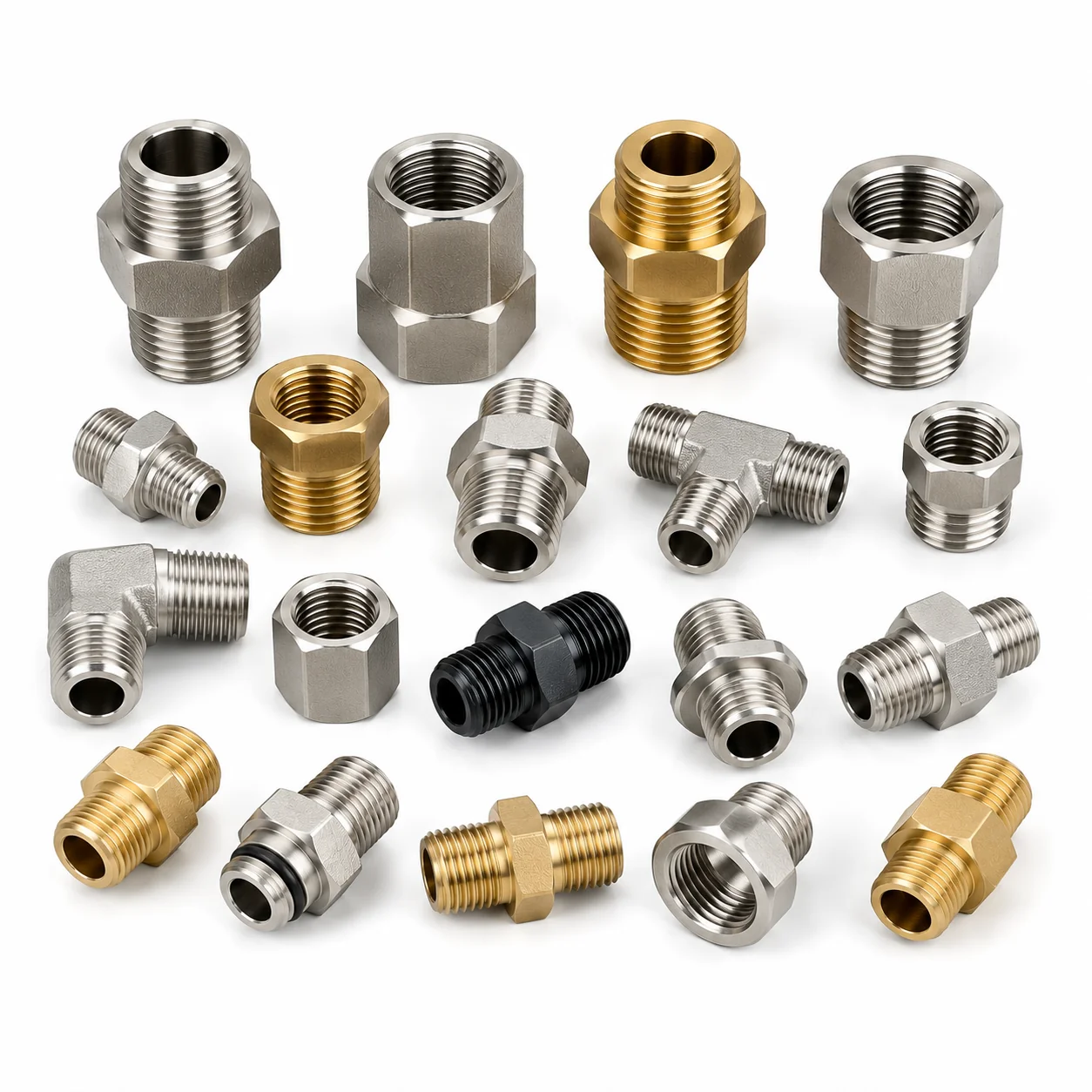
BSPP and BSPT share a 55° Whitworth thread angle. NPT (National Pipe Taper, ASME B1.20.1) uses a 60° thread angle. This is a fundamental incompatibility — the flanks of a BSP thread and an NPT thread cannot mate correctly. In some sizes the threads will appear to engage, but under pressure the joint will leak, and with repeated assembly the threads will damage each other.
If you have BSP-ported equipment and NPT-threaded instruments, pumps or fittings — or vice versa — the correct solution is a machined adapter with the right thread form on each end. A standard BSP-to-BSP or NPT-to-NPT adapter from a catalogue won't help.
EKINSUN machines BSP to NPT adapters in any combination — BSPP or BSPT, 1/8″ to 2″, brass / carbon steel / 316 stainless, in hex nipple, reducing bush, elbow or tee form. One piece minimum, no CAD needed, quote in 12 hours.
Frequently Asked Questions
No, but they are close enough to cause damage. At 1/2 and 3/4 both standards use 14 threads per inch, and the diameters differ by only 0.38 mm and 0.23 mm — so the joint runs down several turns by hand and feels correct. The thread angles are still 55° for BSP against 60° for NPT, so the flanks meet at a single point and the connection weeps once it is pressurised. At every other size the TPI differs as well (1/4 is 19 against 18, 1 inch is 11 against 11.5), which makes the mismatch bind early enough to catch on the bench.
G thread (ISO 228-1) is BSPP. G1/4 equals 1/4 BSPP, G3/8 equals 3/8 BSPP, and so on. European and Japanese fluid power manufacturers use the G designation on port markings. If you see G on a valve or manifold drawing, specify BSPP when ordering adaptors.
BSPP stands for British Standard Pipe Parallel. It is a straight (non-tapered) thread defined in BS EN ISO 228-1, used in the vast majority of hydraulic and pneumatic systems in the UK, Europe, Asia and Australia. It seals on a flat face, not in the threads.
No. BSPP seals on a flat face — the sealing element is a washer or O-ring at the face, not the threads. Applying PTFE tape to BSPP threads can prevent the fitting from reaching full seating torque and leave the face seal under-compressed. Use a bonded seal (Dowty washer) or O-ring, not tape.
Only if the mating port will also accept BSPP. If the female port is BSPT (tapered internal thread with no sealing face), you must use a BSPT male. Fitting a BSPP male into a BSPT female port and applying PTFE tape may hold at low pressure but will not be reliable. If you want to change from BSPT to BSPP throughout a joint, both fittings need to change.
On a female fitting, look for a flat chamfered face or a small O-ring recess around the port opening. If you see one, it is BSPP — the flat face is where the seal occurs. If the port just has clean tapered threads with no recessed sealing face, it is BSPT. On a male fitting: measure the outside diameter at the root and the tip of the thread with a calliper. If they are the same, it is BSPP. If the diameter is smaller at the tip (taper), it is BSPT.
Yes, they will partially engage because the thread pitch and angle are the same. But they should not be used together as a sealed assembly — a BSPT male threaded into a BSPP female port will not seal correctly. The taper of the BSPT male will bottom out without the face-to-face contact that BSPP needs. And a BSPP male in a BSPT female will not create the thread interference needed for a sealed joint. Using the wrong type is a common cause of persistent leaks.
BSP covers both. BSPP is the parallel (non-tapered) type defined in BS EN ISO 228. BSPT is the tapered type defined in BS 21. In hydraulic and pneumatic systems, BSPP is far more common. When ordering parts or adapters, always specify BSPP or BSPT explicitly — not just BSP.