// Part · material · wall · quantity
Free, no sign-up, no CAD file needed — a sketch, photo or sample is enough. Real quote back within 12 h.
A 25 g part in ABS with a 2 mm wall runs a 10.4 s cycle on a 25 t machine. At this quantity a tool makes sense. Send a sketch, photo or the part itself and we will confirm it against your real geometry within 12 hours. Send what you have →
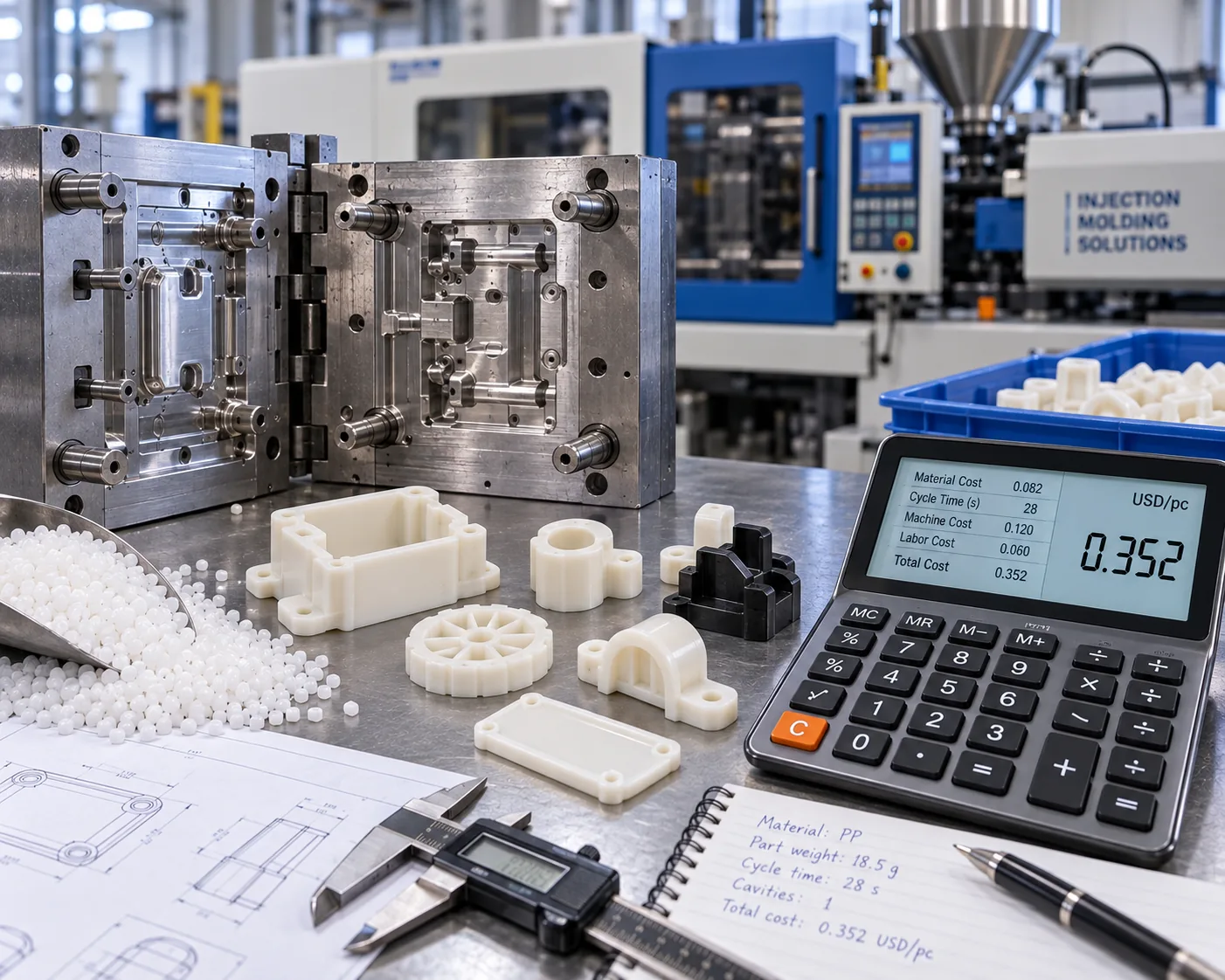
Should You Even Be Moulding This?
Almost every injection molding calculator online assumes the answer is yes, because almost every one of them is published by somebody who sells moulds. It is a bad assumption below a few hundred pieces. A tool is a fixed cost, and a fixed cost divided by a small number is a large number.
The table below prices your part three ways at each quantity — machined from solid stock, vacuum cast in a silicone mould, and injection moulded with the tool you configured above. The cheapest route at each quantity is highlighted.
| Quantity | Machined from stock | Vacuum cast | Injection moulded | Cheapest route |
|---|---|---|---|---|
| 50 pc | €46.67 | €60.05 | €181 | Machined |
| 200 pc | €46.67 | €48.15 | €45.59 | Injection moulded |
| 500 pc | €46.67 | €44.41 | €18.44 | Injection moulded |
| 1,000 pc | €46.67 | €44.07 | €9.40 | Injection moulded |
| 5,000 pc | €46.67 | €43.53 | €2.16 | Injection moulded |
| 20,000 pc | €46.67 | €43.41 | €0.80 | Injection moulded |
Figures above are for the calculator's starting example — a 25 g ABS part, 2 mm wall, single cavity in a P20 tool. Change the inputs and every row recalculates for your own part.
At 1,000 pieces the tool has paid for itself. Moulding is your cheapest route here at €9.40 a part, against €44.07 vacuum cast. On this part the crossover happens somewhere around 200 pieces.
This is how our plastic work is organised in the first place — by quantity, not by machine. One to five pieces are machined from plastic stock. Small batches are vacuum cast in silicone, which gives 20 to 25 parts per mould and is ready in days. Hundreds to a few thousand suit an aluminium bridge tool. Only genuine volume justifies hardened steel.
Wall Thickness Is the Whole Game
If you take one number away from this page, take this one: cooling time rises with the square of the wall thickness. Halving the wall does not halve the cooling time — it quarters it. And cooling is typically 60 to 80 percent of the entire cycle, so it is most of what you pay for in machine time.
The calculator uses the standard cooling expression rather than a fudge factor, so you can check it:
| Wall | Relative cooling time | What it means in practice |
|---|---|---|
| 1.0 mm | 0.25 × | Fast, but hard to fill on anything large; needs high injection pressure |
| 1.5 – 2.5 mm | 0.56 – 1.6 × | The sweet spot for most thermoplastics — fills reliably, cools quickly |
| 3.0 mm | 2.25 × | Roughly double the cycle of a 2 mm wall, and starting to sink on ribs |
| 4.0 mm | 4.0 × | Four times the cooling of 2 mm, visible sink marks, real warp risk |
| 6.0 mm | 9.0 × | Almost always the wrong answer — core it out and rib it instead |
If a section has to be thick for strength, coring it out and adding ribs at about 60 percent of the nominal wall gives you the stiffness without the cycle time, the sink marks or the warp. That single change often takes more cost out of a moulded part than any amount of negotiating on price.
The polymer data the calculator runs on
Every figure the cooling model uses is printed here, so nothing is hidden behind the number. Thermal diffusivity α is what governs how fast heat leaves the wall; the three temperatures are typical processing values. Material prices are indicative for standard unfilled grades in small tonnages and move with the resin market.
| Polymer | α (mm²/s) | Melt °C | Mould °C | Eject °C | Density | €/kg |
|---|---|---|---|---|---|---|
| ABS | 0.10 | 230 | 50 | 90 | 1.05 | 2.5 – 4.0 |
| PP (polypropylene) | 0.07 | 230 | 30 | 90 | 0.905 | 1.5 – 2.5 |
| PE-HD | 0.11 | 220 | 30 | 90 | 0.95 | 1.5 – 2.6 |
| PS (polystyrene) | 0.09 | 230 | 40 | 80 | 1.05 | 1.8 – 2.8 |
| PA66 (nylon) | 0.10 | 290 | 80 | 140 | 1.14 | 3.5 – 6.0 |
| PC (polycarbonate) | 0.13 | 300 | 90 | 130 | 1.20 | 4.0 – 6.5 |
| POM (acetal) | 0.09 | 200 | 90 | 120 | 1.41 | 3.0 – 5.0 |
| PMMA (acrylic) | 0.09 | 250 | 70 | 90 | 1.18 | 3.0 – 5.0 |
| TPU | 0.08 | 210 | 30 | 60 | 1.20 | 5.0 – 9.0 |
| PEEK | 0.13 | 380 | 180 | 250 | 1.30 | 90 – 160 |
The rest of the model: machine rate is €28/h plus €0.18 per tonne of clamp force, so a 100 t machine bills at €46/h and a 250 t at €73/h. Clamp force is taken as 0.45 t per cm² of projected area across all cavities, rounded up to the next 5 t. Cycle adds 2 s injection and hold plus 4.5 s to open, eject and close. Material includes 6% for sprue, runner and start-up scrap, and there is a €0.11 per part allowance for bagging and boxing. As on the machining calculator, 20% is added for shop overhead and margin, because a cost build-up is not a price.
What Actually Drives the Tool Price
Part size matters less than people expect. What moves a tool quotation is whether the mould can simply open, and how many times you want it to open at once.
- Undercuts. A feature that stops the tool opening in a straight line needs a side action or a lifter. Each one is real engineering, and it is why the complexity setting above moves the number more than the part dimensions do.
- Cavity count. Doubling cavities does not double the tool. Each doubling adds roughly 70 percent of the single-cavity cost, because the frame, ejection and cooling circuit are shared. That is why multi-cavity tools get cheaper per part quickly at volume.
- Tool material. Aluminium cuts faster and costs less but wears; P20 steel is the normal production compromise; hardened steel is for hundreds of thousands of shots or abrasive glass-filled polymers.
- Texture and tolerance. A textured surface or a tight-tolerance fitting feature adds bench work and inspection, not just machining.
What You Have vs What Molders Demand
| What you actually have | Typical online molding quote | How EKINSUN handles it |
|---|---|---|
| 3D CAD of the part | Accepted — the intended input | Accepted; we quote from it directly |
| A sketch or a photo of the part you want | Not accepted | Accepted; we build the model and send it back for approval before a tool is cut |
| An existing plastic part to copy | Not accepted | Accepted; measured or scanned, and reproduced |
| No draft angle on your model | Rejected or silently altered | We add it and show you exactly where on a marked-up drawing |
| You only need 200 pieces | Quoted as a moulding job anyway | We tell you to vacuum cast it instead, and quote that |
| You do not know which polymer | Required field | Tell us the environment and the load; we suggest grades and why |
The row that matters most is the highlighted one about 200 pieces. Being told to not buy a tool is worth more than a 10 percent discount on one you should not have bought.
Injection Molding Cost FAQ
A single-cavity aluminium bridge tool for a small part starts around EUR 1,500 to 4,000. The same part in a P20 steel tool runs roughly EUR 4,000 to 12,000, and a hardened multi-cavity production tool climbs into the tens of thousands. Cavity count is the biggest multiplier after part size: cavities do not double the tool price, they add roughly 70 percent of the single-cavity cost each time the count doubles, because the frame, ejection and cooling are shared.
Cooling time is governed by wall thickness squared. The standard expression is t = (s squared divided by 2 pi squared alpha) times the natural log of (4 divided by pi) times (melt temperature minus mould temperature) divided by (ejection temperature minus mould temperature), where s is the wall thickness and alpha is the thermal diffusivity of the polymer. The practical consequence is that halving the wall does not halve the cooling time, it quarters it. Cooling is typically 60 to 80 percent of the whole cycle, so wall thickness is the single most powerful cost lever a designer holds.
For a small part the crossover against vacuum casting usually lands somewhere between roughly 300 and 1,500 pieces, and against machining much earlier. Below the crossover the tool cost spread across your parts is larger than the saving on each part, so you pay more in total for the privilege of owning a mould. The calculator on this page works out the crossover for your specific part rather than quoting a rule of thumb, because part weight, wall thickness and cavity count move it by an order of magnitude.
Usually vacuum casting in a silicone mould, not injection molding. A silicone tool is a fraction of the cost of a steel one and is normally ready in days rather than weeks, and it will give 20 to 25 parts before it needs replacing. At 200 pieces you are paying for a handful of silicone moulds instead of one steel tool, and the total lands well below a moulded part. Below roughly five pieces, machining the parts from solid plastic stock is usually cheaper again.
Not to start. EKINSUN works from a sketch, a photo with a caliper for scale, or the existing part itself, and produces the drawing and the tooling model from that. What does have to be settled before a tool is cut is draft angle, parting line, gate position and ejector layout, and we come back to you with those decisions marked on a drawing for approval rather than making them silently.
Because cooling time rises with the square of the wall and cooling is most of the cycle. A part with a 3 mm wall does not cost 50 percent more to run than a 2 mm wall, it costs closer to double, and it also warps and sinks more. Uniform walls between 1.5 and 3 mm suit most thermoplastics. If a section has to be thick for strength, coring it out and adding ribs at roughly 60 percent of the wall is almost always cheaper and better than leaving it solid.
If you pay for the tool, it is yours. EKINSUN stores and maintains it for as long as you keep ordering, and it can be released to you or shipped to another moulder if you choose. Ask for this to be written into the order rather than assumed, whoever you buy from.
The estimate is instant and free, with no sign-up and no file upload. It is not a quote. Tooling in particular depends on undercuts, side actions, texture and tolerance, and no calculator can see those. Send a sketch, photo or sample and a real figure comes back within 12 hours.
Get the Route, Not Just the Number
Tell us the part and the quantity. If a tool is not the right answer yet, we will say so and quote the route that is.