Three situations send people looking for this process, and they all end at the same wall: an injection molding quote where the tool costs more than the entire order.
- The part is discontinued. The machine, the vehicle or the instrument still works. The plastic cover, housing or trim does not, and nobody makes it anymore. You need twenty, maybe fifty.
- The design is not frozen yet. You need real plastic parts in real material for field trials, certification samples or a first customer — before you commit five figures to a steel tool you may have to modify.
- Production tooling is being cut right now. Meanwhile a customer wants 100 sets, and "wait six weeks" is not an answer you can give them.
What all three have in common: you need parts that behave like plastic parts — not printed prototypes — in a quantity that lands in the dead zone between "machine one from a block" and "cut a steel mold."
Vacuum casting fills that dead zone. We build a flexible silicone mold around your part (or a printed master), then cast polyurethane into it under vacuum so no air is trapped. The mold takes about 3 days. First parts follow in roughly 5–7.
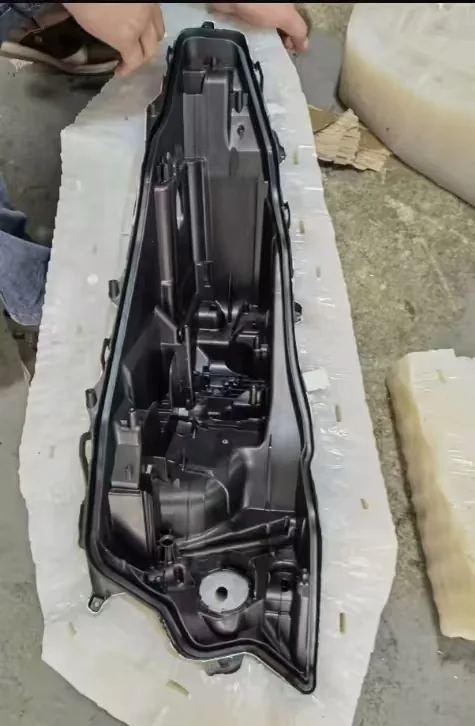
What Actually Comes Out of the Mold
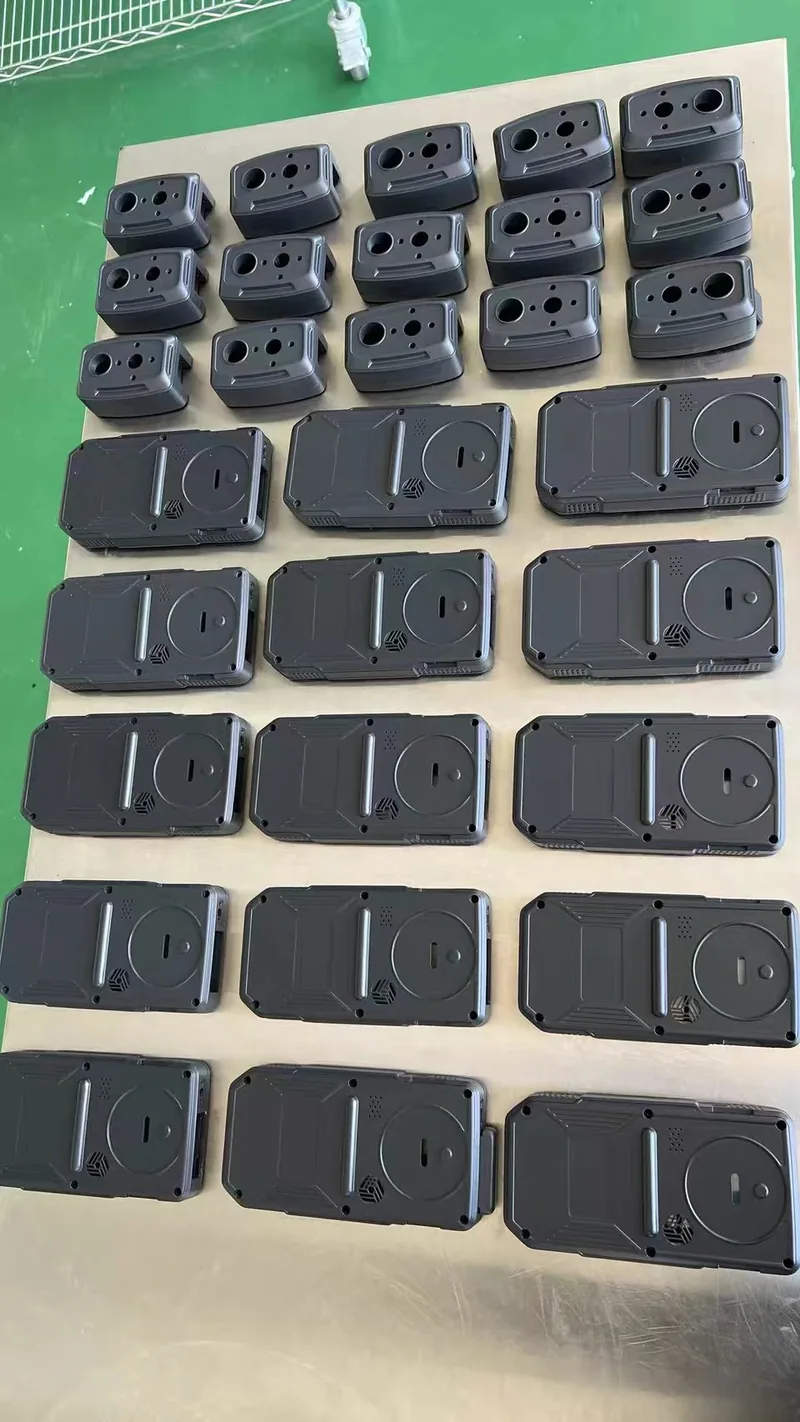
Most pages about this process show a grey block with no branding on it. Here is what a real order looks like on the bench — a mixed run of enclosure bodies and back covers, cast from masters, trimmed, painted and ready to assemble.
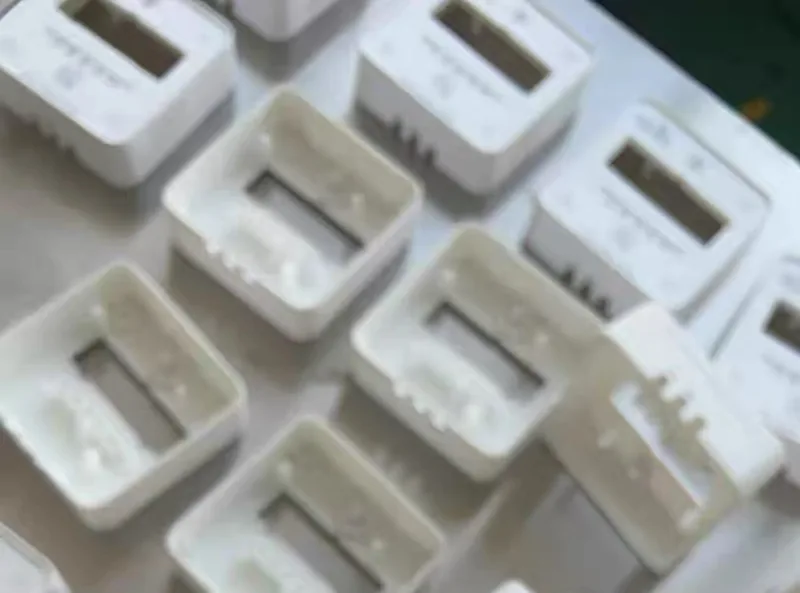
And here is the same kind of part before any finishing, straight out of the silicone with the flash still attached. This is what "as-cast" means, and it is worth seeing, because the gap between this and the finished part is the part of the job most suppliers do not talk about.
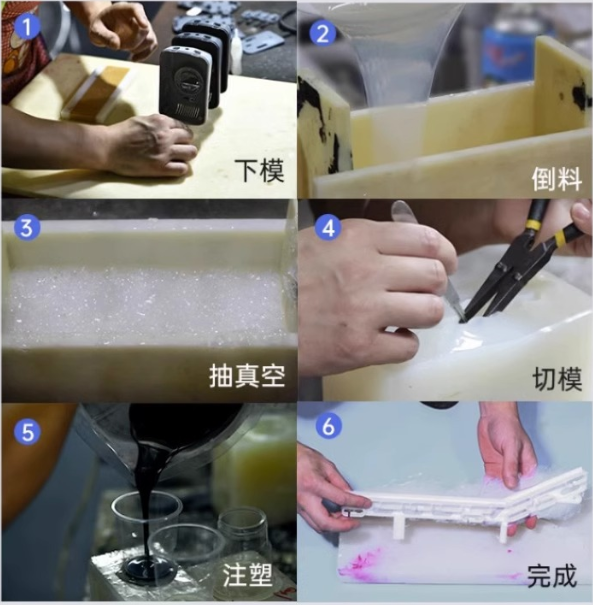
How the Process Runs — 6 Steps
Master in the box
Your sample part — or a printed master from your file — is suspended and sealed inside a casting box.
Pour silicone
Liquid RTV silicone is poured around the master, picking up every radius, rib and surface grain.
Vacuum & cure
The mold is degassed under vacuum so no bubble sits against a visible face, then cured to a solid flexible block.
Cut the mold
The cured silicone is opened along a parting line and the master lifted out, leaving a clean cavity.
Cast under vacuum
Polyurethane matched to ABS, PC, nylon, PP or rubber is poured into the cavity under vacuum and cured warm.
Trim & finish
Parts are demolded, flash removed, then painted, textured, printed or fitted with inserts as required.
The One Number That Shapes Your Order
A silicone mold is consumable. It gives roughly 20–25 good castings before edges soften and small features start to round off. That single fact decides how your job is priced and how long it takes.
So a 60-piece order is not one mold worked hard — it is three molds built from the same master and run in parallel. We would rather tell you that at quoting time than hand you piece 40 out of a tired cavity and hope you do not notice.
What mold life means for your quantity →
Materials We Cast
Casting resins are formulated to behave like the injection-molding plastics they stand in for. You tell us what the part has to survive; we pick the grade.
| Simulates | Typical use | Character |
|---|---|---|
| ABS-like | Housings, covers, trim, brackets | Rigid, tough, takes paint and texture well |
| PC-like / optically clear | Lenses, light pipes, transparent covers | Rigid; clear grades can be polished |
| Nylon / PP-like | Clips, snap features, functional parts | Tougher, slightly flexible, better fatigue |
| Rubber-like, Shore A20–A90 | Seals, grips, gaskets, soft-touch overlays | Elastomeric; hardness chosen per part |
| Glass-filled / heat-resistant | Under-hood, higher-load, near-warm parts | Stiffer, raised heat deflection |
| Flame-retardant grades | Electrical enclosures, terminal covers | Available on request; state the standard you need |
Colour can be pigmented into the resin or sprayed afterwards. Brass or stainless threaded inserts are cast in place or heat-set after demolding, so screws go into metal rather than into plastic.
What We Need From You
| What you have | What happens | Adds to lead time |
|---|---|---|
| The physical part | It becomes the master directly. Fastest route. | — |
| A 3D file (STEP / STL) | We print a high-resolution master and smooth it before moulding. | ~1–2 days |
| A broken or worn part | We repair the master, or reverse engineer it back to correct geometry first. | ~2–4 days |
| Only photos and measurements | We model it, send you the CAD to approve, then print the master. | ~3–5 days |
When Vacuum Casting Is the Wrong Answer
It is worth saying plainly, because picking wrong here costs real money:
- Above roughly 500 pieces per year, mold replacement stops making sense. That is where bridge tooling or a production tool takes over.
- If a feature must hold tighter than about ±0.1 mm — a bearing seat, a sealing land — cast plastic will not hold it reliably. We machine that feature afterwards, or make it a metal insert.
- Sustained high temperature or structural load. Cast polyurethane is not a substitute for glass-filled nylon in a hot, loaded application.
- Regulated contact applications — food, implant, long-term skin contact — where the casting resin has no matching certification. Say so early and we route it differently.
Everything Else in This Section
Common Questions
Around 20 to 25 castings from a standard RTV silicone mold before the cavity starts losing sharpness on edges and small features. With gentle geometry and careful demolding you can reach 30 to 40. If you need more than that we simply build more molds from the same master and run them in parallel — a 100-piece order is normally 4 to 5 molds, not one mold pushed past its life.
Yes, and that is most of what we do here. The physical part becomes the master. We do not need the original drawing, the original tooling or the original supplier — we need the part in our hands. A used part works. A part with a cracked corner works, because we repair the master before we pour silicone around it.
Layer lines and material. A cast part comes out of a cavity, so the surface is continuous the way an injection-molded part is, and it takes texture, paint and silkscreen properly. Cast polyurethane is also isotropic — it does not split along print layers when you torque a screw into a boss.
Roughly ±0.1 to ±0.3 mm depending on the size and shape of the part, plus about 0.15% shrinkage against the master. For enclosures, covers, trim and housings that is normally invisible. If your part has a bearing fit or a sealing face that must be held tighter, we machine that feature afterwards or make it a metal insert.
A photo of the part with something for scale, the quantity you need, and what the part has to survive — heat, sunlight, load, chemicals. That is enough for a price and a lead time within 12 hours. A 3D file speeds things up but is not required.
Yes. Ask and we sign before you upload files or ship a sample. Tooling and masters made for your project stay yours. See our NDA and confidentiality policy.