If you are hunting for an M35 to M30 adapter and coming up empty, it is not you. M35 is a non-preferred size — the standards went M33, then M36, and skipped it. We machine the pairing to order, and we have already delivered one in 316L. Send your two callouts →
Where M35 went in the standards
ISO 261 sets out the general plan for metric screw threads and arranges the diameters into preference series. Industry standardised on the first series, and around this diameter that means M33 and M36. M35 falls between them as a non-preferred intermediate size.
The practical effect is total. Distributors build their ranges from the preferred series, so M35 bar stock, taps, dies, nuts and blanks are not part of normal supply. It is not that M35 is exotic or difficult — it is an ordinary 35 mm thread — it simply never got a place in the catalogue. Anyone who has an M35 thread on a machine has it because somebody once machined it on purpose, and the mating part has to be machined the same way.
One exception, and it explains a lot. M35×1.5 is reserved in the standards for bearing lock nuts. That fine pitch is the one corner where M35 survived — which is why a search for "M35" tends to return lock nuts and spindle nuts. If your M35 thread came off a bearing seat or a spindle end, that is likely the pitch you are looking at. Custom bearing lock nuts →
We have already machined this exact pairing
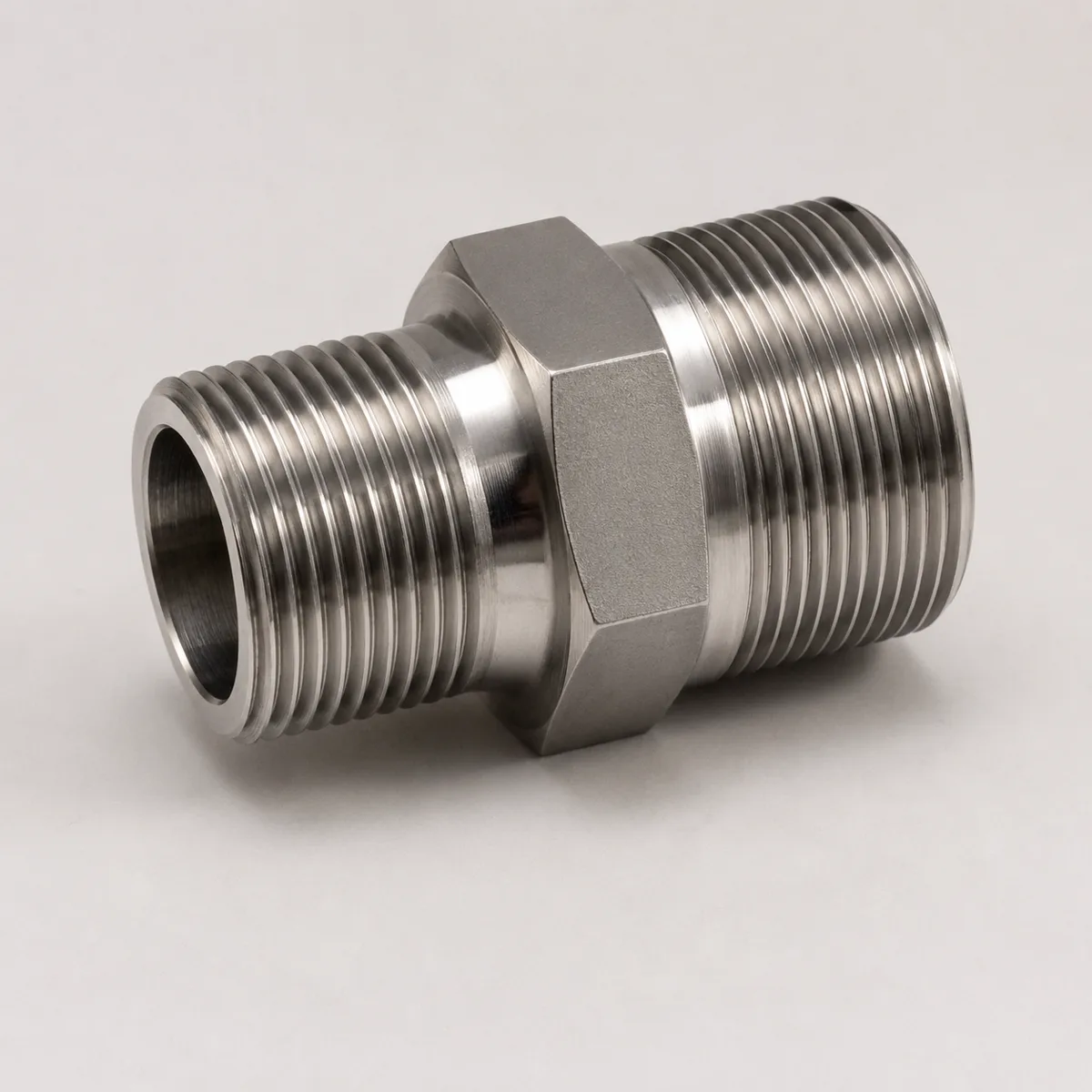
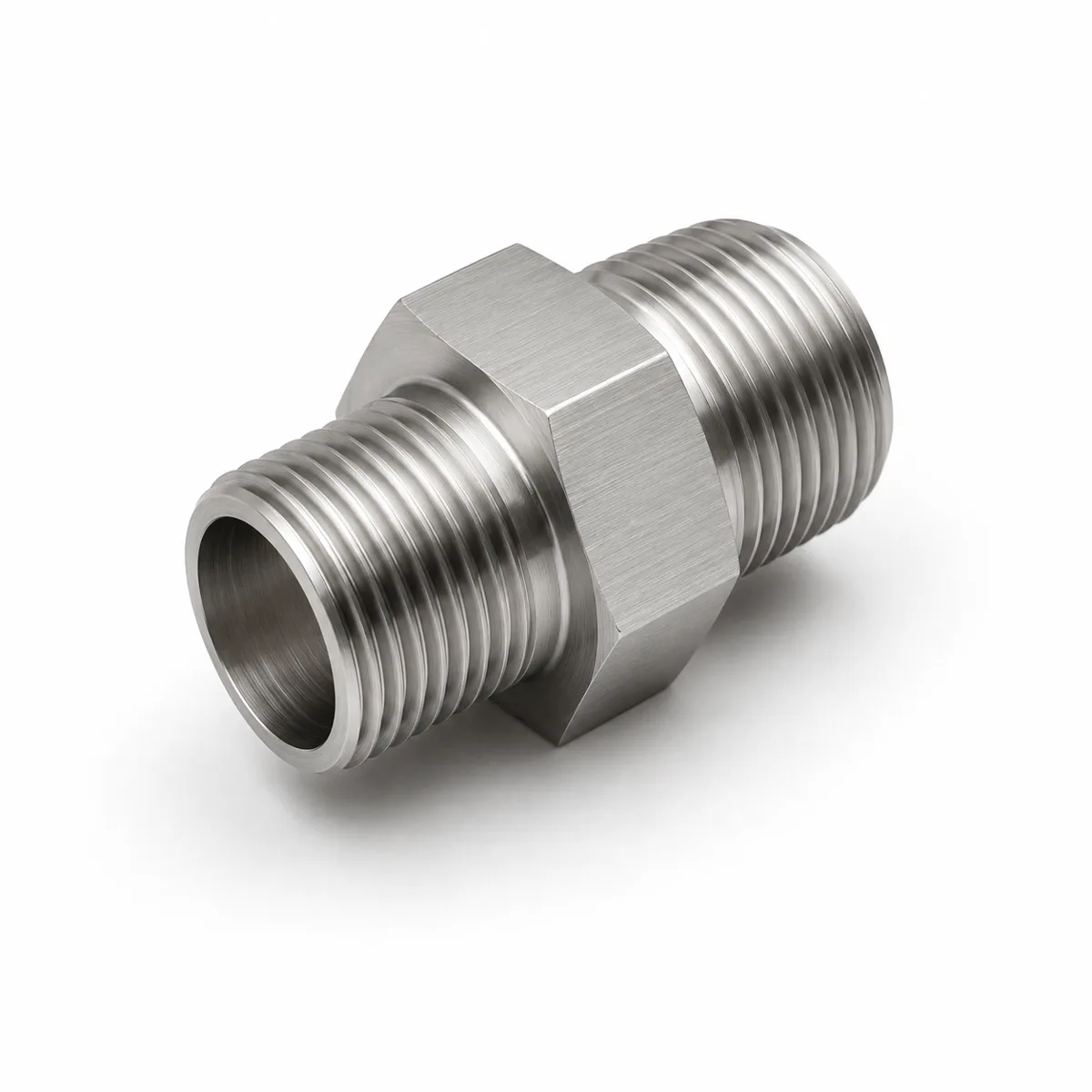
This is not a speculative listing. We turned a double-male reducing adapter, M35×1.5 to M30×2, from solid 316L, with a wrench hex between the two threads — a fine pitch on the large end, a coarser one on the small end, which is precisely the combination no catalogue carries. The build is documented, including why it could not be bought:
Why searching for "M35" fights you
Worth knowing, because it wastes a lot of people's afternoon. Two separate collisions sit on top of this size:
- M35 is also a car. It is an Infiniti model designation, so vehicle parts listings dominate the results for the bare term.
- M35 gets read as M3.5. Search engines and supplier site filters routinely treat it as a typo for the 3.5 mm screw size, returning tiny fasteners.
- Camera and optics threads look almost identical. The optical trade uses M35.5×0.5, M30.3×0.8 and M30.5×0.5 for filter and lens mounts, and several specialists machine those to order. Search "M35 to M30 adapter" and much of the first page is lens hardware.
None of these has anything to do with a 35 mm load-bearing metric thread. The optics case is the easiest to get wrong, so it is worth stating plainly: if the thread you are matching is an M35.5×0.5 or M30.3×0.8 filter mount, that is an optical interface — a pitch roughly three times finer than anything on this page, carrying no mechanical load. This page is about industrial threads such as M35×1.5 on a bearing seat or M30×2 on a machine boss. Searching the pair plus your pitch cuts through all three collisions, which is exactly why buyers who need the industrial part struggle to find anyone who makes it.
Because the size is non-preferred, tell us the pitch
On a standard size we can assume the coarse pitch and be right most of the time. On M35 there is no safe default, so pitch is the one thing we ask you to confirm rather than guess.
| Feature | Options | Notes |
|---|---|---|
| M35 end | M35×1.5 · ×2.0 · ×3.0 · or as measured | ×1.5 is the bearing lock nut pitch and the most likely one you'll meet |
| M30 end | M30×3.5 (coarse) · ×2.0 · ×1.5 | Coarse is the default here, but state it |
| Form | Double-male stud · male-female · female-female | The delivered example was double-male |
| Drive | Central hex band · two spanner flats · pin holes | A central hex suits double-male, where neither end can be gripped |
| Material | 316L · 316 · 304 · 42CrMo4 · 12L14 steel · 6061 / 7075 aluminium | 316L was used on the delivered part for corrosion service |
| Length | Overall length plus engagement per end | Give both — total length alone is not enough to cut it |
If you are unsure of the pitch, the fastest route is to send the mating part or the old adapter. Measuring a thread off the real component removes the guesswork, and it is usually quicker than trying to describe it.
What people use this size for
M35 turns up in a fairly consistent set of places, all of them consequences of the size being machined rather than bought: bearing seats and spindle ends where the M35×1.5 lock nut thread lives, hydraulic and instrument bosses on older European machinery, tie-rod and linkage ends on equipment built before a size rationalisation, and replacement work where the original manufacturer chose 35 mm and is no longer around to supply the mating part. In nearly every case the customer is not designing something new — they are trying to connect to a thread that already exists and cannot be changed.
Nearby sizes we machine
Will it fit? M35 to M30 checks before you order
M35×1.5 is the bearing lock-nut thread (KM 7), so a KM 7 nut threads onto an M35×1.5 spindle but nothing in a fitting catalogue does. An M35×2.0 or M35×3.0 part will not go onto that same spindle — the pitch differs — and on the M30 side an M30×3.5 coarse nut will not take an M30×2.0 fine stud. Measure the pitch on both parts with a gauge before ordering; at this size a wrong pitch strips the first two turns.
What do I need to connect an M30 part to an M35 thread?
A reducing adapter with an M35 end at the measured pitch and an M30 end at yours: M35 female × M30 male to fit an M30 stud into an M35 bore, or M35 male × M30 female to put an M30 fitting onto an M35 spindle nose. Both are turned from one piece of 316L or 42CrMo4.
Same M35 to M30 adapter, but a different pitch, longer, or in aluminium
M35×2.0 instead of ×1.5, 15 mm more length, a central hex band for a spanner, or 7075 aluminium where weight matters — quoted as a variant of the same drawing, one piece and up, in 12 hours.
Where the Catalogue Stops for This Size Pair
If a plain reducer in this step exists on a stockist's shelf, buy it. These are the versions that do not exist as a part number.
| What you need | In the catalogue? | How we machine it |
|---|---|---|
| A plain coarse-to-coarse reducer in this size step | Sometimes stocked | If a stockist lists it, buy it off the shelf. We are worth calling when the pitch, length, material or form is not on their page. |
| M35 at all — a non-preferred ISO size | No | M35 is not on the preferred-size list, which is why searching for it fights you. Tell us the pitch and we cut it. |
| Different pitch on each end | No | Each thread single-pointed to its own pitch on the same bar. |
| Double-male stud instead of a bush | Thin | Male on both ends; far fewer sizes stocked and almost none in mixed pitch. |
| Female-female coupling | Thin | Joins two studs rather than reducing a hole. Any pitch pair. |
| Hex flats sized to a spanner you already own | No | Cut to your wrench, not to a catalogue table. |
| Through-bore for a shaft, cable or fluid | No | Bore and both threads cut in one setup so they stay concentric. |
| Shortened body for a crowded plate | No | Catalogue parts come in one length. State the space you have. |
| Left-hand thread on either end | No | Not stocked at any size. |
| 316 stainless or alloy steel instead of plated mild steel | Rare | Material is open; no tooling cost at these sizes. |
Frequently asked
Why can't I find an M35 adapter anywhere?
M35 is a non-preferred size under ISO 261 — the preferred sizes either side are M33 and M36. Distributors build ranges from the preferred series, so M35 never enters normal supply. It is made, not bought.
Why does M35×1.5 keep appearing on bearing lock nuts?
That fine pitch is reserved in the standards for bearing lock nut use — the one corner where M35 survived. If your thread came off a bearing seat or spindle, that is probably the pitch. Custom bearing lock nuts →
Why does searching M35 return car parts, tiny screws and camera adapters?
Three collisions: M35 is an Infiniti model name; search engines often read it as M3.5; and the optical trade uses M35.5×0.5 and M30.3×0.8 for filter mounts — similar-looking, but about three times finer in pitch and carrying no load. Searching the pair plus your pitch (e.g. M35×1.5 to M30×2) cuts through all three.
Have you made an M35 to M30 adapter?
Yes — a double-male M35×1.5 to M30×2 in 316L with a wrench hex. See the build →
What do you need from me to quote an M35 part?
The pitch on each end above all, plus gender per end, overall length, engagement per end, material and quantity. No CAD needed — a sketch, the callouts, or the part itself. Ordering without CAD →
Can you make the matching M35 nut or bolt too?
Yes. Since the size is non-preferred, the mating fastener usually has to be machined as well, and it makes sense to cut both together so the fit is gauged as a pair. Large & oversize bolts →
Send the pitch, or send the part. For example: "M35×1.5 male → M30×2 male, 316L, 70 mm overall, 25 mm engagement each end, central hex". Free drawing, quote in 12 hours. Get a quote →