You need an M36 to M30 adapter and every search ends at a size chart rather than a part. This is a size where stock reducers run out and most custom adapter shops hit their own diameter ceiling. We turn it from bar — M36×4.0 to M30×3.5, or any fine-pitch pairing you specify. Send your two callouts →
The pitch problem nobody mentions
M36 and M30 are both standard sizes, which is exactly why people assume the adapter between them must be standard too. It isn't. The coarse pitch for M36 is 4.0 mm; the coarse pitch for M30 is 3.5 mm. So even the most ordinary coarse-to-coarse M36→M30 adapter is carrying two different pitches in one piece of steel.
On the shop floor that means two separate single-point threading operations, each with its own pitch setting, its own tool path and its own gauge. There is no single die or tap that produces this part. That's the whole reason it is machined rather than picked from a bin — and it's also why a supplier who only cuts one pitch per part will quote it as two parts and a weld. We turn it as one piece.
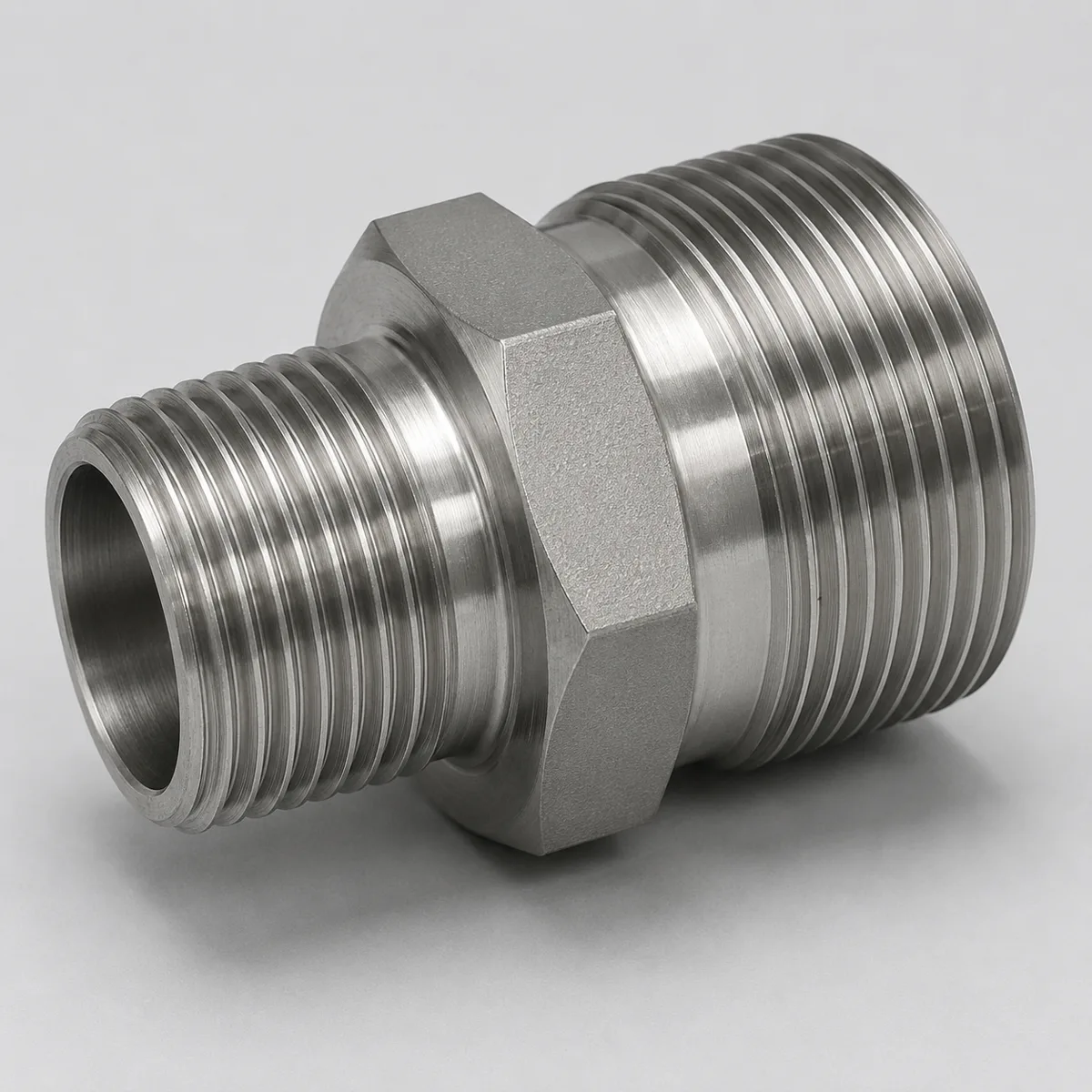
Where the catalogue stops — and where the custom shops stop
Two ceilings sit between you and this part, and it helps to know both.
The first is distribution. Stock reducers and hex bushings exist in the pairings that sell in volume, which in practice means the small end of the metric range. Nobody warehouses M36→M30 because the people who need it need it once.
The second ceiling is the more useful one to know about. Several of the specialist custom thread-adapter shops publish a hard limit on what they will make: roughly 1 inch in diameter and 2 inches long. One inch is 25.4 mm. M30 is already past it and M36 is well past it. That is why searching for a custom M36 adapter tends to return either a chart or a shop that quietly declines the job. Above about M25 the work moves to general turning capacity, which is where we sit.
Rule of thumb. Below M20 you are usually shopping for a commodity and should buy one. Above M25 you are commissioning a part. M36→M30 sits firmly in the second category.
Sizes, pitches and wrench access
Each end is single-point turned to its own pitch and gauged with a ring or plug before it ships. Any combination in the table can be paired with any other:
| Feature | Options | Notes |
|---|---|---|
| M36 end | M36×4.0 (coarse) · M36×3.0 · M36×2.0 · M36×1.5 | Male or female; tapping drill 32 mm for the female form |
| M30 end | M30×3.5 (coarse) · M30×2.0 · M30×1.5 | Male or female; tapping drill 26.5 mm for the female form |
| Form | Male-female · double-male stud · female-female coupling | Tell us the gender of each mating part |
| Drive | Hex from 55 mm across flats · two spanner flats · pin-wrench holes | 55 mm matches a standard M36 nut, so ordinary sockets fit |
| Length | Overall length and each end's thread engagement set independently | State engagement per end, not just total length |
| Bore | Solid · through-bored for a shaft, cable or fluid path | Through-bore reduces weight and allows a rod to pass |
The 55 mm figure is worth planning around. It is the across-flats dimension of a standard M36 hex nut, so specifying it means the finished adapter can be driven with wrenches your fitters already carry. Going smaller to save material usually costs more in the field than it saves in the shop.
Materials at this diameter
At M36 the part is heavy enough that material choice changes both cost and behaviour:
- Steel / 12L14 — the default for dry mechanical joints indoors. 12L14 machines fast and keeps the price down where load is modest.
- 42CrMo4 alloy steel — for tie-rods, tooling and anything carrying real tension. This is the usual pick when the adapter is in a load path.
- 304 stainless — general corrosion resistance, the most common stainless request at this size.
- 316 stainless — marine, chemical and washdown environments.
- 6061 aluminium — only where weight dominates and load is light; threads this coarse in aluminium gall easily, so we normally recommend a steel insert or a longer engagement.
- 7075 aluminium — where an aluminium part still has to take some load, at higher cost and with the same thread-wear caveat.
Plating, passivation and black oxide are all available. If the joint has to seal as well as hold, tell us the fluid and the pressure and we will add a seal face rather than relying on the threads.
Free-cutting steel arrives under four names — 12L14, 11SMnPb30, SUM24L, Y15Pb — and only one question matters for an adapter: leaded or lead-free. The free-machining steel equivalents chart crosses the names and the RoHS pairs.
Sister sizes we machine
M36→M30 is the top rung of a ladder we already cover. If your pair is one step down, start here instead:
Where the Catalogue Stops for This Size Pair
If a plain reducer in this step exists on a stockist's shelf, buy it. These are the versions that do not exist as a part number.
| What you need | In the catalogue? | How we machine it |
|---|---|---|
| A plain coarse-to-coarse reducer in this size step | Sometimes stocked | If a stockist lists it, buy it off the shelf. We are worth calling when the pitch, length, material or form is not on their page. |
| Wrench access at this diameter | No | At M36 the hex gets large enough to foul neighbours. We size the across-flats to the clearance you have. |
| Different pitch on each end | No | Each thread single-pointed to its own pitch on the same bar. |
| Double-male stud instead of a bush | Thin | Male on both ends; far fewer sizes stocked and almost none in mixed pitch. |
| Female-female coupling | Thin | Joins two studs rather than reducing a hole. Any pitch pair. |
| Hex flats sized to a spanner you already own | No | Cut to your wrench, not to a catalogue table. |
| Through-bore for a shaft, cable or fluid | No | Bore and both threads cut in one setup so they stay concentric. |
| Shortened body for a crowded plate | No | Catalogue parts come in one length. State the space you have. |
| Left-hand thread on either end | No | Not stocked at any size. |
| 316 stainless or alloy steel instead of plated mild steel | Rare | Material is open; no tooling cost at these sizes. |
Frequently asked
What pitches does an M36 to M30 adapter normally use?
The coarse defaults are M36×4.0 and M30×3.5, so even a plain coarse-to-coarse adapter carries two pitches. Fine options are M36×3, ×2 or ×1.5 and M30×2 or ×1.5. Each end is turned and gauged separately, so any pairing works. More on mixing pitches →
Why can't I buy an M36 to M30 adapter off the shelf?
Distributors stock only high-volume pairings, and the specialist custom adapter shops commonly cap out near 1 inch — 25.4 mm — which both M36 and M30 exceed. Above roughly M25 the part is turned from bar for the specific job.
How big does the hex need to be?
Allow at least 55 mm across flats on the M36 end, matching a standard M36 nut so normal sockets fit. Where space is tight we machine two spanner flats or pin-wrench holes instead. See double-male forms →
Material and minimum order?
Steel, 12L14, 42CrMo4, 304 or 316 stainless, and 6061 or 7075 aluminium where weight matters. MOQ one piece, no tooling cost, no CAD needed — the two callouts, a length and a material are enough. How ordering without CAD works →
Can you copy an adapter I already have?
Yes. Send the worn or broken one and we measure the threads, pitch and engagement directly off it. That is often faster than describing it, and it removes the risk of a callout being wrong. Reverse engineering from a sample →
Tell us your two threads. Just the callouts will do — for example "M36×4.0 male → M30×3.5 male, 42CrMo4, 90 mm overall, 30 mm engagement each end". Free drawing, quote in 12 hours. Get a quote →