The Problem
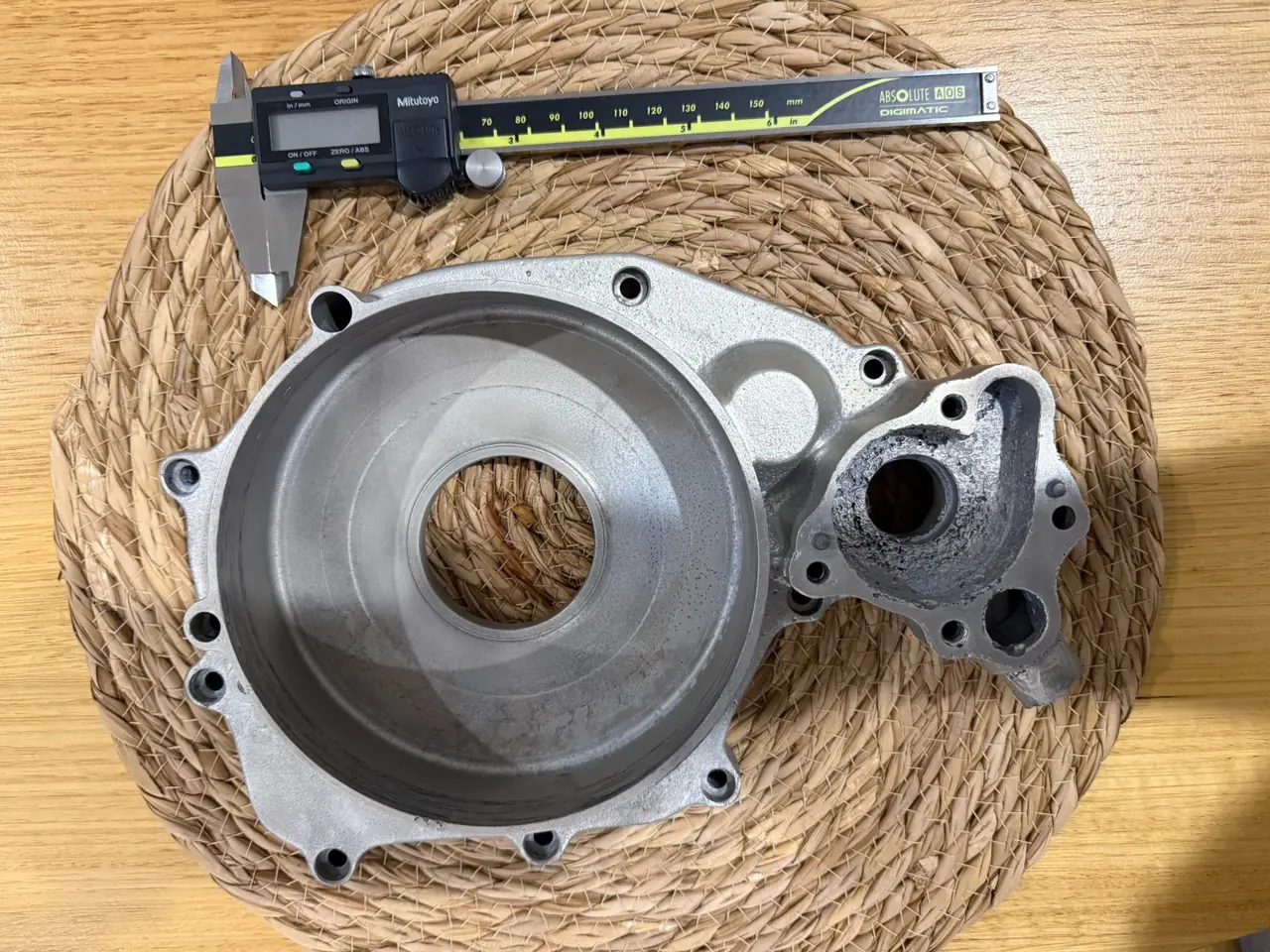
A 125cc motorcycle clutch cover. No drawings — nothing from the manufacturer, no scan, not even a sketch. The buyer needs two covers machined from 6061 aluminium, and he has exactly one original to work from.
The original is a casting. The as-cast texture is visible across the outer faces, the walls carry draft, and there are ribs that exist partly to stiffen a thin cast wall and partly to help the metal flow when it was poured. The replacements are to be cut from solid billet, which is the right call at this quantity — two pieces never justify the cost of tooling.
Three Ways a Job Like This Starts
Buyers arrive in one of three states, and none of them is a dead end.
- You have the manufacturer drawing or a CAD file. The fastest route by some margin. Nothing has to be measured or reconstructed — the job goes straight into programming and onto the machine. If you have this, send it.
- You have the part, but no paperwork. Equally workable. The cover comes to us, we measure and model it here, and machine from that.
- You have photographs and nothing else. Enough for us to tell you whether the job is possible and roughly what it costs. Not enough to cut from — the part still has to travel.
This buyer was in the third state. The rest of this page follows that route, because it is the one that needs explaining.
Photographs are the right first move. They tell us within minutes whether a job is possible and roughly what it will cost. What they cannot do is carry the geometry.
With No Drawing: What the Photographs Told Us
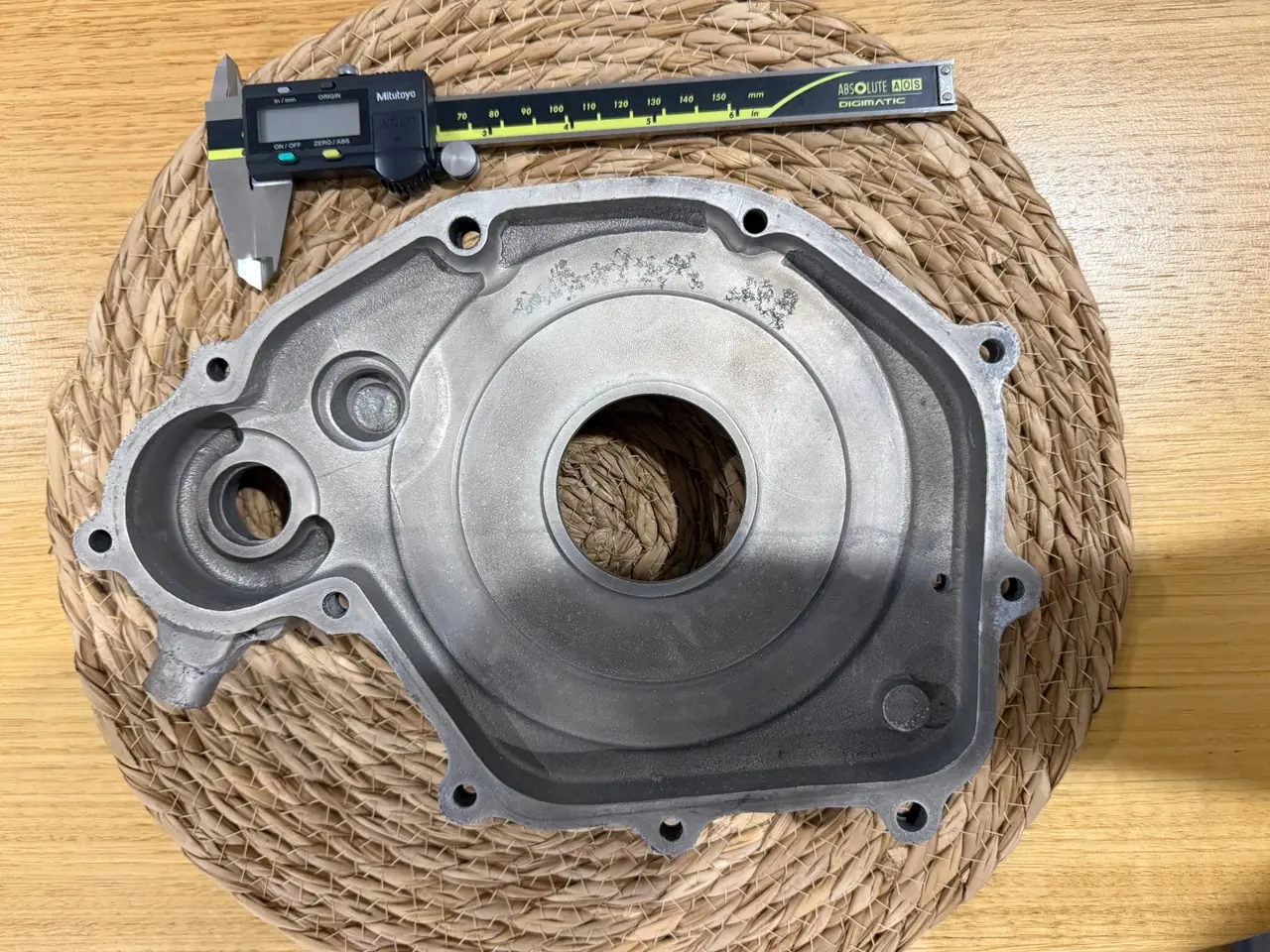
Two frames arrived, each with a digital caliper laid on the table beside the cover for scale. From those we could establish:
- Roughly how large the cover is, from the caliper scale in frame
- That it is a casting rather than a fabrication or a machined billet part
- Roughly where the bolt bosses, the central bore and the main recess sit
- That the job is well within what we make — enough to answer the buyer the same day
And what they could not
- Depth of anything. Both frames were shot straight down at the part. A top-down photograph tells you nothing about how deep the main recess runs, how far the central boss stands proud of the face, or how much wall is left behind it.
- Any actual dimension. The caliper was laid beside the part as a scale reference, not closed on a feature. It gives a rough scale for the frame, not a measurement.
- How the features relate to one another. This is the one that matters, and it is the reason the part has to travel.
Why a Handful of Measurements Is Not Enough
It is tempting to ask a customer for a few key dimensions and save him the postage. For a bushing or a thread adapter that often works. For a cover like this one it does not, and promising otherwise only moves the risk onto the buyer.
A cast cover carries dozens of features, and almost none of them stand alone. The bolt holes have to land on the pattern in the crankcase it bolts to. The seal bore has to be concentric with the shaft running through it. The gasket face has to be flat across the whole perimeter, and the recess behind it has to clear the clutch basket without touching. A handful of isolated numbers describes none of those relationships. A cover built from them will look right on the bench and will not bolt on.
What You Have, and What It Buys You
| What you have | Enough to start cutting? | What actually happens |
|---|---|---|
| Manufacturer drawing or CAD | Yes | Straight into programming and machining |
| The physical part | Yes | It comes to us, we measure and model it in-house, then machine from that |
| Photographs only | No | Still send them — they tell us within minutes whether the job is possible and roughly what it costs |
| A few dimensions you measured yourself | No | Enough for us to put a price on the work. Not enough to make it |
| Nothing at all | No | Nothing to reproduce — a replacement has to come from somewhere |
6061 is EN AW-6061 / 3.3211 in Europe and A6061 in Japan, but the bar a European shop holds is 6082 — the aluminium alloy equivalents chart says which of the two a cover like this is machined from and what changes.
Cast Original, Machined Replacement
Copying the geometry is not the same as copying the production method. A rib on a casting may be there because a thin poured wall needed stiffening, or because the mould needed the metal to reach a far corner — and a part cut from solid needs neither. The same rib may equally be there because something bolts to it, or because it carries load.
Reproducing every cast feature blindly in a milled part burns hours of cutting time for no benefit. Deleting the wrong one breaks the part. Which ribs stay is a question we settle with the customer before cutting, not afterwards.
What You Get Back
Finished covers. EKINSUN LTD is a manufacturer — measuring the original and modelling it are steps on the way to cutting metal, not products in their own right. We do not sell CAD files or drawings, and the deliverable on a job like this is the part in your hand.
Where This One Stands
At the time of writing this job is still at the quoting stage. The buyer is taking a first set of measurements so we can put a price on the work, and the cover itself will be posted over before anything is cut. This page will be updated with the finished parts.
The Workflow
Photographs received
Two frames of the cover with a caliper in shot. Enough to confirm the job is possible and to answer the same day.
Rough measurements for pricing
Overall size, thickness, the large centre bore, recess depth, bolt-hole count and size. Enough to price the work, not to cut it.
Price agreed, part posted over
Once the quote is accepted the original cover travels to the workshop.
Measured and modelled in-house
Every feature captured, including the depths a photograph cannot show, and the geometry rebuilt so the features hold their true relationships.
Machined from solid 6061 and checked
Two covers cut from billet, inspected against the rebuilt geometry, and shipped back with the original.