The Crosswalk — 10 Wrought Aluminium Alloys Across AA, EN AW / DIN, JIS and GB
Aluminium is the easy family on paper: the Aluminum Association four-digit number is adopted unchanged by EN 573-3 (as EN AW-xxxx, with a chemical name and a DIN Werkstoffnummer alongside), by JIS H4040 (as Axxxx) and by GB/T 3190, so 7 of the 10 alloys below are direct equivalents by registration. The 3 nearest pairs are the ones that matter for a purchaser — 6082 for 6061, 5754 for 5052, 6060 for 6063 — because they are what the other continent actually stocks. China’s domestic “A” alloys (2A12, 7A04, 7A09) are listed in the GB column as near-alloys, not as equivalents.
EKINSUN LTD machines brackets, housings, cooling plates, heat sinks, spacers, flanges and racing parts in every alloy in the chart from one piece — from a drawing in AA, EN AW, JIS or GB names, a sketch or the worn part. This page is part of the material grade equivalents series.
| AA | UNS | EN AW name — number (Werkstoff) | JIS | GB/T 3190 | BS | Equivalence |
|---|---|---|---|---|---|---|
| 6xxx Al-Mg-Si — the general machining alloys | ||||||
| 6061 | A96061 | AlMg1SiCu — EN AW-6061 (3.3211) | A6061 | 6061 (legacy LD30) | H20 | direct: the same registered alloy in every system (Aluminum Association number adopted by EN 573-3, JIS H4040 and GB/T 3190). |
| 6082 | A96082 | AlSi1MgMn — EN AW-6082 (3.2315) | — | 6082 | H30 / HE30 | nearest to 6061: Europe's structural and machining alloy, with more silicon (0. |
| 6063 | A96063 | AlMg0.7Si — EN AW-6063 (3.3206) | A6063 | 6063 (legacy LD31) | H19 / HE9 | direct: the extrusion and architectural alloy (window frames, heat-sink profiles); T6 minimum only 190 MPa tensile / 160 MPa yield, so it is a substitute for 6061 in shape but not in strength. |
| 6060 | A96060 | AlMgSi — EN AW-6060 (3.3206) | — | 6060 | — | nearest to 6063: Europe's architectural extrusion alloy, slightly leaner in magnesium than 6063; both anodise to the same bright finish and both are too soft for load-bearing machined parts. |
| 7xxx and 2xxx — the high-strength alloys | ||||||
| 7075 | A97075 | AlZn5.5MgCu — EN AW-7075 (3.4365) | A7075 | 7075 (domestic near-alloy 7A09, legacy LC9) | L95 / 2L95 | direct: the aerospace and racing alloy (T6: about 540 MPa tensile, 480 MPa yield) is registered under the same number everywhere. |
| 2024 | A92024 | AlCu4Mg1 — EN AW-2024 (3.1355) | A2024 | 2024 (domestic near-alloy 2A12, legacy LY12) | 2L97 / L109 | direct: the fatigue-rated aircraft alloy (T3: 400-430 MPa tensile). |
| 2011 | A92011 | AlCu6BiPb — EN AW-2011 (3.1655) | A2011 | 2011 | FC1 | direct: the free-machining screw-machine alloy: bismuth and lead break the chip, so it turns at the highest rates of any aluminium. |
| 5xxx Al-Mg — the marine and welded alloys | ||||||
| 5083 | A95083 | AlMg4.5Mn0.7 — EN AW-5083 (3.3547) | A5083 | 5083 | N8 | direct: the seawater and pressure-vessel plate alloy, not heat-treatable (H111 / H321 tempers, about 275-300 MPa tensile). |
| 5052 | A95052 | AlMg2.5 — EN AW-5052 (3.3523) | A5052 | 5052 | — | direct: the US and Asian sheet-metal alloy (enclosures, brackets, H32 about 230 MPa tensile); Europe stocks 5754 (AlMg3) in the same role. |
| 5754 | A95754 | AlMg3 — EN AW-5754 (3.3535) | — | 5754 | — | nearest to 5052: the European sheet and tread-plate alloy, a little more magnesium (2. |
6082, 5754 and 6060 have no JIS H4040 registration and the cells stay blank. Legacy Chinese names (LD30, LD31, LY12, LC4) are given only where they existed; GB/T 3190 today uses the four-digit numbers. Bands come from the pages in the dataset’s source list (MakeItFrom, aircraftmaterials.com, Wikipedia alloy pages); rows marked “std” carry a band from the EN 573-3 / Aluminum Association registration instead.
Need a part machined in the aluminium alloy on your drawing? EKINSUN is a custom parts manufacturer: we machine parts in the aluminium alloy on your drawing — 6061, 6082, 7075, 2024 or its equivalent to your drawing, sketch or sample, from 1 piece, with a material certificate on request and a quote in 12 hours. Already a catalogue size? Ask us too — we may have it in stock, and larger quantities cost less per piece. How ordering without CAD works →
Composition Bands — What Each Number Stands For (mass %)
The bands are the same in every system for a registered alloy, which is why the table has one line per alloy. Read 6061 against 6082 to see the whole difference between the two continents’ machining bars: silicon 0.40–0.8 against 0.7–1.3 %, copper 0.15–0.40 against ≤ 0.10 %, manganese ≤ 0.15 against 0.40–1.0 %.
| Alloy | Si | Fe | Cu | Mn | Mg | Cr | Zn | Ti |
|---|---|---|---|---|---|---|---|---|
| 6061 | 0.40–0.8 | ≤ 0.7 | 0.15–0.40 | ≤ 0.15 | 0.8–1.2 | 0.04–0.35 | ≤ 0.25 | ≤ 0.15 |
| 6082 | 0.7–1.3 | ≤ 0.50 | ≤ 0.10 | 0.40–1.0 | 0.6–1.2 | ≤ 0.25 | ≤ 0.20 | ≤ 0.10 |
| 6063 | 0.20–0.6 | ≤ 0.35 | ≤ 0.10 | ≤ 0.10 | 0.45–0.9 | ≤ 0.10 | ≤ 0.10 | ≤ 0.10 |
| 6060 | 0.30–0.6 | 0.10–0.30 | ≤ 0.10 | ≤ 0.10 | 0.35–0.6 | ≤ 0.05 | ≤ 0.15 | ≤ 0.10 (std) |
| 7075 | ≤ 0.40 | ≤ 0.50 | 1.2–2.0 | ≤ 0.30 | 2.1–2.9 | 0.18–0.28 | 5.1–6.1 | ≤ 0.20 |
| 2024 | ≤ 0.50 | ≤ 0.50 | 3.8–4.9 | 0.30–0.9 | 1.2–1.8 | ≤ 0.10 | ≤ 0.25 | ≤ 0.15 |
| 2011 | ≤ 0.40 | ≤ 0.7 | 5.0–6.0 | — | — | — | ≤ 0.30 | — (Bi 0.20–0.6, Pb 0.20–0.6) |
| 5083 | ≤ 0.40 | ≤ 0.40 | ≤ 0.10 | 0.40–1.0 | 4.0–4.9 | 0.05–0.25 | ≤ 0.25 | ≤ 0.15 |
| 5052 | ≤ 0.25 | ≤ 0.40 | ≤ 0.10 | ≤ 0.10 | 2.2–2.8 | 0.15–0.35 | ≤ 0.10 | — |
| 5754 | ≤ 0.40 | ≤ 0.40 | ≤ 0.10 | ≤ 0.50 | 2.6–3.6 | ≤ 0.30 | ≤ 0.20 | ≤ 0.15 (std) |
The Drawing Says… — What We Make the Part In
This is the column no stockholder chart has. The alloy on a drawing is chosen where the drawing was made; the bar on the shelf is chosen where the part is made. The table says, alloy by alloy, what the part is machined in and what changes; the rule behind every row: the alloy and temper actually used are written on the quote before machining and on the EN 10204 3.1 certificate after it, and parts for one anodised assembly are never split between two alloys.
| The drawing says | What we make it in — and what changes |
|---|---|
| 6061-T6, A6061 or LD30 | made in 6061-T6 (or T651 plate); no change. A European buyer who has 6082 on the drawing and 6061 stock in Asia gets the difference explained on the quote (see 6082). |
| 6082-T6, AlSi1MgMn or 3.2315 | made in 6082-T6 when the part is ordered from Europe; when the drawing came from the US in 6061 and the part is made for a European customer, we state which of the two was used and never mix them within one batch. |
| 6063-T5/T6, A6063 or LD31 | made in 6063 for extruded profiles and heat sinks; a machined-from-solid part drawn in 6063 is quoted in 6061 / 6082 bar with a note, because 6063 bar is rarely stocked. |
| 7075-T6 / T651, A7075 or 3.4365 | made in 7075-T651 plate or T6 bar with an EN 10204 3.1 certificate naming 7075; no substitution. |
| 2024-T3 / T351, A2024 or LY12 | made in 2024-T351 plate; if only 2A12 is available we say so before machining, never after. |
| 2011-T3 or AlCu6BiPb | made in 2011-T3 bar for turned parts; a RoHS note on the drawing switches the order to a lead-free 6xxx machining alloy and the quote says which. |
| 5083-H111 / H321, A5083 or AlMg4.5Mn | made in 5083 plate; a machined block drawn in 5083 for strength alone is offered in 6082-T6 with the difference stated. |
| 5052-H32 or A5052 | made in 5052 sheet when the part is a formed bracket or panel; a European customer's 5754 drawing is made in 5754 and the two are not swapped without a note. |
| 5754-H22 / H111 or AlMg3 | made in 5754 when the part is European; US-sourced drawings in 5052 stay in 5052. |
| 6060-T66 or AlMgSi | extruded profile made in 6060; a solid machined part in 6060 is quoted in 6082-T6 with the change stated. |
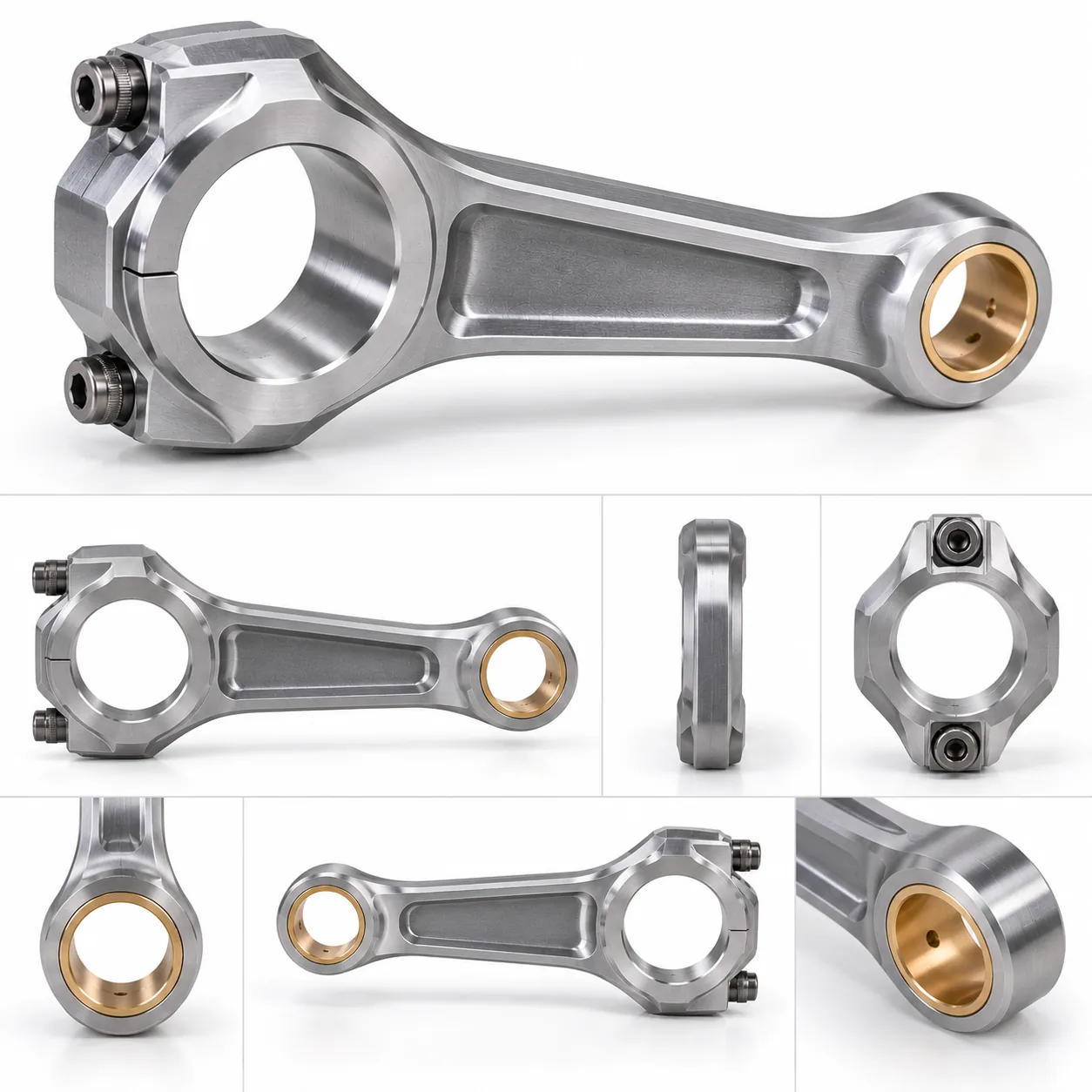
Two requests from the inbox show the two directions. A German buyer with a US drawing: “it says 6061-T6, our stockholder only has 6082 — can you make it in 6082?” Yes, and the quote says 6082-T6 (Si 0.7–1.3 %, bar 310 / 270 MPa) so the certificate matches the part. A US buyer sourcing in Asia: “the supplier offers 7A04 for our 7075 bracket, is that the same?” No: 7A04 is a domestic near-alloy with its own Cu and Mn bands, and the part is made in 7075-T651 or not at all. Custom brackets, heat sinks, spacers and shafts in these alloys follow the same route; a hand sketch with the main dimensions is enough to start.
Four Traps — Where a Number Match Is Not a Stock Match
Trap 1 — 6061 and 6082 are two alloys, one job. Same T6 heat treatment, same machining, same anodising process — but Si 0.40–0.8 vs 0.7–1.3 %, Cu 0.15–0.40 vs ≤ 0.10 %, and a visibly different anodised tone. Substitute freely for a functional part, never inside one anodised assembly, and always name the one used.
Trap 2 — the Chinese “A” alloys. 2A12 (LY12), 7A04 (LC4) and 7A09 (LC9) are China’s own registrations near 2024 and 7075. A mill that is out of 7075 will offer 7A04; a certificate that reads 7A04 for a part drawn in 7075 is a substitution the buyer did not approve.
Trap 3 — extrusion alloys in a machined part. 6063 and 6060 exist as profiles, not bar; their T6 minimum is 190 / 160 MPa against 290 / 240 MPa for 6061-T6. A block drawn in 6063 and machined from solid is really a 6061 / 6082 part.
Trap 4 — the temper is half the name. 6061-T6 bar and 6061-T651 plate are the same alloy with different residual stress; 7075-T6 and 7075-T73 differ in strength and stress-corrosion resistance. A drawing that gives the number without the temper has not specified the material.
Tempers, Strength and the Numbers Behind the Names
| Fact | Value | Standard / source |
|---|---|---|
| Same number, different stock | The four-digit Aluminum Association number is adopted unchanged by EN 573-3 (as EN AW-xxxx), JIS H4000 / H4040 (as Axxxx) and GB/T 3190 (as xxxx), so 6061 is 6061 in every system. What differs by region is what stockholders hold: 6061 and 7075 bar in the US and Asia, 6082 bar and 7075 plate in Europe. | EN 573-3; JIS H4040; GB/T 3190 |
| 6061 vs 6082 in numbers | 6061: Si 0.40–0.8 %, Cu 0.15–0.40 %, Cr 0.04–0.35 %, Mn ≤ 0.15 %. 6082: Si 0.7–1.3 %, Cu ≤ 0.10 %, Cr ≤ 0.25 %, Mn 0.40–1.0 %. T6 bar minimums: 6061 290 MPa tensile / 240 MPa yield; 6082 310 / 270 MPa (bar 20-150 mm). Typical T6: 6061 310 / 270 MPa, 6082 330 / 270 MPa. | MakeItFrom 6061 and 6082 pages; aircraftmaterials 6082; Wikipedia 6061 |
| Temper codes travel with the alloy | T6 (solution treated and artificially aged), T651 (T6 plus stress relief by stretching, plate), T5 (cooled from extrusion and aged), H32 / H111 / H321 (strain-hardened, 5xxx). The temper is part of the material call-out in every system: 6061 without a temper is an incomplete specification. | ANSI H35.1; EN 515 |
| 7075 strength | 7075-T6 typical: 560 MPa tensile, 480 MPa yield, 7.9 % elongation, 150 HB; Wikipedia quotes the specification band as 510-540 MPa tensile and 430-480 MPa yield. Twice the strength of 6061-T6 at the same density, no fusion welding, and colour anodising comes out darker than on 6xxx. | MakeItFrom 7075-T6; Wikipedia 7075 |
| Chinese domestic near-alloys | GB/T 3190 also carries China's own 'A' series: 2A12 (legacy LY12) near 2024, 7A04 (LC4) and 7A09 (LC9) near 7075, 6A02 (LD2) near 6061 in the older aircraft sense. They are separate registrations with their own bands; a certificate for a 7075 part that reads 7A04 is a substitution, not an equivalence. | GB/T 3190 |
| Anodising and alloy | 6xxx alloys (6061, 6082, 6063, 6060) anodise clear and take colour evenly; 7075 anodises with a yellow-grey cast; 2xxx alloys anodise poorly and the copper-rich 2011 is not decoratively anodised at all. Mixing 6061 and 6082 parts in one anodised assembly gives two visibly different tones. | Shop practice; alloy datasheets |
| Lead-free machining alloys | 2011 contains 0.20–0.6 % lead. EN AW-2011A and the 6xxx machining alloys 6026 (AlMgSiBi) and 6262 (AlMg1SiPb, US) are the alternatives when a drawing carries a RoHS or ELV note; 6082 machines well enough for most turned parts without a free-cutting addition. | EN 573-3; Aluminum Association |
The two alloys of this chart that get swapped most often are compared number by number on 6061 vs 6082 for machined parts; choosing between the two that carry most machined parts is on 6061 vs 7075 for machined parts; machining data and typical parts are on the 6061, 7075 and aluminium machining pages; the weight of a blank in any of them on the part weight calculator.
Where the Chart Stops — Bar From Stock, Parts From a Drawing
Bar, plate and profile in every alloy above is a stock item somewhere — the chart is how you order the right one on another continent; a bracket, housing, cooling plate or suspension link in that alloy to your drawing is not on any shelf. The table is plain about which is which.
| What you need | In the catalogue? | What we machine |
|---|---|---|
| Bar or plate in 6061, 6082 or 7075 for your own shop | Yes — every stockholder | Buy it from stock (6082 bar in Europe, 6061 bar in the US and Asia, 7075 plate everywhere). A stockholder cuts to length for less than any machined blank, and we say so in the quote. Standard parts: ask us too — we may have them in stock. |
| A bracket, housing or spacer drawn in 6061-T6 by a US customer, ordered for delivery in Europe | No | Machined in 6061-T6 bar when the drawing insists, otherwise in 6082-T6 (Si 0.7–1.3 %, T6 bar 310 / 270 MPa) with the alloy named on the quote and the certificate; parts for one anodised assembly are never split between the two. See custom brackets and the aluminium flange plate batch. |
| A suspension link, clutch cover or racing part in 7075-T6 or 7075-T651 | No | Machined in 7075-T651 plate or T6 bar with a 3.1 certificate reading 7075 — never 7A04 or 7A09; see the 7075 page and the 125 cc clutch cover made from the customer's drawing. |
| A liquid-cooling plate or heat sink drawn in 6063 or AlMgSi0.5 | No | Extruded profiles stay in 6063 / 6060; a plate machined from solid is made in 6061 / 6082 and the change is stated — see the cooling plate case, the 6061 wire-EDM heat sink and custom heat sinks. |
| Wheel spacers, adapters or a one-off block from a hand sketch, alloy not stated | No | Quoted in 6082-T6 or 6061-T6 (stated on the quote) unless the sketch or the use calls for 7075; see the wheel spacers from a hand drawing and parts from a sketch. |
| Turned parts drawn in 2011 for a product with a RoHS or ELV note | No | Made in a lead-free machining alloy (2011A, 6026 or 6082-T6) and the alloy change is on the quote, because 2011 carries 0.20–0.6 % lead. |
Quick Answers
What is 6061 in EN?
EN AW-6061, AlMg1SiCu, 3.3211 (Si 0.40–0.8 %, Mg 0.8–1.2 %, Cu 0.15–0.40 %); JIS A6061; GB 6061, legacy LD30. European bar stock is 6082 instead.
What is 6082 in the US?
There is no US stock twin: 6082 (AlSi1MgMn, 3.2315, BS H30) is a European alloy, nearest to 6061 (Si 0.7–1.3 vs 0.40–0.8 %, T6 bar 310 / 270 vs 290 / 240 MPa). Not registered in JIS; GB/T 3190 lists it as 6082.
What is 7075 in EN and GB?
EN AW-7075, AlZn5.5MgCu, 3.4365 (old DIN AlZnMgCu1,5); JIS A7075; GB 7075. China's 7A04 (LC4) and 7A09 (LC9) are near-alloys, not equivalents.
What is 2024 in EN and GB?
EN AW-2024, AlCu4Mg1, 3.1355 (Cu 3.8–4.9 %, Mg 1.2–1.8 %); JIS A2024; GB 2024, with the domestic near-alloy 2A12 (legacy LY12) offered as a substitute.
What is 5083 in EN?
EN AW-5083, AlMg4.5Mn0.7, 3.3547 (Mg 4.0–4.9 %, Mn 0.40–1.0 %); JIS A5083; GB 5083; BS N8. Not heat-treatable — ordered as H111 or H321 plate.
What is 5052 in EN?
EN AW-5052, AlMg2.5, 3.3523 (Mg 2.2–2.8 %); JIS A5052; GB 5052. Europe stocks 5754 (AlMg3, Mg 2.6–3.6 %) in the same sheet-metal role.
What is 2011 in EN?
EN AW-2011, AlCu6BiPb, 3.1655 (Cu 5.0–6.0 %, Bi and Pb 0.20–0.6 %); JIS A2011; GB 2011. Lead-free alternatives: 2011A, 6026, 6262.
Other families in the series: stainless steels (304 / 1.4301, 316L / 1.4404), quenched-and-tempered steels (4140 / 42CrMo4, 4340, 40Cr), medium-carbon steels (1045 / C45 / S45C), case-hardening steels (8620, 16MnCr5), free-machining steels (12L14 / 11SMnPb30), plastic trade names (Delrin, Teflon, Ertalyte), copper (C11000, Cu-ETP, T2), brass (C360, CW614N); the index is the material grade equivalents hub.
Aluminium Alloy Equivalents FAQ
EN AW-6061, chemical name AlMg1SiCu, DIN Werkstoffnummer 3.3211 — the same registered alloy (Si 0.40–0.8 %, Mg 0.8–1.2 %, Cu 0.15–0.40 %, Cr 0.04–0.35 %). The practical answer is different: European stockholders carry 6082 (EN AW-6082, AlSi1MgMn, 3.2315) as the general machining bar and hold 6061 mainly as plate, so a European shop quoting a 6061 drawing will usually offer 6082-T6 and should say so.
No — nearest equivalents. 6082 has Si 0.7–1.3 %, Mn 0.40–1.0 % and almost no copper (≤ 0.10 %); 6061 has Si 0.40–0.8 %, Cu 0.15–0.40 % and Cr 0.04–0.35 %. In T6 the bar minimums are 6082 310 MPa tensile / 270 MPa yield against 6061 290 / 240 MPa, so 6082 is slightly stronger; machining and anodising behave alike, but the anodised tone differs enough that the two must not be mixed in one visible assembly. A part drawn in 6061 and made in 6082-T6 is a safe upward substitution as long as the certificate names 6082.
LD30 and LD31 are the legacy Chinese names (old GB/T 3190) for 6061 and 6063; current GB/T 3190 uses the international four-digit numbers unchanged. LY12 is the legacy name of 2A12, China's domestic duralumin near 2024, and LC4 is 7A04, a domestic alloy near 7075 — those two are separate registrations, not equivalents, and a certificate for a 7075 part must read 7075.
Yes: EN AW-7075 (AlZn5.5MgCu, 3.4365), JIS A7075 and GB 7075 are the same registration — Zn 5.1–6.1 %, Mg 2.1–2.9 %, Cu 1.2–2.0 %, Cr 0.18–0.28 %. Typical 7075-T6 is 560 MPa tensile and 480 MPa yield (specification band 510–540 / 430–480 MPa). The alloys to watch are China's 7A04 (LC4) and 7A09 (LC9), near-alloys with their own Cu and Mn bands that a mill may offer as 'like 7075'.
Only in shape. 6063-T6 has a minimum of 190 MPa tensile / 160 MPa yield against 290 / 240 MPa for 6061-T6, so it is a substitute for extruded profiles and heat-sink sections, not for a load-bearing machined part. A part drawn in 6063 but machined from solid is quoted in 6061 or 6082 bar with the change stated, because 6063 bar is rarely stocked.
No. T6, T651, T5, H32, H111 and H321 are defined the same way in ANSI H35.1 and EN 515 and are printed the same on a JIS or GB certificate. The temper is part of the material call-out: '6061' without a temper is an incomplete specification, and a quote for 6061-T6 and 6061-T651 plate can differ in flatness after machining because T651 is stress-relieved.
EKINSUN LTD is a custom parts manufacturer that machines brackets, housings, cooling plates, heat sinks, spacers, flanges, clutch covers and suspension links in 6061-T6 / T651, 6082-T6, 7075-T6 / T651, 2024-T351, 5083 and 2011-T3 from one piece, from a drawing written in AA, EN AW, JIS or GB names, a sketch or the worn part. The quote states which alloy and temper the part is made in and any difference from the drawing; the EN 10204 3.1 certificate names the alloy actually used. Quote in 12 hours.